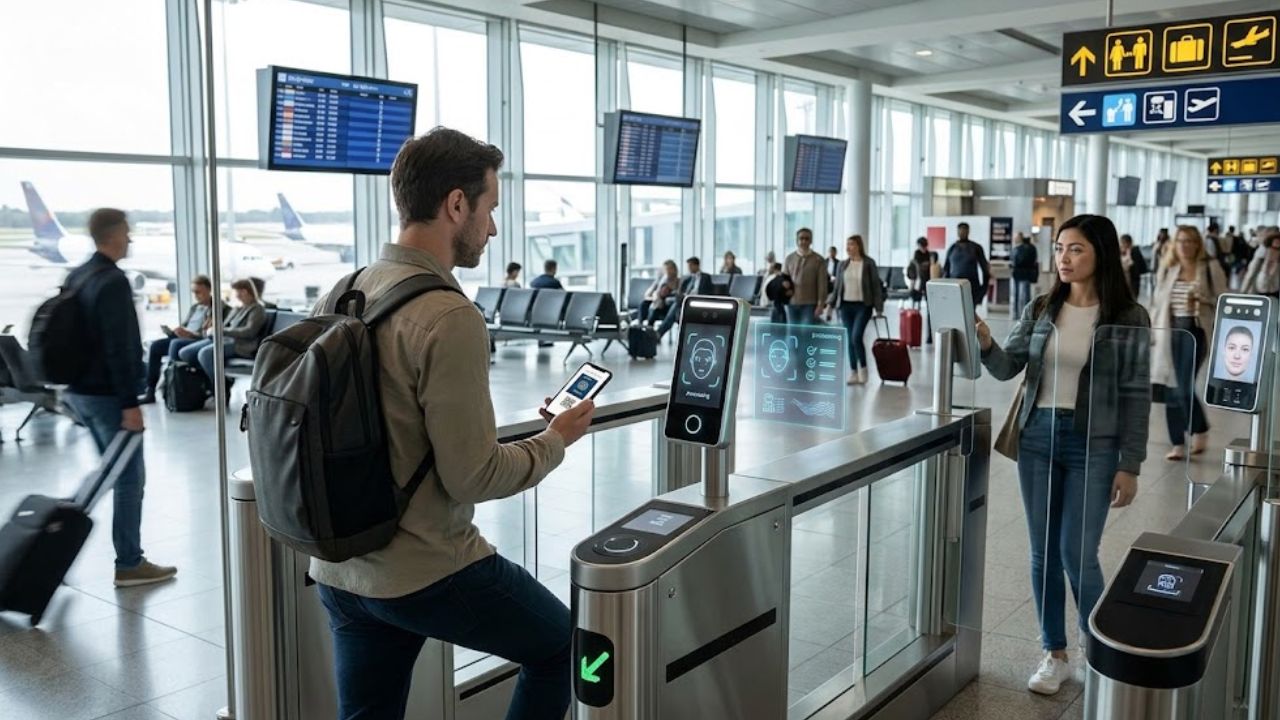
Hong Kong International Airport says more than 93 million passengers have used its Flight Token biometric system since it launched in 2021. On October 28, 2026, the airport and Air New Zealand became the first organizations to earn certification under the International Air Transport Association’s (IATA) One ID program.
The announcement marks a shift in the debate about digital travel. Face-scanning gates have been operating for years. The emerging question is whether an identity checked by one airline or airport can be trusted by the next organization in a journey, without requiring travelers to present the same documents again.
IATA’s latest passenger survey suggests demand is substantial. Of more than 10,000 respondents across over 200 countries, 58% said they had encountered airport biometrics in the preceding 12 months, while 84% said they were interested in using a digital passport for online check-in. Interest is not the same as availability, however, and the services travelers encounter today remain highly dependent on country, airline and airport.
A certification that addresses a practical problem
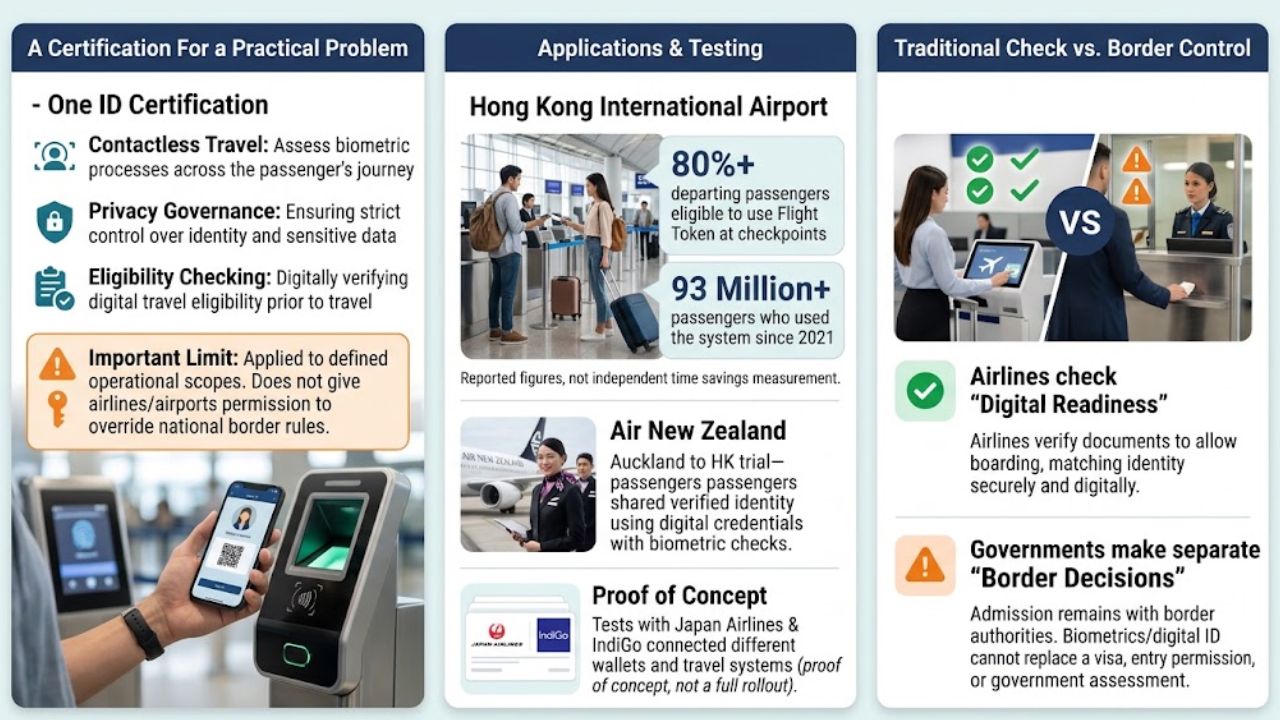
IATA’s One ID framework covers digital identity and biometric processes across a passenger’s journey. Its new certification assesses relevant capabilities and controls, including contactless travel, biometric handling, privacy governance and the digital checking of travel eligibility. Certification applies to defined operational scopes; it does not give an airline or airport permission to override another country’s border rules.
Hong Kong International Airport is a useful example because it already has a mature departure system. The airport operator says more than 80% of departing passengers are eligible to use Flight Token at all key departure checkpoints. Its October 28 announcement described more than 93 million passengers using the system since 2021. These are the operator’s reported figures, not an independent measurement of every passenger’s time savings.
Air New Zealand has approached the problem from the airline side. In an April trial involving Auckland and Hong Kong, passengers shared verified identity information using digital credentials, with biometric checks at selected points. IATA also reported separate tests involving Japan Airlines and IndiGo that demonstrated connections between different wallets and travel systems. Those were proofs of concept, not a rollout to all passengers or routes.
The distinction matters because airlines already check whether a passenger has the necessary documents to board, while border authorities make separate decisions about admission. A successful identity match cannot replace a visa, entry permission or a government’s immigration assessment.
Digital passport, ePassport and face scan: three different functions
The language of passportless travel can obscure how these technologies fit together.
An ePassport is a physical passport with an electronic chip. Its digitally signed data helps inspectors authenticate the document. A Digital Travel Credential (DTC) is a standardized digital representation of passport information that may be shared and verified electronically under an applicable issuance and acceptance framework. A digital wallet is a possible way to hold or present credentials; having an ID in a wallet does not automatically mean it is accepted for international border crossing.
A biometric check, meanwhile, attempts to establish that a person matches a trusted identity reference. At a facial-recognition checkpoint, a camera captures an image and a system compares it with an authorized reference. It is possible for the document data to be authentic while the person presenting it fails the biometric check, or for a face match to succeed even though the traveler lacks the necessary entry authorization.
Editorialge previously explored the wider shift in e-passports and digital border control. The October One ID certifications add a new development: testing whether different participating organizations can reliably trust shared digital identity checks.
IATA wants more of those checks completed before people reach an airport. Its April 2026 trials showed how wallet-based credentials and biometric verification could work across participating organizations. Governments still need to decide which digital credentials they issue and accept, and under what legal conditions. ICAO’s standards and trust infrastructure provide technical foundations, but implementation and legal recognition are separate decisions.
What passengers can actually use today?
Singapore offers some of the clearest evidence of operational change. Since September 2024, eligible Singapore residents have been able to clear immigration at Changi Airport using facial and iris biometrics without presenting their passports; foreign visitors can use the process when departing. Singapore’s Immigration & Checkpoints Authority reported that the average clearance time at Changi fell from 25 seconds to 10 seconds when the initiative was introduced. Its later report of nearly 127 million passportless clearances during 2025 covers Singapore’s wider checkpoint network, not Changi alone. Foreign visitors arriving in Singapore must still show a passport, and the authority advises travelers to carry one.
The European Union has made a different change. Its Entry/Exit System (EES) became fully operational on April 10, 2026. For covered non-EU short-stay travelers, it records passport information, facial images, fingerprints and border crossings electronically, replacing routine passport stamps. The system modernizes border records; it does not eliminate the requirement to travel with a valid passport or establish permission to enter.
The United States has narrower identity-verification programs at specific checkpoints. Eligible TSA PreCheck Touchless ID participants can opt into facial matching through participating airlines at supported locations. They must still carry acceptable physical identification as a backup. US Customs and Border Protection’s Simplified Arrival is a separate process for international entry; its rules and available alternatives are not identical to TSA’s airport security procedure. Editorialge has also covered the expansion of state-issued digital IDs in Apple Wallet, which should not be confused with a digital passport accepted for international border crossing.
These examples show different parts of the same transformation. Singapore is reducing document presentation at immigration gates; the EU is digitizing border records; US programs are simplifying selected identity checks; and the recent IATA certification is intended to improve trust between participating organizations. None amounts to a single worldwide digital passport accepted at every border.
Faster checkpoints will be judged alongside privacy and reliability
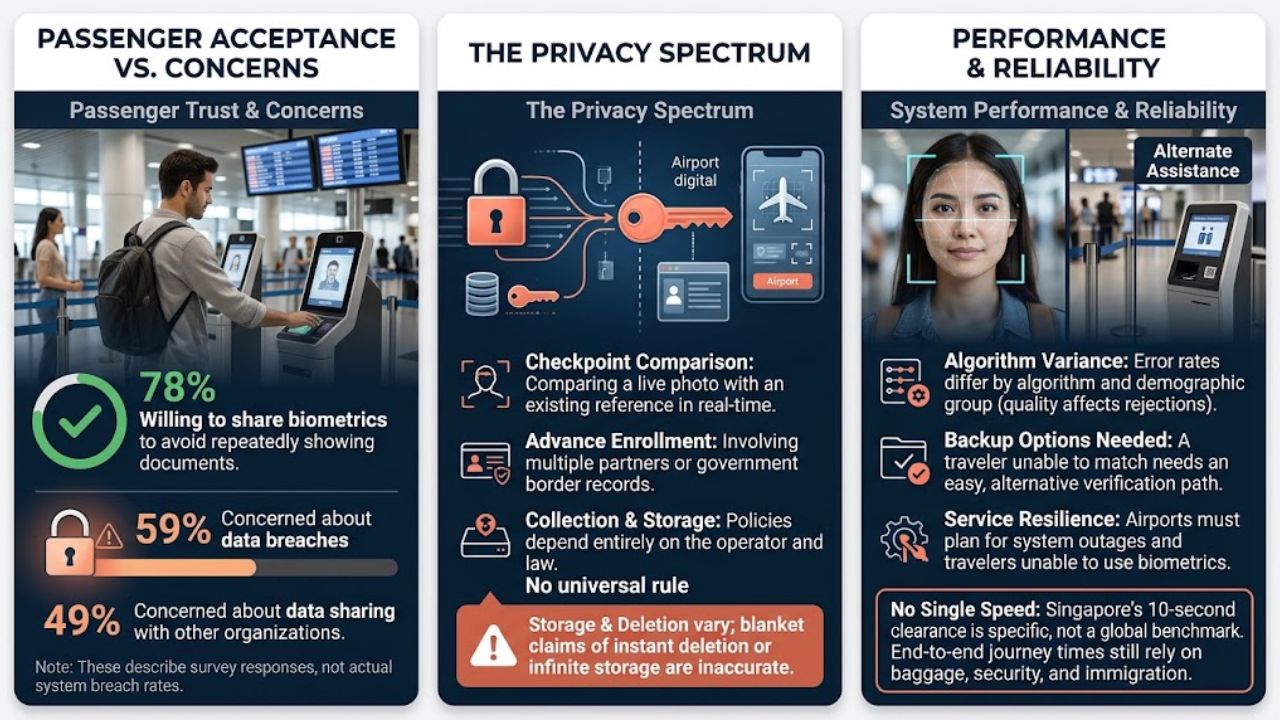
Passenger acceptance is real, but so are reservations about biometric data. In IATA’s October survey, 78% said they would be willing to share biometrics to avoid repeatedly showing documents. Data breaches concerned 59%, while 49% were concerned about sharing information with other organizations. These numbers describe survey responses, not the measured breach rate of an airport system.
The distinction between systems also matters to privacy. Some programs compare a live photograph with an existing reference for a single checkpoint. Others involve advance enrollment, multiple partners or government-managed border records. Collection, storage, opt-out choices and retention periods depend on the operator and the applicable law. A blanket claim that airport facial images are always deleted immediately—or always stored indefinitely—would be inaccurate.
Performance deserves the same precision. The US National Institute of Standards and Technology has documented differences in facial-recognition error rates among algorithms and demographic groups, with image quality particularly important for false rejections. A traveler who cannot be matched needs a workable alternative and a way to resolve the problem. Airports also need plans for equipment failures and people who cannot use a particular biometric service.
No single speed estimate applies across airports. Singapore’s reported 10-second clearance is an outcome for a specific process, not a benchmark every airport can claim. End-to-end journey time also depends on baggage, security screening, staffing and immigration decisions beyond identity matching.
The next test is international acceptance
The technology needed to recognize a traveler at a gate has moved further than the agreements needed to use the same verified identity across borders. IATA says wider adoption requires governments to issue and recognize secure Digital Travel Credentials, while airlines, airports and authorities establish interoperable methods for handling them.
For travelers, the advice in late 2026 is practical: check the rules for the specific route and program, enroll only through official participating services, and carry the physical passport and other documents required by each country. An airport’s biometric lane may let someone keep a passport in their bag at one checkpoint. It cannot guarantee the next authority will accept a phone-based credential instead. The October 28 certifications are a meaningful industry milestone because they test the trust behind a digital journey, rather than merely introducing another camera at a gate. What happens next depends on adoption by governments and cooperation among the organizations that handle a passenger’s identity from departure to arrival.