Most wellness tech wearables promise a cleaner, healthier version of your life. Better sleep. Better recovery. Better workouts. Better stress awareness. Better habits. Maybe even a version of you that closes every activity ring, drinks enough water, sleeps on time, and somehow does not check notifications from bed. Nice dream. Real life is messier.
The problem is not that wellness wearables are useless. The problem is that many people buy the wrong one. A casual walker buys an athlete-first recovery band and gets buried in data. A runner buys a beautiful smart ring and misses the GPS. A sleep-focused user buys a smartwatch that needs charging before bed. Someone who hates subscriptions buys a device that feels incomplete without one. That is where comparison matters.
The right wearable should fit your phone, habits, comfort, budget, and health goals. It should help you notice useful patterns without turning wellness into another daily performance review. These devices can support better routines, but they should not make you feel like your body has become a dashboard you are failing to manage.
This guide compares 8 wellness tech wearables worth considering in 2026, including smartwatches, smart rings, screenless trackers, and hybrid watches.
How to Choose the Right Wellness Wearable
Before comparing brands, start with the real question: what do you want the wearable to help you understand?
If your main goal is sleep and recovery, a smart ring or screenless tracker may fit better than a smartwatch. If you want workouts, GPS, calls, notifications, safety tools, apps, and real-time feedback, a smartwatch makes more sense. If you want passive tracking without another glowing screen, avoid feature-heavy watches. If you want something that looks like a normal watch, a hybrid model may be the better fit.
Also, pay attention to subscriptions. Some wellness gadgets are useful out of the box. Others become much more valuable only when you pay for an ongoing membership.
A simple way to think about it:
- For iPhone users: Apple Watch Series 11 is the easiest all-around choice.
- For sleep and recovery: Oura Ring 5, WHOOP 5.0, Samsung Galaxy Ring, and RingConn Gen 3 stand out.
- For fitness plus wellness: Garmin Venu 4 is one of the strongest, balanced options.
- For minimalist tracking: Fitbit Air is simple, lightweight, and screenless.
- For traditional watch style: Withings ScanWatch 2 is the cleanest hybrid option.
The best wellness wearable is not the one with the longest feature list. It is the one you will actually wear consistently.
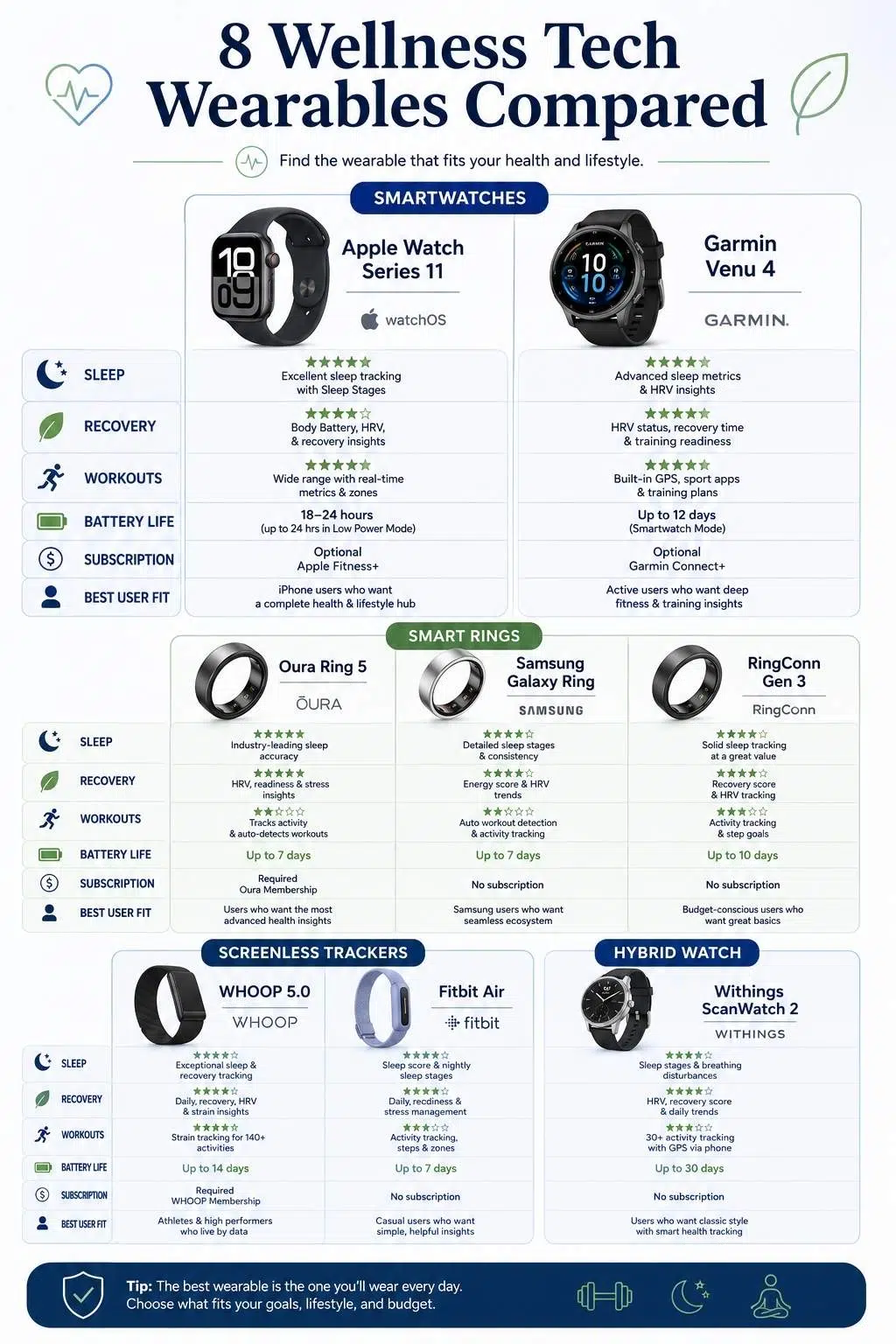
8 Wellness Tech Wearables Compared
Each wearable below has a different personality. That matters because “best” depends on whether you care most about sleep, recovery, workouts, battery life, design, ecosystem, or cost over time.
1. Apple Watch Series 11
Apple Watch Series 11 is the strongest all-around wellness wearable for iPhone users because it combines health tracking, workouts, safety features, apps, notifications, and everyday convenience in one polished device.
It tracks activity, workouts, sleep, heart rate, wrist temperature trends, and other wellness signals. Apple also highlights newer health features such as Sleep Score and hypertension notifications, which make the watch more useful for people who want broader daily health awareness.
The biggest strength is convenience. If you already use an iPhone, Apple Watch fits into your life easily. It handles calls, messages, timers, payments, music, maps, workout tracking, safety alerts, and health data from the same device. That makes it one of the most complete wellness wearables for people who want fewer devices, not more.
The main weakness is battery life. Apple lists up to 24 hours of normal use, which is better than older daily-charge habits but still not close to a smart ring, WHOOP, Garmin, or Withings. If you want effortless sleep tracking for several nights without thinking about charging, the Apple Watch may feel less convenient.
A strong match for: iPhone users who want health tracking, workouts, safety tools, notifications, and apps in one wearable.
Standout wellness angle: Broad daily health tracking with Apple’s strongest ecosystem experience.
Worth considering: It can feel like a small phone on your wrist. If your goal is fewer digital interruptions, turn off nonessential notifications.
2. Oura Ring 5
Oura Ring 5 is one of the strongest wellness wearables for people who care most about sleep, recovery, readiness, and low-distraction tracking.
The ring format is the main appeal. There is no watch face, no app grid, no buzzing notification stream, and no pressure to check a screen every few minutes. You wear it, sleep with it, and review insights when you choose. That makes it especially useful for people who want health patterns without another device constantly asking for attention.
Oura is strongest around sleep, readiness, heart rate variability, resting heart rate, temperature trends, and long-term habit patterns. It is less ideal if your main priority is GPS workouts, running metrics, live training displays, or smartwatch-style alerts.
The biggest buying consideration is the membership. Oura Ring 5 with active membership gives access to the deeper insights that make the ring feel complete. Without membership, the experience is more limited, so the long-term cost matters.
Ideal for: Sleep-first users, recovery tracking, readiness insights, and people who dislike wearing watches overnight.
Best feature: Comfortable, screen-free wellness tracking with strong sleep and recovery interpretation.
Before buying: Factor the membership into the real cost, not just the ring price.
3. WHOOP 5.0
WHOOP 5.0 is built for people who want recovery, strain, sleep, and coaching without a screen.
Unlike a smartwatch, WHOOP does not try to replace your phone. It does not show messages, apps, maps, or a watch face. Its job is narrower: track your body, interpret recovery patterns, and help you understand how training, sleep, stress, and habits affect readiness.
WHOOP works especially well for athletes, gym users, endurance trainees, and people who like coaching-style feedback. Its Strain and Recovery framework is easy to understand once you get used to the system. The 14+ day battery life also makes it much easier to wear continuously than many smartwatches.
The trade-off is cost structure. WHOOP is subscription-first. You are not just buying a band; you are buying into an ongoing service. That makes sense if you use the coaching and recovery data often. It makes less sense if you only want basic steps, sleep, and heart rate.
Works well for: Recovery-focused users, athletes, and people who want serious tracking without a screen.
Notable strength: Sleep, Strain, Recovery, Healthspan features on higher plans, and personalized coaching.
Practical note: Casual users may find WHOOP too expensive if they do not need deep recovery and performance insights.
4. Garmin Venu 4
Garmin Venu 4 is a strong choice for people who want a proper fitness smartwatch with serious wellness tracking and better battery life than most app-heavy watches.
It sits in a useful middle ground. It is not as iPhone-integrated as Apple Watch, not as ring-focused as Oura, and not as subscription-centered as WHOOP. Instead, it gives you GPS, workouts, sleep tracking, HRV status, stress tracking, Body Battery, health status, lifestyle logging, and up to 12 days of smartwatch battery life.
That mix makes Garmin Venu 4 especially useful for people who exercise regularly but do not want their watch to feel like a notification machine. Garmin’s fitness tracking depth is stronger than many lifestyle-first wellness gadgets, while the Venu design still feels more everyday-friendly than rugged outdoor watches.
The main learning curve is Garmin’s data depth. Some users love the dashboards and metrics. Others may find them too much at first.
Great match for: Fitness-minded users who want wellness tracking, GPS, and multi-day battery life.
Top advantage: Strong balance of workout tracking, sleep, HRV, Body Battery, and battery performance.
Check first: Garmin makes the most sense if you actually want to look at training and health metrics regularly.
5. Fitbit Air
Fitbit Air is the best fit for people who want simple wellness tracking without a screen or smartwatch price.
It is a lightweight, screenless tracker designed for comfortable 24/7 wear. Google describes it as pairing with the Google Health app for fitness insights, sleep tracking, and week-long battery life. That makes it a practical option for beginners, budget-conscious users, and people who do not want another display competing for attention.
The screenless design is the point. There is no watch face to check, no smartwatch feel, and no constant temptation to scroll through data on your wrist. You wear it, let it collect information, and check the app when needed.
The limitation is that Fitbit Air is not built for advanced athletes. It is also less immediate than a smartwatch because you need the app to see most information. Some deeper insights may also depend on Google Health Premium.
Most useful for: Beginners, budget-conscious users, and people who want simple, low-distraction wellness tracking.
Why it stands out: Lightweight screenless design with core health and fitness tracking.
Small drawback: No display means less real-time feedback during workouts or daily movement.
6. Samsung Galaxy Ring
Samsung Galaxy Ring is a strong option for Samsung users who want sleep and wellness tracking in a ring instead of a watch.
The Galaxy Ring tracks sleep-related signals, heart rate, blood oxygen, skin temperature, activity, and Energy Score through Samsung Health. It is especially appealing if you already use a Galaxy phone and want a low-profile wearable that does not feel like another smartwatch.
The biggest advantage is ecosystem fit. Samsung Health users will get the smoothest experience, and the ring can feel more natural than wearing a watch to bed. Samsung also highlights up to seven days of charge, with the charging case extending practical use between outlet charges.
The downside is that it is less universal than some other smart rings. It makes the most sense inside the Samsung ecosystem. It is also not ideal for serious workout tracking because smart rings generally do not offer GPS, live pace, or on-screen workout controls.
Recommended for: Samsung users who want sleep, Energy Score, and passive wellness tracking without a watch.
Signature feature: Samsung Health integration and low-profile ring-based tracking.
Worth knowing: It is strongest for Galaxy users. Non-Samsung users should compare compatibility carefully before buying.
7. Withings ScanWatch 2
Withings ScanWatch 2 is for people who want wellness tracking but still want their wearable to look like a traditional watch.
It is a hybrid smartwatch, which means it avoids the full-screen tech look of Apple Watch or Garmin. Withings lists features such as ECG, SpO2, temperature tracking, sleep analysis, and up to 35 days of battery life. That combination makes it appealing for people who want health insights without a bright screen or daily charging.
This is a good option for office wear, formal outfits, and users who dislike rectangular smartwatches. It feels more like a watch that happens to track health than a gadget you wear on your wrist.
The trade-off is that it does not offer the same app depth, workout features, or smart functionality as the Apple Watch or Garmin. It is better for wellness awareness than for full smartwatch use.
A smart pick for: Traditional watch lovers who still want health tracking.
Best use case: Everyday wellness tracking with classic styling and long battery life.
One thing to note: Withings+ can add more insight features, but casual users may be happy with the core watch experience.
8. RingConn Gen 3
RingConn Gen 3 is a compelling choice for people who want smart ring tracking without a required subscription.
It tracks sleep, SpO2, stress, activity, and daily health trends, while RingConn highlights Gen 3 features such as vascular health insights, smart vibration alerts, next-generation sensing, a universal charging case, and up to 14 days of power. For users who dislike monthly fees, this is one of RingConn’s biggest advantages.
The long battery life is also a major strength. A smart ring that lasts longer between charges is easier to wear consistently, especially for sleep tracking. If a device keeps asking to be charged, people eventually stop using it.
The caution is that advanced wellness insights should be interpreted carefully. RingConn Gen 3 can help users notice trends and prompts, but users should not treat wearable data as a diagnosis or replacement for professional medical advice.
Best suited to: Smart ring buyers who want long battery life and no required subscription.
Key benefit: Strong ring-based tracking with no mandatory membership.
Practical note: Use health trends as awareness signals. Speak with a qualified medical professional if symptoms or concerns appear.
Quick Comparison: 8 Wellness Tech Wearables
| Wearable | Best For | Form Factor | Battery Style | Subscription Reality |
| Apple Watch Series 11 | iPhone users who want one device for wellness, fitness, and smart features | Smartwatch | Up to 24 hours normal use | No required subscription for core Apple features |
| Oura Ring 5 | Sleep, readiness, recovery, and low-distraction tracking | Smart ring | Typically 6–9 days | Membership needed for full deeper insights |
| WHOOP 5.0 | Recovery, strain, coaching, and 24/7 athlete-style tracking | Screenless band | 14+ day battery | Subscription-based model |
| Garmin Venu 4 | Fitness, wellness, GPS, and long battery life | Smartwatch | Up to 12 days smartwatch mode | No required subscription for core Garmin features |
| Fitbit Air | Affordable screenless wellness tracking | Screenless tracker | Up to a week | Optional Google Health Premium |
| Samsung Galaxy Ring | Samsung users and sleep-first ring tracking | Smart ring | Up to 7 days, more with the charging case | No required monthly ring subscription |
| Withings ScanWatch 2 | Traditional watch lovers who want health tracking | Hybrid smartwatch | Up to 35 days | Optional Withings+ extras |
| RingConn Gen 3 | Subscription-free smart ring buyers | Smart ring | Up to 14 days | No required subscription |
Best Wellness Tech Wearables by User Type
| User Type | Best Pick |
| iPhone user who wants everything | Apple Watch Series 11 |
| Sleep-first user | Oura Ring 5 |
| Recovery-focused athlete | WHOOP 5.0 |
| Fitness Plus Wellness user | Garmin Venu 4 |
| Budget minimalist | Fitbit Air |
| Samsung phone user | Samsung Galaxy Ring |
| Traditional watch wearer | Withings ScanWatch 2 |
| Subscription-free smart ring buyer | RingConn Gen 3 |
Smartwatch vs Smart Ring vs Screenless Tracker
The best wearable category depends on how you want to interact with your data.
Smartwatch: Best if you want workouts, GPS, safety features, notifications, apps, and real-time information. Apple Watch Series 11 and Garmin Venu 4 fit this category.
Smart ring: Best if you want sleep, recovery, low-distraction tracking, and comfort overnight. Oura Ring 5, Samsung Galaxy Ring, and RingConn Gen 3 fit this category.
Screenless tracker: Best if you want passive health tracking without a display. WHOOP 5.0 and Fitbit Air fit this category.
Hybrid watch: Best if you want a classic design with wellness features. Withings ScanWatch 2 fits that role.
The right choice depends less on the category and more on your daily behavior. If you hate wearing rings, do not buy a smart ring. If you hate charging devices every day, be careful with full smartwatches. If notifications stress you out, screenless tracking may be healthier for you than a feature-packed watch.
What to Check Before Buying a Wellness Wearable
Do not buy only because a device looks good in a review. Check these details first:
- Does it work well with your phone?
- Is there a required subscription?
- Can you comfortably wear it overnight?
- Does it track the metrics you actually care about?
- How often does it need charging?
- Is it better for fitness, sleep, stress, recovery, or general wellness?
- Are the health features wellness-oriented or medically cleared?
- Does the app explain the data clearly?
- Will you still use it after the first two weeks?
A wearable is only useful if it changes what you notice, understand, or do.
Common Mistakes People Make With Wellness Wearables
- Buying the most expensive device and assuming it will fix your habits. A wearable can show patterns, but it cannot sleep for you, train for you, or make your calendar less chaotic.
- Tracking too much. More data can become noise if you do not know what to do with it. A simple sleep trend you act on is more useful than 20 metrics you ignore.
- Treating every alert like a medical conclusion. Wellness wearables can show trends and possible signals, but they are not a replacement for professional care.
- Ignoring comfort. If a ring pinches, a band irritates your skin, or a watch feels bulky at night, you will stop wearing it.
- Forgetting subscription costs. A device can look affordable upfront and become expensive over two or three years.
- Choosing based on hype instead of the ecosystem. Apple Watch makes the most sense for iPhone users. Galaxy Ring makes the most sense for Samsung users. Garmin makes more sense for people who care about training data. The best device is the one that fits your real setup.
Wrapping Up
The best wellness tech wearables are not all trying to solve the same problem.
Apple Watch Series 11 is the best all-around option for iPhone users who want wellness, fitness, safety, and smart features in one device. Oura Ring 5 is excellent for sleep and readiness. WHOOP 5.0 is strong for recovery-focused users who like coaching and do not mind a subscription.
Garmin Venu 4 is the best balance of fitness, wellness, GPS, and battery life. Fitbit Air is the simplest screenless option for budget-conscious users. Samsung Galaxy Ring makes the most sense for Galaxy users. Withings ScanWatch 2 is ideal if you want a traditional watch look. RingConn Gen 3 is compelling if you want a smart ring without required membership fees.
The smartest choice is not the wearable with the most features. It is the one that fits your phone, your habits, your budget, your comfort, and the kind of wellness data you will actually use.
Frequently Asked Questions About Wellness Tech Wearables
1. What are wellness tech wearables?
Wellness tech wearables are devices worn on the wrist, finger, or body to track everyday health and lifestyle signals. They may monitor sleep, heart rate, activity, recovery, stress, temperature trends, workouts, and daily readiness. They are meant to support wellness habits, not replace medical advice.
2. Which wellness wearable is best for sleep tracking?
Oura Ring 5, Samsung Galaxy Ring, WHOOP 5.0, and RingConn Gen 3 are strong sleep-focused options because they are comfortable for overnight wear and focus heavily on recovery, sleep patterns, and readiness-style insights.
3. Are smart rings better than smartwatches?
Smart rings are usually better for sleep comfort, low-distraction tracking, and passive wellness insights. Smartwatches are better for workouts, GPS, notifications, apps, safety features, and real-time information. The better choice depends on whether you want passive tracking or active smartwatch functions.
4. Do wellness wearables need subscriptions?
Some do, some do not. Oura is much more useful with membership. WHOOP is built around membership plans. Fitbit Air may offer deeper features through Google Health Premium. Apple Watch Series 11, Garmin Venu 4, Samsung Galaxy Ring, Withings ScanWatch 2, and RingConn Gen 3 offer strong core features without the same required subscription model, though some brands offer optional paid extras.
5. Can wellness wearables detect health problems?
Some wearables provide alerts, trends, or wellness signals that may point to patterns worth checking, but they should not be treated as a medical diagnosis. If a wearable shows unusual health data or you have symptoms, speak with a qualified medical professional.
6. What is the best wellness wearable for beginners?
Fitbit Air is a good beginner-friendly option because it is simple, screenless, affordable, and focused on core wellness tracking. Apple Watch Series 11 is better for iPhone users who want a full smartwatch, while Garmin Venu 4 is better for people who want fitness depth with wellness tracking.