

The internet has evolved rapidly in the last few decades. From the early days of static websites to today’s smart, interactive platforms, we’ve seen huge changes. But most of the internet still relies on centralized systems. This means big companies control user data, access to content, and even how we interact online.
However, a major shift is taking place. Decentralization and the Internet are becoming closely connected. This movement is about giving control back to the users. Instead of one central authority, multiple users, servers, or nodes share responsibility. This can lead to more privacy, better data ownership, and fewer restrictions.
In this article, we will explore five key ways decentralization is changing the internet. From user control to content monetization, the impact is significant. Let’s dive in.
1. Empowering Users with Data Ownership
One of the biggest problems with today’s internet is data ownership. When you use apps or platforms, your personal information is stored on central servers. These servers are owned by companies that can access, share, or even sell your data.
Decentralization changes this. It allows users to control their own data. Technologies like decentralized identity (DID) give people the power to manage who can access their information.
Real-World Examples:
- Solid: A project by web inventor Tim Berners-Lee. It lets users store their data in “pods” they control.
- Ethereum Name Service (ENS): Gives users ownership of their digital identity using blockchain.
Traditional vs Decentralized Data Ownership
| Feature | Centralized | Decentralized |
| Data Control | Held by companies | Controlled by users |
| Access | Limited user control | Full user permission |
| Privacy | Often compromised | Strong privacy options |
| Portability | Tied to platforms | Easily portable |
2. Redefining Online Privacy and Security
Privacy is a growing concern. Centralized systems collect massive amounts of data, making them targets for hackers. Also, many users feel uncomfortable not knowing how their data is used.
With decentralization, privacy and security improve. Peer-to-peer networks reduce the need for a central hub. Data is encrypted and shared across multiple nodes, making it harder to hack.
Zero-knowledge proofs and end-to-end encryption are key tools in this system. They ensure that only the intended user can access their data.
Real-World Examples:
- Signal: Uses end-to-end encryption for private messages.
- Tor: Routes internet traffic through multiple nodes to ensure anonymity.
- IPFS: A decentralized file storage system that doesn’t rely on central servers.
Privacy in Centralized vs Decentralized Systems
| Feature | Centralized | Decentralized |
| Data Storage | Central servers | Distributed nodes |
| Risk of Hack | High | Lower |
| Encryption | Partial | End-to-end |
| User Control | Limited | Strong |
3. Revolutionizing Content Creation and Monetization
In the traditional internet model, content creators rely on platforms like YouTube, Instagram, or TikTok. These platforms decide how much the creators earn, often taking large cuts.
Decentralization gives more power to creators. They can earn directly from their audiences. Blockchain technology ensures transparency, and smart contracts automate payments.
Real-World Examples:
- Lens Protocol: A decentralized social media platform built on the blockchain.
- Mirror.xyz: A Web3 platform for writers to publish and monetize content.
- Audius: A decentralized music platform where artists earn directly from fans.
Creator Monetization in Centralized vs Decentralized Platforms
| Feature | Centralized | Decentralized |
| Platform Fees | High | Low to zero |
| Transparency | Limited | Fully transparent |
| Control | Platform decides | Creator decides |
| Ownership | Platform owns content | Creator owns content |
4. Censorship Resistance and Freedom of Speech
Governments and corporations often control what content can be published or viewed. This has led to censorship of important information and limits on freedom of speech.
A decentralized internet resists censorship. Since no single authority controls the network, it’s harder to block or remove content. Users have more freedom to express themselves without fear of being silenced.
However, this also brings challenges. With more freedom comes the need for community moderation and ethical guidelines.
Real-World Examples:
- Mastodon: An open-source social network that users can host themselves.
- Nostr: A decentralized protocol for building censorship-resistant apps.
- Farcaster: A social protocol where users own their data and content.
Censorship in Centralized vs Decentralized Networks
| Feature | Centralized | Decentralized |
| Content Control | Central authority | Distributed users |
| Freedom of Speech | Limited | Broad |
| Moderation | Platform-driven | Community-led |
| Risk of Content Ban | High | Low |
5. Enabling the Rise of DAOs and Decentralized Communities
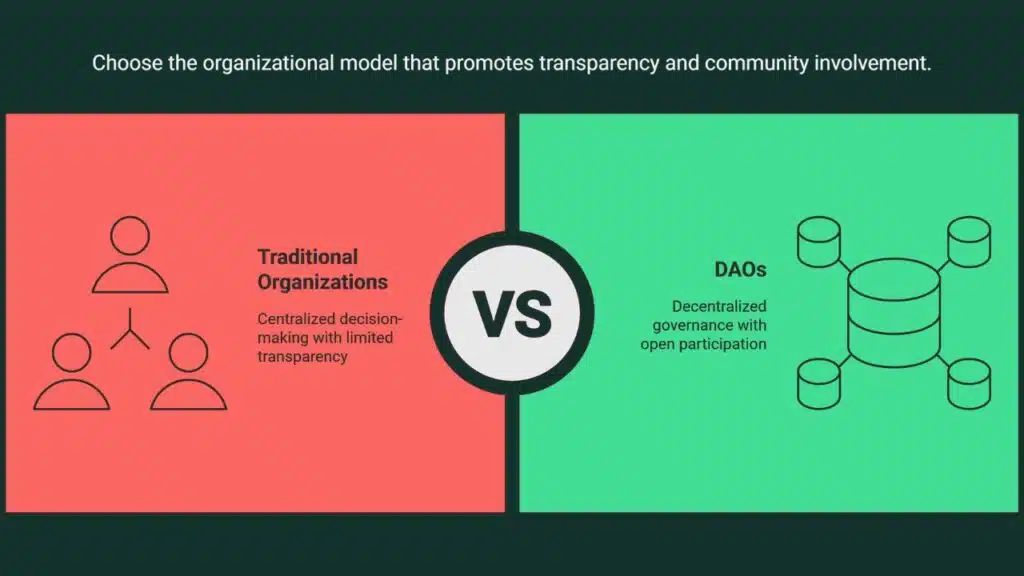
Another big change is the rise of DAOs – Decentralized Autonomous Organizations. These are groups of people who collaborate using blockchain-based rules. There is no CEO or central board. Instead, members vote on decisions.
This model is changing how communities and companies operate online. It promotes transparency, collective decision-making, and global collaboration.
Real-World Examples:
- Aragon: A platform for creating and managing DAOs.
- Gitcoin: A DAO that funds open-source software.
- Friends With Benefits (FWB): A community of creators and builders operating as a DAO.
Traditional Organizations vs DAOs
| Feature | Traditional | DAO |
| Decision Making | Top-down | Community voting |
| Transparency | Limited | Full on-chain |
| Governance | Central authority | Decentralized protocol |
| Participation | Restricted | Open to members |
Hurdles and the Road Ahead
Despite its benefits, decentralization faces challenges:
- Scalability: Many decentralized platforms struggle to handle large numbers of users.
- User Experience: Web3 interfaces can be complex and confusing.
- Regulations: Legal uncertainty around blockchain and DAOs.
- Security Risks: Bugs in smart contracts can be exploited.
But innovation is happening fast. Solutions like Layer 2 technologies, zkRollups, and better UI/UX are already making Web3 more accessible.
Key Challenges and Solutions in Decentralization
| Challenge | Solution |
| Scalability | Layer 2 (e.g., Arbitrum, Optimism) |
| User Experience | Intuitive Web3 apps |
| Legal Issues | Global policy frameworks |
| Smart Contract Risks | Audits and formal verification |
FAQs
What is a decentralized internet?
A decentralized internet distributes control across users and servers instead of central authorities.
How does blockchain support decentralization?
Blockchain stores data in a secure, transparent way without needing a central database.
Will decentralization replace the current internet?
It may not replace it entirely but will likely become a major part of its evolution.
Takeaways
The internet is at a turning point. With growing concerns over privacy, data misuse, and content control, people are looking for better solutions. Decentralization and the Internet offer a promising path forward.
By empowering users, enhancing privacy, supporting creators, resisting censorship, and enabling new forms of governance, decentralization is transforming the online world. While there are hurdles to overcome, the movement is gaining momentum every day.
Whether you’re a developer, creator, or everyday user, now is the time to explore what a decentralized internet can offer. The future is not only about using the internet but owning a part of it.






















