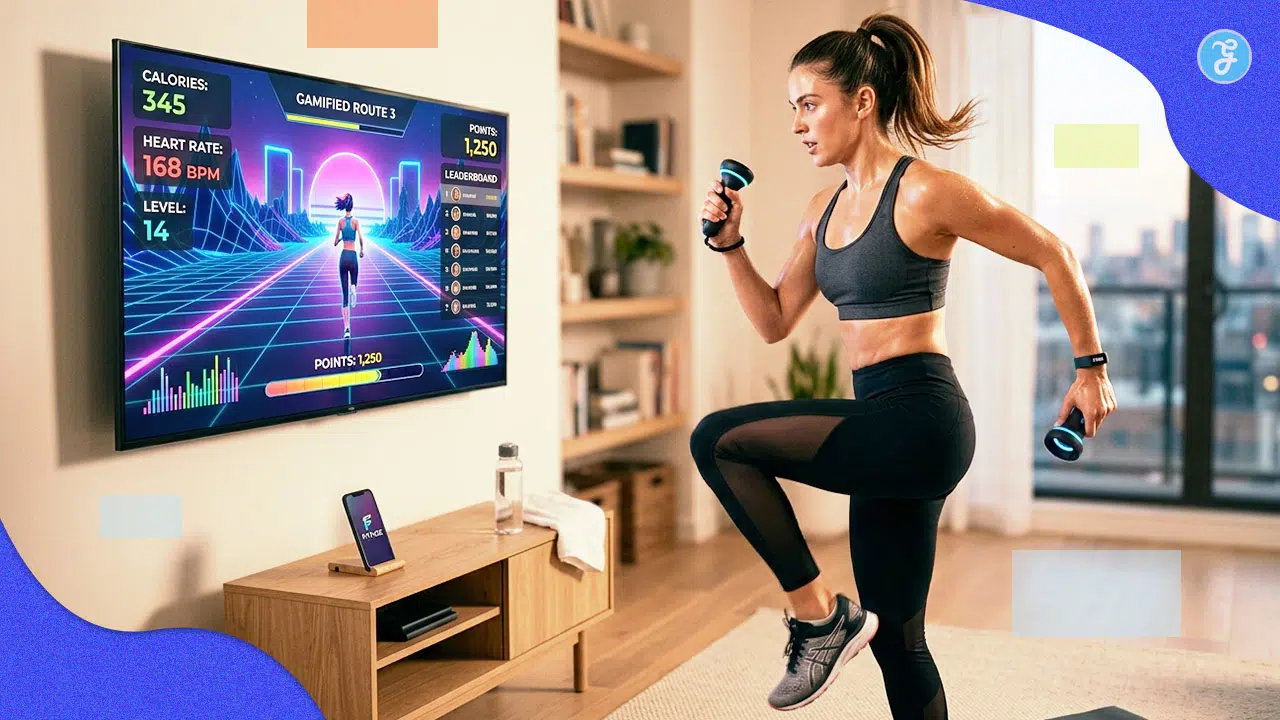
The American gym floor has gone quiet. In its place, a digital playground has emerged. As of early 2026, the US gamified fitness market is projected to mature into a financial powerhouse valued at over $4.2 billion. This shift is not just about technology. It is about a fundamental change in how we move. Americans are no longer just tracking steps. They are playing for their health. With a 17% growth rate, this sector has turned the solitary sweat of the treadmill into a social, high-stakes competition.
What is Gamified Fitness?
In easy words: Gamified fitness is the use of video game elements in physical exercise to keep you motivated. Think about why people play games for hours.

They want to earn points, reach the next level, and beat their friends. Gamified fitness takes those same “hooks” and applies them to your workout. Instead of just running on a treadmill, you might be outrunning a virtual horde of zombies or racing a digital avatar through a virtual forest.
The 4 Pillars of the Game
To understand how it works, look at these four main ingredients:
- Rewards and Badges: Just like earning a trophy in a video game, you earn digital badges or streaks for working out consistently.
- Leaderboards: This adds a social spark. You can see how your performance ranks against other people in your city or across the country.
- Narrative and Story: Some apps turn your run into a movie. You are no longer just jogging. You are a secret agent or a survivor in an apocalypse.
- Real-Time Feedback: Your smart ring or watch acts as your game controller. It shows you instantly how many points you have earned based on your heart rate.
The Rise of the Fitness Player
The year 2026 marks a tipping point. The old “New Year’s Resolution” cycle is dead. It has been replaced by year-round engagement driven by game mechanics. People are trading traditional memberships for digital ecosystems that reward them in real-time.
The focus has shifted from the mirror to the leaderboard. This transition is fueled by a desire for community and instant feedback. Whether you are outrunning a zombie or racing a virtual bike through a digital forest, exercise has become a byproduct of play.
Why the US Market is Booming in 2026
The US has become the global leader in this space for a few simple reasons. First is tech obsession. With high smartphone and smartwatch use, Americans already have the consoles needed to play these fitness games.
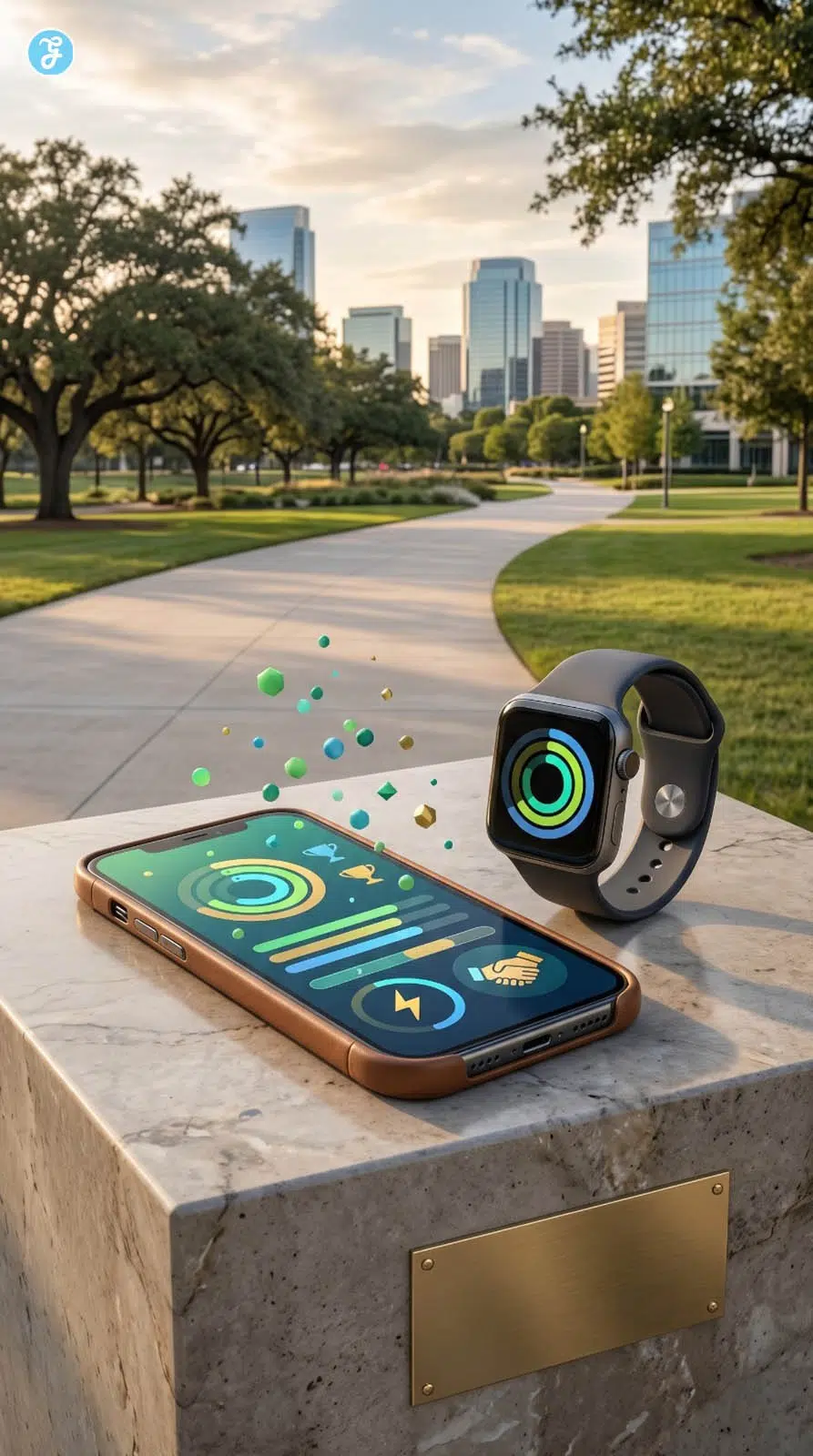
Second is the dopamine effect. It is scientifically harder to quit a workout when your brain is getting small hits of feel-good chemicals every time you unlock a new achievement. Finally, there is workplace wellness. Many US companies now pay for these apps for their employees because a gamified staff is often a healthier and more productive one.
When Motivation Becomes a Metric
The American fitness scene has quietly shifted into a game of numbers and nerves. We are no longer just people hitting the pavement or the gym. We are active players in a health-based simulation. This new reality suggests that we have learned to tap into our own biology, using our hunger for social validation and the anxiety of losing a streak to counter a sedentary lifestyle.
I find this shift both fascinating and slightly unsettling. There is a discomfort in realizing that my motivation now comes from a pixelated badge rather than a genuine love for movement. Critics are right to worry that we may be reducing the human body to data points. Yet the results are hard to ignore. A digital reward or a virtual challenge often works better than a doctor’s warning.
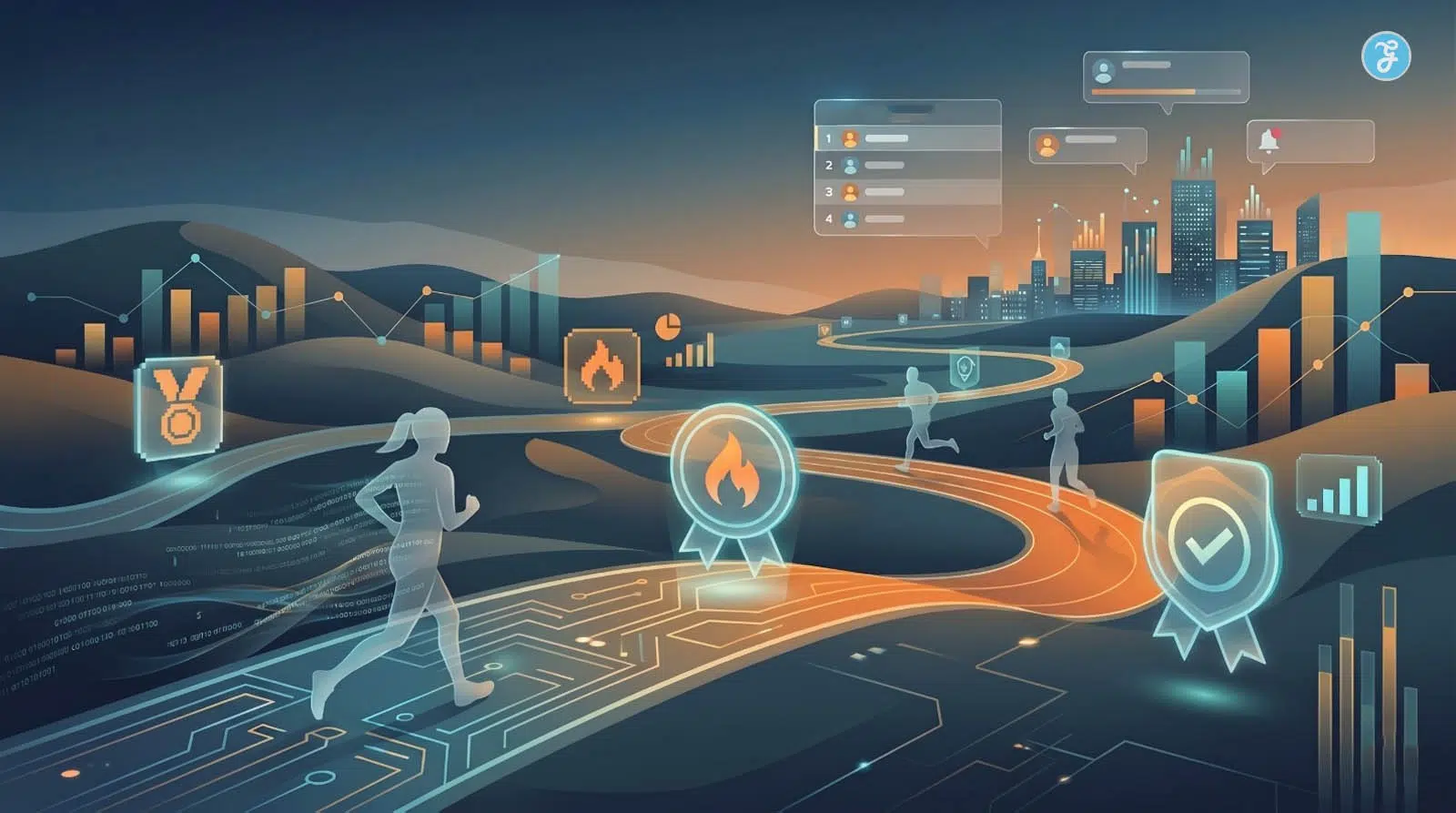
Looking ahead, the challenge feels deeply personal. We need to ensure that these systems serve us, not the other way around. The rewards may be digital, but the effort and impact are real. The question is whether we can stay in control while playing the game.
The Pulse of Personalization: AI as the New Coach
By 2026, the US Gamified Fitness Market has moved beyond static leaderboards. The real intelligence now lies in the “invisible coach” powered by generative AI. Modern platforms are no longer just guessing your effort; they are analyzing real-time biometric data streams from smart rings and skin sensors. This hardware-software convergence allows apps to adjust the “game difficulty” on the fly.
If your heart rate variability (HRV) shows high stress or poor sleep, your digital avatar might receive a “rest quest” instead of a high-intensity challenge. This level of hyper-personalization ensures that the game stays sustainable. It prevents the burnout that often comes with traditional fitness. We are seeing a shift where AI does not just track our past; it predicts our future performance. This predictive edge has increased user retention by over 40% compared to the early 2020s. It turns a simple app into a responsive, living health partner.
10 Apps Leading the US Gamified Fitness Market
The US gamified fitness market is currently on pace to become a massive $4.2 billion sector. This estimated 17% CAGR is fueled by a new era of behavioral design that keeps users coming back.
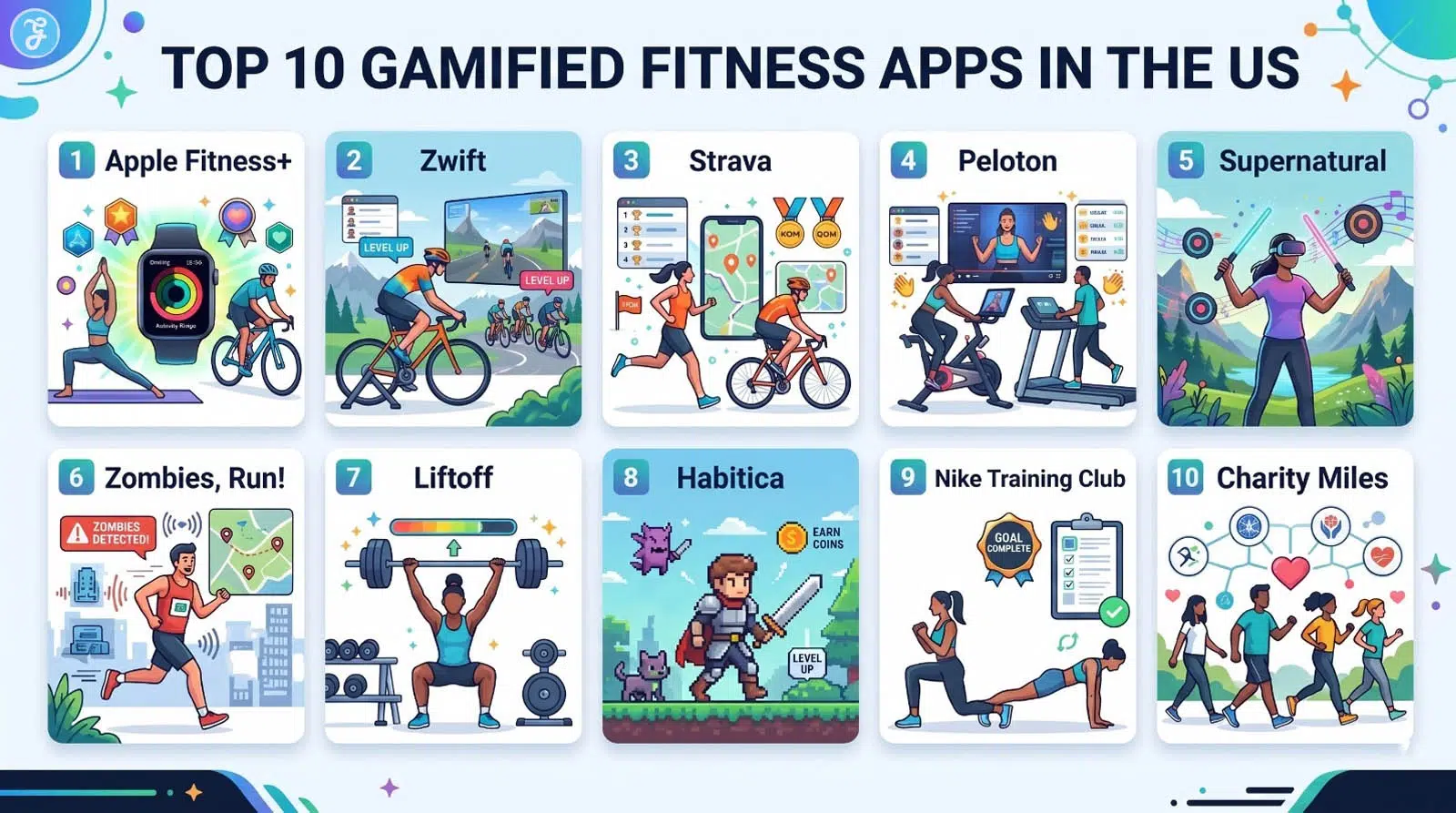
The following ten apps have mastered this shift. They use competition and storytelling to turn every calorie burned into a digital win.
- Apple Fitness+ (The Ubiquity Leader) Apple owns the wrist. By syncing perfectly with the Apple Watch, it has turned basic health metrics into a social game. The Activity Rings are now a cultural staple in the US.
- Recommended For: Apple users who crave seamless data integration.
- Underlying Technology: Proprietary biometric syncing and watchOS integration.
- Industry Impact: It holds the highest retention rate due to the “lock in” effect of the Apple ecosystem.
- Key Challenges: It remains a closed garden, requiring an Apple Watch for the full experience.
- Zwift (The Metaverse Pioneer) Zwift has turned boring indoor cycling into a massive multiplayer event. It replaces your garage wall with the vibrant, virtual paths of Watopia.
- Recommended For: Serious cyclists and triathletes training indoors.
- Underlying Technology: MMO server architecture and ANT+ or Bluetooth trainer connectivity.
- Industry Impact: It has professionalized e-sports in cycling, hosting sanctioned global races.
- Key Challenges: High entry cost due to the need for a smart trainer or power meter.
- Strava (The Competitive Social Network) Strava is where the “humble brag” meets elite performance. Its Segments feature creates a permanent, digital racecourse on every American street.
- Recommended For: Competitive outdoor runners and cyclists.
- Underlying Technology: GPS spatial mapping and leaderboard algorithms.
- Industry Impact: With 150 million users, it is the primary social platform for the athletic community.
- Key Challenges: Ongoing privacy concerns regarding “heatmap” data and residential security.
- Peloton (The Community Standard) Peloton moved beyond the bike to become a software powerhouse. Its Lanebreak game makes high-intensity interval training feel like a rhythm-based arcade challenge.
- Recommended For: Users who miss the energy of live boutique fitness classes.
- Underlying Technology: Low latency streaming and cadence-based gaming mechanics.
- Industry Impact: It set the standard for “at home” luxury fitness during the digital boom.
- Key Challenges: The premium subscription cost is a barrier for budget-conscious consumers.
- Supernatural (The Immersive King) Supernatural is the crown jewel of the Meta Quest 3. It transports you to photorealistic deserts and glaciers to hit targets in time with hit music.
- Recommended For: People who find traditional gym environments intimidating or dull.
- Underlying Technology: Spatial 6DoF (Six Degrees of Freedom) VR and motion tracking.
- Industry Impact: It validated VR as a legitimate tool for weight loss and cardiovascular health.
- Key Challenges: Possible motion sickness and the physical weight of the VR headset.
- Zombies, Run! (The Narrative Specialist) This app uses the power of story to distract from the pain of cardio. You are “Runner 5,” and your mission is to collect supplies while avoiding the undead.
- Recommended For: Solo runners who need a creative reason to keep moving.
- Underlying Technology: Audio AR (Augmented Reality) and GPS triggered soundscapes.
- Industry Impact: It pioneered the “gamify for a reason” movement in the early app era.
- Key Challenges: Minimal visual feedback compared to more modern, screen-based competitors.
- Liftoff (The Strength Disruptor) Liftoff focuses on the “gymbro” demographic that other apps often ignore. It ranks your strength across hundreds of movements to see how you stack up globally.
- Recommended For: Weightlifters and powerlifters focused on progressive overload.
- Underlying Technology: Relational database for lift volume and social ranking APIs.
- Industry Impact: It brought the “leaderboard” mentality to the weight room floor.
- Key Challenges: Relies heavily on manual user input, which can lead to data inaccuracies.
- Habitica (The Role-Playing Legend) Habitica turns your real life into a 16-bit RPG. Completing a workout earns you gold to buy digital armor, while failing a task hurts your health.
- Recommended For: Gamers and productivity enthusiasts who love classic RPG tropes.
- Underlying Technology: Gamified task management software with social “party” features.
- Industry Impact: It successfully merged life coaching with traditional gaming mechanics.
- Key Challenges: The retro graphics may not appeal to users looking for a high-tech visual experience.
- Nike Training Club (The Achievement Master) Nike offers elite coaching with a focus on badges and milestones. It makes the user feel like they are part of a global athletic roster.
- Recommended For: Beginners looking for high quality, free workout plans.
- Underlying Technology: Video on demand (VOD) paired with cloud-based achievement tracking.
- Industry Impact: It forced other apps to reconsider their paywalls by offering “pro” content for free.
- Key Challenges: Less focus on the “multiplayer” aspect compared to Zwift or Strava.
- Charity Miles (The Purpose-Driven App) This app gamifies the desire to do good. Every mile you walk or run earns money for a charity of your choice, funded by corporate sponsors.
- Recommended For: Purpose-driven individuals motivated by altruism.
- Underlying Technology: GPS mileage tracking and corporate sponsorship integration.
- Industry Impact: It proved that social impact is a powerful psychological lever for consistency.
- Key Challenges: The monetary payout per mile is relatively small, requiring high volume for impact.
The Corporate Arena: Why Your Boss Wants You to Level Up
The impact of gamification has officially reached the American boardroom. As of 2026, an estimated 46% of US worksites have integrated gamified fitness platforms into their employee benefits packages. This is not just a perk; it is a strategic move to lower healthcare costs and boost productivity. Companies are finding that team-based challenges do more for office culture than any traditional retreat ever could.
When a marketing team in New York competes against a sales team in Chicago for a top spot on a virtual leaderboard, the results are measurable. These programs have been shown to reduce absenteeism by up to 25% by fostering a culture of active health. Some insurance providers even offer “premium credits” to employees who maintain their digital streaks. This financial incentive adds another layer to the game. It makes wellness a shared corporate goal rather than a private burden. The office watercooler has been replaced by the digital dashboard, where “leveling up” is now part of the professional ladder.
Deep Analysis: The Human Mechanics of the Game
The success of the US Gamified Fitness Market 2026 is not an accident of technology. It is a triumph of behavioral design. By moving beyond the physical act of exercise, developers have tapped into the fundamental ways the human brain processes reward and social status. In a country where willpower often fails against the lure of the couch, these apps have turned health into an irresistible game.
Why Gamification Wins: The Dopamine Advantage
In the world of behavioral economics, “badges” often beat “willpower” because they provide immediate feedback. Traditional exercise offers a delayed reward, like weight loss or muscle gain, which can take weeks to see. Gamification changes the timeline.
By using the Octalysis framework, apps like Strava and Peloton trigger core drives such as accomplishment and social influence. Every digital trophy or leaderboard climb releases a small hit of dopamine. This turns a grueling workout into a series of mini-wins. This “dopamine ledger” creates a habit loop that makes it harder to quit than it is to continue.
The Hardware Factor: Rings and Headsets as Consoles
In 2026, the gym has migrated from the weight room to the wearable. Smart rings and VR headsets have become the primary consoles for the digital fitness era. Smart rings now account for over $1 billion of the US market, offering a discreet way to track biometrics 24/7.
These devices do more than just count calories. They measure heart rate variability and sleep quality to determine your “readiness” score. Meanwhile, VR headsets like the Meta Quest 3 have turned living rooms into photorealistic fitness zones. These tools have lowered the barrier to entry, making high-end athletic tracking accessible to everyone with a smartphone.
Demographic Tensions: High-Earners and Gen Z
The current billion-dollar pivot is being driven by two specific groups. Gen Z and Millennials now treat wellness as a social experience rather than a private chore. For Gen Z, fitness is a way to connect, with 65% stating they are motivated by the social aspect of exercise.
On the other end, high-earning households making over $75,000 annually remain the “core” users. These individuals view fitness as an essential investment in longevity. They are more likely to cut spending on dining out or travel before they cancel a fitness subscription. This creates a recession-resistant market where health is no longer a luxury, but a non-negotiable necessity.
From Sweat to Score: The Rise of Playable Fitness
The old way of working out is over. We have traded the lonely grind of the treadmill for a digital world that celebrates every move. This transition marks a permanent shift in how Americans view their bodies. Wellness is no longer a chore we have to do. It has become a game we want to win.

The growth of the US Gamified Fitness Market proves that people crave connection and meaning in their movement. We are social animals. We respond to the cheer of a virtual crowd and the satisfaction of a closed ring. These apps have successfully bridged the gap between our primitive instincts and our modern technology. They offer a reason to show up when our own motivation fails.
As we look ahead, the line between gaming and health will continue to blur. We are entering an era where our physical well-being is directly tied to our digital interactions. This is a positive step for a nation fighting a sedentary crisis. By turning health into play, we have finally found a way to make consistency stick. The game is just beginning. It is time to find your team and hit start.
Frequently Asked Questions (FAQs) on US Gamified Fitness Market
Can gamified fitness apps actually lower my health insurance premiums?
In 2026, many US insurers have integrated gamified platforms into their policy structures. Companies like UnitedHealthcare and John Hancock now offer “premium credits” or lower monthly rates for users who hit specific digital milestones. By sharing your verified data from apps like Apple Fitness+ or Peloton, you can prove a lower risk profile. This shift has turned digital badges into a form of financial currency.
Do these apps work for people over the age of 50?
The fastest growing segment in the US Gamified Fitness Market is actually the 50+ demographic. Developers are now moving away from “extreme” gaming toward “longevity gaming.” New features focus on mobility, balance, and joint health rather than just high-intensity speed. Apps like Nike Training Club have introduced low-impact “Active Aging” tracks that use the same reward systems to encourage sustainable movement.
What are the “shadow” privacy risks of sharing my workout routes?
While social validation is a huge driver, it comes with a location risk. In a past high-profile incident, a naval officer’s Strava route accidentally revealed the coordinates of a secret military asset. Experts now recommend using “Privacy Zones” to hide the start and end points of your runs. Most top tier apps now allow you to keep your precise home address hidden from global leaderboards while still competing for time.
Can I use these gamified tools to manage chronic conditions like diabetes?
The market has seen a surge in “Digital Therapeutics.” Apps like Sidekick Health are now being prescribed by US doctors to help manage chronic illnesses. These platforms use the same RPG mechanics found in Habitica to help patients track blood sugar and medication. By reframing a medical chore as a “quest,” these apps have shown much higher adherence rates than traditional paper logs.
Is it possible to become “addicted” to fitness gamification?
Psychologists have identified a phenomenon called “Streak Stress” in 2026. This occurs when the fear of losing a digital record, like an Apple Activity Ring streak, leads to overtraining or injury. To combat this, newer apps are introducing “Rest Day Rewards.” These algorithms use your heart rate variability (HRV) data to tell you when the most “athletic” thing you can do is stay on the couch. Winning now includes knowing when to stop.
Disclaimer: This article is for informational purposes only. It does not constitute medical or fitness advice. The apps and technologies mentioned are motivational tools and should not replace professional medical judgment. Always consult a qualified healthcare provider before starting a new exercise protocol or making significant health decisions.
Note on Methodology: This list reflects the research and analysis conducted by our editorial team. While we have numbered these apps for clarity, the list does not represent a strict hierarchy or a definitive judgment of one platform over another. Each application featured here offers distinct technological breakthroughs within the US Gamified Fitness Market 2026.