

Elon Musk, the billionaire tech entrepreneur behind Tesla and SpaceX, has officially entered the political arena by launching a new political party in the United States called the America Party. The announcement, made through a series of posts on his social media platform X (formerly Twitter), marks a sharp turn in Musk’s public role from corporate innovator to political influencer.
The formation of the party comes after a highly publicized falling out between Musk and former U.S. President Donald Trump. The two had once enjoyed a close working relationship during Trump’s presidency, with Musk heading a task force aimed at reducing government spending. However, ideological differences—especially around Trump’s recent tax and spending policies—caused a dramatic rift.
The Trigger: A Controversial Tax Bill and Policy Disagreements
The primary catalyst for Musk’s political pivot appears to be a deep disagreement over a new tax and spending bill backed by Trump and recently approved by U.S. lawmakers. The legislation, dubbed by supporters as the “Big Beautiful Bill,” drew criticism for its massive scope and its projected impact on the federal budget deficit. Musk, who has long advocated for efficient governance and fiscal responsibility, saw this as a betrayal of conservative principles.
This wasn’t the first time Musk voiced concerns about federal spending. As head of the now-defunct Department of Government Efficiency (DOGE) under Trump’s administration, he had been a strong proponent of reducing bureaucratic waste and streamlining public services. His opposition to the new bill reignited discussions about creating a political force outside the traditional two-party structure.
Launching the America Party: Vision and Strategy
Musk’s new party, the America Party, is not designed to challenge the two dominant parties head-on in every race—at least not initially. Instead, Musk has stated that the party will focus on strategic intervention in key congressional races, particularly in the U.S. House and Senate. The goal is to apply focused political pressure in tight races that could influence the balance of power in Congress.
This approach is grounded in the belief that a relatively small but strategically placed number of elected officials could hold decisive votes on major legislation, giving the America Party real influence without needing to dominate elections nationwide. In other words, the party seeks to act as a disruptive force rather than a full-scale replacement of either major party.
Trump Dismisses the Idea, Defends Two-Party System
Donald Trump, who is seeking re-election and remains a central figure in the Republican Party, was quick to denounce Musk’s political ambitions. Speaking publicly on Sunday, Trump argued that America’s two-party system—despite its flaws—remains the only workable model for governance. He dismissed the idea of a third party as impractical and warned that it could confuse voters and splinter opposition forces, potentially benefiting Democrats in the long run.
His comments reflect a long-standing concern among Republicans that any new party formed by right-leaning or libertarian figures like Musk could divide the conservative vote, allowing left-leaning candidates to win in otherwise competitive districts.
Public Support: Growing Interest in Alternatives
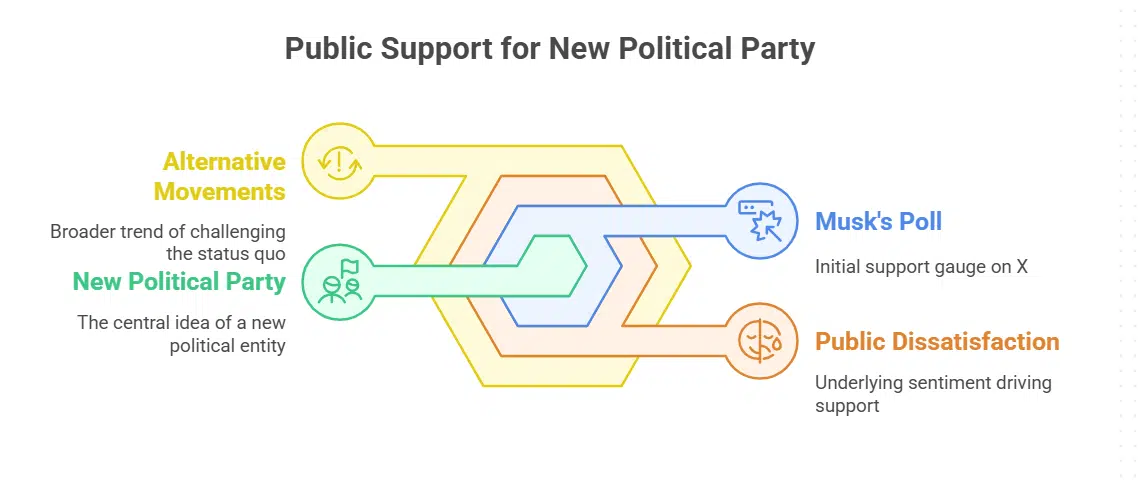
Despite criticism from political veterans, Musk’s idea appears to have struck a chord with a significant portion of the American public. In a poll conducted on X, Musk asked his followers whether they wanted to see an end to the two-party system. More than 1.2 million users responded, and over 60% expressed support for forming a new political party.
This response highlights a broader trend of public dissatisfaction with the current political establishment. Polling data from Gallup and Pew Research consistently show that a large number of Americans feel unrepresented by either major party. Many independents, moderates, and younger voters are increasingly open to alternative political movements that challenge the status quo.
Historical Context: The Long Road for Third Parties
The idea of forming a viable third party in the U.S. is not new. Over the past century, several figures have tried—and mostly failed—to challenge the dominance of the Democratic and Republican parties.
In 1912, former President Theodore Roosevelt mounted one of the most successful third-party campaigns in American history. After losing the Republican nomination to incumbent President William Howard Taft, Roosevelt founded the Progressive Party, commonly known as the Bull Moose Party. He won 27% of the popular vote and 88 electoral votes, finishing second and beating the Republican nominee. Yet, even this high-profile campaign ultimately failed to break the two-party cycle.
In 1992, billionaire businessman Ross Perot ran as an independent presidential candidate, earning 19% of the popular vote. Although he didn’t win any electoral votes, his campaign influenced the national debate on fiscal responsibility and trade policy. Perot later established the Reform Party, but it failed to gain lasting momentum.
These examples show that while third-party candidates can make a splash, the structural and electoral challenges remain formidable, particularly under the Electoral College system.
Financial Firepower: Musk’s Political War Chest
One advantage Musk has that many third-party challengers lacked is a nearly unlimited budget. According to data from OpenSecrets.org, Musk was the largest individual political donor in the 2023–2024 election cycle, contributing more than $291 million to Republican candidates and causes.
In total, nearly $16 billion was spent across the 2024 presidential and congressional elections—highlighting the enormous scale of U.S. political financing. Musk’s ability to self-fund campaigns, attract media attention, and mobilize supporters on social platforms could make the America Party a unique force.
His influence has already been tested at the state level. In April 2025, Musk reportedly gave million-dollar checks to voters in Wisconsin ahead of a State Supreme Court election. Despite the heavy spending, the Democratic-backed candidate, Susan Crawford, defeated conservative challenger Brad Schimel. The loss served as a reminder that money alone can’t guarantee electoral success, especially when voter sentiment and local dynamics are strong.
What’s Next for the America Party?
As of now, the America Party’s leadership structure, official policies, and candidate slate remain unclear. Musk has not announced whether he plans to run for office himself, or if the party will focus solely on influencing policy by backing like-minded candidates.
Observers expect the party to target competitive swing districts in states like Wisconsin, Arizona, Georgia, and Pennsylvania—places where just a few thousand votes can determine control of Congress. If successful, the America Party could act as a kingmaker in future legislative battles.
There is also speculation that Musk may use the party to support ballot initiatives on key issues like digital privacy, AI governance, tax reform, and government transparency—areas where he holds strong views and significant expertise.
A Disruption or a Revolution?
Musk’s entry into American politics is both bold and risky. On one hand, he has the wealth, platform, and public following to shake up the current system. On the other hand, the institutional hurdles for third parties are deeply entrenched in the U.S. political landscape.
Whether the America Party becomes a meaningful force or fades into the long list of failed third-party efforts will depend on Musk’s ability to build grassroots support, avoid vote-splitting traps, and navigate the legal and electoral barriers designed to protect the two-party system.
For now, the America Party stands as a symbol of rising public frustration with traditional politics—and a signal that Silicon Valley’s influence may soon extend beyond tech and into the very heart of American democracy.





















