

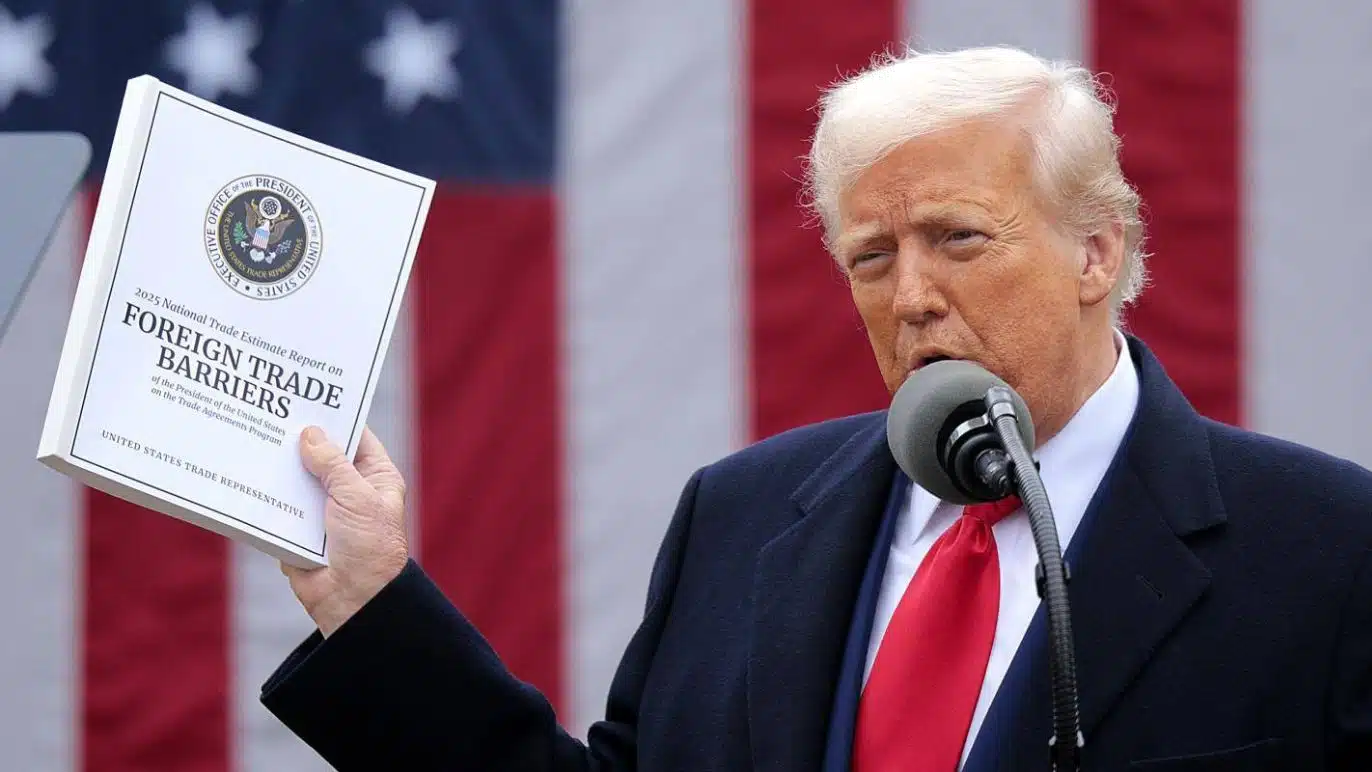
In a bold announcement that could redefine the architecture of international commerce, former U.S. President Donald Trump has declared what he called a “total reset” of the current global trade order. Framing it as an effort to “restore fairness, sovereignty, and strength” to American economic policy, Trump outlined a sweeping proposal for how the United States will engage with major trading partners and international institutions under his leadership.
The declaration, made during a televised speech from Mar-a-Lago, marks one of the most ambitious trade policy agendas in modern history. Analysts and foreign governments alike are calling it a potential turning point—one that could unravel decades of globalization while setting the stage for a new era of economic nationalism.
A New Economic Doctrine: Trump’s “Reset”
Trump’s “Reset” isn’t merely a policy shift; it’s a blueprint for rebuilding global trade on terms that prioritize national wealth and manufacturing independence. “The era of one-sided trade is over,” Trump declared. “America will no longer be the engine of prosperity for countries that refuse to play fair.”
Under the proposed framework, the administration plans to:
-
Reassess all existing bilateral and multilateral trade pacts.
-
Reduce dependency on Chinese imports by as much as 60% over the next five years.
-
Incentivize companies that onshore manufacturing and critical supply chains.
-
Impose universal tariffs—a new baseline tax—on all foreign goods entering the United States.
-
Expand strategic trade partnerships with select nations aligned with American security interests.
The “Reset” reflects Trump’s conviction that the global trade system—dominated by large institutions like the WTO, IMF, and World Bank—has long disadvantaged the United States. He argues that these structures allowed nations such as China, India, and Germany to build surpluses at the expense of American workers and industries.
From Tariff Diplomacy to Trade Reengineering
The roots of this radical shift trace back to Trump’s first term in office (2017–2021), when he initiated tariffs on steel, aluminum, and a range of Chinese goods. His “America First” trade agenda prioritized renegotiating trade deals like NAFTA (renamed USMCA) and withdrawing from the Trans-Pacific Partnership (TPP).
Eight years later, the global environment looks dramatically different. Supply chain disruptions during the COVID-19 pandemic, geopolitical tensions with China, and Europe’s divided stance on industrial competition have revitalized Trump’s argument that “globalism has failed.”
But the difference now lies in scale. Rather than a piecemeal tariff strategy, the new plan introduces a systemic remapping of U.S. trade policy, intended to reassert American leverage and manufacturing superiority across critical sectors such as semiconductors, electric vehicles, rare earth minerals, and defense components.
Universal Tariff Policy: The Core Mechanism
At the heart of Trump’s Reset is his proposal for a universal baseline tariff—a flat duty applied to all imports regardless of source. Though details remain under discussion, insiders suggest the rate could hover between 10% and 20%, effectively serving as an automatic premium for goods entering the U.S. market.
According to Trump, this measure would “level the playing field” while encouraging domestic production. Critics, however, warn of ripple effects across the global economy—raising consumer prices and inviting retaliatory tariffs from trading partners.
The universal tariff is designed to apply above targeted penalties for nations deemed to engage in unfair trade practices. That means Chinese, Mexican, and certain European products could face steep combined rates that exceed 40%.
Economists argue that if implemented broadly, such tariffs could generate an estimated $300 billion annually in federal revenue. However, they also caution that this windfall might come at the cost of inflation and reduced purchasing power.
The China Question: Decoupling Accelerates
Perhaps the most consequential element of Trump’s Reset is his commitment to “strategic decoupling” from China—the world’s second-largest economy and America’s largest trading partner. Citing espionage concerns, supply chain vulnerabilities, and what he calls Beijing’s “predatory” trade behavior, Trump vowed to phase out U.S. reliance on Chinese manufacturing.
“The Chinese Communist Party has used trade to control global industries,” Trump said. “No more. We will reclaim our independence.”
The administration plans to:
-
Reinstate and expand tariffs on key Chinese-made goods, including electronics, batteries, and pharmaceuticals.
-
Offer relocation tax credits to American manufacturers shifting production to the U.S. or to strategic allies such as India, Vietnam, and Mexico.
-
Restrict technology transfers and corporate partnerships with firms linked to the Chinese state.
Beijing’s initial reaction was one of restrained outrage. The Chinese Commerce Ministry warned that “unilateral protectionism undermines global stability” and hinted that China would pursue “necessary countermeasures.”
Global analysts see Trump’s move as part of a broader reshaping of global supply chains—one already underway as companies diversify production away from China and toward Southeast Asia and Latin America.
New Trade Alliances: Beyond the Old Order
Despite its protectionist tone, Trump’s Reset is not an isolationist policy. Instead, it envisions forming what the administration describes as “a network of trusted trade partners”—countries that share economic and security goals with the U.S.
Reports indicate early talks are already underway to expand trade cooperation with:
-
India, as a regional counterweight to China and a hub for manufacturing diversification.
-
Brazil, focusing on agricultural trade and mineral resources.
-
United Kingdom, to strengthen post-Brexit bilateral trade.
-
Japan and South Korea, to secure semiconductor and technology supply chains.
-
Mexico and Canada, reinforcing existing USMCA partnerships for nearshoring manufacturing.
This approach would create a “tiered” system of alliances built on mutual benefit and transparency—Trump’s stated antidote to what he calls “globalism without accountability.”
Political observers note that this strategy resembles a commercial version of NATO, aligning trade with geopolitics to build a coalition of like-minded economies against authoritarian influence.
Global Reactions: Allies Alarmed and Rivals Ready
The announcement triggered mixed reactions worldwide. European leaders expressed concern that the U.S. shift could fracture economic cooperation and trigger retaliatory measures. French President Emmanuel Macron warned that “a blanket tariff policy risks fragmenting the global economy into competing blocs.”
In Asia, Japan and South Korea responded more cautiously, signaling willingness to engage diplomatically while seeking clarity on how tariffs would apply to their industries.
Meanwhile, Mexican President Andrés Manuel López Obrador expressed guarded optimism that new nearshoring incentives could strengthen North American trade integration, provided “mutual respect” guided negotiations.
Financial markets reacted swiftly. The U.S. dollar strengthened temporarily against major currencies, while global equity indices dipped amid worries over potential trade wars reminiscent of 2018–2019. The International Monetary Fund urged restraint, warning that “broad-based tariffs could reduce global GDP growth by up to 1% annually.”
Domestic Political Repercussions
On the home front, Trump’s declaration ignited debate in Washington. Republican lawmakers largely praised the move as a reaffirmation of U.S. economic sovereignty. Senator Josh Hawley (R-MO) called the Reset “a corrective course after decades of sellouts to global corporations.”
Democrats, however, accused Trump of returning to failed policies that hurt consumers and strained alliances. Senate Majority Leader Chuck Schumer argued that “reckless tariff wars” would raise everyday costs while alienating partners crucial for confronting China’s influence.
Economists remain divided. Supporters argue that tariffs could boost domestic job creation, particularly in steel, automotive, and electronics manufacturing. Skeptics counter that higher input costs would make U.S. exports less competitive and squeeze small businesses reliant on global supply chains.
Key Sectors Likely to be Affected
The Reset’s impact will likely vary across industries, with some sectors poised for revival and others bracing for disruption:
-
Manufacturing: Incentives for reshoring could benefit U.S. factories but face challenges from labor shortages and automation costs.
-
Technology: Restrictions on Chinese components may accelerate investment in American semiconductor production, particularly through CHIPS Act expansion.
-
Energy: Domestic energy exports (LNG and oil) might gain leverage in new bilateral trade deals.
-
Agriculture: A likely flashpoint as retaliatory tariffs could target U.S. soybeans, corn, and meat exports—echoing trade tensions from Trump’s first term.
-
Retail & Consumer Goods: Price hikes may hit electronics, clothing, and household products as import tariffs ripple through the supply chain.
The administration is reportedly considering selective exemptions for essential goods like medical supplies, but these details remain unclear.
The End of the WTO Era?
Central to Trump’s rhetoric is his disdain for what he calls “obsolete global bureaucracies”—chief among them, the World Trade Organization. In his speech, he accused the WTO of enabling “cheaters” and vowed to challenge its authority by shifting toward bilateral enforcement mechanisms.
Insiders suggest the U.S. may even consider establishing a new trade body composed of nations that share its principles of reciprocal trade and sovereignty. Whether this represents a total break from the WTO or a reform initiative remains uncertain.
If realized, such a move could signal the most dramatic realignment of global trade governance since World War II.
Trade historians point to the potential parallels with the 1944 Bretton Woods conference—except this time, the push for change is driven not by collective rebuilding but by competitive realignment.
Economic Analysts’ Forecast: Opportunity or Risk?
Market analysts diverge sharply on the long-term implications of Trump’s Reset.
Proponents argue that it could:
-
Accelerate domestic job growth by incentivizing U.S.-based production.
-
Create leverage in renegotiating unbalanced trade agreements.
-
Reduce dependence on geopolitical rivals and enhance national resilience.
Critics caution that it might:
-
Trigger widespread retaliatory tariffs and depress global demand.
-
Fuel inflation, undermining middle-class purchasing power.
-
Strain diplomatic ties with traditional allies.
-
Decrease global investment confidence due to uncertainty in trade rules.
Morgan Stanley’s economic outlook report notes that “a structural U.S. trade reset could raise global transaction costs by up to 15% in the short term while stimulating regional trade blocs in Asia and the Americas.”
The “Reset” in a Fragmented World Economy
Trump’s proposal also comes at a moment when globalization itself faces existential challenges. The fragmentation of global supply chains, the rise of economic nationalism, and shifting energy dynamics have already eroded the cooperative framework built in the late 20th century.
According to the World Bank, global trade growth decelerated to below 2% in 2024—the slowest pace in decades. Rising protectionism and geopolitical rivalries contributed to this stagnation. Against this backdrop, Trump’s Reset may serve as both a catalyst and a symptom of broader systemic change.
Some experts predict a world of trade clusters—self-contained economic zones centered on shared interests. Under this model, U.S.-led Western blocs would coexist with China’s Belt and Road network and Europe’s internal single market.
What It Means for Global Businesses
For multinational corporations, Trump’s declaration introduces fresh uncertainty. Companies with global supply chains now face strategic decisions: whether to localize operations, diversify sourcing, or absorb higher costs through pricing adjustments.
Industries dependent on Chinese manufacturing—electronics, solar panels, and medical devices—may accelerate their relocation plans to Vietnam, India, and Mexico. Others, especially in high-tech sectors, will need to navigate complex export restrictions and evolving U.S.-China tech rivalries.
Consulting firms already report a surge in demand for geoeconomic risk assessment—a sign that boardrooms are actively preparing for a transformed business landscape.
Experts Weigh In: Is a “Reset” Feasible?
Trade scholars note that while Trump’s Reset embodies political momentum, its practical execution remains complicated. International trade treaties, existing WTO rules, and global supply interdependencies make a complete overhaul difficult without extensive renegotiation.
Dr. Robert Haass, former president of the Council on Foreign Relations, called the speech “a declaration of intent rather than a detailed blueprint.” He added, “The question is not whether America can reset global trade—but whether the rest of the world will follow.”
Others see it as a potential recalibration rather than an outright revolution. “Trump’s rhetoric is maximalist, but his past record suggests he will pursue pragmatic deals that deliver symbolic wins at home,” noted economist Diane McKeon of the Brookings Institution.
The Political Timing: Economic Reset as Election Catalyst
With Trump’s campaign regaining momentum heading into 2026, the Reset also carries clear political weight. Echoing his signature themes of sovereignty and strength, the plan could galvanize voters frustrated by inflation, industrial decline, and global uncertainty.
Analysts see it as a strategic reassertion of his “America First” doctrine—updated for a post-pandemic, multipolar world. By framing global trade as a battlefield for national prosperity, Trump effectively transforms economic policy into political identity.
“Trump isn’t just setting trade rules,” political scientist Sarah Longwell observed. “He’s redefining what it means for America to lead.”
The Road Ahead: Trade Reset or Trade Conflict?
As nations brace for negotiations—or confrontations—the global economy stands at a crossroads. Whether Trump’s Reset ushers in renewed prosperity or rekindles economic conflict will depend on the balance between protectionism and partnership.
For now, the world watches as the United States moves to dismantle pillars of globalization it once helped build. The question remains: can a new order emerge from the fractures of the old, or will the “reset” plunge global trade into a prolonged fragmentation?





















