We are almost half done with 2026 and TikTok for B2B Brands is no longer a joke. The joke is that serious companies still treat it like a place where marketing teams go to embarrass themselves with forced trends and “fun” office videos.
TikTok is not converting for B2B because buyers suddenly want vendors to dance near a whiteboard. Thankfully, civilization has not fallen that far yet.
It is converting because buyers now research like normal people. They search, watch, compare, save, question, and judge a brand long before they speak to sales. They do not want another gated PDF pretending to be insight. They want clear answers, sharp expertise, real proof, and a reason to believe your company is not just another vendor shouting “transformation” into the void.
Forrester’s 2026 buyer research found that social media has become the second most meaningful information source for B2B buyers, just behind generative AI search tools. The same research points out that younger B2B buyers are using platforms like TikTok as part of their buying journey, which should make every boring B2B brand mildly uncomfortable. Good. Discomfort usually means the market moved and someone missed the meeting.
Why TikTok For B2B Brands Deserves A Serious Seat In 2026
For years, B2B marketers treated TikTok like it was allergic to serious business. That was lazy thinking.
The real issue was never TikTok. The issue was that too many B2B brands had no idea how to speak like humans. They knew how to write landing pages, make case studies, run LinkedIn ads, and produce webinars with the emotional energy of a printer manual. But short-form video exposes weak thinking very quickly.
TikTok works when the idea is clear. It fails when the brand has nothing to say.
B2B buyers are no longer waiting for sales teams to educate them. They are building opinions on their own. They look at creators, experts, comment sections, short videos, reviews, search results, and AI summaries before they ever book a demo.
That is why TikTok matters. Not because it replaces SEO, LinkedIn, email, webinars, or sales. It does not. Anyone selling that fantasy probably also has a “seven-figure funnel” course waiting in the bio.
TikTok matters because it helps shape buyer memory before the buyer reaches the form.
What Is Actually Converting On TikTok Right Now
Let’s be practical. Views are not conversions. Likes are not a pipeline. A viral post from people who will never buy from you is not demand generation. It is applause from the wrong room.
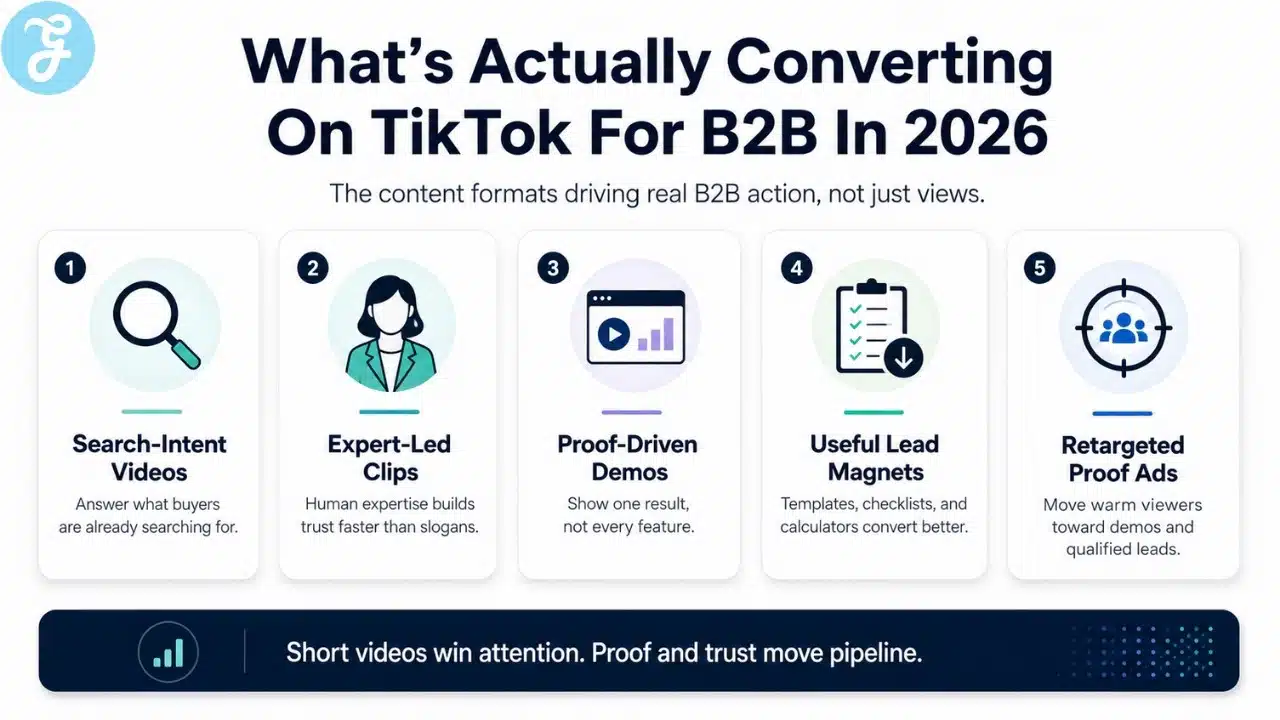
What converts on TikTok in B2B is usually content that helps buyers understand a problem, trust a voice, compare options, or take one useful next step.
Here is the clean version of what is working.
| Conversion Driver | What It Looks Like | Why It Works |
|---|---|---|
| Search-led videos | Short answers to buyer questions | Captures people already researching |
| Expert-led clips | Real practitioners explaining real problems | Builds trust faster than brand slogans |
| Proof videos | One workflow, one result, one clear benefit | Makes value visible quickly |
| Objection content | Pricing, setup, risk, adoption, security answers | Reduces buyer hesitation |
| Useful lead magnets | Templates, checklists, calculators, audits | Turns attention into measurable intent |
| Retargeted proof ads | Case snippets, comparison clips, demo nudges | Moves warm viewers closer to action |
This is not complicated. It is just less glamorous than pretending every brand needs a mascot, a sound trend, and three people pointing at floating text.
The Search Angle Most B2B Teams Still Underuse
TikTok is not only a scrolling app anymore. It is also a search habit.
TikTok’s own Search Ads Campaign documentation explains that advertisers can use keyword-based search behavior to reach people looking for specific topics related to a product or service. TikTok also supports objectives such as lead generation and sales, which matters for B2B brands that want something more useful than “brand awareness” floating around like incense.
This is where many B2B teams are still asleep.
A buyer searching “best CRM for small sales team,” “SOC 2 checklist,” “how to reduce customer churn,” “cloud cost optimization,” or “AI tools for support teams” is showing intent. Maybe early intent, but intent nonetheless.
That buyer does not need your corporate anthem. They need a useful answer.
How TikTok For B2B Brands Wins Search Intent
Search-led TikTok content should be built around the words buyers actually use.
Not this:
“We empower scalable revenue transformation through intelligent enablement workflows.”
Nobody talks like that unless they are trapped inside a SaaS homepage.
Better:
“Three signs your sales handoff is killing good leads.”
That is searchable. That is clear. That sounds like a real problem.
Useful search-led formats include:
- “Why your sales team is losing qualified leads”
- “How to compare project management tools without wasting a month”
- “What security teams ask before approving new software”
- “Three CRM setup mistakes that hurt pipeline”
- “Why your AI support bot fails after launch”
- “What to check before buying payroll software”
The goal is not to sound clever. The goal is to be the answer buyers remember when they finally need help.
Expert-Led Content Is Beating Polished Brand Noise
B2B buyers trust people before they trust brands. This should not be controversial, but marketing departments have spent years proving they can turn any human thought into a lifeless campaign asset.
LinkedIn’s 2026 B2B marketing insights argue that thought leadership is becoming more people-powered, with creator and expert voices playing a bigger role in how buyers discover and evaluate companies. LinkedIn also cites research showing that decision-makers often trust strong thought leadership more than standard product sheets or marketing materials.
This applies perfectly to TikTok.
A cybersecurity specialist explaining what goes wrong during vendor risk reviews is more believable than a brand account saying, “We care about secure innovation.”
A payroll expert breaking down a compliance mistake is more useful than a company posting, “Meet the team behind the platform.”
A customer success manager explaining why implementations fail is more valuable than a product tour where every button is apparently “powerful.”
The content that converts usually comes from people with actual experience:
- Operators
- Consultants
- Customer success teams
- Sales engineers
- Implementation specialists
- Industry creators
- Analysts
- Technical experts
- Power users
The best B2B TikTok content sounds like someone who has solved the problem, not someone who discovered the problem five minutes before recording.
Proof Beats Production Value
I love good production. Clean visuals matter. Good lighting helps. Audio should not sound like it was recorded inside a lunchbox.
But production value is not proof.
A simple screen recording that shows a real workflow can beat a polished brand film because buyers do not care how cinematic your software looks. They care whether it saves time, reduces risk, cuts cost, improves output, or makes their team less miserable.
Proof-led TikTok clips work because they show one clear thing:
- A messy task becoming simpler
- A manual process becoming faster
- A report being created from scattered data
- A customer support ticket being routed correctly
- A compliance checklist being generated
- A dashboard showing a before-and-after result
Do not show every feature. That is how demos become sleeping pills.
Show the moment where the buyer thinks, “Yes, that would help.”
The Content Formats Converting Best In 2026
TikTok’s 2026 trend forecast highlights “Reali-Tea,” “Curiosity Detours,” and “Emotional ROI,” which is a fancy way of saying people want honesty, discovery, and a reason to care before they give attention or money. For B2B, that means overproduced corporate fluff is going to struggle, as it deserves.
Here are the formats I would prioritize.
1. Problem Diagnosis Videos
These work because they help buyers name the issue.
A strong problem-diagnosis video says:
- Here is the problem
- Here is why it happens
- Here is what it costs you
- Here is what to fix first
Example:
“Your CRM is not the problem. Your team’s follow-up process is.”
That kind of line works because it attacks a real assumption. It gives the buyer language for a problem they already feel.
2. Objection-Handling Videos
B2B buyers are skeptical. Good. They should be.
They worry about pricing, setup time, security, adoption, reporting, integrations, data privacy, switching costs, and whether your tool will become another expensive tab nobody opens.
Answer those worries directly.
Strong topics include:
- “When this tool is not worth buying”
- “What security teams ask before approval”
- “Why implementation fails in the first 30 days”
- “What buyers misunderstand about pricing”
- “How long setup actually takes”
- “What happens if your team refuses to adopt it”
This kind of content converts because honesty reduces friction. Shocking, I know. Telling the truth remains undefeated.
3. Comparison Content
B2B buyers compare everything.
They compare vendors. They compare pricing. They compare “build vs buy.” They compare doing nothing versus changing process. They compare your tool with the spreadsheet they secretly hate but still use.
Comparison content works because it respects the buyer’s decision process.
Examples:
- “HubSpot vs Salesforce for small B2B teams”
- “Agency vs in-house marketing team”
- “Manual reporting vs automated dashboards”
- “Cheap CRM vs expensive CRM: what you actually pay for”
- “Build your own AI tool or buy one?”
The best comparison content does not pretend one answer fits everyone. That is what weak vendors do.
A strong comparison says, “Here is when each option makes sense.” Buyers respect that because it sounds like advice, not bait.
4. Micro Case Studies
A full case study is useful. A TikTok case study needs to be tighter.
Use this structure:
- Problem
- Constraint
- Action
- Result
- Lesson
Bad version:
“We helped a fast-growing organization unlock operational excellence.”
Good version:
“A 40-person sales team cut lead response time from two days to under four hours after fixing their routing workflow.”
One has meaning. The other sounds like it escaped from a consulting brochure.
5. Useful Lead Magnet Prompts
TikTok can create attention, but attention needs somewhere to go.
The strongest B2B lead magnets are not bloated PDFs. They are tools buyers can use immediately:
- Audit checklist
- ROI calculator
- Pricing comparison sheet
- Implementation readiness scorecard
- Compliance checklist
- Vendor evaluation template
- Prompt library
- Buyer question list
- Workflow teardown worksheet
A good lead magnet should feel like the next step after the video, not a punishment for clicking.
How Paid TikTok Fits Into B2B Conversion
Organic content tells you what the market cares about. Paid media helps scale what already works.
The mistake is using paid TikTok to force weak content into the feed and then blaming the platform when nobody converts. Paid media does not fix bad messaging. It only makes bad messaging more expensive.
TikTok Ads Manager lets advertisers define campaign objectives, target audiences, set budgets, and direct users toward business goals. TikTok also supports lead generation objectives for collecting prospect information on TikTok or through a company website.
For B2B, paid TikTok works best when it supports a funnel like this:
| Paid Layer | Best Use | What To Promote |
|---|---|---|
| Spark Ads | Boost strong organic posts | Expert clips, proof videos, sharp POVs |
| Search Ads | Capture intent | Problem keywords, category searches |
| Lead Gen Ads | Collect demand | Checklists, audits, templates, calculators |
| Retargeting | Warm up serious viewers | Case clips, comparison pages, demo offers |
Cold viewers rarely book a demo after one video. That is not failure. That is normal human behavior.
A better path looks like this:
First, they see a useful problem video.
Then, they watch a proof clip.
Then, they download a checklist.
Then, they see a retargeted case study.
Then, they book a demo or join a sales conversation.
Not magical. Just logical.
What Is Not Converting, No Matter How Much Marketing Pretends
Some TikTok content gets views but does nothing for B2B revenue.
Here is the content I would cut without sending flowers:
- Random trend-jacking
- “Day in the life” videos with no buyer relevance
- Webinar clips with no hook
- Founder speeches about disruption
- Generic thought leadership with no actual thought
- Product tours that explain every button
- Fake behind-the-scenes videos
- Overdesigned corporate videos
- AI avatar explainers with the warmth of a tax invoice
A B2B video should help the buyer do at least one of these things:
- Understand a problem
- Compare options
- Trust an expert
- See proof
- Reduce risk
- Take a useful next step
If it does none of those, it is probably just content-shaped decoration.
The Metrics That Actually Matter
I do not hate views. I hate pretending views are revenue.
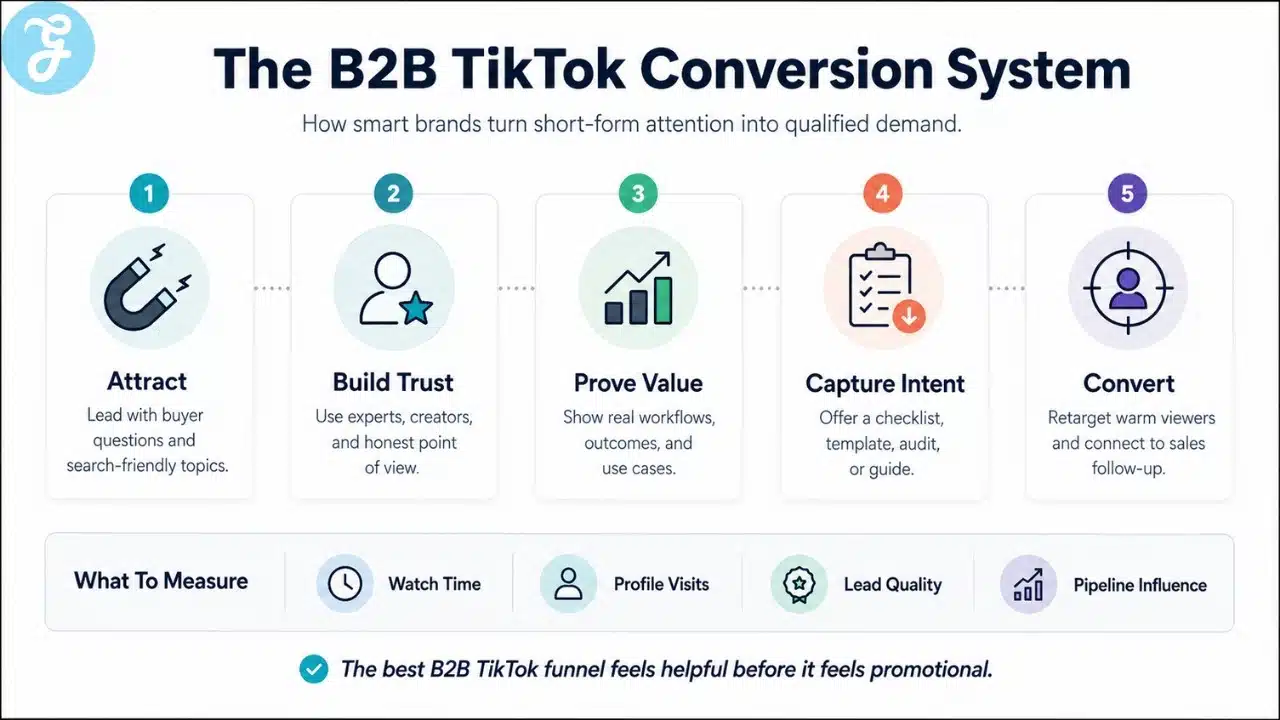
For B2B, TikTok measurement should separate attention from intent. A video with 300,000 views from random users may be less valuable than a video with 8,000 views from the right job roles, right industries, and right buying stage.
Here is what I would track.
| Funnel Stage | What To Measure | Why It Matters |
|---|---|---|
| Attention | Hook rate, watch time, completion rate | Shows whether people care enough to stay |
| Relevance | Saves, shares, profile visits, qualified comments | Shows whether the right audience is engaging |
| Intent | Search clicks, landing page visits, downloads | Shows research behavior |
| Lead quality | Role, company size, use case, urgency | Separates buyers from browsers |
| Revenue influence | Assisted with pipeline, demo requests, and CRM notes | Connects TikTok to sales outcomes |
The question is not, “Did it go viral?”
The better question is, “Did it move the right buyer closer to trusting us?”
Less sexy. More profitable. Funny how that works.
Where TikTok Fits In A Serious B2B Strategy
TikTok should not carry the whole marketing plan. That would be reckless.
It should sit inside a wider system with SEO, LinkedIn, email, retargeting, paid search, webinars, sales enablement, and owned content.
TikTok is strongest when it does these jobs:
- Builds early trust
- Makes complex ideas easier to understand
- Creates brand memory
- Tests buyer pain points
- Supports retargeting
- Sends traffic to useful assets
- Turns experts into visible voices
- Helps the brand sound less like a committee
It is not always the final conversion point. Often, it is the reason the buyer recognizes you later.
That matters. B2B buying is not one click. It is a long argument between budget, risk, urgency, and internal politics. TikTok can influence that argument if the content is useful enough.
The Best B2B Categories For TikTok In 2026
Not every B2B category needs the same TikTok push. Let’s not pretend every industrial supplier now needs a content creator in a hoodie.
But some categories are naturally stronger because the problems are visual, educational, emotional, or easy to explain in short form.
| Category | Why TikTok Can Work |
|---|---|
| SaaS | Workflows and results can be shown visually |
| HR and payroll | Buyers need simple explanations for messy processes |
| Cybersecurity | Fear, risk, and education create strong content angles |
| Marketing and sales tech | Buyers already consume short-form business content |
| Finance operations | Cost savings and process fixes are easy to frame |
| AI tools | Curiosity is high, but proof must be strong |
| EdTech and career services | Learning content fits the platform naturally |
| Agencies and consultants | Expertise can become the product before the sale |
The more specific the problem, the better the content.
“B2B growth tips” is vague.
“Why your demo request form is killing qualified leads” is specific.
Specific wins. Vague gets politely ignored.
The Risk Smart Brands Should Not Ignore
TikTok is useful, but no brand should build its entire demand engine on one rented platform.
TikTok has faced ongoing regulatory pressure in the U.S. around ownership, data, and national security. Reuters reported in January 2026 that ByteDance said TikTok USDS Joint Venture LLC would secure U.S. user data, apps, and algorithms, while details of the broader divestiture arrangement remained limited.
For B2B brands, the lesson is simple.
Use TikTok. Learn from TikTok. Convert from TikTok.
But capture emails. Build owned assets. Strengthen SEO. Use retargeting. Send serious buyers to pages and systems you control.
The algorithm is not your business partner. It is a landlord with a mood problem.
The Practical TikTok For B2B Brands Playbook
If I were building a TikTok system for a B2B brand in 2026, I would not start with trends. I would start with buyer questions.
Here is the workflow I would use:
- List the top 25 buyer questions.
- Turn each question into one short video.
- Build videos around pain, proof, comparison, and objections.
- Use experts, not faceless brand copy.
- Create one useful lead magnet for each major buying pain.
- Test organically before spending heavily.
- Boost the best expert-led clips.
- Use search ads for high-intent topics.
- Retarget engaged viewers with proof.
- Track lead quality, not vanity metrics.
This is how TikTok becomes a real part of B2B marketing. Not by acting young. Not by chasing sounds. Not by asking the social media manager to “make us go viral,” which is usually management-speak for “we have no strategy but enjoy the pressure.”
The Brands That Win Will Sound Useful Before They Sound Promotional
The future of B2B TikTok is not corporate cringe in vertical video form. It is not every SaaS company becoming a comedy account. It is not forcing serious experts to act like influencers if they hate being on camera.
The winning brands will do something much simpler.
They will answer better questions.
They will show proof faster.
They will use real experts.
They will respect buyer intelligence.
They will turn short-form attention into useful next steps.
They will measure quality instead of worshipping views.
That is what TikTok for B2B Brands really comes down to in 2026.
The brands that convert will not be the loudest. They will be the clearest. They will make buyers feel smarter after watching, not trapped in a sales pitch wearing sneakers.
The losers will keep asking whether TikTok is “right for B2B” while their buyers quietly learn from someone else.
Painful? Yes.
Avoidable? Also yes.
Very on-brand for B2B marketing? Unfortunately, absolutely.