


The confetti that rained down on Chase Stadium last night, December 6, 2025, was pink, but the legacy it celebrated was gold. When Lionel Messi hoisted the MLS Cup—his 47th major trophy and Inter Miami’s first-ever league title—the roar from the 21,000 in attendance wasn’t just a celebration of a victory; it was a defiance of time itself.
The scoreboard read 3-1 against the Vancouver Whitecaps, marking a poetic end to a season that felt less like a retirement tour and more like a cautionary tale. Facing a Vancouver side energized by the mid-season arrival of his old German nemesis, Thomas Müller, Messi did not look like a man winding down.
He looked like a grandmaster who had memorized the board. He didn’t score in the final, but his fingerprints were everywhere: two assists, three key passes, and a relentless orchestration of play that earned him the MLS Cup MVP.
Defying the Logic of Time
For years, the pundits have asked the same question: “At nearly 39, surely the decline is imminent?” Yet, as the 2026 World Cup looms on the horizon—hosted right here in the stadiums he has spent the last two years conquering—the answer from Fort Lauderdale is a resounding no.
Messi has evolved. He is no longer the alien who outruns you; he is the quarterback who outthinks you. And it is precisely this evolution that makes “The Unstoppable Messi” not just a nostalgic luxury for Argentina, but their absolute best hope for defending the World Cup title next summer.
The 2025 Season: Anatomy of a Champion
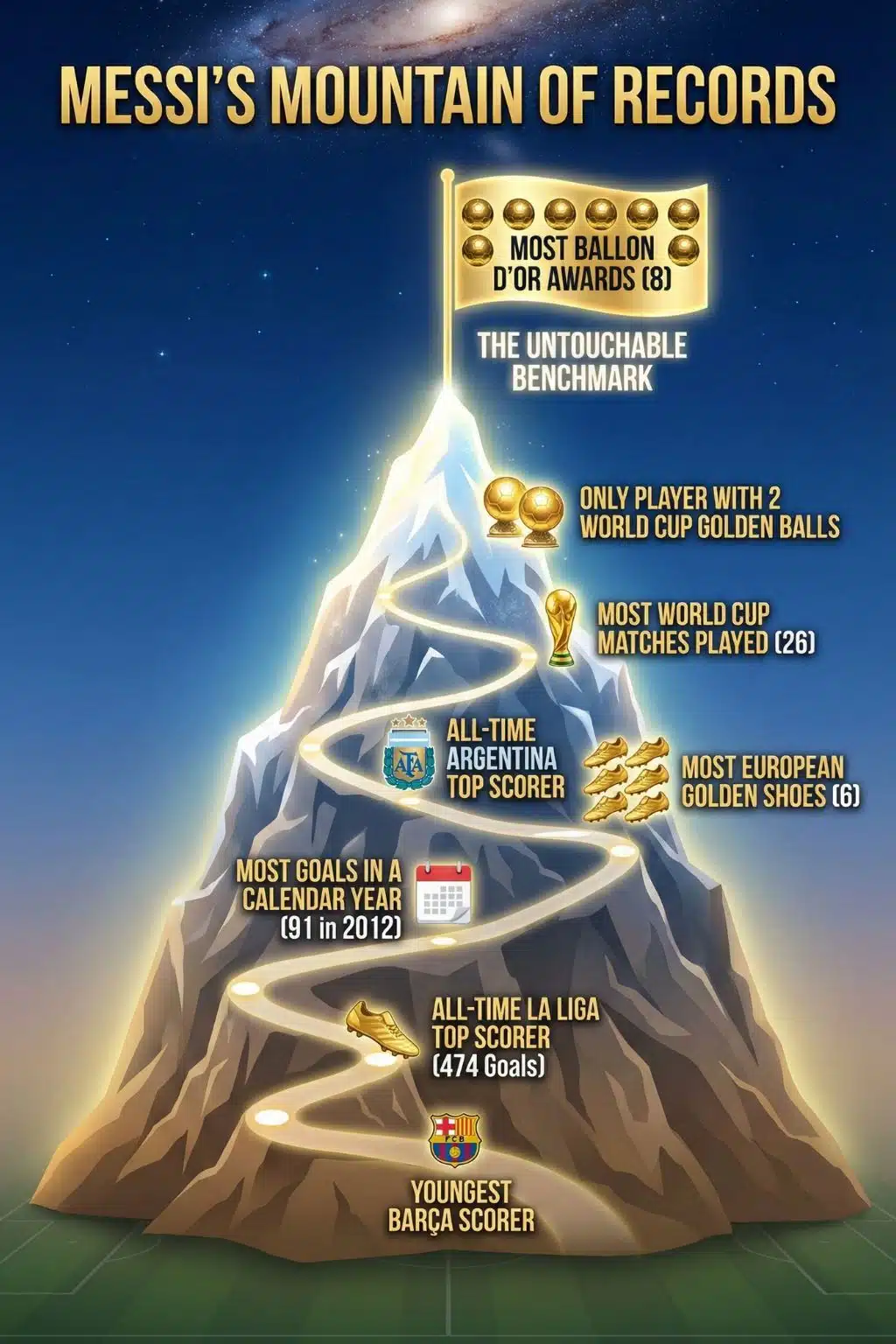
To understand why Messi remains indispensable for Argentina, we must first dissect the brutality of his 2025 MLS campaign. This was not a cameo season. It was a grind. Over a grueling 34-game regular season and a high-stakes playoff run, Messi delivered numbers that would be career-defining for a player in their prime, let alone one approaching 40.
By The Numbers
Finishing with the Golden Boot and the Landon Donovan MVP Award, his stats tell the story of a player who has mastered efficiency.
The Unstoppable Messi: 2025 Key Stats
-
Matches Played: 34
-
Goals: 29 (Golden Boot Winner)
-
Assists: 19
-
Distance Walked: 85% of total minutes
-
Pre-Assists: 1st in MLS (The pass before the assist)
The Final: Vision Over Speed
The final against Vancouver encapsulated this “new” Messi. The narrative going into the match was heavy with history—Messi vs. Müller, a rematch of the 2014 World Cup Final. Müller, true to form, organized a rigid German-style press designed to isolate the Argentine. For 60 minutes, it worked. The game was gridlocked at 1–1.
Then came the moment of clarity. In the 71st minute, with Vancouver’s midfield overcommitted, Messi didn’t sprint into the open space. He dropped deep, almost to the center-back position. He lulled the defense into a false sense of security, received a pass from Busquets, and swiveled. In a fraction of a second, he launched a 40-yard, laser-guided through ball that bypassed six Vancouver defenders, landing perfectly in the path of Rodrigo De Paul.
“He didn’t sprint into the open space. He dropped deep… The game was broken open not by speed, but by vision.”
This performance was also an emotional crescendo. It was the final professional match for Sergio Busquets and Jordi Alba, the last of the Barcelona guard. Messi wasn’t just playing for silverware; he was playing to give his “brothers” the perfect send-off. That emotional drive—the ability to summon greatness for the sake of his team—remains his most underrated attribute.
Tactical Evolution: From “False 9” to “The Quarterback”
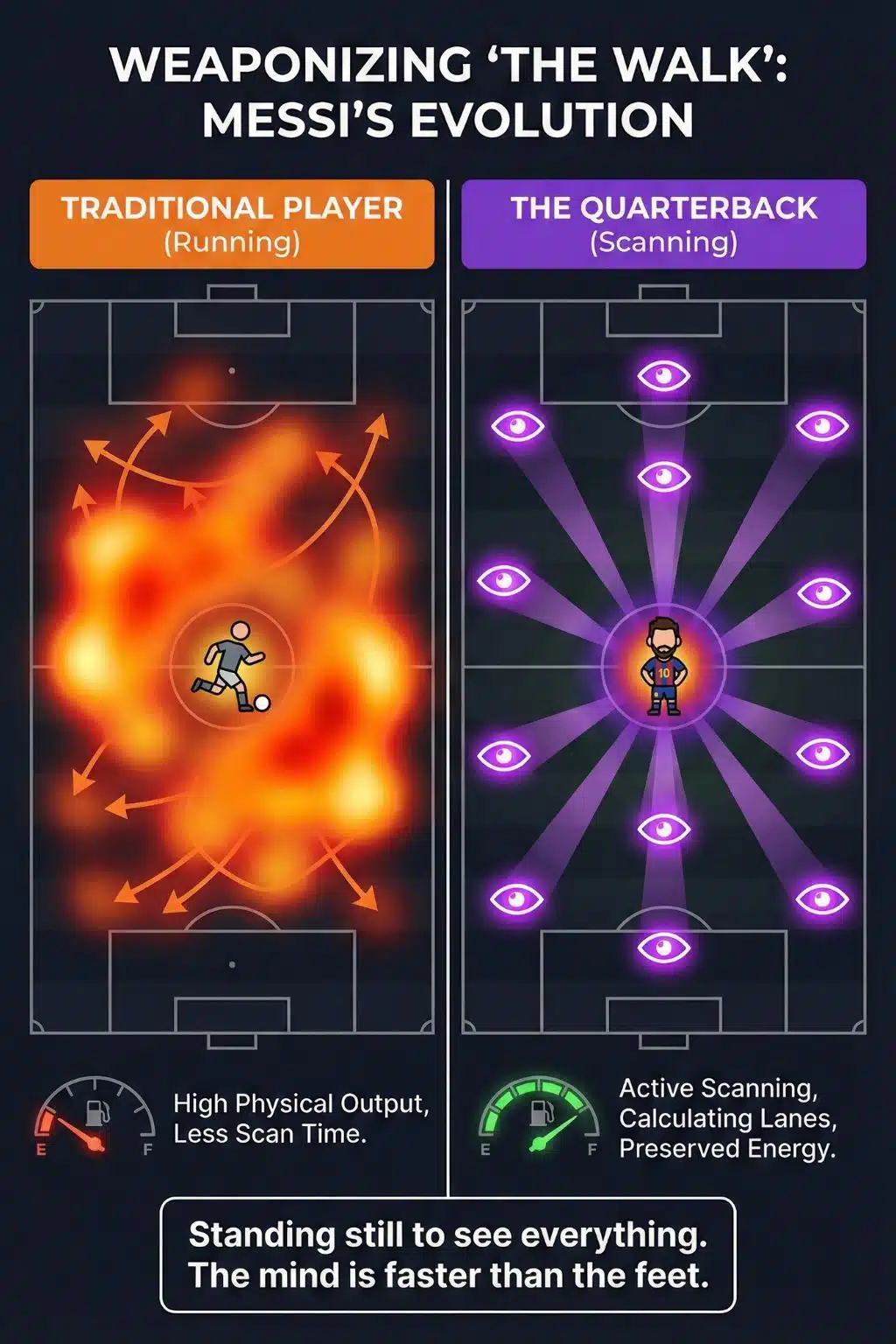
The “unstoppable” nature of Messi in 2025 is fundamentally different from the “unstoppable” Messi of 2012. The 2012 version was a force of nature—vertical, explosive, and a dribbling anomaly. The 2025 version is a force of geometry.
The Mascherano System
Credit must be given to Inter Miami manager Javier Mascherano, who took the helm early this year. Mascherano, Messi’s former teammate and protector, understood a simple truth: You cannot ask a 38-year-old to press, but you cannot afford to play with 10 men.
Mascherano’s solution was the “Defensive Box.” He deployed a 4-4-1-1 formation where the midfield four—anchored by the tireless Federico Redondo and the bulldog-like De Paul—did the running of five men. This structure created a protective cocoon that allowed Messi to essentially “walk” for 85% of the match.
Weaponizing “The Walk”
Critics often mock the walking, but analysts know better. Messi’s walking is active scanning. He is mapping the pitch, calculating passing lanes, and finding the pockets of space that chaos creates. By standing still in harmless areas, he becomes invisible to markers. The moment the ball turns over, he is the only player on the pitch who knows exactly where the next pass needs to go.
This shift to a “quarterback” role—operating deeper, dictating the tempo, and prioritizing the “pre-assist”—has preserved his body. He takes fewer hits because he releases the ball sooner. He suffers fewer muscle injuries because he rarely engages in 50-yard sprints. Paradoxically, by doing less physically, his stamina for moments of brilliance has increased.
The “Bodyguard” Connection: De Paul & The Miami-Argentina Bridge
No analysis of the “Unstoppable Messi” is complete without discussing the engine that powers him: Rodrigo De Paul. When De Paul joined Inter Miami on loan from Atlético Madrid earlier this season, it felt like a cheat code. It was the transfer that changed everything.
Telepathic Chemistry
De Paul has long been jokingly referred to as Messi’s “unofficial bodyguard,” but on the pitch, the connection is telepathic. In Miami, they have refined a relationship where De Paul acts as the lungs for Messi’s brain. If Messi drifts left, De Paul covers the center. If Messi drops deep, De Paul makes the vertical run to stretch the defense (as seen in the Cup final goal).
“By the time the 2026 World Cup kicks off, Messi and De Paul will have spent 18 months training together daily. That is a synchronized understanding other nations cannot replicate.”
The Locker Room Culture
Moreover, Messi has cultivated a locker room culture in Miami that mirrors the 2022 Argentina squad. Young players like Benjamin Cremaschi and Facundo Farías don’t just pass to him; they run through brick walls for him. This “cult of devotion” is a tactical asset. When ten teammates are willing to die on the pitch to cover your defensive deficiencies, your offensive genius becomes amplified. Argentina will bring this exact energy to the World Cup—a squad of soldiers led by a general they adore.
Argentina in 2026 World Cup: The Advantages and Drawbacks With Messi
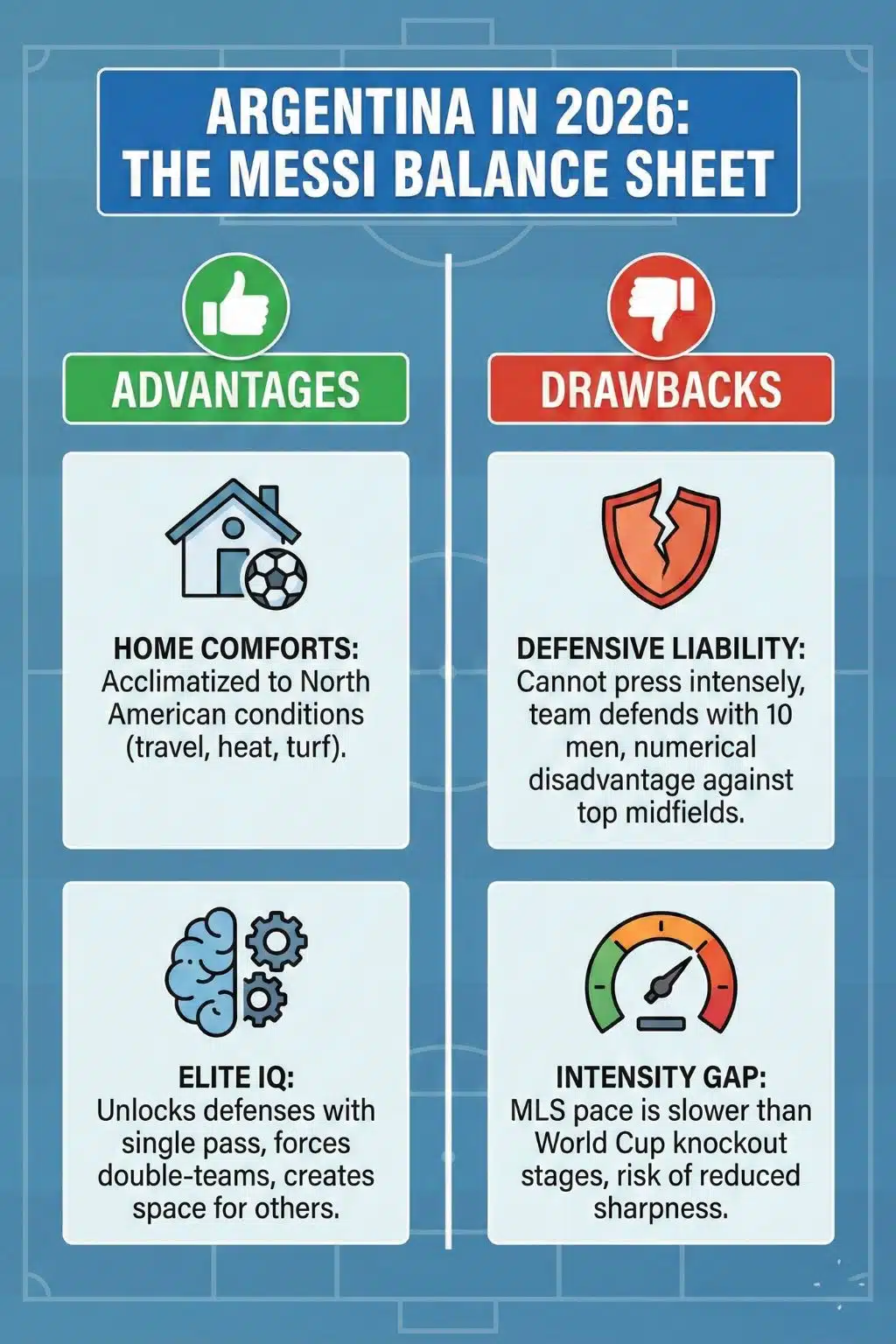
Bringing a nearly 39-year-old to a World Cup is a gamble, no matter his name. It requires a brutally honest assessment of the risks versus the rewards.
The Advantages: Home Comforts & Elite IQ
The most significant advantage is environmental. Messi will have spent nearly three years acclimatizing to the unique demands of North American soccer—the travel, the humidity, and the turf. While European stars may struggle with the transition, Messi will be playing “at home.” Furthermore, his creative output remains elite. In a tournament likely to be defined by low blocks and defensive setups, Messi’s ability to unlock a defense with a single pass is a skill that does not age. His mere presence forces opponents to alter their game plans, often dedicating two markers to him, which inevitably opens space for Julian Álvarez and Lautaro Martínez.
The Drawbacks: The Defensive Liability
However, the drawbacks are real. Modern football is increasingly defined by high-intensity pressing, a game Messi can no longer play. Fielding him essentially means Argentina must defend with 10 men. Against superior opposition like France or Spain, who possess dynamic midfields, this numerical disadvantage could be fatal. Additionally, there is the “intensity gap.” Critics warn that the MLS, while improved, does not replicate the ferocious speed of the Premier League or La Liga. There is a legitimate fear that Messi’s sharpness could be blunted by a lack of elite weekly competition, leaving him a step slow when the intensity ramps up in the World Cup knockout stages.
Project 2026: The Final Crusade
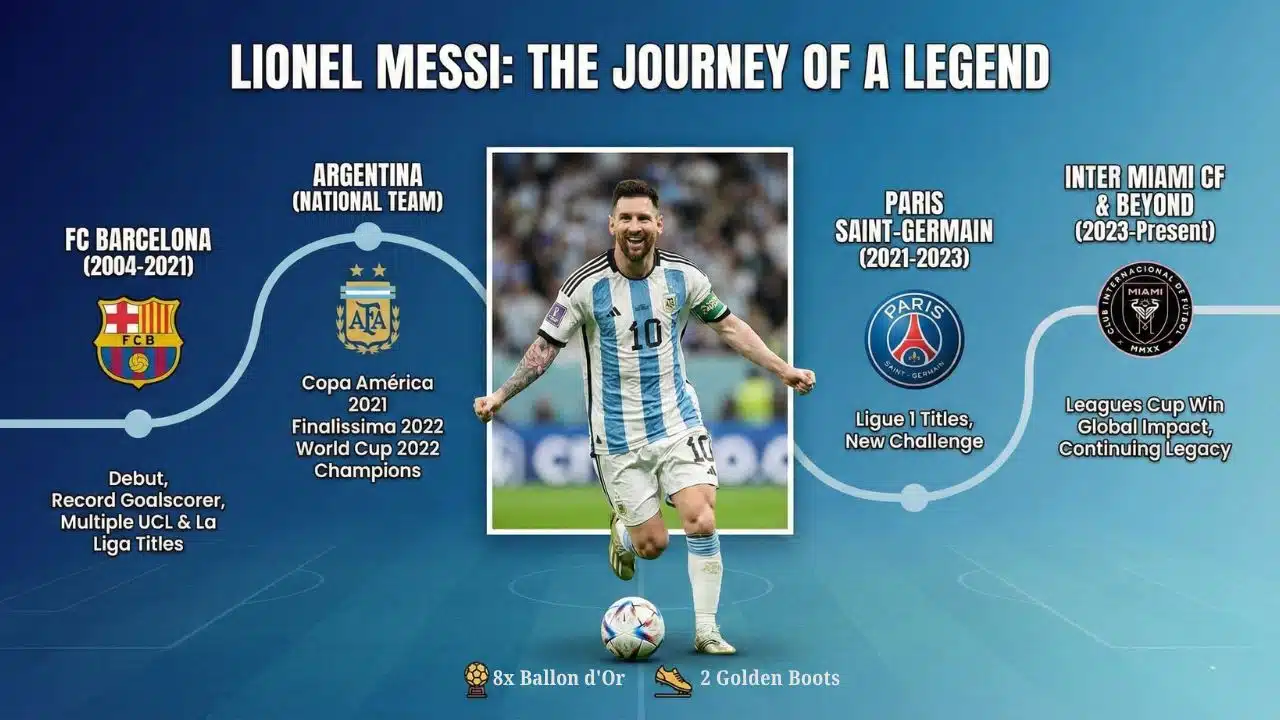
So, why is this version of Messi Argentina’s best hope for 2026?
Home Field Advantage
First, consider the venue. The 2026 World Cup is being played in the USA, Mexico, and Canada. By the time the tournament starts, Messi will have spent two and a half years acclimatizing to the unique challenges of North American soccer: the excessive travel, the varying time zones, the artificial turf, and the summer heat. While European teams will be adjusting to the humidity of Miami or the altitude of Mexico City, Messi will be playing at home.
The Antidote to Chaos
Second, look at the alternative. The Argentina squad is talented, boasting elite finishers like Julian Álvarez and Lautaro Martínez. They are high-energy pressing machines. However, they lack “La Pausa”—the ability to slow the game down and control chaos. Without Messi, Argentina is a frenetic, high-octane team that risks burning out. With Messi, they possess the antidote to pressure. In a World Cup knockout game, when the tension is suffocating, you don’t need a player who runs fast; you need a player who can freeze time.
The Clutch Factor
Finally, there is the mental edge. World Cups are rarely won by the team that dominates 90 minutes; they are won by the team that wins the decisive moments. Even at 39, Messi’s processing speed in high-leverage situations remains superior to any 20-year-old on the planet. He doesn’t need to dominate the game for 89 minutes. He only needs one second, one inch of space, and one lapse in concentration from the opponent to end the match.
Final Words
As Lionel Messi walked off the pitch at Chase Stadium last night, clutching the MVP trophy and the MLS Cup, the image was striking. He looked content. He has nothing left to prove. He has won the World Cup, the Copa América, and the Champions League, and now, he has conquered America.
This lack of pressure is perhaps what makes him most dangerous for 2026. He isn’t chasing a ghost anymore; he isn’t playing to silence critics. He is playing with the freedom of a man who has already completed the game.
“The Unstoppable Messi” is no longer about defying biology; it is about mastering it. He has transformed from a relentless scorer into a wise architect, a leader who empowers his team not just with goals, but with belief. As long as he can walk, he can think. And as long as he can think, he remains the most lethal weapon in world football.
Argentina doesn’t need the 25-year-old Messi to win in 2026. They just need the one who played yesterday: the one who sees the pass no one else sees and who has the friends around him to make it count. The king is not dead. Long live the King.
























