

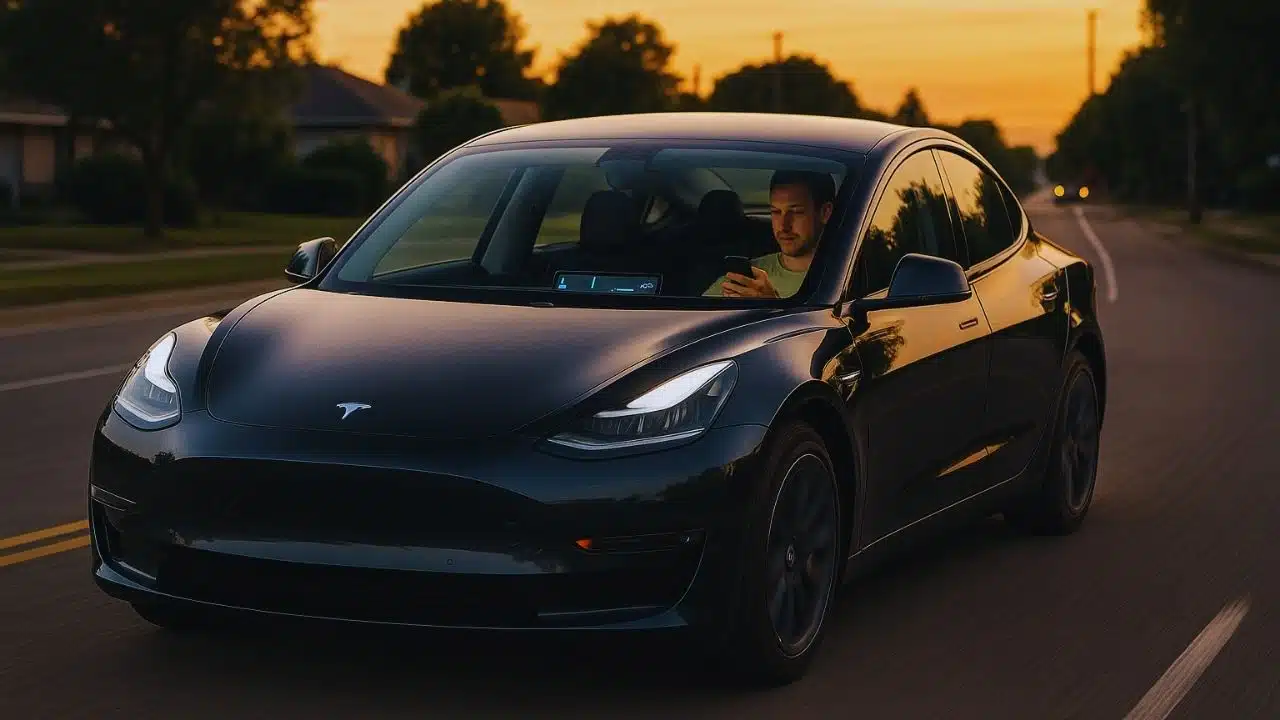
Tesla has ignited a new wave of debate after CEO Elon Musk confirmed that the company’s newest Full Self-Driving software, version 14.2.1, may allow drivers to text while the vehicle is in motion. Musk acknowledged the change after a user noticed the system no longer issued warnings when a driver used their phone. According to Musk, the feature relies on “the context of surrounding traffic,” although he did not explain how the system evaluates those conditions or what specific factors determine when texting is considered permissible. This marks a significant change in Tesla’s approach to distracted-driving management, especially because FSD is still officially categorized as a driver-assistance system requiring active human supervision.
The update comes at a time when Tesla continues to promote its long-term vision of autonomous mobility, yet regulators still classify FSD as a Level 2 system — one that demands continuous attention from the driver. By enabling texting in certain situations, Tesla appears to be signaling renewed confidence in the system’s ability to handle driving tasks more independently. However, this shift has surfaced new concerns among safety experts who emphasize that distracted driving remains one of the leading causes of road fatalities in the United States. Allowing phone use even selectively recreates a behavior that state-level policies have spent years attempting to eliminate.
Musk’s announcement also exposes tensions between innovation and legal compliance. Almost every U.S. state bans texting while driving, and many prohibit any form of handheld phone use. Even if FSD handles the driving task safely, the law still identifies the person behind the wheel as the responsible operator. That means drivers remain fully liable for any violations or collisions that occur, regardless of FSD’s capabilities. Tesla has repeatedly stated that FSD is not autonomous, but critics argue that the company’s messaging — including features like this one — often blurs that distinction for consumers.
Legal Tensions, Investigations, and the Growing Regulatory Pressure on Tesla
The rollout of an update that may permit texting while driving immediately intensified scrutiny from regulators already monitoring Tesla’s automated systems. The National Highway Traffic Safety Administration has an active investigation into FSD following reports of vehicles allegedly running red lights, drifting into opposing lanes, and struggling with visibility challenges during nighttime or low-light conditions. These investigations reflect a broader trend in which safety authorities are questioning whether Tesla’s approach to beta-testing on public roads exposes drivers, pedestrians, and other road users to unnecessary risk.
This software change may add new layers to the ongoing debate. Allowing phone use risks undermining enforcement of distracted-driving laws, which were implemented nationwide to reduce traffic deaths. Even if Tesla’s intention is to demonstrate the increasing sophistication of its system, the legal framework remains unchanged: drivers may face citations or liability if they are found texting behind the wheel, regardless of whether their vehicle is steering, accelerating, or braking on its own.
Tesla also faces pressure at the state level. The California Department of Motor Vehicles has been pursuing legal action against the company since 2022, arguing that Tesla misrepresented the capabilities of both Autopilot and FSD in its marketing. The agency claims the branding itself could mislead buyers into believing the vehicles are fully autonomous. California regulators are considering penalties that could temporarily suspend Tesla’s ability to manufacture or sell vehicles in the state for at least 30 days. A decision on that case is expected soon, and the new texting-while-driving capability may influence that discussion by raising further questions about how Tesla communicates safety expectations.
These developments occur amid a broader industry conversation about how advanced driver-assistance systems should be regulated. Other automakers take a more conservative approach by disabling phone features and requiring drivers to keep their eyes on the road even when hands-free features are engaged. Tesla’s approach — relying on software-based monitoring and periodic steering wheel checks — has been criticized by some safety researchers who argue that humans are poor supervisors of automated systems, particularly when those systems appear capable but still require intervention at unpredictable moments.
Inside the Real-World Test: How FSD Behaved While the Driver Texted
To understand how the updated system functions in real conditions, a reporter conducted a real-world test using a 2024 Tesla Model 3 equipped with FSD version 14.2.1. Over a roughly seven-minute drive through Silicon Valley, the reporter was able to continuously use their phone, type messages, and interact with the device without receiving the typical alerts previously triggered by distracted behavior. The vehicle handled residential streets, parked cars, oncoming vehicles, and tight navigation spaces with no major issues, completing the route smoothly.
However, the car still issued periodic reminders — such as requests for steering-wheel pressure — and occasional warnings designed to ensure the driver remained engaged. These alerts show that although Tesla has loosened certain restrictions, the system retains some level of driver-monitoring enforcement. The test demonstrated that the car could competently handle low-to-moderate complexity environments even when the driver’s attention was divided. Yet it also highlighted a deeper issue: drivers may feel overly confident in situations where FSD performs well, potentially leading to complacency and slower reactions in unexpected or high-risk scenarios.
Tesla’s driver-monitoring system relies on a combination of steering-wheel sensors and in-cabin cameras that track head position and eye movement. Researchers have noted that camera-based monitoring can be effective but is not foolproof, especially when software updates reduce the frequency or intrusiveness of alerts. Reducing phone-use warnings could lead some drivers to believe that the car is fully capable of handling emergency maneuvers — a perception experts warn can lead to delayed human intervention during critical moments.
Although the brief test drive showed no performance failures, it did not represent highway speeds, complex intersections, or unpredictable conditions such as heavy rain or construction zones. Regulators often stress that a technology functioning correctly during short intervals does not guarantee safety over longer, more varied driving experiences. This is especially relevant for systems like FSD, which are still evolving and depend on continuous real-world data collection.
A Pivotal Moment for Tesla, Drivers, and the Future of Semi-Autonomous Transportation
Tesla’s decision to soften rules around texting while driving is more than a minor software tweak. It signals the company’s growing push toward a future where drivers may increasingly rely on automated systems and where the boundary between driver and passenger becomes more ambiguous. For supporters, the update showcases Tesla’s progress in refining FSD’s ability to understand complex traffic environments. For critics, it illustrates the risks of expanding driver freedom before the technology is proven reliable enough to replace human attentiveness.
The change also forces a public conversation about responsibility and risk. Even if Tesla believes FSD can safely manage certain tasks while the driver is distracted, the legal system does not yet recognize any vehicle on U.S. roads as fully autonomous. Until laws evolve, drivers remain accountable for their actions, meaning that texting while using FSD could still result in fines, legal consequences, or liability in the event of a crash.
The broader implications reach beyond Tesla. This decision could influence how regulators think about partial automation, how insurers evaluate liability, and how the public perceives automated driving technology. If Tesla continues to roll out features that assume higher system reliability, lawmakers may feel pressure to update traffic codes, while safety organizations may amplify warnings against complacency.
Ultimately, Tesla’s update underscores the tension between rapid innovation and public-safety frameworks that evolve far more slowly. As the company pushes further into autonomy, society will have to reckon with how much freedom drivers should have while machines take control — and what trade-offs come with that shift. The new FSD texting capability is likely only the beginning of a much larger debate about the future of human-machine responsibility on the road.






















