

In a landmark legal decision that may set a precedent for the future of autonomous driving liability, a Florida jury has found Tesla Inc. partially responsible for a 2019 fatal crash involving its Autopilot system. The verdict requires the electric carmaker to pay around $242.5 million in damages to the family of a deceased young woman and a man who survived the incident with life-altering injuries.
The trial, which took place in the U.S. District Court for the Southern District of Florida, concluded with the jury assigning 33% of the blame to Tesla, citing system design flaws and misleading public messaging about the capabilities of Autopilot, Tesla’s semi-autonomous driving software.
Breakdown of the $329 Million Verdict
The total damages awarded in the case amounted to $329 million. This includes:
- $129 million in compensatory damages, intended to cover the actual losses—such as medical costs, pain and suffering, and funeral expenses.
- $200 million in punitive damages, which are meant to punish Tesla for what the jury deemed as willful negligence and to deter similar behavior in the future.
Because the jury deemed Tesla 33% responsible for the crash, the company is liable for about $42.5 million of the compensatory damages. However, Tesla is also solely responsible for the punitive damages, which pushes the total payout closer to $242.5 million.
The 2019 Key Largo Crash: What Happened
The incident occurred in March 2019 in Key Largo, Florida, when a Tesla Model S driver, George McGee, was traveling with the vehicle’s Enhanced Autopilot feature enabled. The driver admitted in court that he dropped his phone while behind the wheel and momentarily took his eyes off the road to retrieve it, expecting the Autopilot to manage the situation safely.
Instead, the car accelerated through an intersection at over 60 mph, crashing into a parked vehicle. Two pedestrians—Naibel Benavides, 22, and her boyfriend Dillon Angulo—were standing behind their car and were hit. Benavides died on the scene from severe trauma. Her body was reportedly found approximately 75 feet away from the point of impact, indicating the force of the collision. Angulo sustained multiple fractures, a traumatic brain injury, and continues to suffer from permanent psychological effects.
Legal Arguments: Who Was at Fault?
The central legal question was whether Tesla should bear any responsibility for what was initially perceived as human error. McGee, the driver, admitted he was not watching the road and that his foot was on the accelerator during the crash.
Tesla’s defense claimed that no current vehicle, including its own, could have prevented the accident given those conditions. The company argued that McGee was entirely responsible because he was distracted, speeding, and overrode the Autopilot system by pressing the gas pedal.
However, the plaintiffs’ legal team successfully argued that Tesla’s Autopilot system:
- Was designed only for use on controlled-access highways, but lacked safety restrictions that would prevent its use on unsuitable roads like the one in Key Largo.
- Was promoted publicly, including by Tesla CEO Elon Musk, as being safer than human drivers, which could mislead users into overtrusting the technology.
- Failed to respond appropriately in this situation, despite claims of advanced obstacle detection and braking features.
The jury agreed that Tesla shared a significant share of the blame, particularly because of the company’s marketing tactics, software design, and lack of safeguards against misuse.
Plaintiffs’ Reaction to the Verdict
The family of Naibel Benavides and survivor Dillon Angulo were visibly emotional following the verdict. They were seen embracing their legal team and one another in court. For the plaintiffs, the ruling offered a form of justice not only for their personal loss but also for the broader issue of road safety concerning semi-autonomous vehicles.
The plaintiffs’ attorneys highlighted that Tesla’s refusal to limit Autopilot’s use to highways, combined with aggressive marketing, created a false sense of security. This, they argued, contributed to a crash that could otherwise have been avoided with better safeguards or clearer driver education.
Tesla’s Response and Future Legal Strategy
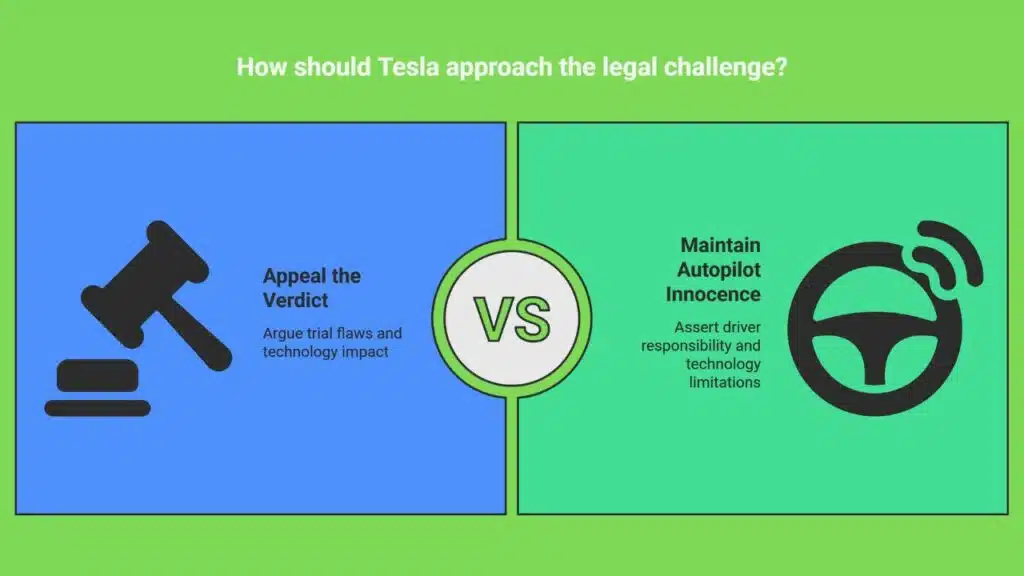
Tesla strongly disagreed with the jury’s decision and has confirmed that it intends to appeal the verdict. The company issued a statement criticizing the legal process, arguing that the trial was flawed due to errors in law and irregularities, and that the verdict could set back the development of safety-enhancing technologies like autonomous driving systems.
Tesla reiterated its belief that Autopilot was not responsible, asserting that McGee’s actions alone—specifically, taking his eyes off the road and pressing the accelerator—led to the crash. Tesla maintains that no car on the market in 2019 or today could have prevented this particular accident.
Why This Verdict Matters for Tesla and the Auto Industry
The ruling carries major implications, not just for Tesla, but for the entire auto industry as it advances towards self-driving technologies. Tesla has over a dozen similar lawsuits pending in courts across the United States, many of which involve fatal or injurious crashes where Autopilot or Tesla’s Full Self-Driving (FSD) system was engaged at the time of impact.
This case marks one of the highest-profile legal challenges Tesla has faced over Autopilot. A verdict of this scale may influence future judgments and put regulatory and legal pressure on Tesla to alter how it markets and deploys its driver-assist systems.
Regulatory Scrutiny from NHTSA
The National Highway Traffic Safety Administration (NHTSA) has been investigating the safety of Tesla’s Autopilot since 2021. The initial probe focused on collisions involving stationary emergency vehicles, like fire trucks and police cars, which Autopilot reportedly failed to detect.
As a result, Tesla issued multiple over-the-air software updates, but in 2024, the NHTSA opened a second investigation. This time, regulators are assessing whether Tesla’s recall remedy was adequate and whether the updates genuinely improved safety around stationary objects and complex traffic scenarios.
The NHTSA also issued warnings about Tesla’s promotional language, particularly on social media, saying it may give drivers the mistaken impression that the vehicles are capable of fully autonomous operation, despite manuals stating that driver attention and control are always required.
Autopilot-Related Deaths Continue to Mount
As public concern grows, watchdog sites such as TeslaDeaths.com have begun tracking Autopilot-related incidents. The site reports at least 58 deaths where Tesla’s Autopilot system was active just before a crash. Some analysts argue that the real number could be significantly higher, especially in cases where Autopilot usage is not disclosed or confirmed.
These data points are adding fuel to debates about autonomous vehicle safety, especially when systems are labeled as “self-driving” but still rely on human oversight.
Impact on Tesla’s Market Performance
Tesla’s stock fell by 1.8% following the verdict, contributing to a broader downward trend for the company. Shares have dropped 25% in 2025 alone, making Tesla the worst performer among major tech companies this year.
Investor concerns are mounting over the company’s legal liabilities, safety concerns, and the slow rollout of its promised robotaxi network. These pressures may force Tesla to reevaluate its Autopilot strategy or increase transparency around its capabilities and limitations.
Looking Ahead: A Precedent for Accountability
This Florida jury verdict sets a strong precedent for holding automakers accountable when advanced driving technologies are involved in fatal crashes. It underscores the legal risks that come with developing and deploying semi-autonomous features without adequate oversight, public education, or built-in usage restrictions.
As more cases move forward and investigations continue, automakers—not just Tesla—will likely be under greater pressure to redesign, rebrand, and reeducate consumers about how to safely use these evolving technologies.
The Information is Collected from CNN and CNBC.






















