

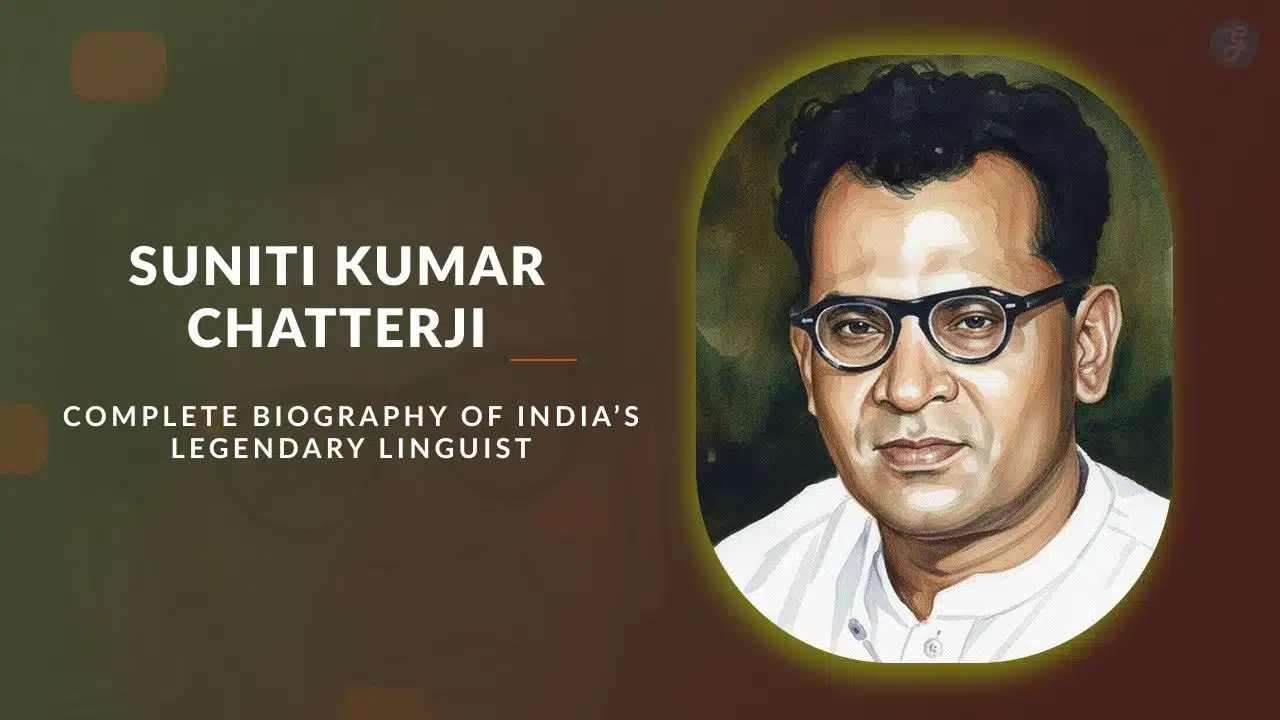
Few scholars have shaped the linguistic understanding of the Indian subcontinent as profoundly as Suniti Kumar Chatterji, also known as Suniti Kumar Chattopadhyay (1890–1977). He was a true polymath: a linguist, philologist, literary critic, cultural historian, and teacher whose work had an impact far beyond Bengal and India.
His monumental works—especially on the origin and development of the Bengali language—cemented his reputation as a global authority in Indo-Aryan linguistics. At a time when modern linguistic science was taking shape, Chatterji bridged Indian and Western scholarship with rare brilliance, offering insights that continue to inform academic discourse today.
This comprehensive biography explores his life, scholarship, and timeless legacy as one of India’s greatest intellectuals.
Early Life and Background
Suniti Kumar Chatterji was born on 26 November 1890 in the village of Shibpur, in the Howrah district of Bengal Presidency (British India). His upbringing took place in a culturally vibrant Bengali household that valued literature, language, and classical learning. His father, a government employee, encouraged academic excellence and fostered an environment in which young Chatterji’s intellectual curiosity could flourish.
Growing up during the Bengal Renaissance—an era of intellectual awakening—exposed him early to literature, philosophy, and debates on identity and culture. This richly stimulating environment influenced his future scholarly pursuits.
| Category | Details |
|---|---|
| Full Name | Suniti Kumar Chatterji |
| Bengali Name | সুনীতি কুমার চট্টোপাধ্যায় |
| Date of Birth | 26 November 1890 |
| Place of Birth | Shibpur, Howrah district, Bengal Presidency, British India |
| Date of Death | 29 May 1977 |
| Place of Death | Kolkata, West Bengal, India |
| Nationality | Indian |
| Field(s) of Expertise | Linguistics, Philology, Phonetics, Indo-Aryan studies, Bengali language, Cultural history, Literary criticism |
| Known For | – Pioneering research on Indo-Aryan languages – Author of Origin and Development of the Bengali Language – Comparative studies on Munda, Mon-Khmer, and Tibeto-Burman languages – President of Sahitya Akademi – National Professor of India |
| Parents | Not widely documented in public academic sources (Father was a government employee) |
| Primary Education | Scottish Church Collegiate School, Kolkata |
| Higher Education (India) | – Scottish Church College, Kolkata – M.A. in English Literature, University of Calcutta |
| Overseas Education | University of London (studied phonetics, general linguistics, and comparative philology) |
| Influential Teachers | Daniel Jones (renowned British phonetician), among others in the European linguistic tradition |
| Academic Positions | – Professor, University of Calcutta – Head of the Department of Comparative Philology |
| Professional Roles | – Linguist – Philologist – Literary critic – Cultural historian – Translator – Educationist |
| Major Publications | – Origin and Development of the Bengali Language (2 vols, 1926) – The Indo-Aryan and Hindi Languages – Bengali Phonetic Reader – Indo-Aryan and Hindi Languages (various editions) – Numerous research papers and essays |
| Research Specializations | – Indo-Aryan historical linguistics – Bengali language evolution – Phonetics and comparative philology – Munda, Mon-Khmer, and Tibeto-Burman languages – South Asian linguistic diversity |
| Awards & Honors | – Padma Bhushan (1955) – National Professor of India (1964) |
| Leadership Roles | – President, Sahitya Akademi (India’s National Academy of Letters) – Member of various academic, linguistic, and cultural committees |
| Languages Known | Bengali, Sanskrit, English, Hindi, several Indo-Aryan languages, and various Asian languages through research (Munda, Mon-Khmer, Tibeto-Burman groups) |
| Academic Influence | Mentor to generations of South Asian linguists; inspired modern linguistic methodologies in India; widely cited internationally |
| Legacy | Considered one of India’s greatest linguists; foundational figure in Bengali linguistic studies; his works remain standard academic references in Indo-Aryan research |
Education and Early Intellectual Growth
Suniti Kumar Chatterji’s intellectual journey began long before he earned global recognition. From an early age, his academic brilliance and insatiable curiosity set him apart, shaping a foundation that would later anchor his pioneering work in linguistics and philology.
Schooling and Early Promise
Chatterji attended Scottish Church Collegiate School and later Scottish Church College, institutions known for their academic rigor. Here, he developed a love for classical literature, linguistics, and comparative studies.
Higher Education in India
He completed his Master’s degree in English literature from the University of Calcutta. Even as a student, his brilliance was unmistakable—he had a strong command over multiple languages, including Sanskrit, Bengali, English, and Hindi.
Advanced Studies in Europe
In 1914, he traveled to the University of London to study phonetics, general linguistics, and comparative philology. He trained under renowned linguists such as Daniel Jones, one of the most influential phoneticians of the 20th century.
His exposure to European scholarship profoundly shaped his methodological and analytical frameworks, equipping him with tools that would later revolutionize the study of Indian languages.
Academic Career in India
Upon returning from Europe, Suniti Kumar Chatterji embarked on an academic career that would redefine linguistic studies in India. His work at the University of Calcutta marked the beginning of a prolific journey as a teacher, researcher, and intellectual leader.
Return to India and Early Career
Upon returning to India, Chatterji joined the University of Calcutta as a professor in the newly established Department of Comparative Philology.
Rise as a Pioneer Linguist
His lectures, research papers, and publications quickly gained recognition, establishing him as a distinguished scholar with multidisciplinary expertise. He was known for blending Western linguistic methods with Indian philological traditions, a rare synthesis in his time.
Mentor and Academic Leader
Chatterji trained several generations of linguists, philologists, and writers. His commitment to education, meticulous research ethos, and mastery over multiple linguistic domains made him one of the most respected academic figures of the 20th century.
Linguistic Contributions: A Scholar Ahead of His Time
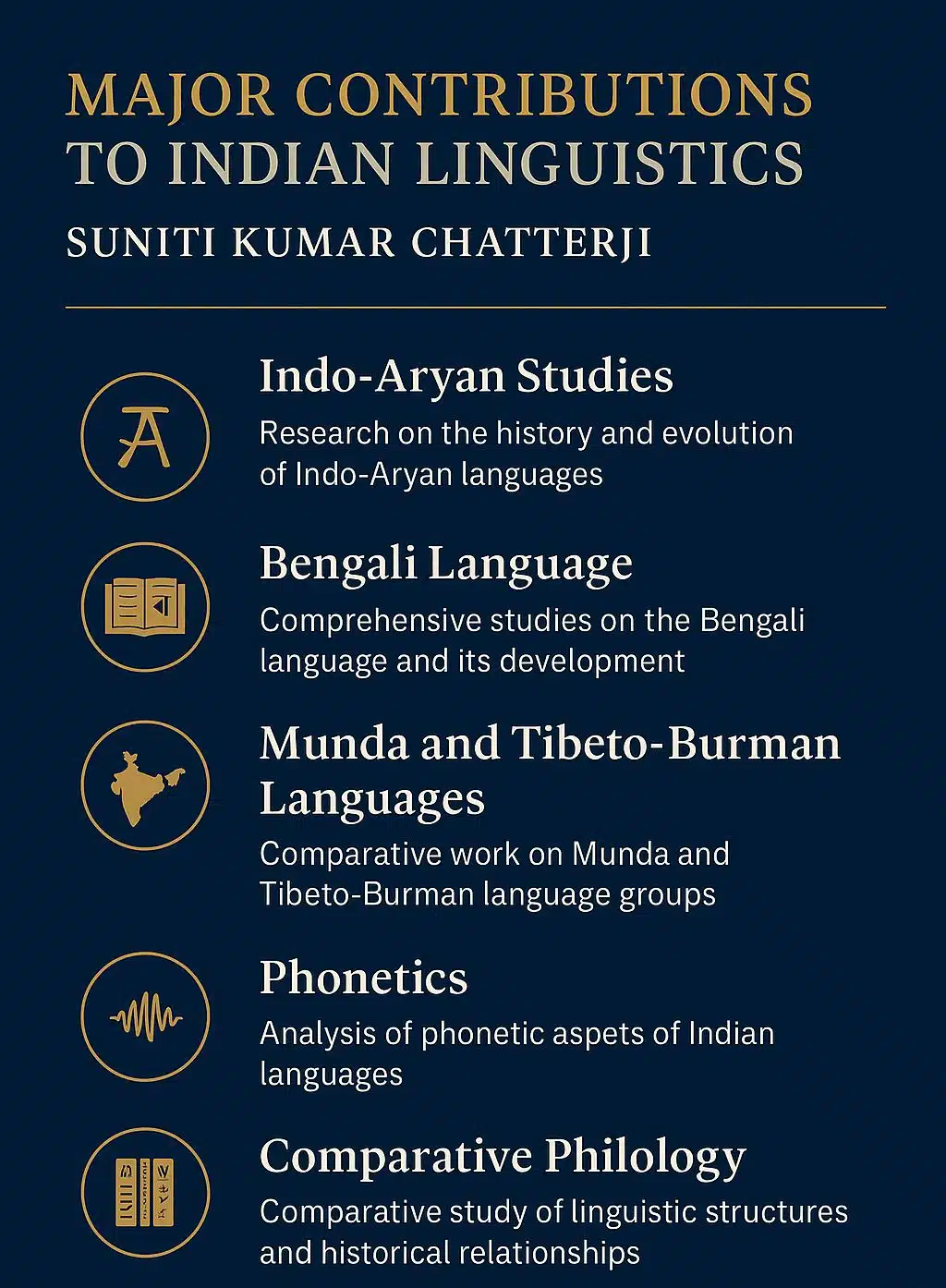
Suniti Kumar Chatterji’s work fundamentally reshaped the field of Indian linguistics.
Work on Indo-Aryan Languages
He provided an authoritative historical account of the evolution of Indo-Aryan languages—from Vedic Sanskrit to modern tongues such as Hindi, Bengali, Assamese, and Odia.
His research clarified the transition from Sanskrit to Prakrit to Apabhramsa to Modern Indo-Aryan, offering detailed phonological and morphological analyses.
Bengali Language Studies (His Magnum Opus)
His most celebrated work, the two-volume “Origin and Development of the Bengali Language” (1926), remains a cornerstone in global linguistic scholarship.
The work:
-
Traces Bengali’s evolution over 1,000+ years
-
Analyzes phonetic and morphological changes
-
Examines its Sanskrit, Prakrit, and local substrate influences
-
Investigates dialects and regional varieties
Linguists worldwide consider it one of the most authoritative studies on any Indo-Aryan language.
Studies on Austroasiatic & Tibeto-Burman Languages
Chatterji conducted pioneering research on:
-
Munda languages (spoken by tribal communities in eastern India)
-
Mon-Khmer languages
-
The Tibeto-Burman languages of Northeast India
His comparative framework highlighted the complexity and diversity of India’s linguistic heritage.
Contributions to Phonetics and Comparative Philology
With training from London, he introduced modern phonetic analysis in India. His research on sound changes, accent systems, and articulatory phonetics influenced later linguistic studies.
Influence on Modern Linguistics
His works remain integral for:
-
Historical linguistics
-
Language reconstruction
-
Dialectology
-
Philology
-
Academic curriculum in Indian universities
His balanced approach—combining hard linguistic science with cultural context—set him apart from contemporaries.
Literary, Cultural & Philosophical Contributions
Beyond his towering reputation as a linguist, Suniti Kumar Chatterji was equally influential in the realms of literature, culture, and philosophy. His writings reveal a mind deeply engaged with India’s civilizational depth, blending scholarly rigor with a humanistic vision.
Literary Criticism
Chatterji was also a distinguished literary thinker. His critical writings explored:
-
Bengali literature and poetry
-
Classical Indian literary traditions
-
Comparative literature
He evaluated literature not just stylistically but through historical and linguistic lenses.
Cultural and Civilizational Thought
Across essays and lectures, Chatterji articulated strong views on India’s composite culture. He believed linguistic diversity was central to Indian civilization and often advocated for cultural unity built on mutual respect.
Translation & Cross-Cultural Work
He translated several classical and modern works, bringing Indian texts to wider audiences and vice versa. His multilingual proficiency made him a bridge between Indian and Western scholarship.
Major Works and Publications
Some of his most notable works include:
Books
-
Origin and Development of the Bengali Language (1926)
-
The Indo-Aryan and Hindi Languages (1921)
-
Indo-Aryan and Hindi Languages
-
Bengali Phonetic Reader
-
Bhasha-Prakash Bengali Primer
Research Papers & Essays
He published extensively in academic journals across India, Europe, and America, contributing to global linguistic discourse.
Institutional Roles
-
Editor of scholarly journals
-
Contributor to language committees
-
Participant in academic conferences from Europe to Southeast Asia
National & International Recognition
Suniti Kumar Chatterji’s innovative research earned him widespread acclaim, both within India and across the world. His contributions to linguistics and cultural studies were recognized by prestigious institutions, solidifying his status as a global intellectual figure.
Awards & Honors
-
Padma Bhushan (1955)—India’s third-highest civilian award
-
National Professor of India (1964)—one of the highest academic titles given by the Government of India
Leadership Roles
-
President of Sahitya Akademi (India’s National Academy of Letters)
-
Chairman and member of linguistic and cultural committees
-
Representative at international linguistic congresses
Global Influence
Foreign scholars studying Indo-Aryan languages frequently cited his work, and he was invited to deliver lectures worldwide. His books were adopted as academic references in universities across Europe and Asia.
Personality, Values & Ideals
Behind Suniti Kumar Chatterji’s scholarly accomplishments stood a personality defined by curiosity, discipline, and humility. His values and ideals shaped not only his academic work but also the generations of students and scholars who looked up to him.
Intellectual Philosophy
Chatterji believed that language was a living entity shaped by culture, history, and human experience. His philosophy emphasized interconnectedness—languages influencing and evolving with one another.
Personal Traits
Peers described him as:
-
Humble
-
Disciplined
-
Intensely curious
-
Multilingual (he mastered more than a dozen languages)
Mentor and Humanist
He inspired countless students and was admired for his clarity of thought, patience, and kindness.
Later Life and Legacy
In the final decades of his life, Suniti Kumar Chatterji remained deeply engaged in scholarship, continuing to write, teach, and contribute to India’s intellectual landscape. His later years showcased his enduring dedication and laid the foundation for a legacy that continues to shape linguistic studies today.
Final Years
Even in his later years, Chatterji remained academically active—writing, speaking, and mentoring.
Passing
He passed away on 29 May 1977, leaving behind a vast body of work and a generation of scholars indebted to his intellectual vision.
Enduring Legacy
His legacy lives on through:
-
University syllabi
-
Linguistic research frameworks
-
Scholarly citations
-
Continued relevance of his insights into Indian culture and language
He is remembered not merely as a linguist but as a civilizational thinker whose scholarship still shapes modern India’s understanding of its linguistic roots.
Why Suniti Kumar Chatterji Still Matters Today
Even decades after his death, Chatterji’s works remain essential reading for linguists, philologists, historians, and cultural scholars. His interdisciplinary approach is now standard in modern humanities research.
His belief in language as a cultural bridge is particularly relevant today, as India continues to celebrate and negotiate its linguistic diversity.
Takeaways
Suniti Kumar Chatterji’s scholarship stands as a monumental achievement in the study of Indian languages and culture. He was not only a pioneering linguist but also a visionary intellectual who understood India’s linguistic diversity with unmatched depth.
His works remain timeless, continuing to guide and inspire scholars across the world. In celebrating his life and contributions, we honor one of India’s greatest minds—an academic giant whose legacy endures through every page he wrote and every idea he championed.
























