

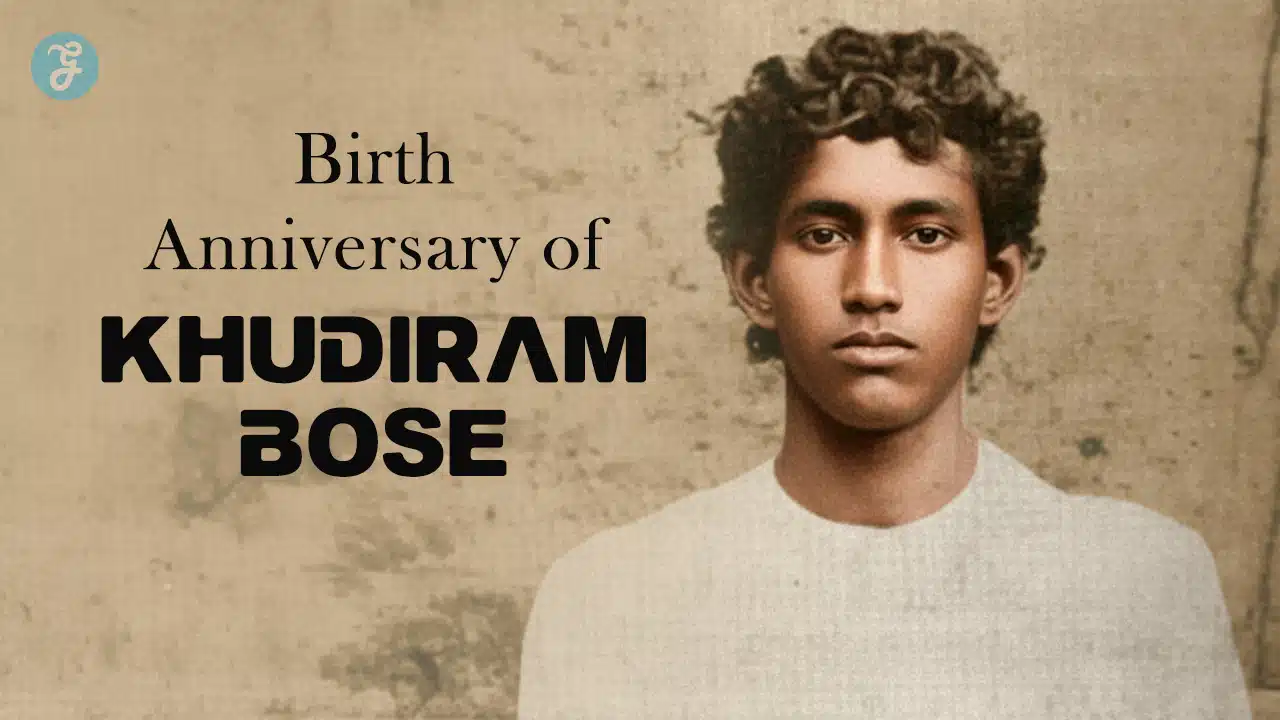
Can you imagine facing a death sentence at just 18 years old and responding with a smile? It sounds impossible, yet that is exactly what one young boy from West Bengal did. While many history books gloss over the details, the story of Khudiram Bose is about much more than just a single act of rebellion.
You might be wondering how a teenager became such a threat to the mighty British Empire. What motivated him to abandon his home and take up arms? The answer lies in a mix of personal tragedy, fierce patriotism, and a fearless spirit that refused to be broken.
Today marks the 136th birth anniversary of Khudiram Bose. We are going to walk through his journey together—from his “stolen” childhood in Midnapore to those final, courageous moments in Muzaffarpur. We will share the little-known details, like the heartbreaking reason behind his name and the “book bomb” plot that failed before he even stepped onto the scene.
Key Takeaways
- A Name Born of Grief: “Khudiram” wasn’t just a name; it meant he was “bought” for three handfuls of rice (khud) by his sister Aparupa Roy to protect him from early death.
- The “Sonar Bangla” Incident: Long before the bombing, a 16-year-old Khudiram famously broke a police constable’s nose while distributing banned pamphlets in Midnapore.
- The Wrong Target: The attack on April 30, 1908, was meant for Magistrate Douglas Kingsford, but the bomb hit the carriage of Mrs. and Miss Kennedy due to a fatal case of mistaken identity.
- A Historic Mistake: Kingsford had actually survived an earlier assassination attempt involving a bomb hidden inside a hollowed-out book, which is why he had been moved to Muzaffarpur for safety.
- The Immortal Smile: Accounts from the Empire newspaper confirm that he walked to the gallows “cheerful and smiling,” a final act of defiance that turned him into a legend.

Early Life of Khudiram Bose
Khudiram Bose wasn’t born into a revolution; he was born into a tragedy that shaped his entire life. Growing up in Mohoboni, West Bengal, he had to grow up fast.
What was the story behind his unique name?
Born on December 3, 1889, into a Bengali Kayastha family, his start in life was marked by loss. His parents, Trailokyanath Bose and Lakshmipriya Devi, had already lost two sons in infancy. When their third son was born, they were terrified the same fate awaited him.
To “cheat” death, they followed a local folk tradition. They symbolically sold the newborn to his eldest sister, Aparupa Roy, for a price of three handfuls of food grains, known locally as “khud.” This is why he was named Khudiram (literally “Rice-Ram”).
Sadly, the ritual couldn’t save his parents. He lost his mother at age five and his father just a year later. It was his sister Aparupa and her husband, Amritalal Roy, who took him in. Amritalal even helped him get into Hamilton High School in Tamluk, hoping for a normal life for the boy. But Khudiram had other plans.
Which revolutionary leaders inspired Khudiram Bose?
By the time he was a teenager, the air in Bengal was thick with rebellion. In 1902 and 1903, heavyweights like Sri Aurobindo and Sister Nivedita visited Midnapore. Their speeches didn’t just inform him; they transformed him.

He soon found his way to the Anushilan Samiti, a fitness club that was actually a front for training revolutionaries. Here, he met mentors like Barindra Kumar Ghosh and Hemchandra Kanungo. They didn’t just teach him politics; they taught him that action spoke louder than words. The Bhagavad Gita became his constant companion, teaching him that fighting against injustice was a spiritual duty, not a crime.
Joining the Freedom Movement
Once he joined the Anushilan Samiti, there was no turning back. Khudiram Bose didn’t just dip his toes into the freedom struggle; he dove in headfirst.
What was his first act of defiance?
Most people know about the Muzaffarpur bombing, but few know about the “Sonar Bangla” incident. In February 1906, an agricultural exhibition was held in Midnapore. It was a British event, but 16-year-old Khudiram turned it into a protest.
He stood at the gates distributing a secret pamphlet titled Sonar Bangla, which exposed British exploitation. When a police constable tried to grab him, Khudiram didn’t run. He struck the officer in the face—breaking his nose—and vanished into the crowd. Although he was later arrested, he was acquitted because of his young age. This was his first taste of victory against the system.
How did he prepare for the big mission?
His bravery caught the eye of the inner circle. He started working closely with Barindra Kumar Ghosh in Calcutta. The group was experimenting with explosives, and Khudiram became a trusted courier. He transported messages and even bomb parts to other freedom fighters like Prafulla Chaki.
He wasn’t just a foot soldier; he was a student of revolution. He learned bomb-making techniques from Hemchandra Kanungo, who had returned from Paris with technical manuals. This training was critical because the group had decided it was time to move from pamphlets to direct action.
The Muzaffarpur Conspiracy Case
The target was Douglas Kingsford, the Chief Presidency Magistrate of Calcutta. Kingsford was infamous for sentencing young freedom fighters to brutal floggings for minor offenses. The revolutionaries had already tried to kill him once with a “book bomb”—a hollowed-out book packed with explosives sent to his home. Kingsford never opened it, but the British got scared and transferred him to the safer district of Muzaffarpur.
They didn’t know that Khudiram Bose and Prafulla Chaki were following him.
The Stakeout
In April 1908, Khudiram and Prafulla arrived in Muzaffarpur under the fake names Haren Sarkar and Dinesh Chandra Roy. They stayed at a local inn and spent three weeks watching the European Club. They needed to know Kingsford’s routine perfectly.
They noted that Kingsford usually played bridge at the club and left in a specific carriage. On the evening of April 30, 1908, they decided to strike.
The Fatal Mistake
Around 8:30 PM, a carriage that looked exactly like Kingsford’s pulled out of the club gate. Khudiram stepped out of the shadows and threw the bomb. The explosion was massive, shattering the carriage instantly.
But Kingsford wasn’t inside.

| The Intended Target | The Actual Victims |
| Douglas Kingsford Known for harsh, unfair sentences against Indians. He was in a different carriage just behind the first one. |
Mrs. & Miss Kennedy The wife and daughter of Pringle Kennedy, a local barrister. Miss Kennedy died within an hour; Mrs. Kennedy died two days later. |
This mistake haunted the revolutionaries. They had wanted to punish a tyrant, not kill two innocent women. The “Muzaffarpur Conspiracy Case” exploded into the headlines, causing a mix of horror and admiration across the country.
Capture and Trial
After the blast, the two boys split up to escape. Khudiram walked for nearly 25 miles barefoot to avoid suspicion. By the next morning, he was exhausted and starving.
The Arrest at Waini Station
He reached a place called Waini Station (now renamed Khudiram Bose Pusa Station) and stopped at a food stall to ask for water and some roasted rice. His disheveled look and dusty feet attracted the attention of two constables, Fateh Singh and Sheo Pershad Singh.
When they searched him, they found two revolvers, ammunition, and a map of the area. He was arrested on the spot. His partner, Prafulla Chaki, was cornered separately at Mokama Ghat and chose to shoot himself rather than be captured. The police later decapitated Prafulla’s body to send the head to Calcutta for identification—a gruesome detail that enraged the public.
The Verdict
The trial began on May 21, 1908, under Judge Cornduff. Despite the efforts of defense lawyers like Kalidas Basu and Narendrakumar Basu, the evidence was overwhelming. On July 13, the death sentence was announced.
The courtroom reaction was legendary. When the Judge passed the sentence, he expected Khudiram to break down. Instead, the 18-year-old smiled. A stunned Judge Cornduff asked if he understood the verdict. Khudiram famously replied that he did, and if given the time, he could teach the Judge how to make a bomb, too.
Execution and Legacy
On the morning of August 11, 1908, crowds gathered outside the jail in Muzaffarpur. People threw flowers and shouted slogans, turning a somber event into a hero’s send-off.
The Final Moments
At 6:00 AM, Khudiram Bose walked to the gallows. He didn’t tremble. Witnesses and the Amrita Bazar Patrika reported that he climbed the steps “cheerful and smiling.” As the noose was tightened, some accounts say his last cry was “Vande Mataram!”—a phrase that the British had tried so hard to silence.
How is he remembered today?
Khudiram’s sacrifice ignited a fire. He became the first of the young revolutionaries to be hanged, making him a martyr for a generation. His legacy is etched into the very map of India today:
- Shahid Khudiram Station: A busy metro station in Kolkata named in his honor.
- Khudiram Bose Pusa Station: The very station where he was captured in Bihar now bears his name.
- Khudiram Bose Memorial Central Jail: The prison in Muzaffarpur where he was executed has been renamed to preserve his memory.
- Education Hubs: The Sahid Khudiram Siksha Prangan (Alipore Campus) at the University of Calcutta ensures students remember his name.
Final Words
Khudiram Bose’s life was short, but it burned with an intensity that changed India forever. He showed the world that age is no barrier to courage and that a single act of defiance can rattle an empire. From the dusty streets of Midnapore to the gallows in Muzaffarpur, his journey wasn’t just about the bomb he threw—it was about the fearlessness he showed.
Today, when you pass by his monuments or hear his name, remember the 18-year-old boy who smiled at death. He proved that you can kill a revolutionary, but you can never kill the revolution.
FAQs on Khudiram Bose
1. Who was Khudiram Bose and what made him a famous freedom fighter?
Born in the small village of Mohobani on December 3, 1889, Khudiram Bose became a legend as one of the youngest revolutionaries to face the gallows at just 18 years old. He joined the Anushilan Samiti and the Jugantar group, dedicating his teenage years to planning bold actions against the British Raj.
2. What happened during the Muzaffarpur conspiracy case involving Khudiram Bose and Prafulla Chaki?
On April 30, 1908, the duo threw a bomb at a carriage opposite the European Club in Muzaffarpur, intending to kill the tyrannical Magistrate Douglas Kingsford. Tragically, the attack killed two innocent women, Mrs. Kennedy and her daughter Grace, leading to Prafulla’s suicide at Mokama Ghat and Khudiram’s arrest.
3. How did Sri Aurobindo, Sister Nivedita, and Barindra Kumar Ghosh connect to Khudiram’s story?
Barindra Kumar Ghosh mentored him at the secret Maniktala Garden House at 32 Muraripukur Road, which served as a training ground for young insurgents. Sister Nivedita was also a key influence, having visited Medinipur as early as 1902 to inspire the local youth with her lectures on national independence.
4. Why did newspapers like Amrita Bazar Patrika cover Khudiram’s trial so closely?
The trial captured the nation’s emotions, with the Amrita Bazar Patrika famously reporting that he “died cheerful and smiling” on the morning of his execution, August 11, 1908. Even Anglo-Indian papers like The Empire were forced to acknowledge his composure, turning the tragic death sentence into a rallying cry for the freedom movement.
5. What is special about places named after Khudiram Bose today?
You can visit lasting tributes to his bravery at the Shahid Khudiram Metro Station in Garia, Kolkata, or the Sahid Khudiram Siksha Prangan university campus.
6. Did any famous leaders speak out for him after his execution?
Bal Gangadhar Tilak risked his own freedom to defend the young revolutionary in his newspaper Kesari, while historian Peter Heehs later documented this fearless spirit in his book The Lives of Sri Aurobindo.





















