


SpaceX’s Starship, the company’s flagship spacecraft, exploded shortly after launch for the second time in 2025, continuing to challenge the company’s ambitious goal of reaching Mars. The failure occurred on March 6, 2025, just minutes into the vehicle’s ascent, leading to significant disruptions on Earth, including flight cancellations and diversions, as well as safety concerns for air traffic.
Details of the Incident: Why Did the SpaceX Starship Explode?
The SpaceX Starship test flight began from the company’s Boca Chica facility in Texas at approximately 6:30 PM local time (2330 GMT). This test flight was part of the company’s ongoing attempts to refine the Starship design and reach milestones necessary for Elon Musk’s goal of sending humans to Mars. The vehicle, which stands at 403 feet (123 meters), is designed to be the largest and most powerful rocket ever built. However, as the rocket ascended, disaster struck.
The rocket’s first stage, which included the booster and several engines, initially performed as expected. After the booster separated, it was intended to fly back to Earth, where it would be caught midair by a crane for reuse. This was in line with SpaceX’s reusable rocket technology that has been successfully demonstrated in the past with Falcon 9 missions.
However, things began to go wrong shortly after the separation. The upper stage of the rocket, which houses the Starship vehicle itself, started experiencing significant technical issues. The engines began to shut down one by one, which led to a loss of control. The Starship, unable to maintain stable flight, began to spin uncontrollably. Moments later, the spacecraft broke up in a fiery explosion.
SpaceX quickly confirmed that the failure occurred during the ascent engine firing, resulting in what was officially described as “a rapid unscheduled disassembly” of the spacecraft. This phrase is SpaceX’s euphemism for the catastrophic failure, underscoring the company’s commitment to investigating and understanding the failure to improve future missions.
The Impact on Air Traffic: A Massive Disruption to Florida’s Airports
While SpaceX may have been prepared for the possibility of a failure in this test flight, the explosion had a significant impact beyond the launch site. The fiery breakup of the Starship caused debris to scatter across a wide area, with some pieces of the rocket raining down on Florida. The Federal Aviation Administration (FAA) acted swiftly to mitigate potential risks to commercial air traffic.
The FAA imposed temporary ground stops on four major Florida airports: Miami, Fort Lauderdale, Orlando, and Palm Beach. This resulted in widespread air travel disruptions, including over 240 flights being delayed. In total, 171 departures were delayed, and 28 flights were diverted due to concerns about the debris from the exploded rocket. This was a major inconvenience for thousands of passengers, many of whom were already on their way to or from Florida, either for vacations or business trips.
Airlines were instructed to hold planes in the air as the FAA’s Debris Response Area (DRA) was active. This meant that 40 flights already airborne were forced to remain in holding patterns for an average of 22 minutes. Passengers on these planes experienced delays, with many expressing frustration as they were kept in the air longer than anticipated.
In one of the more unusual impacts of the incident, a Frontier Airlines flight en route from Punta Cana in the Dominican Republic to Chicago had to turn around mid-flight. Passengers aboard the flight were able to witness the explosion and reported seeing the fiery debris from the Starship breakup. The situation turned into a serious safety concern, prompting the aircraft to return to Punta Cana rather than proceed to Chicago.
According to reports, debris from the explosion posed a significant threat to the Caribbean as well, causing minor damage on the Turks and Caicos Islands. Fortunately, the damage was limited, and no injuries were reported.
This incident, while not causing fatalities or major damage, underscores the challenges of space exploration and the potential risks associated with high-profile space missions. With so many commercial flights in operation, a failure like this has widespread implications, extending far beyond the launch site itself.
SpaceX’s Response: Will Musk Be Able to Overcome These Setbacks?
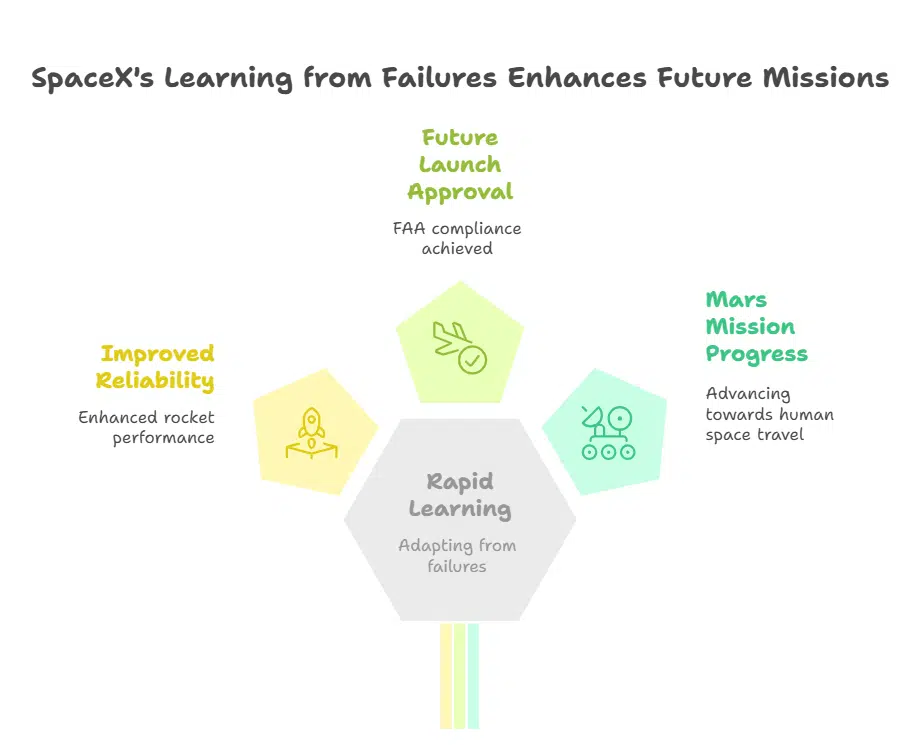
SpaceX’s response to the explosion was prompt, with company officials acknowledging the mishap and noting that lessons learned from this incident would be crucial for future flights. The company’s spokesperson, Dan Huot, remarked during a live stream of the event, “Unfortunately, this happened last time too, so we’ve got some practice now.” This statement reflected SpaceX’s attitude toward failure, one that focuses on rapid learning and adaptation rather than discouragement.
In the aftermath of the explosion, SpaceX committed to investigating the causes of the failure thoroughly. The company’s engineers are expected to analyze the data from the flight to identify the exact reasons for the engine shutdowns and the subsequent loss of control. They are also expected to explore potential fixes to prevent similar failures in the future. SpaceX is required to submit a detailed investigation report to the FAA before receiving approval for any further launches.
Despite the setback, SpaceX remains steadfast in its long-term vision. Elon Musk, who is known for his resilience in the face of challenges, took to social media to downplay the incident, calling it “a minor setback.” He reiterated that the failure was part of the company’s “rapid iterative testing” process and that future tests would continue, with the goal of improving the rocket’s reliability. Musk’s ultimate goal remains sending humans to Mars, a feat that Starship is central to achieving.
Musk has expressed his hope that SpaceX will be able to send humans to Mars by the end of the decade. Starship, which is designed to carry both crew and cargo to deep space destinations, is a cornerstone of this ambitious plan. Although the setbacks are discouraging, Musk’s confidence in the Starship program has not wavered, and he believes the technology will eventually be ready for its intended purpose.
What’s Next for SpaceX and the Starship Program?
This failure is not the end for SpaceX’s Starship program, but rather a part of the learning curve. The company has already demonstrated a capacity for recovering from failures, as seen with the success of the Falcon rockets after multiple test mishaps. SpaceX has indicated that it will continue with further tests, learning from each failure and improving upon the design until the Starship is deemed reliable enough for its mission to Mars.
SpaceX is also expected to submit its investigation findings to the FAA, which will have a critical role in deciding whether to allow future flights. The FAA’s oversight ensures that safety remains a top priority, and SpaceX’s ability to investigate and correct the issues will be essential for future mission approval.
As Musk’s plans for Mars remain ambitious, the public and private sectors continue to monitor SpaceX’s progress. Space exploration is inherently risky, but SpaceX’s rapid approach to testing and adapting remains a crucial factor in its quest to revolutionize space travel and eventually colonize Mars. The company’s ability to overcome setbacks and learn from mistakes will ultimately determine the future success of the Starship program.
For now, the mission that was supposed to be a crucial step toward space exploration has instead marked another challenging chapter in SpaceX’s history. Nonetheless, SpaceX’s resolve to overcome these obstacles and continue testing remains strong, and the dream of interplanetary travel still seems within reach.






















