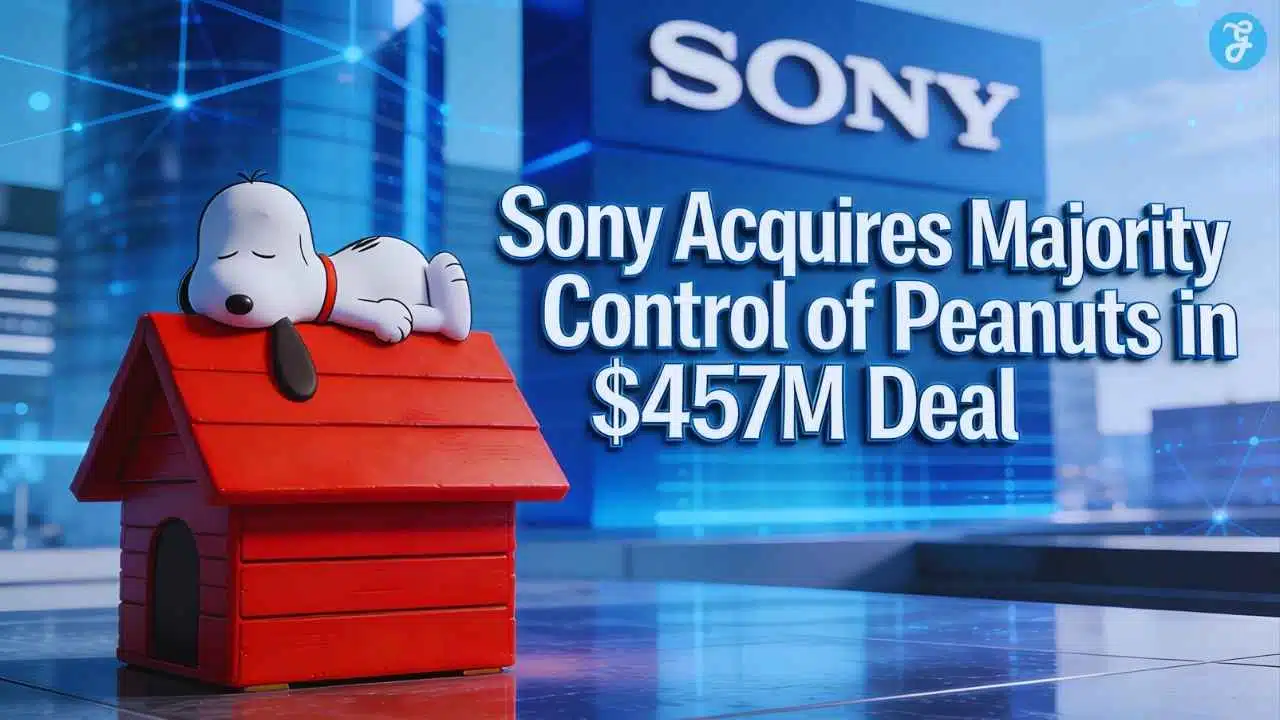
Sony acquires majority control of Peanuts in a cash deal worth C$630 million, buying WildBrain’s 41% stake and lifting Sony’s ownership to 80% while the Schulz family retains 20%.
Deal details: who is buying what, for how much, and when?
Sony Pictures Entertainment and Sony Music Entertainment (Japan) have entered a definitive agreement to purchase Canadian company WildBrain’s 41% stake in Peanuts Holdings LLC, the entity tied to the Peanuts intellectual property (IP). The price is C$630 million in cash (roughly US$457 million based on contemporaneous exchange rates), subject to customary closing adjustments.
The announcement landed in the December 18–19, 2025 window depending on time zone and market, and the transaction is expected to close after standard conditions are met, including regulatory approvals and other customary requirements.
Once the deal closes, the post-transaction ownership structure becomes straightforward:
- Sony: 80%
- Schulz family: 20%
That 20% is the continuing stake held by the family of Peanuts creator Charles M. Schulz, keeping the founding family financially tied to the franchise even as Sony becomes the controlling owner.
Deal snapshot
| Item | Details |
| Buyer | Sony Pictures Entertainment + Sony Music Entertainment (Japan) |
| Seller | WildBrain Ltd. (Canada) |
| Asset | 41% interest in Peanuts Holdings LLC |
| Purchase price | C$630 million cash (approx. US$457 million) |
| Ownership after closing | Sony 80% / Schulz family 20% |
| Status | Signed agreement; closing conditions still apply |
| What does not change immediately | Existing production and licensing relationships are expected to continue under multi-year arrangements |
The “majority control” change matters because it typically gives the controlling owner final say on strategic direction—how aggressively to expand the brand, where to invest in content, how to structure licensing and partnerships, and how to align the franchise with broader entertainment and consumer-products plans.
Why Sony wants Peanuts: an evergreen franchise with global reach?
Peanuts is one of the rare entertainment brands that functions across generations and formats. It started as a newspaper comic strip in 1950 and grew into a global franchise powered by recognizable characters like Charlie Brown, Snoopy, Lucy, and Linus. Over decades, those characters have anchored TV specials, films, books, consumer products, and modern streaming content.
For Sony, acquiring majority control fits a wider industry pattern: large entertainment groups increasingly prioritize “durable” IP—brands that can be refreshed without being reinvented, and that generate revenue through multiple channels at once.
Peanuts is attractive for several practical reasons:
- Cross-generational audience: Parents introduce the brand to children, and long-time fans continue to buy and watch. That reduces the risk of sudden audience drop-off.
- Global licensing strength: Peanuts is not only a screen property; it’s a consumer-products engine. Apparel, accessories, home goods, stationery, seasonal retail, toys, and collaborations can remain active even between major screen releases.
- Content flexibility: Peanuts can succeed as short-form animation, holiday specials, streaming series, and event programming, with a tone that suits family viewing.
- Brand safety: Compared with many franchises, Peanuts has a broadly “family-safe” identity that is easier to place with mainstream retailers and partners.
Majority control also helps Sony coordinate Peanuts across its own divisions and partner network. Even without changing any creative approach, control can simplify approvals, speed up negotiations, and allow more unified planning across territories and product lines.
This acquisition is also the latest step in a multi-year ownership journey. Sony first became a major Peanuts shareholder in 2018, when it purchased a large portion of then-owner DHX Media’s stake. That earlier transaction created the long-standing split in which DHX (later rebranded as WildBrain) held 41%, Sony held 39%, and the Schulz family held 20%. The new transaction essentially “finishes the arc” by transferring the remaining WildBrain stake to Sony.
Ownership timeline at a glance
| Year | Milestone | Ownership impact |
| 2017 | DHX Media acquires a majority stake in Peanuts | DHX becomes the main corporate owner |
| 2018 | Sony buys a large portion of DHX’s Peanuts interest | DHX 41% / Sony 39% / Schulz family 20% |
| 2025 | Sony buys WildBrain’s remaining 41% stake | Sony 80% / Schulz family 20% |
What WildBrain gets out of the sale: balance-sheet reset and a narrower focus?
WildBrain is not presenting this transaction as a retreat from Peanuts as much as a financial and strategic pivot. The company has described the sale proceeds as a way to significantly reshape its balance sheet—specifically by paying down debt and reducing ongoing interest costs.
WildBrain has said the net proceeds are expected to:
- fully repay its Senior Secured Credit Facility, effectively removing that debt,
- leave more than $40 million in cash surplus after repayment (based on WildBrain’s own expectations and after allowing for adjustments),
- Generate around $50 million in annual interest savings once the debt is removed.
Those figures matter because entertainment businesses often carry debt while they invest in content and acquisitions. When interest costs are high, it can pressure budgets, reduce flexibility, and constrain long-term planning. If WildBrain removes a major layer of debt, it can reallocate resources toward areas it fully owns and controls.
WildBrain has also emphasized that it plans to reinvest in:
- wholly owned or tightly controlled brands (such as other family and kids franchises),
- digital distribution and advertising (including large video platforms),
- and technology and operational efficiency initiatives.
Just as important: WildBrain is not exiting the Peanuts ecosystem operationally. It expects to remain a key partner under multi-year arrangements, which allows WildBrain to keep business lines tied to Peanuts—like production services and licensing representation in certain regions—without having its capital tied up as an equity owner.
Key financial metrics WildBrain has highlighted for Peanuts (Fiscal 2025)
| Measure | WildBrain-reported figure (Fiscal 2025) |
| EBITDA attributable to WildBrain’s 41% equity stake | $27 million |
| “Recognized EBITDA” including consolidation benefits | $43 million |
| Expected annual interest savings after repayment | ~ $50 million |
| Expected cash remaining after debt repayment | $40 million+ |
In plain terms: WildBrain is trading future upside from equity ownership for immediate cash, debt elimination, and continued service-based participation in Peanuts going forward.
What this means for Peanuts content, licensing, and fans?
For audiences, the key point is that this deal is not framed as a disruption to Peanuts’ current production pipeline. WildBrain is expected to continue in operational roles that already support the brand, while Sony becomes the controlling owner.
The most significant areas to watch are content production, distribution, and licensing.
Content production continuity
WildBrain has been deeply involved in producing Peanuts animation in the modern era. Under the post-deal structure described by the companies, WildBrain is expected to remain the exclusive production studio for new Peanuts animated content for a multi-year period. That includes development already underway, and it supports continuity in creative execution and production operations.
In recent years, Peanuts has also been active on streaming, with newer specials and programming developed for modern platforms—helping the franchise stay visible beyond the classic holiday cycle.
Licensing and consumer products: what “exclusive agent” really means
Peanuts is a major global licensing business. Licensing is the system where the IP owner (or its agent) authorizes third parties to manufacture and sell products that feature the characters—often in exchange for royalty payments.
WildBrain’s licensing arm, WildBrain CPLG, has been heavily involved in representing Peanuts in multiple international markets. Under the ongoing relationship described around the deal, WildBrain CPLG is expected to continue acting as the exclusive licensing agent in certain regions, which may include parts of Europe, the Middle East, and segments of Asia, with territory definitions carved out by the parties. The practical impact is that retailers and consumer-product partners in those territories may keep working with the same licensing representatives, even as Sony becomes the majority owner.
What could change over time?
Even if day-to-day operations stay stable, majority ownership can shift strategy in subtle but important ways:
- Global coordination: Sony may push for tighter consistency across product lines, partnerships, and regional campaigns.
- New content cadence: Sony could invest more in a predictable schedule of specials, series, or events to keep the brand “always on.”
- Bigger partnerships: Major owners often pursue larger cross-industry collaborations (retail capsules, experiential pop-ups, gaming tie-ins, or special events) because they can approve and execute faster.
None of those outcomes are guaranteed, and the companies have not promised specific new initiatives beyond confirming the ownership change and ongoing partnership roles. But majority control typically makes expansion easier to pursue if Sony chooses.
Why timing matters: Peanuts’ milestone year?
Peanuts marked its 75th anniversary in 2025, a milestone that tends to energize licensing activity, special-edition product drops, and promotional campaigns. Anniversary cycles often function like a spotlight moment—brands use them to reach new audiences and to give long-time fans a reason to re-engage.
That context helps explain why both sides might see a 2025 ownership change as a logical pivot point:
- Sony gets control at a moment when attention and commercial momentum are naturally elevated.
- WildBrain crystallizes value and reduces debt at a moment when it can point to strong brand performance.
What happens next and what to watch?
The transaction is signed but not yet fully complete, because it still requires closing steps such as regulatory approvals and customary conditions. Once it closes, Sony will hold an 80% controlling stake and the Schulz family will continue with 20%.
For readers tracking what comes next, these are the most concrete watch points:
- Closing confirmation: A formal notice that approvals and closing conditions have been met.
- Operational details: Any additional clarity on how long WildBrain’s production and licensing roles will run and how territories are defined.
- Content roadmap: Whether new Peanuts projects are announced under Sony’s majority ownership, and how frequently new specials or series arrive.
- Licensing expansion: Whether Sony prioritizes new partnerships in categories like apparel, home, collectibles, and family experiences—especially in fast-growing international markets.
For the broader entertainment industry, the deal reinforces a clear trend: major media groups are willing to pay premium prices for iconic, global, “evergreen” franchises—particularly those that generate revenue from both screens and store shelves.