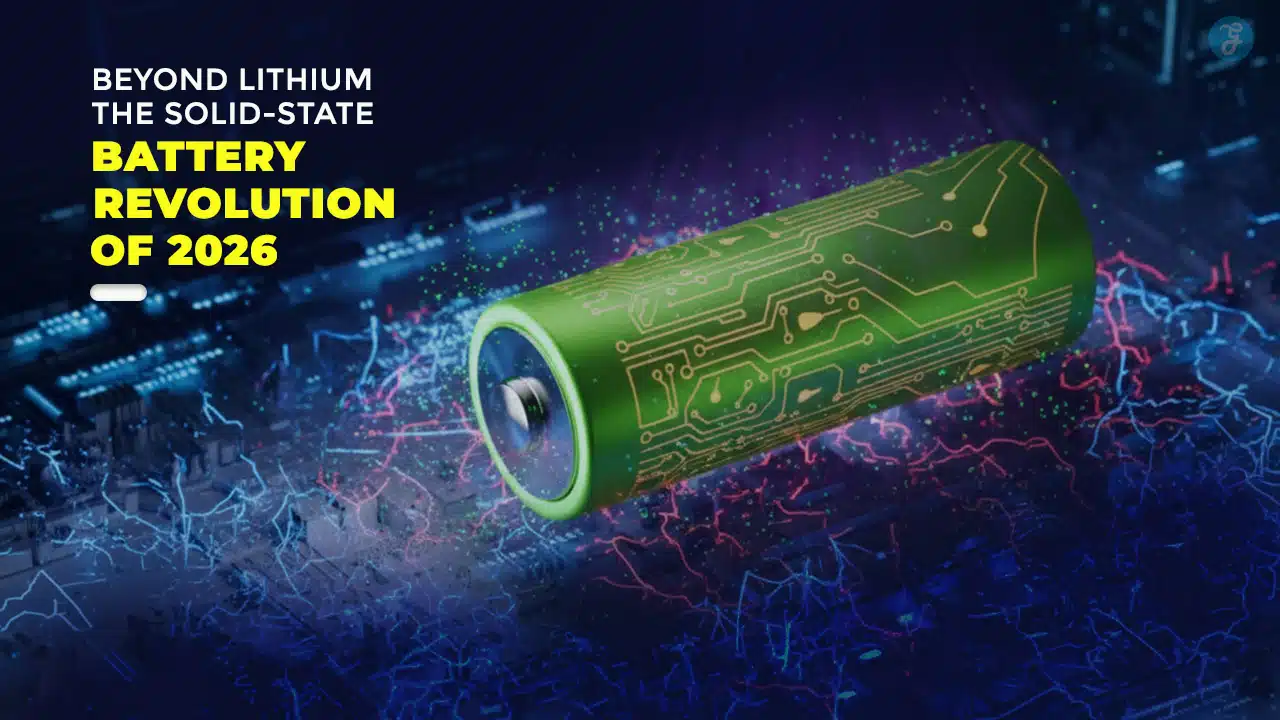
For over a decade, the promise of the solid-state battery has been the Holy Grail of the electric vehicle industry: double the range, half the charging time, and zero fire risk. But while the last few years were defined by hype and prototypes, 2026 is the year of commercial reality. From the showroom floors of CES to the test tracks of Munich, the shift from liquid to solid electrolytes is reshaping the energy landscape.
This isn’t just an upgrade; it is a fundamental chemistry shift moving the world “Beyond Lithium-Ion.”
Key Takeaways
- Commercial Debut: The first production vehicles with solid-state batteries (like the Verge TS Pro motorcycle) are delivering to customers in Q1 2026.
- The “Big Three” Benefits: SSBs offer 2x energy density, 5-minute charging, and near-zero fire risk compared to traditional lithium-ion.
- The Leaders: While startups like Donut Lab are shipping niche products now, giants like Toyota and Volkswagen have accelerated mass-market timelines to 2027–2028.
- Beyond Lithium: New 2026 breakthroughs in Solid-State Sodium batteries are paving the way for cheaper, sustainable energy storage without critical mineral reliance.
Why the World Is Moving Beyond Lithium-Ion Batteries
The lithium-ion battery has powered the modern world since Sony commercialized it in 1991. However, as we push for mass EV adoption and grid-scale renewables in 2026, the technology has hit a hard physical ceiling.
Limitations of Lithium-Ion Technology
- Energy Density Ceiling: Traditional liquid-electrolyte batteries are maxing out around 280–300 Wh/kg. To get more range, you currently have to make the battery heavier, which kills efficiency.
- Fire and Thermal Runaway: The liquid electrolyte inside current batteries is a volatile, flammable solvent.2 If the separator fails (due to a crash or defect), the battery catches fire. This safety risk requires heavy, expensive cooling systems that add “dead weight” to EVs.
- Charging Speed Constraints: Fast charging generates heat and can cause lithium plating (dendrites) in liquid cells. This limits how fast we can charge without destroying the battery’s lifespan.
- Material Scarcity: Reliance on cobalt and nickel has created supply chain bottlenecks and ethical concerns that solid-state chemistries aim to solve.
Rising Global Demand for Better Energy Storage
The pressure isn’t just coming from drivers wanting more range.
- EV Adoption: Governments in the EU and parts of Asia are enforcing stricter zero-emission mandates for 2030, requiring cheaper, lighter batteries.
- Renewable Storage: As solar and wind capacity explodes in 2026, the grid needs batteries that are safe enough to sit in residential basements without fire suppression systems.
- Consumer Tech: From AR glasses to drones, next-gen devices need power sources that are smaller and safer than lithium-ion.
What Are Solid-State Batteries?
At its core, a solid-state battery is exactly what it sounds like: a battery where the liquid inside is replaced by a solid.
Solid Electrolyte vs. Liquid Electrolyte
In a traditional Lithium-Ion battery, ions move from the cathode to the anode through a liquid electrolyte solution.3 This liquid is effective but heavy and flammable.
In a Solid-State Battery (SSB), that liquid is replaced by a solid electrolyte made of ceramic, glass, or sulfide.4 This solid material acts as both the highway for ions and the physical barrier separating the positive and negative sides.
How Solid-State Batteries Store and Release Energy
- Charging: When you plug in, lithium ions travel through the solid electrolyte to the anode. Because the electrolyte is solid, we can strip away the graphite anode used in old batteries and use pure lithium metal.
- Storage: Lithium metal holds far more energy in a smaller space than graphite-hosted lithium.
- Discharging: When driving, the ions travel back through the solid layer to the cathode, releasing power.
Why Solid-State Batteries Are a Game Changer
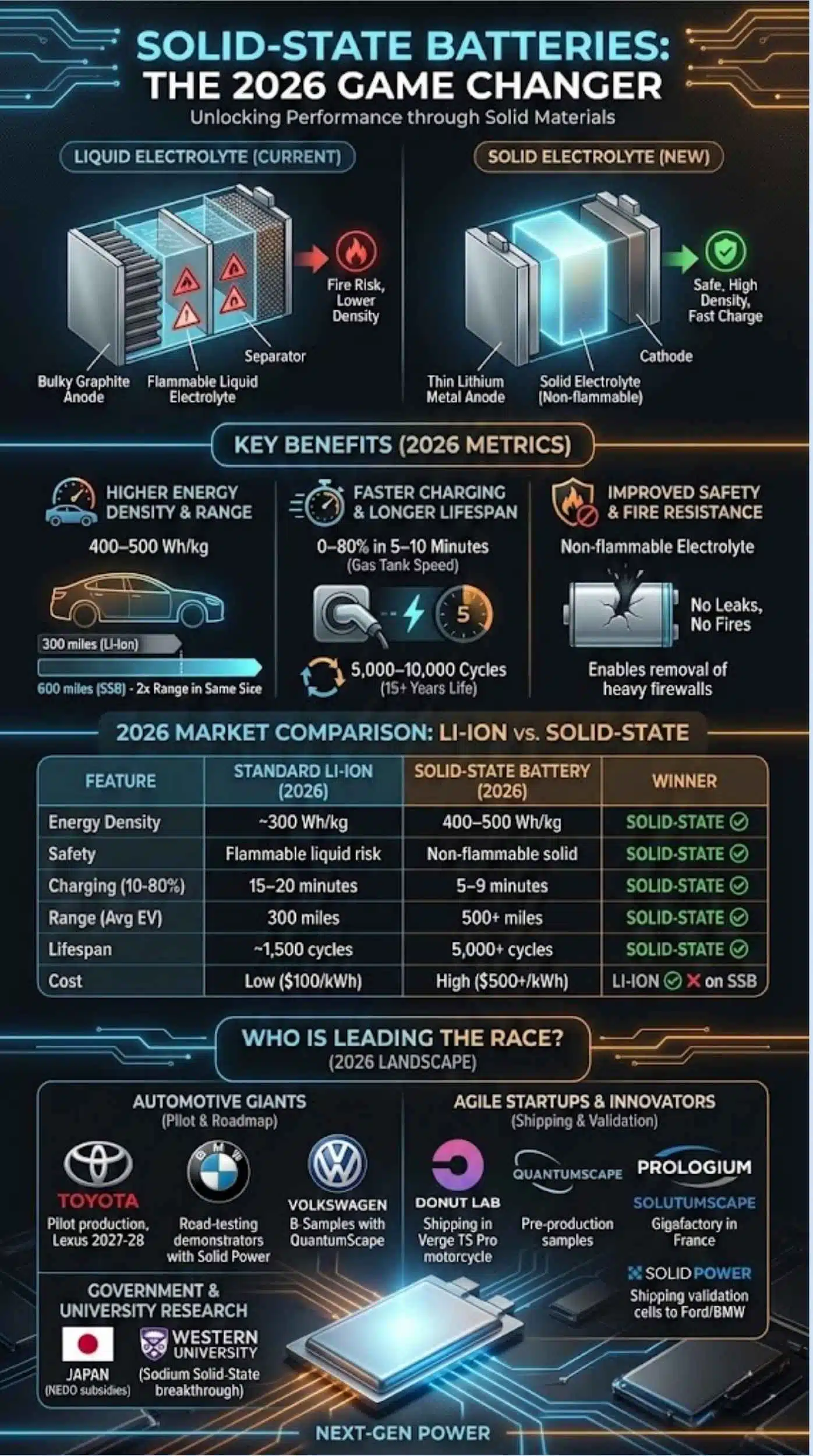
The shift to solid electrolytes unlocks performance metrics that were physically impossible with liquids.
Higher Energy Density and Longer Range
By eliminating the bulky graphite anode and the heavy safety equipment required for liquid cooling, SSBs can achieve energy densities of 400–500 Wh/kg in 2026.
- Real-World Impact: An electric sedan that used to go 300 miles can now go 600 miles on a battery of the same physical size.
Faster Charging and Longer Lifespan
Solid electrolytes are more resistant to heat and degradation.
- Speed: You can blast the battery with current without overheating it. Companies like Donut Lab are demonstrating 0–80% charges in 5–10 minutes—comparable to filling a gas tank.
- Life: Early 2026 data suggests these batteries can survive 5,000 to 10,000 cycles, potentially lasting the entire life of the vehicle (15+ years).
Improved Safety and Fire Resistance
This is the most critical selling point for manufacturers.
- No Leaks: There is no toxic liquid to spill in a crash.
- No Fires: Even if punctured or shot, a true solid-state battery does not catch fire because the electrolyte is non-flammable.12 This allows automakers to remove heavy steel firewalls from EV chassis.
Solid-State Batteries vs. Lithium-Ion Batteries
How do the two technologies compare in the 2026 market?
| Feature | Standard Lithium-Ion (2026) | Solid-State Battery (2026) | The Winner |
| Energy Density | ~300 Wh/kg | 400–500 Wh/kg | Solid-State |
| Safety | Flammable liquid risk | Non-flammable solid | Solid-State |
| Charging (10-80%) | 15–20 minutes | 5–9 minutes | Solid-State |
| Range (Avg EV) | 300 miles | 500+ miles | Solid-State |
| Lifespan | ~1,500 cycles | 5,000+ cycles | Solid-State |
| Cost | Low ($100/kWh) | High ($500+/kWh) | Lithium-Ion |
Who Is Leading the Solid-State Battery Race in 2026?
The race to commercialization has split into two tracks: the massive automotive OEMs planning for 2028, and the agile startups shipping products in 2026.
Automotive Giants
- Toyota: Holding the world’s largest patent portfolio for solid-state tech. In 2026, they have begun pilot production with a roadmap to launch a mass-market Lexus model by 2027-2028.
- BMW: Working closely with Solid Power, BMW is currently road-testing demonstrator vehicles with solid-state cells in Germany.
- Volkswagen: Through its partnership with QuantumScape, VW has received “B-Sample” cells in 2026, a critical step before mass production for brands like Porsche and Audi.
Battery Startups and Innovators
- Donut Lab: The breakout star of 2026. They are the first to ship a production-ready solid-state battery in the Verge TS Pro motorcycle, proving the tech works in the real world.
- QuantumScape: The US-based leader has moved from lab prototypes to pre-production samples, targeting the automotive sector.
- ProLogium: This Taiwanese firm is aggressively targeting the consumer electronics and luxury EV market, with a gigafactory opening in France.
- Solid Power: Focusing on sulfide-based electrolytes, they are shipping validation cells to Ford and BMW.
Government and University Research
- Japan: The government’s NEDO organization continues to heavily subsidize the supply chain for solid electrolytes.
- Western University (Canada): Made headlines in 2026 for breakthroughs in Sodium Solid-State batteries, a cheaper alternative to lithium.
Real-World Applications of Solid-State Batteries
In 2026, SSBs are moving out of the lab and into specific high-value use cases.
Electric Vehicles (EVs)
This is the primary driver. The first applications are in “Halo Vehicles”—expensive, high-performance cars and motorcycles where the high cost of the battery is justified by the performance. The Verge TS Pro is the prime example, offering 370 miles of range in a motorcycle form factor.
- Cold Weather: SSBs perform significantly better in freezing temps (-30°C) than liquid batteries, solving a major pain point for Nordic and Canadian drivers.
Consumer Electronics
Because SSBs are safer and thinner, they are ideal for:
- Wearables: Smartwatches and AR glasses that need to be light and sit against the skin without heat risks.
- Medical Devices: Pacemakers and implants where battery leakage is not an option.
Grid Storage and Renewable Energy
While currently too expensive for massive grid use, the safety profile of SSBs makes them attractive for residential storage (e.g., Tesla Powerwall successors) where homeowners want non-flammable batteries in their garages.
Challenges and Limitations Still Facing Solid-State Batteries
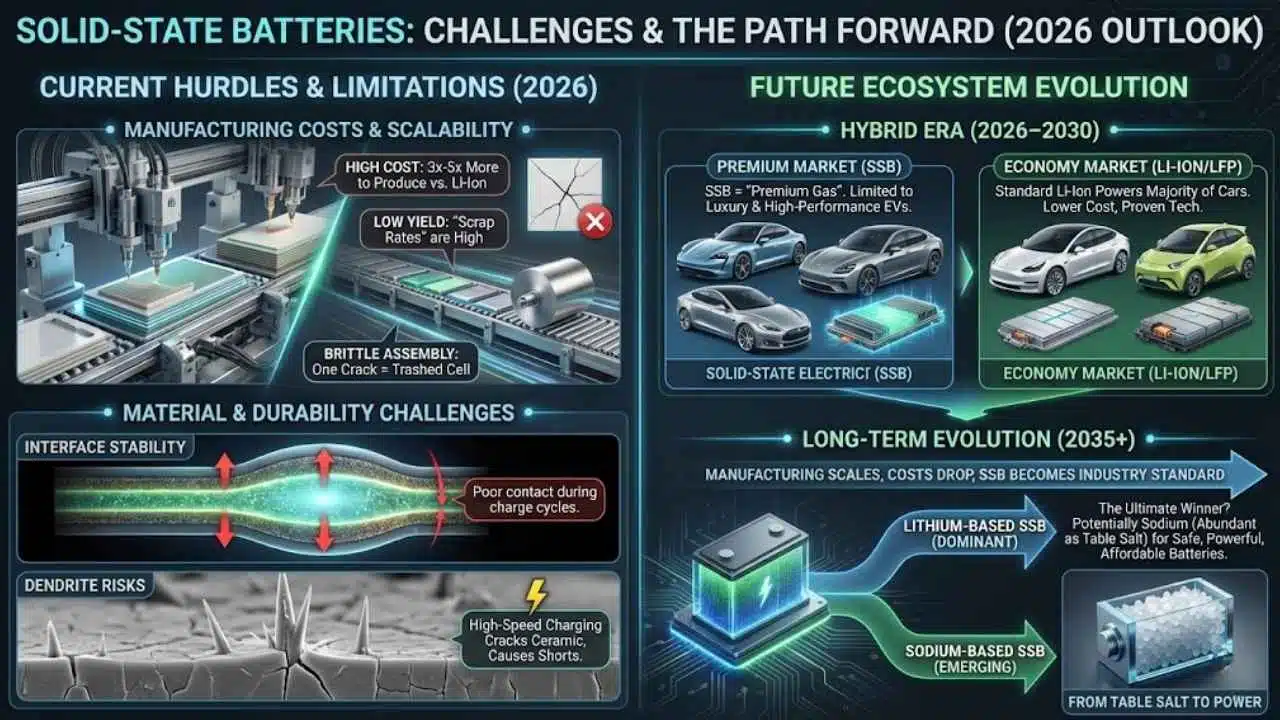
Despite the 2026 breakthroughs, hurdles remain before this tech is in every $25,000 sedan.
Manufacturing Costs and Scalability
Making a solid-state battery is like printing a ceramic plate; it is brittle and difficult to manufacture at the speed of newsprint (which is how liquid batteries are made).
- The Cost: In 2026, SSBs still cost 3x-5x more to produce than lithium-ion.
- Yield Rates: Factories are struggling to keep “scrap rates” low. If one layer of the solid electrolyte cracks during assembly, the whole cell is trash.
Material and Durability Challenges
- Interface Stability: Keeping the solid electrolyte in perfect contact with the electrodes as the battery swells and shrinks during charging is a major engineering challenge.
- Dendrites: While solid electrolytes resist dendrites (lithium spikes), they aren’t immune. At high charging speeds, lithium can still sometimes crack the ceramic, causing shorts.
Will Solid-State Batteries Replace Lithium-Ion Completely?
Short-Term (2026–2030) Outlook
No. We are entering a “Hybrid Era.”
For the rest of the 2020s, solid-state batteries will be the “Premium” option (like premium gas). You will see them in luxury cars (Porsche, Lexus, Mercedes). Meanwhile, standard Lithium-Ion (and cheaper LFP batteries) will continue to power the vast majority of economy cars (Tesla Model 3, BYD Seagull).
Long-Term Battery Ecosystem Evolution
By 2035, as manufacturing scales and costs drop, solid-state technology is expected to become the industry standard.
However, the ultimate winner might not even be lithium-based. The rise of Solid-State Sodium batteries suggests a future where our batteries are not only safe and powerful but made from materials as common as table salt.
Final Thoughts
The Solid-State Battery Revolution of 2026 is real, but it is uneven. It is here for the motorcycle rider willing to pay for a Verge TS Pro, and it is here for the test pilots of the Dodge Charger Daytona. For the rest of us, the significance of 2026 is proof of concept. The question is no longer if the physics works, but how fast the factories can be built. The era of the “forever battery” has officially begun.
We are witnessing the most significant shift in energy storage since the 1990s. While lithium-ion will remain the workhorse of the economy car for the next decade, the “flagship” experience has fundamentally changed. If you are looking at the cutting edge of automotive or tech in 2026, look for the solid-state label—it is the new gold standard for performance, safety, and longevity.