

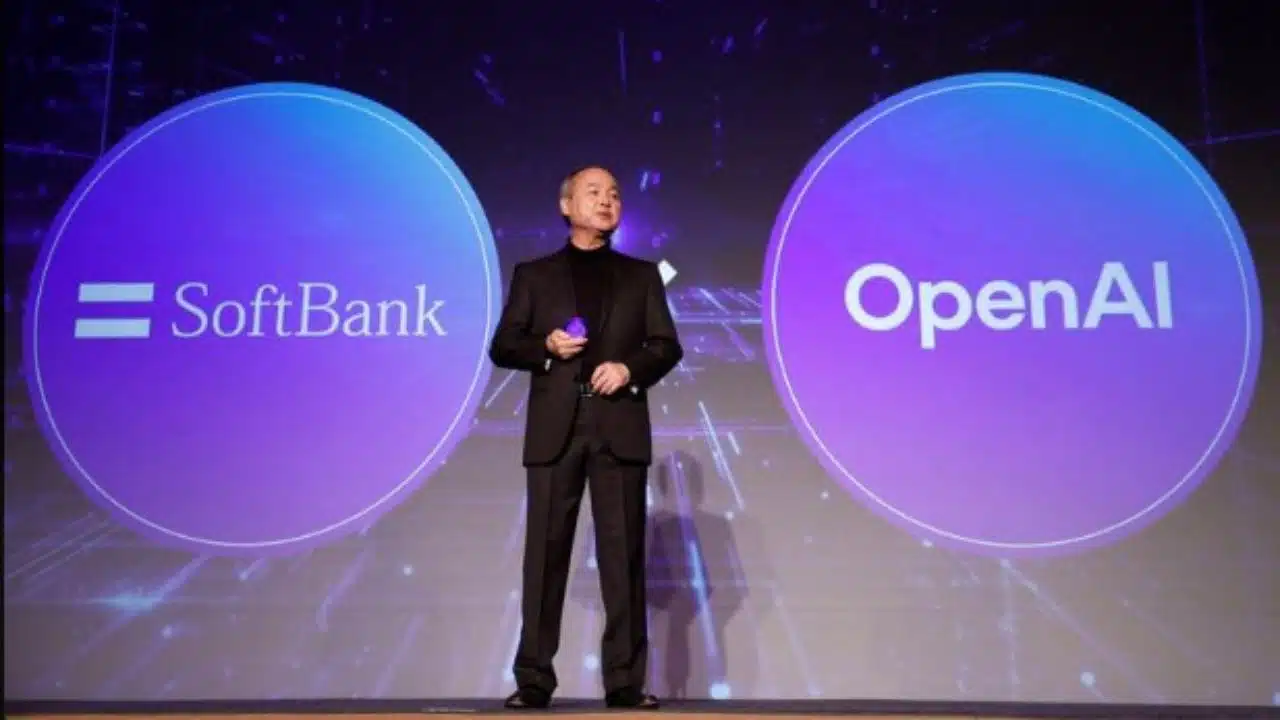
Japanese tech conglomerate SoftBank has finalized its landmark $40 billion investment in OpenAI, marking one of the largest private technology funding deals in history. The completion, announced on December 30, 2025, solidifies SoftBank’s position as OpenAI’s largest investor and accelerates the Stargate AI infrastructure initiative.
Investment Structure and Timeline
SoftBank Group Corp. first announced its commitment to invest up to $40 billion in OpenAI in March 2025, with the deal initially valuing the ChatGPT maker at approximately $300 billion on a post-money basis. The investment was structured in multiple tranches, beginning with $10 billion disbursed in mid-April 2025, followed by an additional $8 billion, and concluded with the final payment of approximately $22 billion to $22.5 billion delivered in late December 2025.
The Japanese investment giant syndicated $10 billion to co-investors, including Microsoft, Coatue Management, Altimeter Capital, and Thrive Capital, while maintaining the majority stake itself. According to sources familiar with the matter, SoftBank now holds more than 10% ownership in OpenAI, surpassing Microsoft as the company’s largest investor.
Financial Details and Valuation Milestones
The investment agreement carried specific conditions tied to OpenAI’s corporate restructuring. SoftBank stipulated that its total commitment could be reduced to as little as $20 billion if OpenAI failed to transition into a for-profit organization by December 31, 2025. OpenAI successfully completed this restructuring in October 2025, splitting the AI lab into a for-profit corporation nested inside a non-profit foundation.
| Investment Milestone | Amount | Date | Valuation |
| Initial announcement | $40B total | March 2025 | $300B post-money |
| First tranche | $10B | April 2025 | $300B |
| For-profit restructuring completion | — | October 2025 | $500B |
| Final payment | $22-22.5B | December 2025 | $500B |
The company’s valuation surged dramatically throughout 2025, reaching approximately $500 billion following a secondary stock sale completed in October 2025, according to data from financial platform Pitchbook.
Stargate Project and AI Infrastructure Expansion
A significant portion of the SoftBank investment supports OpenAI’s involvement in the Stargate Project, a collaborative $500 billion initiative unveiled by President Donald Trump in January 2025. The project brings together SoftBank, OpenAI, Oracle, and other technology partners to build massive AI data center infrastructure across the United States.
SoftBank CEO Masayoshi Son chairs the Stargate initiative, with SoftBank holding financial responsibility while OpenAI manages operational oversight. In September 2025, the partners announced plans for five new artificial intelligence data centers, significantly expanding Stargate’s planned capacity to nearly 7 gigawatts—equivalent to the output of seven large nuclear reactors.
The initial $100 billion commitment is expected to scale to $500 billion over the next four years, creating an estimated 25,000 construction jobs at the data center sites. The first major facility in Abilene, Texas, began construction in April 2025 and is projected for completion by mid-2026.
Masayoshi Son’s AI Vision and Strategy
For SoftBank founder Masayoshi Son, the OpenAI investment represents the culmination of a long-term vision centered on artificial intelligence. Son has publicly stated his belief that artificial superintelligence (ASI)—intelligence surpassing human capabilities by 10,000 times—will emerge within the next decade.
Son’s AI strategy extends beyond OpenAI, encompassing multiple investments and acquisitions designed to position SoftBank at the center of the AI revolution. The company announced on December 30, 2025, its agreement to acquire data center and digital infrastructure assets from investment firm DigitalBridge for approximately $4 billion, further strengthening its AI infrastructure capabilities.
The OpenAI investment also leverages SoftBank’s ownership of Arm, the chip design company whose architecture powers billions of devices worldwide. This vertical integration strategy aims to span the entire AI stack, from silicon design to model deployment, creating synergies across SoftBank’s portfolio.
Funding Mechanics and Financial Strategy
To fund the initial $10 billion payment, SoftBank utilized loans from Mizuho Bank and other financial institutions. This aggressive capitalization strategy underscores the strategic importance Masayoshi Son places on securing dominant position in AI infrastructure.
The investment differs markedly from SoftBank’s past mega-bets on companies like WeWork or Sprint, which focused on software and services. The OpenAI commitment represents a wager on the physical means of production for artificial intelligence itself, positioning SoftBank to benefit from the surging global demand for AI compute power and infrastructure.
OpenAI’s Growth and Usage Metrics
The funding enables OpenAI to push the frontiers of AI research, scale computational infrastructure, and deliver increasingly powerful tools for its massive user base. OpenAI reported that approximately 500 million people use ChatGPT every week, highlighting the platform’s remarkable adoption and the computational demands required to serve this global audience.
The company plans to utilize the new capital to advance AI research boundaries and enhance its computational infrastructure, with approximately $18 billion projected to support OpenAI’s involvement in Stargate.
Corporate Restructuring and Regulatory Approval
OpenAI’s successful transition to a for-profit structure proved crucial to securing the full SoftBank investment. The restructuring, completed in October 2025, established OpenAI Group as a public benefit corporation with the non-profit OpenAI Foundation maintaining legal control and appointing the board of directors.
Under the new structure, Microsoft received approximately 27% stake in the for-profit corporation, valued at over $100 billion based on the $500 billion company valuation. The restructuring followed nearly a year of constructive dialogue with officials from Delaware and California, where OpenAI is registered and headquartered, respectively.
Final Thoughts
SoftBank’s completed $40 billion investment in OpenAI represents a watershed moment in private technology funding and signals the massive capital requirements for advancing artificial intelligence capabilities. The deal positions SoftBank as the dominant financial backer of the world’s leading AI research company while simultaneously advancing the Stargate Project’s ambitious infrastructure buildout. As AI compute demands continue escalating and competition intensifies among technology giants, this partnership establishes a framework for how next-generation AI development will be financed and deployed at scale. The success of this investment will largely depend on OpenAI’s ability to maintain its technological leadership, commercialize its innovations effectively, and justify the extraordinary valuations placed on the company throughout 2025.





















