


Singapore has secured a remarkable position in The Economist’s latest global wealth rankings, emerging as the second-richest nation in the world in terms of GDP per capita at market exchange rates.
The 2024 assessment, which analyzed 178 countries and territories, shows that the city-state’s per-person economic output far surpasses that of its Southeast Asian neighbors and rivals many advanced economies worldwide.
GDP Per Capita: How Singapore Measures Up Globally
The Economist’s data places Singapore’s GDP per person at approximately US $90,700 in 2024 when calculated at market exchange rates. This puts it second only to Switzerland, which holds the top spot at around US $100,000 per person. In third place globally is Norway, with roughly US $86,800 per capita GDP.
These figures reflect the total value of all goods and services produced in the country divided by its population. Because Singapore has a relatively small population — about 5.9 million people — combined with its position as a major financial hub, its GDP per capita is significantly elevated compared to larger economies.
Regional Context: A Clear Southeast Asian Leader
Within Southeast Asia, no other country comes close to Singapore’s economic performance on this measure.
| Country | GDP per Capita (USD, 2024 est.) | Global Position (approx.) |
| Singapore | $90,700 | 2nd |
| Brunei | $33,400 | ~30th |
| Malaysia | $11,900 | ~80th |
| Thailand | $7,800 | ~100th |
| Indonesia | $5,700 | ~110th |
| Vietnam | $4,720 | ~120th |
| Cambodia | $2,000 | ~140th |
| Myanmar | $1,300 | ~150th |
The gap between Singapore and the second-place Southeast Asian economy, Brunei, is dramatic — more than 2.7 times higher in per-capita terms. Compared to Vietnam, one of the region’s fastest-growing economies, Singapore’s GDP per person is over 19 times greater.
Purchasing Power Parity (PPP): Singapore Takes the Global Crown
While nominal GDP per capita is useful for comparing raw income levels, it doesn’t account for cost-of-living differences between countries. To address this, economists use Purchasing Power Parity (PPP) — a measure that reflects how much goods and services actually cost locally.
On this PPP-adjusted basis, Singapore overtakes Switzerland to rank first in the world. This means that, after adjusting for local prices, the average Singaporean enjoys more purchasing power than citizens of any other country.
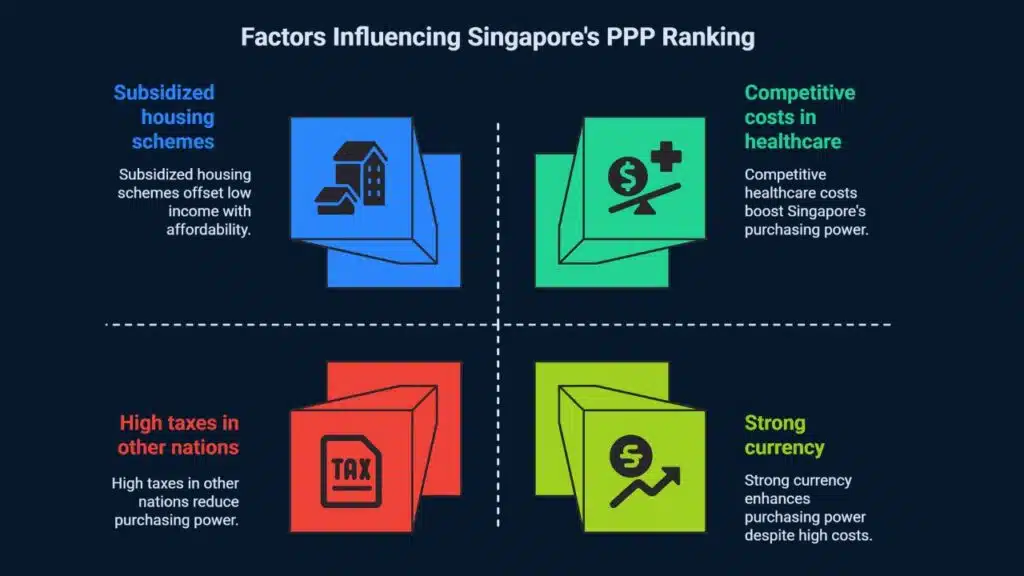
The PPP figure for Singapore is estimated at around US $156,755 per person in 2024, according to IMF and World Bank data. This is driven by:
- Competitive costs in certain sectors (e.g., public healthcare, subsidized housing schemes)
- Absence of certain high taxes found in other wealthy nations
- High incomes combined with a strong currency
A Closer Look at Singapore’s Economic Model
Singapore’s rise to the top tier of global wealth rankings is the result of deliberate economic and policy choices over decades:
- Strategic Location: Serving as a major shipping and aviation hub.
- Open Economy: Strong trade links, low tariffs, and business-friendly regulations.
- Financial Services Hub: Global banking, insurance, and investment sectors contribute heavily to GDP.
- High-Value Manufacturing: Advanced electronics, biomedical sciences, and precision engineering.
- Foreign Talent & Investment: Liberal immigration policies for skilled workers and strong foreign direct investment inflows.
The Work-Hours Factor: Why Singapore Falls to Eighth in Productivity Ranking
The Economist’s analysis also introduced a third metric: productivity per hour worked. Here, Singapore ranks 8th globally, as long working hours impact its standing despite high overall output.
Countries such as Norway, Qatar, and Denmark achieve higher productivity per hour due to:
- Shorter workweeks
- Strong worker protections
- Advanced automation and efficiency measures
In Singapore, long hours are common across many sectors, including finance, technology, and logistics. While this boosts total GDP, it reduces the ranking when efficiency is measured by output per hour.
Comparing Nominal GDP vs PPP vs Productivity
| Ranking Type | Singapore’s Position | Key Competitors |
| Nominal GDP per Capita | 2nd (US $90,700) | Switzerland, Norway |
| PPP-Adjusted GDP per Capita | 1st (US $156,755) | Luxembourg, Ireland, Qatar |
| Productivity per Hour Worked | 8th | Norway, Denmark, Qatar |
Regional Implications and Global Standing
Singapore’s economic dominance in Southeast Asia underscores:
- The success of its long-term planning and investment in human capital.
- Its ability to remain competitive despite limited natural resources.
- The role of global trade networks in boosting small economies.
In global terms, Singapore’s rankings show that small states can outperform much larger nations when policy, infrastructure, and governance are aligned toward growth and efficiency.
The Information is Collected from MSN and AOL.





















