

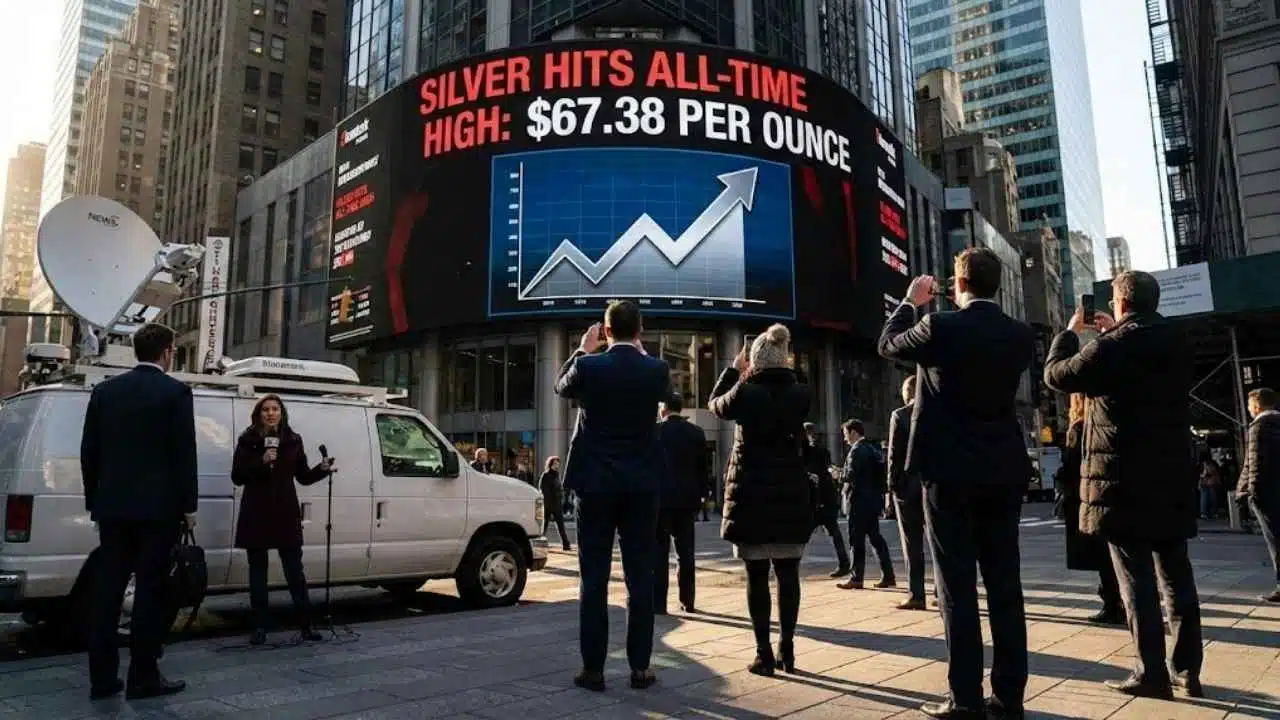
Silver hit a fresh all-time high near $67 an ounce on Friday, Dec. 19, 2025, extending a sharp rally fueled by strong investment demand, persistent supply deficits, and rising expectations that U.S. interest rates will keep falling into 2026.
Silver price surge: what happened this week
Silver climbed to a record $67.46 per ounce and traded around $67.14 on Friday, capping a volatile week that pulled more investors into the market.
While silver is often described as a precious metal, it trades like a “hybrid” asset: part safe-haven, part industrial input. That dual identity helps explain why prices can accelerate quickly when both investment and manufacturing demand rise at the same time.
Key price snapshot (weekly)
| Metric | Level |
| Record high (spot reference) | $67.46/oz |
| Friday level (spot reference) | ~$67.14/oz |
| Market move (context) | Record-setting week |
Note: Spot references shown reflect widely followed benchmark tracking of silver pricing.
Why silver is rallying now
The current move is not being driven by one headline. Instead, several forces are reinforcing each other:
- Interest-rate expectations: Lower rates typically reduce the “carry cost” of holding non-yielding assets like precious metals.
- A multi-year supply deficit: The physical market has struggled to keep up with demand.
- Industrial pull from electrification: Solar, EVs, and power electronics are increasingly silver-intensive.
Fed policy and inflation: the macro tailwind behind precious metals
Investors have been closely watching U.S. inflation and Federal Reserve policy signals. In its Dec. 10, 2025 statement, the Federal Reserve said it lowered the target range for the federal funds rate by 0.25 percentage point to 3.50%–3.75%, reinforcing expectations that the peak in rates is behind us.
Inflation data also supported the “easing” narrative. The U.S. Bureau of Labor Statistics reported CPI up 2.7% year over year in November 2025, with core CPI (excluding food and energy) up 2.6%.
For precious metals markets, that combination—slower inflation readings and a Fed already cutting—can increase demand from investors looking to diversify.
Supply deficit enters a fifth year
A major part of the bullish argument is structural: silver supply has not expanded fast enough to meet a broadening base of demand.
The Silver Institute has projected that the global silver market will remain in a sizeable deficit in 2025, marking the fifth consecutive year of shortfalls.
What “deficit” means in the silver market
A deficit occurs when total demand (industrial use, jewelry, silverware, and investment) exceeds total supply (mine production plus recycling and other sources). Over time, repeated deficits can tighten available inventories and raise sensitivity to disruptions.
Supply-demand outlook (2025)
| Measure | Latest widely cited outlook |
| Market balance | Deficit expected (5th straight year) |
| Key driver | Industrial demand staying elevated |
The deficit estimate varies by methodology and update cycle, but the direction is consistent: demand outpacing supply.
Industrial demand is doing more of the heavy lifting
Silver’s industrial role has expanded as electrification and digital infrastructure grow. The Silver Institute reported that industrial demand rose to a new record in 2023, highlighting “green economy” uses as a key driver.
Solar: a growing silver consumer
Photovoltaic (PV) manufacturing requires silver paste for electrical conductivity. Growth in installations—along with technology shifts in cell design—has kept PV-related silver demand in focus. The Silver Institute has repeatedly pointed to photovoltaics as a major contributor to rising industrial offtake.
Electric vehicles: higher silver loading than conventional cars
EVs typically use more silver than internal combustion engine vehicles because of higher electronics content and power management needs. A Silver Institute report on technology-sector demand says EVs consume about 67%–79% more silver than internal combustion vehicles, using roughly 25–50 grams per EV (depending on design and features).
Investment demand: ETFs and products pull metal off the market
Beyond industrial consumption, investment flows can tighten the market by removing physical metal into long-term holdings.
The Silver Institute reported that global silver ETP holdings reached about 1.13 billion ounces by June 30, 2025, and that net inflows totaled about 95 million ounces in the first half of 2025, already surpassing the total for all of the prior year.
That matters because ETP inflows can amplify price moves during momentum phases: when buying accelerates, more metal is demanded immediately, even if industrial users cannot quickly reduce usage.
ETF/ETP flow indicators (H1 2025)
| Indicator | Reported level |
| Net inflows (H1 2025) | ~95 million ounces |
| Total holdings (June 30, 2025) | ~1.13 billion ounces |
Why silver can move faster than gold
Silver markets are smaller and often more volatile than gold. When investor demand rises quickly—especially through leveraged or momentum channels—price swings can be sharper.
That volatility is one reason silver can outperform in strong up-cycles, but it also explains why pullbacks can be steep when sentiment shifts, margin requirements change, or industrial buyers pause.
What to watch next
Several near-term factors could shape whether silver holds near record levels:
1. U.S. rate path into 2026
Markets will focus on whether the Fed continues easing and how quickly. The Fed’s December rate cut has already shifted expectations, but future decisions will hinge on incoming inflation and labor-market data.
2. Physical availability and premiums
If retail and wholesale premiums remain elevated—especially in major consumption hubs—this can signal stress in physical supply even when futures markets are liquid.
3. Industrial demand durability
Solar and EV demand are structural themes, but they can still be cyclical. Manufacturing slowdowns, policy changes, or substitution efforts can affect the pace of growth, even if long-run direction remains upward.
4. ETP flows
ETP/ETF inflows have been a major marginal buyer. A sustained slowdown (or reversal) in flows can cool momentum.
Final thoughts
Silver’s run to an all-time high near $67 reflects a rare alignment: tight physical fundamentals, expanding industrial use, and investor demand strengthened by a falling-rate backdrop. Whether prices can stay near record territory will likely depend on how quickly supply can respond, how durable “green economy” demand remains, and whether investment inflows continue to absorb available metal.





















