The era of “passive income” dropshipping is dead; the era of “autonomous commerce” has begun. Shopify’s latest AI suite—colloquially dubbed “Magic Merchant” but officially powered by the new Agentic Storefronts and Sidekick Pulse—doesn’t just automate tasks; it creates a self-correcting global supply chain that threatens to make the traditional dropshipper obsolete while empowering a new class of AI-native retail titans.
The “RenAIssance”: From Arbitrage to Autonomy
For the past decade, dropshipping was defined by a simple, often predatory arbitrage model: find cheap goods on AliExpress, run Facebook ads, and pocket the difference. It was a game of “click and hope.” By late 2024, this model had fractured. Rising customer acquisition costs (CAC), aggressive crackdowns on low-quality listings by platforms like TikTok Shop, and consumer fatigue with 30-day shipping times squeezed margins to near-zero. The “get rich quick” crowd was effectively priced out.
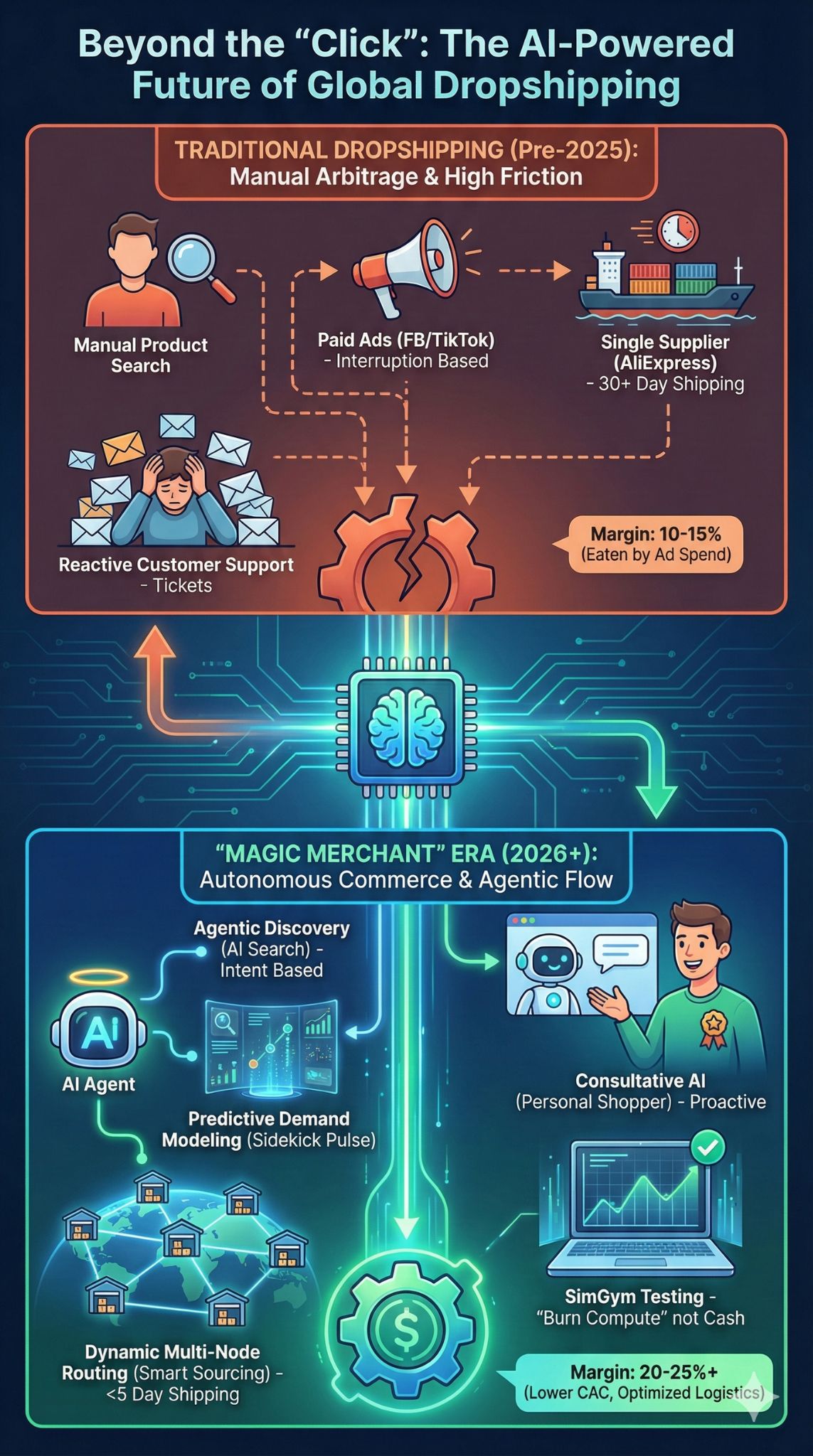
We are now entering the “Autonomous Commerce” phase of 2026. The industry has shifted from manual arbitrage (human finds product, human writes ad, human fulfills order) to agentic workflows. Shopify’s Winter 2026 release, featuring Agentic Storefronts and Sidekick Pulse, marks the pivot point where software stops being a tool for the merchant and starts becoming the merchant. This isn’t just an update; it is a fundamental rewriting of retail operating systems.
The Mechanics of the “Magic Merchant” Shift
1. The Rise of “Agentic” Storefronts: The Invisible Store
The most disruptive feature of this new era is the Agentic Storefront. In the traditional web 2.0 model, a merchant’s goal was to drive human traffic to a visual landing page. In the Agentic era, the “customer” is often an AI agent acting on behalf of a human.
- The Mechanism: Shopify’s new infrastructure allows product catalogs to be “read” and sold directly by AI agents like ChatGPT, Perplexity, or Microsoft Copilot.
- The Shift: A dropshipper no longer relies solely on interrupting users with ads. Instead, their inventory is structured to be “picked up” by AI assistants answering user queries (e.g., “Find me a sustainable, non-toxic yoga mat under $40 with 3-day delivery to Berlin”).
- Implication: The “Magic Merchant” tool automates the schema and metadata required for this, effectively creating a new, invisible sales channel. If your store isn’t “agent-readable,” it doesn’t exist.
2. Sidekick Pulse & Automated Supply Chain Routing
The “Magic” in the tool refers to its ability to handle multi-node fulfillment logic without human input. This is powered by Sidekick Pulse, which transforms analytics from a “pull” process (you looking for data) to a “push” process (the AI alerting you to anomalies).
- How it works: If a demand spike for “smart home humidifiers” is detected in Munich, the AI doesn’t just report it. It analyzes real-time data—shipping costs, warehouse stock in Poland vs. China, customs fees, and delivery speed—to route the order to the optimal supplier.
- The “Auto-Negotiation” Factor: In advanced tiers, the AI agents can negotiate raw material prices or shipping rates with suppliers in real-time, balancing cost against reliability scores. This kills the “30-day shipping” stigma by dynamically switching between local warehouses and cross-border suppliers.
3. The “SimGym”: Testing Before Selling
One of the most underrated aspects of the 2026 suite is Shopify SimGym. This tool allows merchants to unleash thousands of AI “customer agents” on their store to test UX, pricing elasticity, and checkout flows before a single real human visits.
- Impact: Dropshippers can now simulate a “Black Friday” scenario to see if their supply chain breaks. This moves the industry from “test with budget” (burning cash on ads to validate products) to “test with compute” (using AI simulations to validate reliability).
4. Hyper-Personalization: The “Consultative” Sales Model
Static product pages are dying. The new tool facilitates “Consultative AI”—chatbots that don’t just answer FAQs but actively sell.
- Scenario: A customer lands on a store. Instead of browsing a catalog, they chat with an AI agent: “I need an outfit for a beach wedding in Italy.” The AI selects items from the dropshipping catalog that fit the aesthetic, shipping timeline, and size, effectively acting as a personal shopper. This increases Average Order Value (AOV) significantly compared to passive browsing.
5. The “Lazy” Merchant Fallacy
There is a dangerous misconception that this tool enables “zero-work” wealth.
- Reality Check: While the logistics are automated, the liability is not. The AI might route an order, but if the product quality is poor, the human merchant bears the chargeback risk. The “Magic Merchant” tool lowers the floor for entry but raises the ceiling for success. It will trigger a purge of low-quality dropshippers, leaving only those who use AI to build legitimate brands.
Data & Visualization: The Economics of Automation
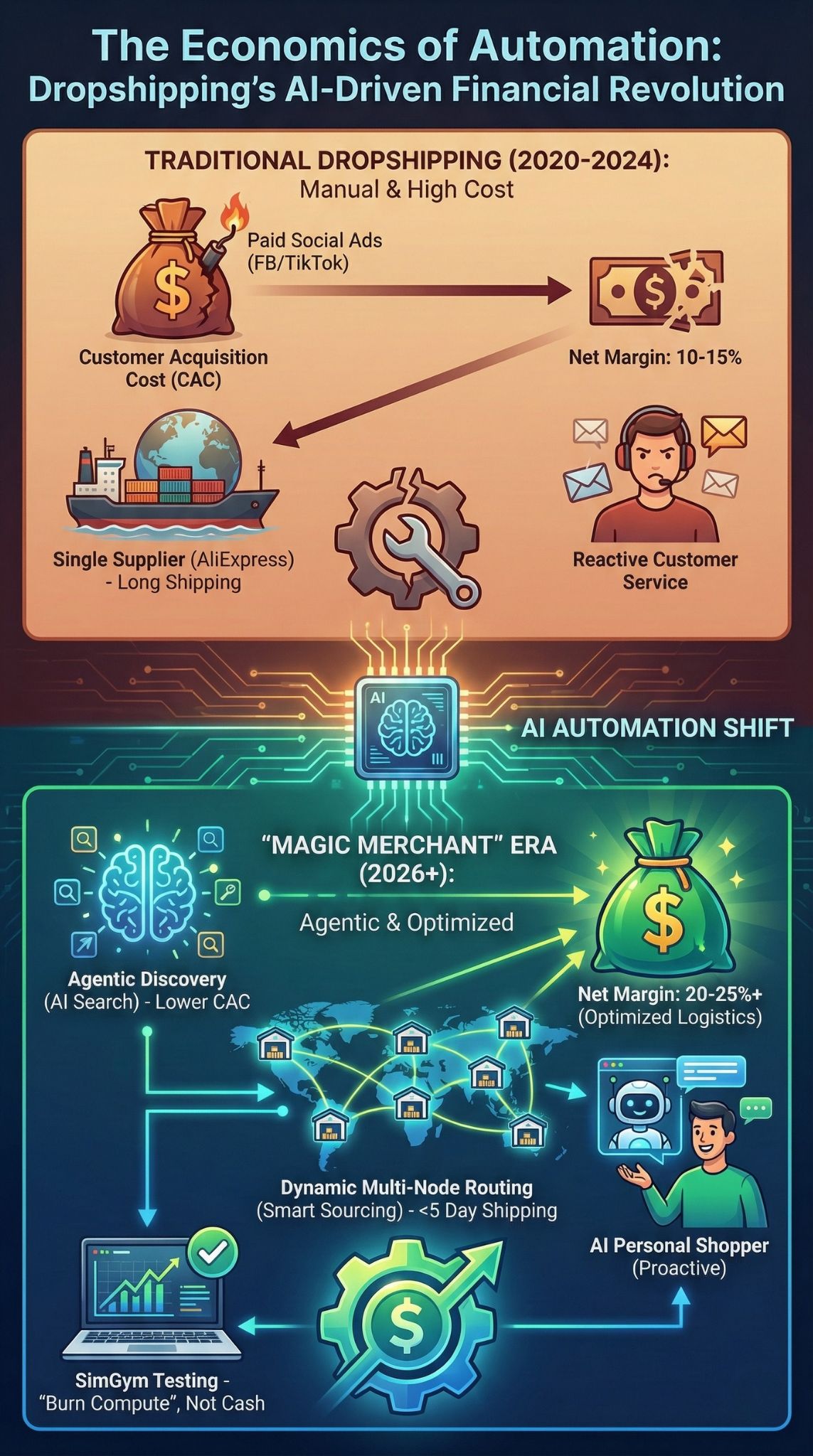
The following comparison highlights the operational shift from the manual dropshipping model of the early 2020s to the AI-integrated model of 2026.
| Metric | Traditional Dropshipping (2020-2024) | “Magic Merchant” Era (2026+) |
| Primary Traffic | Paid Social (FB/TikTok Ads) | Agentic Discovery (AI Search) + Ads |
| Product Research | Manual Spy Tools (AdLibrary) | Predictive Demand Modeling (Sidekick Pulse) |
| Inventory Logic | Single Supplier (AliExpress) | Dynamic Multi-Node Routing (Smart Sourcing) |
| Customer Service | Email/Tickets (Reactive) | AI Personal Shopper (Proactive/Consultative) |
| Testing Method | “Burn Cash” on Live Ads | “Burn Compute” on AI Simulations (SimGym) |
| Global Sales | Complex Tax/Customs Issues | Automated Merchant of Record (MoR) |
| Net Margin | 10–15% (Eaten by Ad Spend) | 20–25% (Lower CAC, Optimized Logistics) |
Key Market Statistics (2026 Projections):
- Global Dropshipping Market: Projected to reach $699 Billion by 2029.
- AI Adoption: 77% of retailers are now using or piloting AI automation.
- Efficiency Gains: AI-driven supply chains are cutting logistics costs by 15%–20%.
- Consumer Shift: 40% of Gen Z/Millennials now prefer interacting with an AI agent for faster service over human support.
Expert Perspectives: The Industry Divide
To understand the real-world impact, we must look at the diverging views within the e-commerce community.
The Optimist View: “We are witnessing the democratization of multinational logistics. A solo founder in a basement can now operate a global supply chain that rivals Zara’s in efficiency. Tools like Sidekick Pulse allow them to compete on speed and price, while SimGym ensures they don’t break under pressure. The barrier to entry isn’t money anymore; it’s taste and curation.”
— Sarah Jenkins, Lead Analyst at FutureRetail Think Tank
The Skeptic View: “This tool is a double-edged sword. By making it ‘easy’ to flood the market with AI-generated stores, we risk an internet filled with ‘zombie brands’—stores that look real but have no human soul. If AI negotiates with AI suppliers to sell to AI search agents, where is the human value? We are entering a ‘Dead Internet’ loop for commerce.”
— Marcus Thorne, Consumer Protection Advocate & Tech Ethicist
Future Outlook: What Comes Next?
As we look toward the latter half of 2026 and into 2027, three major trends will emerge from this release:
- The “Reputation Score” Economy:
With AI able to generate stores instantly, platforms (Google, Meta, Shopify) will likely introduce “Merchant Trust Scores” based on fulfillment speed, return rates, and product quality to filter out AI-spam stores. High-performing “Magic Merchants” will get algorithmic preference. - Reverse Dropshipping:
We will see Western brands using these same tools to “dropship” into Asian markets. The “Magic” suite’s auto-translation and localized checkout features allow a US brand to sell in Japan without a local entity, using AI to handle the cultural and logistical nuance. - Subscription-Based AI Management:
Shopify may pivot its pricing model. Instead of just paying for the platform, merchants might pay for “compute” credits—effectively paying a salary to their AI “Sidekick” to manage the store 24/7.
Final Verdict:
Shopify’s “Magic Merchant” tools are not a magic button for easy money. They are high-powered weapons for serious retail warfare. The winners will be those who use this automation to buy back time—time they then invest in building a brand voice that humans actually care about. The dropshippers who survive 2026 will be the ones who stop acting like middlemen and start acting like product curators.