
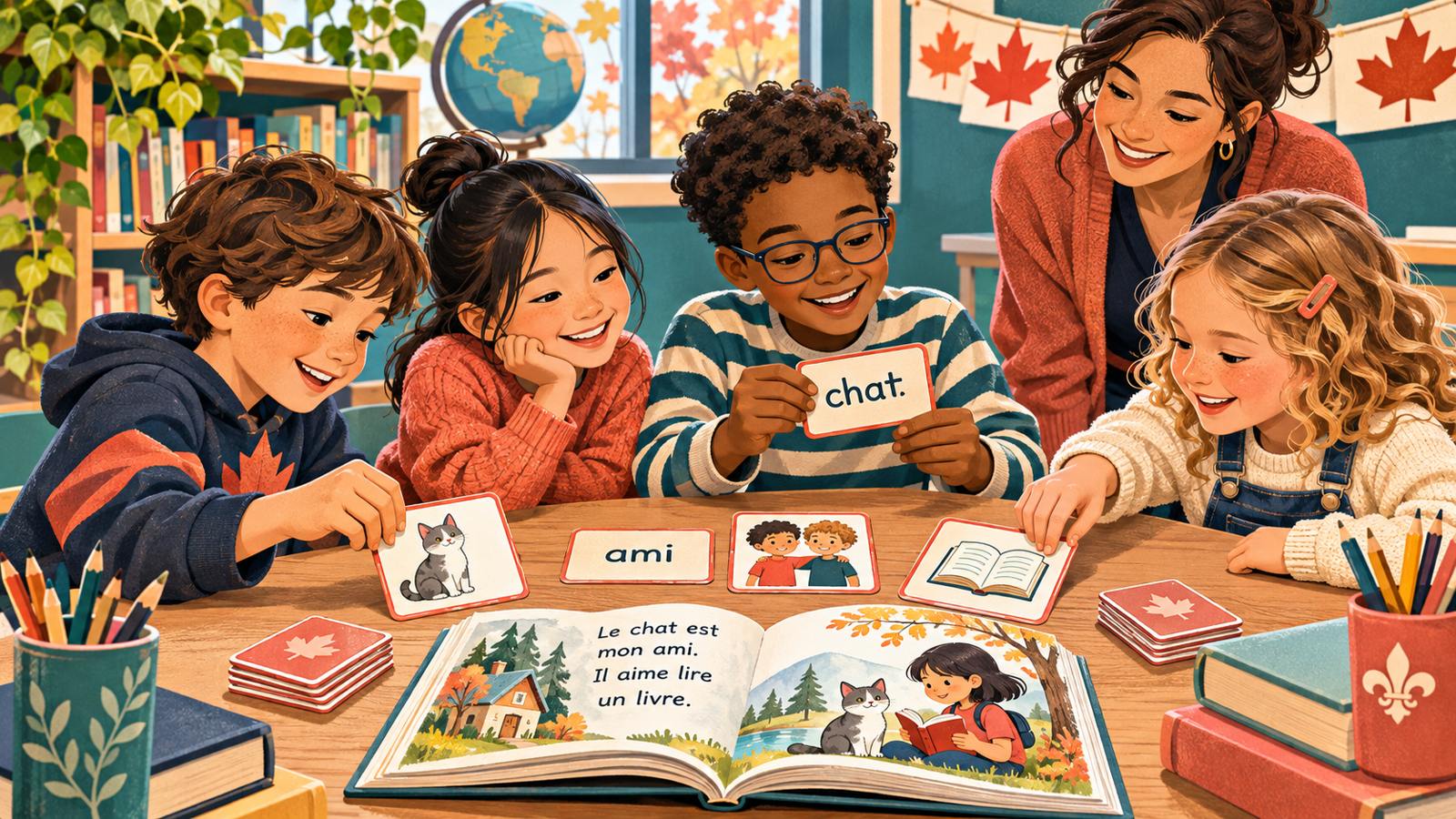
French Reading Games for Canadian elementary learners work best when the game matches the reading task: recognizing a taught spelling pattern, understanding a sentence, or explaining what happened in a story. These 12 practical games give parents and teachers ways to practice those skills with paper cards, familiar books, and short French texts. Each includes a playable example and an adjustment for learners who need more support or a greater challenge.
You do not need twelve subscriptions or a cupboard of commercial kits. This is a collection of adaptable classroom and home activities, rather than a ranking of apps. Most require only reusable paper materials. Choose by what the child can currently read in French, not simply by age or grade.
Which French Reading Games for Canadian Learners Should You Start With?
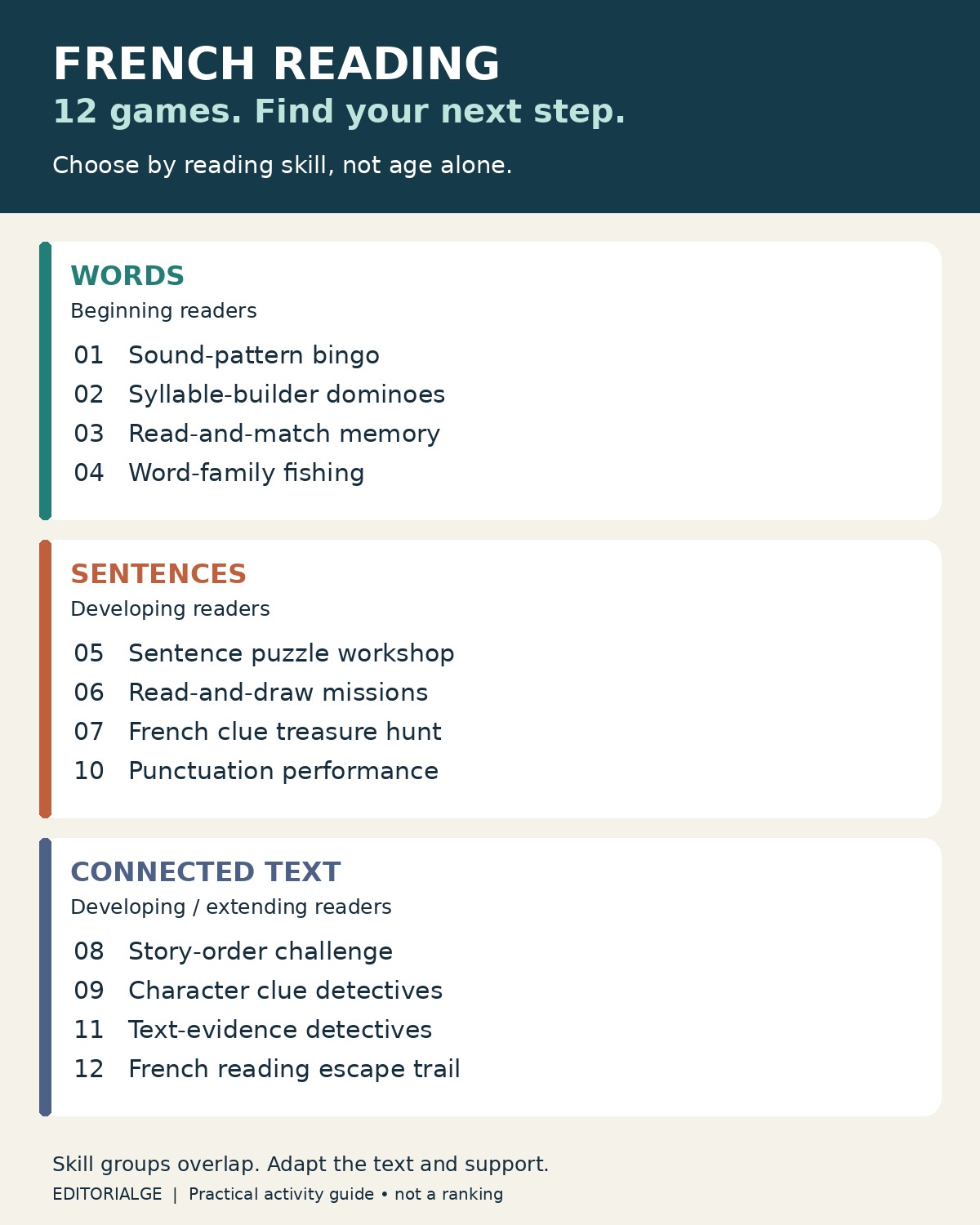
Start with word–picture matching or sound-pattern bingo when a child is working on individual words. Try sentence puzzles and read-and-draw missions when short sentences are manageable. Choose story sequencing, clue hunts, and text-evidence detectives for children ready to read connected text. Keep a short book alongside the game so practice leads back to meaningful reading.
How this list was developed: We reviewed Canadian curriculum guidance and published French literacy activity collections, then designed practical versions of familiar game formats. The examples, suggested timings, and difficulty adjustments below are editorial teaching suggestions, not results from classroom trials. The sequence moves broadly from words to texts; it is not an effectiveness ranking.
Match the Game to the Canadian Learning Context
A French-speaking child learning to decode, an early immersion learner, and an older beginner in core French may need very different texts. Ontario’s overview of French as a second language programs distinguishes core, extended, and immersion pathways. Do not treat an immersion grade label as a reading-level guarantee for every learner.
For this guide, “beginning” means working with taught letter–sound patterns and familiar words; “developing” means reading short sentences; “extending” means working across several sentences or paragraphs. These are activity-selection labels, not provincial assessment categories. A student can be extending in oral French while still beginning in decoding.
British Columbia’s Grade 1 French immersion curriculum explicitly connects reading with both decoding and understanding meaning. It also includes sound awareness, punctuation, and story elements. That provides a useful rationale for balancing word games with meaning-focused activities; it does not certify the twelve adaptations below.
Use vocabulary from the child’s actual classroom, family, and community. French-language life in Canada includes Quebec, Acadian communities, Franco-Ontarian communities, and many other settings. Local names and familiar places can make a clue meaningful without turning every activity into a maple-leaf theme. Follow the teacher’s pronunciation and spelling sequence, and discuss regional vocabulary as variation rather than automatically treating it as an error.
| Game | Best starting point | Reading focus | Materials |
|---|---|---|---|
| 1. Sound-pattern bingo | Beginning | Reading taught spelling patterns | Word grid and counters |
| 2. Syllable-builder dominoes | Beginning | Blending printed syllables | Syllable cards |
| 3. Read-and-match memory | Beginning | Connecting words and meaning | Separate word and picture cards |
| 4. Word-family fishing | Beginning/developing | Comparing spelling patterns | Small word-card deck |
| 5. Sentence puzzle workshop | Developing | Sentence order and meaning | Word strips |
| 6. Read-and-draw missions | Developing | Following written details | Instruction cards and paper |
| 7. French clue treasure hunt | Developing | Reading for a purpose | Clue cards and objects |
| 8. Story-order challenge | Developing/extending | Sequencing events | Short text and event cards |
| 9. Character clue detectives | Developing/extending | Linking descriptions to evidence | Character cards and descriptions |
| 10. Punctuation performance | Developing/extending | Expressive rereading | Dialogue strips |
| 11. Text-evidence detectives | Extending | Checking claims against a text | Passage and statement cards |
| 12. French reading escape trail | Extending | Combining reading strategies | Three envelopes and short texts |
1. Sound-Pattern Bingo
A small bingo board gives repeated encounters with a spelling pattern without requiring a long worksheet. It suits a learner who has already been taught the pattern and needs to read it in different words. Start with a two-by-three grid rather than a crowded full-size board.
For an illustrative ou set, use words such as roue, joue, poule, boule, soupe, and moule, provided their other spellings are familiar. Say a word, let the child locate it, and ask them to read it before placing a counter. After a row is complete, have the player read the entire row. The win condition is a checked row, not the fastest hand.
For the next round, show a word briefly and ask the child to find its matching printed form. An adult should listen to the reading: visual matching alone does not show that the child can decode. To make the game harder, mix two already-taught patterns. Avoid introducing several unfamiliar spellings simply to fill the grid.
2. Syllable-Builder Dominoes
This game makes the joining process visible. Prepare a few cards that can form familiar words, such as la + pin, sa + pin, and ma + tin. Model the sounds first, then invite the learner to join two cards, read the resulting word, and explain or illustrate its meaning.
Players earn a building token for each correctly read word. They can work toward a shared tower instead of competing. Keep a small adult answer sheet so an accidental combination does not get accepted as a real word. Invented combinations can be a separate decoding exercise, but label them clearly as made-up words.
Choose examples with the teacher: printed syllable divisions and spoken syllables are not interchangeable in every French word. For a learner who stalls, reduce the choices to two endings and model one join. For a confident reader, ask them to find a completed word inside a short sentence. This last step checks whether card practice transfers to ordinary text.
3. Read-and-Match Memory
Best for: Children who can attempt familiar printed words but need practice connecting them to meaning.
Make six pairs: one card with a word and another with its picture. Possible pairs include chat, vélo, and livre. Begin face up. The child reads a word and chooses the matching image; once the vocabulary is understood, turn the cards face down for a memory round.
A player keeps a pair only after reading the word. That rule matters because remembering card positions can otherwise replace reading. Keep the picture off the word card so it does not supply the answer before the child looks at the letters.
If a child reads the word accurately but does not know its meaning, explain the vocabulary rather than making them sound it out repeatedly. For an older beginner, use age-respectful pictures of sports, school clubs, or everyday objects. For a stronger reader, replace isolated nouns with short phrases such as le petit chat.
4. Word-Family Fishing
Turn a small set of word cards into a “fishing” deck. Players collect cards that share a chosen written pattern, reading each card before placing it in a group. For example, bateau, gâteau, and château share the ending eau. Explain unfamiliar meanings before the round.
One player asks for a card from the selected family; the other hands over a matching card or invites them to draw. A group is complete when the player can read its cards and point to the shared spelling. Use “spelling-pattern family” here: these words are not necessarily related in meaning or built from the same root.
This format is useful when a child can read a pattern in one familiar word but misses it elsewhere. Its limitation is that a matching ending can distract from the rest of the word. Ask the player to read the complete word, including its beginning, before accepting a match. Introduce a second family only after the first is manageable.
5. Sentence Puzzle Workshop
Write a short sentence on a strip, cut it into word cards, and shuffle them. A starting example is Le chat dort sur le tapis. Learners rebuild the sentence, read it aloud, and explain what it means. Award a shared point for a sentence that makes sense and another for a clear rereading.
Keep the capital letter and final punctuation as useful supports at first. Later, offer two plausible versions and discuss how the meaning changes. With suitable cards, Le chien regarde le chat and Le chat regarde le chien are both grammatical; the reader must explain who is doing the looking.
For beginners, keep Le chat or sur le tapis together as phrase chunks. For more experienced readers, add an adjective or a second sentence. Do not judge success only by whether the cards match an answer key. A different grammatical sentence may be valid, and explaining it can reveal more than reproducing the original order.
6. Read-and-Draw Missions
Read-and-draw turns comprehension into something visible. Give the child a short instruction such as Dessine un chat sous la table. After drawing, the learner points to the words that explain where the cat belongs. The drawing is evidence to discuss, not an art contest.
Start with one instruction per card. A harder mission might say, Dessine deux étoiles au-dessus de la maison. Check both the number and location. Partners can compare pictures, locate a difference, and reread the wording to resolve it. A mission is complete when the reader can connect the important details to the text.
Use objects or picture pieces instead of drawing if fine-motor demands get in the way. If an adult reads the whole instruction aloud, the activity becomes listening comprehension; that is useful, but record it accurately. To keep an independent reading goal, let the learner read first and offer help with a specific word afterward.
7. French Clue Treasure Hunt
A clue hunt gives reading an immediate purpose: find the next card. Begin with three clues in a small, accessible area. An example might be Cherche sous le livre bleu. The child reads it, identifies the key information, and retrieves the next clue.
The final “treasure” can be choosing the next story or revealing a class joke. Avoid making running speed part of the score. At a desk, use a picture map or several small objects so children with different mobility needs can participate in the same reading task.
Canadian classroom vocabulary can enter naturally through a library corner, an entryway, or familiar winter clothing. Use the words actually taught at school. A clue that depends on an unknown noun may measure vocabulary more than decoding. For a harder round, add a second condition, such as a color or relative position. Ask the reader to explain the clue before moving so following another player’s movement does not replace reading.
8. Story-Order Challenge
After reading a short text, give the learner three or four event cards. Their job is to arrange the events and defend the order by returning to the story. Use a shared point for each placement the group can justify.
An original mini-story could follow a child who finds a seed, plants it, waters it, and later sees a shoot. Begin with picture-and-sentence cards; progress to text-only cards. Keep the original passage available. This is an opportunity to reread, not a test of how much a child can hold in memory.
Watch for a subtle problem: children may order events using everyday knowledge without reading the passage. Include one detail that makes them check the text, such as where the seed was found or who watered it. More advanced readers can identify which events are essential to a short retelling. Avoid implying that every story follows one rigid formula or that sequence alone establishes full comprehension.
9. Character Clue Detectives
Create a small cast of fictional characters with written descriptions. Learners read a clue and identify the matching character, then underline the phrase that supports their answer. No information about real classmates is needed.
For example: Lina porte un manteau rouge. Elle cherche son livre. A clue asking who is looking for a book should lead back to the second sentence. For developing readers, keep descriptions to one or two sentences and make the options clearly different. For extending readers, give two characters one shared feature so a single keyword is insufficient.
The game can move from literal details to cautious inference. If a character has packed an umbrella, a learner might infer that they expect rain, but should distinguish that interpretation from a fact explicitly stated in the text. Reward a defensible explanation, including “the text does not tell us.” Avoid guessing personality, ability, or family background from names or pictures.
10. Punctuation Performance
Turn short dialogue strips into a cooperative performance game. Read a line once to establish its meaning, then try a version that makes its punctuation audible. Compare Tu viens., Tu viens ?, and Tu viens ! Discuss what each speaker might be communicating.
Partners can draw a punctuation card, rehearse quietly, and read their line to the group. The group identifies the punctuation and explains which part of the reading helped. There need not be one exaggerated “correct voice”; meaning and context matter more than theatrical volume.
This activity is a better fit when decoding the chosen sentence is already comfortable. If nearly every word requires help, shorten the text before asking for expression. Give a quiet partner-reading option to children who dislike public performance. A useful finishing challenge is to read a new sentence with the same punctuation, checking that the learner is attending to the marks rather than remembering one rehearsed line.
11. Text-Evidence Detectives
Offer a short passage and three statement cards labeled “supported,” “contradicted,” or “not stated.” Players place each statement in a category and identify the relevant words. This extends a basic true-or-false game by allowing the text to leave something unanswered.
Try this original passage: Sam va à la bibliothèque le mardi. Il emprunte deux livres sur les animaux. “Sam borrows two books” is supported. “Sam goes on Thursday” is contradicted. “Sam’s favorite animal is a bear” is not stated. Use French statement cards when the learner’s level allows; an English explanation can help an adult check understanding without requiring polished spoken French.
For a richer round, add a short informational paragraph and require two supporting details. Keep background knowledge separate from textual evidence: knowing a fact about bears does not establish what Sam prefers. The practical value of this game is that the adult can see how the reader reached an answer. It is not a standardized comprehension assessment.
12. French Reading Escape Trail
Finish with a cooperative trail that combines familiar tasks. Put a word match in the first envelope, a sentence puzzle in the second, and a short comprehension clue in the third. Completing each task earns a symbol; the three symbols identify the final envelope.
Build the trail from words and formats the children already know. The novelty should come from connecting tasks, not from suddenly introducing difficult vocabulary. In a classroom, rotate the reader, evidence-finder, and materials-helper roles so one fluent student does not solve everything.
Provide a hint card for each station and keep all envelopes physically accessible. The group wins by explaining its reading decisions, with no countdown needed. For an older beginner, use a school-library mystery rather than preschool imagery. For a confident group, add a clue that requires rereading an earlier sentence. Preparation is heavier than for bingo, so reuse this format after simpler games have shown which skills need practice.
A Practical 15-Minute French Reading Routine
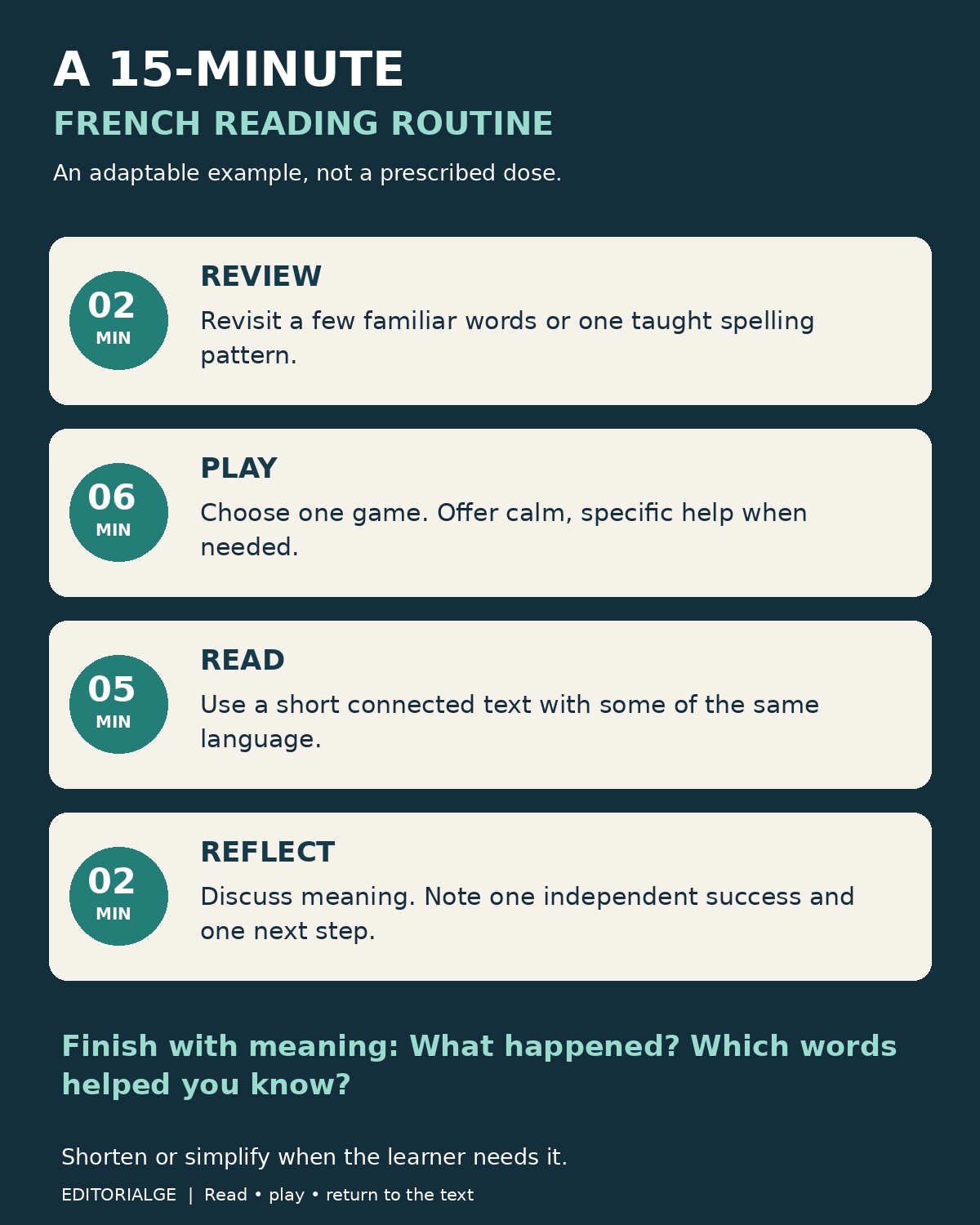
The following is a sample schedule, not a prescribed learning dose. Shorten it if the learner becomes tired or frustrated. One well-matched game is enough for a session.
- Spend 2 minutes reviewing a few words or a spelling pattern already taught.
- Spend 6 minutes playing one game, with immediate, calm help when needed.
- Spend 5 minutes reading a short connected text that uses some of the same language.
- Spend 2 minutes discussing meaning and noting one next step.
For example, follow sound-pattern bingo with a short text containing familiar ou words. After a story-order game, ask the child to retell the beginning and ending. Do not expect a new book to contain only words from the game; choose a text the child can approach with appropriate support.
Families who also want digital reading options can consult our guide to reading apps for kids. Its broader app list is not a French-specific recommendation: check language availability and the particular learning activity before choosing a tool.
How to Tell Whether the Activity Is Helping
Keep a tiny observation record: the text or pattern practiced, what the child did independently, and what required help. “Read three new words with the taught pattern” is more informative than “won bingo.” These observations guide your next activity; they do not diagnose a reading difficulty.
Try one unfamiliar example using the same taught pattern, or ask a new question about a familiar passage. If success disappears when the picture, card position, or memorized sequence changes, simplify the task and model the reading step again. Distinguish a word-reading problem from a vocabulary gap: a child can pronounce a word without understanding it, or understand it orally without being able to read it.
Offer larger print, clear spacing, fewer cards, additional response time, or a pointing response when appropriate. Avoid removing accents to make French “easier.” If difficulties persist, share specific observations with the child’s teacher and ask how home practice can support the school’s approach.
Frequently Asked Questions
Can these games work for both immersion and core French?
Yes, as adaptable formats. The vocabulary, sentence length, and adult support must change with the learner’s French reading experience. An older core French beginner may need simpler text with more mature topics than a younger immersion reader.
Can a parent who does not speak French help?
A parent can organize cards, encourage rereading, and discuss meaning. Ask the teacher for a small approved word set and a pronunciation model. Avoid guessing unfamiliar sounds or marking a child’s regional pronunciation wrong. Let the school guide corrections you cannot confidently make.
Are these games free?
The versions described here require no paid app or commercial kit. Paper, printing, books, and preparation may still have costs. Use your own short example texts or materials you are permitted to copy; a purchased resource is optional.
Should children race against a timer?
A timer is unnecessary for these versions. Cooperative goals and accurate explanations make it easier to see the reading process. If you add a playful time limit, avoid letting speed or competition crowd out understanding.
Do reading games replace a structured reading program?
No. They provide opportunities to practice selected skills and discuss texts. Use them alongside teaching, suitable books, and feedback. A game score cannot establish grade-level proficiency or replace an educator’s assessment.
Choose One Game, Then Return to the Text
The most useful French Reading Games for Canadian learners are the ones that fit the next reading step. Begin with a small word set, move into sentences when those words are manageable, and make room for stories and informational texts. Choose one activity, listen to how the child reads, and adjust from that evidence. The goal is a reader who can make sense of new text, not simply win another round.