

Scandinavian style has been the global “default” look for more than a decade. Light wood. White walls. Simple lines. Hygge candles. For many homeowners, it feels like the safest choice you can make. But as we move into 2026, a quiet backlash is building. People still love the calm of Nordic interiors, yet they are starting to notice something uncomfortable: many homes feel cold, generic, and impractical.
In other words, Scandinavian design flaws are no longer invisible. This doesn’t mean Scandinavian interior design is “over”. It means the way we copy it needs to evolve. When you strip the style down to a few Instagram clichés, you create Scandinavian design mistakes that ignore context, climate, family life, and personality.
Let’s unpack 12 Scandinavian design flaws no one talks about and show you how to update them with 2026-ready fixes. The goal is not to abandon Nordic style, but to keep its soul while making your home warmer, more functional, and more future-proof.
Scandinavian design started from a very real need: long, dark winters, small homes, and a cultural love of simplicity. The result was a style built on light, functionality, and comfort. Over time, it spread worldwide through magazines, social media, and global retailers.
But along the way, the message got simplified.
What began as a thoughtful, context-aware way of living turned into a product look. The same pale sofa, the same rug, the same “minimalist” shelf appeared in homes from Stockholm to Singapore. In many cases, spaces started to look more like staged showrooms than lived-in homes.
At the same time, life changed. Remote work, rising rents, smaller apartments, and a stronger focus on sustainability all challenged the old formula.
People started to ask:
- Why does my “calm” home feel sterile and cold?
- Why does this minimalist living room never stay tidy?
- Why does this Nordic look not work in a hot or tropical climate?
These questions expose Scandinavian interior design problems that were always there, but easier to ignore. Now, they are shaping the next wave of global design.

Before we look at the flaws, it helps to remember what Scandinavian design actually stands for at its core:
- Simplicity – clean lines, no visual noise
- Functionality – every piece has a purpose
- Light – bright spaces to combat dark winters
- Natural materials – wood, wool, leather, linen
- Calm palettes – muted colors and soft neutrals
These principles still make sense. The problem is not the philosophy. It’s the way it gets translated into real homes.
When Scandinavian style is reduced to “white everything, one plant, one lamp”, it stops being a human-centered design and becomes an aesthetic template. That’s where Nordic minimalism’s drawbacks begin to show.
Let’s break down the most common Scandinavian design flaws – and how to fix them for 2026.
1. The “White Box” Obsession That Drains All Personality
One of the most common Scandinavian design mistakes is the all-white interior. White walls, white floors, white furniture. The intention is to make the room feel airy and bright. In reality, many spaces end up looking clinical.
An all-white palette also magnifies every scuff, scratch, and stain. Instead of a serene, hygge home, you get a high-maintenance backdrop that feels more like a gallery than a living space.
2026 Fix: Swap the “white box” for layered neutrals.
Use warm whites, soft greys, greige, sand, or clay tones on walls. Bring in mid-toned natural woods, oatmeal textiles, and stone to add depth. Introduce one or two nature-inspired accent colors – olive green, rust, deep blue – through cushions, throws, or artwork.
You still get Scandinavian calm, but without the emotional flatness.
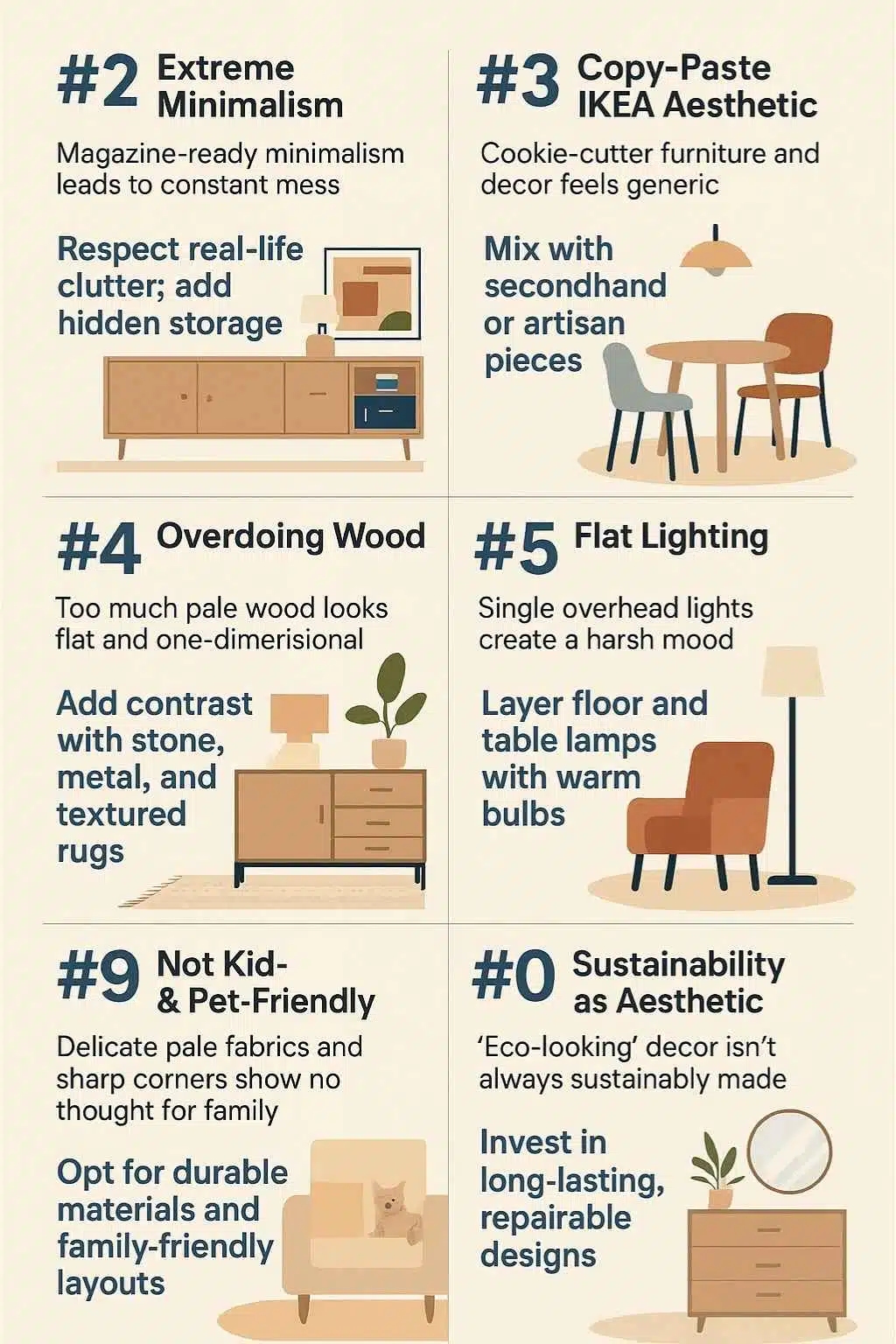
2. Extreme Minimalism That Ignores Real-Life Clutter
Another major Scandinavian interior design problem is the myth of perfect minimalism. Many homes try to copy the sparse, styled look of magazine spreads: empty surfaces, no visible cables, almost no objects.
In real life, people have hobbies, work equipment, kids’ toys, and seasonal clothes. For most households, extreme minimalism leads to either permanent stress (“Where do I put everything?”) or constant mess.
2026 Fix: Aim for edited, not empty. Keep the clean lines, but respect your actual lifestyle.
- Use built-in cupboards and tall wardrobes for hidden storage.
- Add benches with storage in hallways and under windows.
- Choose coffee tables, beds, and media units with drawers or shelves.
This way, you preserve the minimalist feel while designing for real-life clutter.
3. Copy-Paste IKEA Aesthetic That Feels Generic
Scandinavian style heavily influenced global retail, especially big-box brands. That’s not bad. Affordable design is a good thing. The issue arises when entire homes are made from the same catalog.
If your living room, bedroom, and home office all look like a showroom set, the space can feel anonymous. You lose the sense of story, place, and personality that truly good interiors have.
2026 Fix: Use budget-friendly Scandi pieces as a base, not a complete solution.
Then layer in:
- Vintage or second-hand furniture with character
- Local artisan ceramics, textiles, or art
- Heirloom items and personal collections
Mixing old and new instantly breaks the “copy-paste” Scandinavian style and makes your home harder to place on a generic Pinterest board.
4. Overdoing Wood and “Natural” Materials Without Contrast
Scandinavian style loves natural materials, especially pale wood. The problem is when everything is the same tone and texture: light wooden floor, light wooden chairs, light wooden table, light wooden cabinets.
Instead of warmth, you get a monotone blur. There is no contrast to guide the eye or define zones in the room.
2026 Fix: Play with contrast and variety while staying within a calm palette.
- Mix light wood floors with a darker wood or a black metal table
- Add stone or ceramic surfaces in kitchens and bathrooms
- Use textured rugs, woven baskets, and linen curtains
You still embrace nature, but in a more layered, interesting way that reflects current interior design trends.
5. Flat Lighting That Kills the “Hygge.”
True Scandinavian homes are famous for warm, layered lighting. Yet many “Scandi-inspired” interiors rely on a single overhead lamp and cold, blue-toned bulbs. That creates harsh shadows and a flat, uninviting mood.
Lighting is one of the most overlooked Scandinavian design flaws outside the Nordic countries.
2026 Fix: Think of lighting as a landscape, not a single point.
- Combine ceiling fixtures with floor lamps, table lamps, and wall sconces
- Choose warm white bulbs and add dimmers where possible
- Highlight corners and reading spots, not just the center of the ceiling
Add candles or lanterns for evenings. This layered approach brings true hygge into your home.
Many people copy Scandinavian interiors without thinking about their own climate. Large unshaded windows, heavy wool textiles, and layouts designed for cold, dark winters may not work in hot or humid regions.
In tropical or very sunny climates, the classic Nordic formula can turn your home into a bright, overheated box.
2026 Fix: Adapt the style to your local context.
- Use lighter, breathable fabrics like linen and cotton instead of thick wool
- Add blinds, curtains, or screens to filter intense sunlight
- Focus on cross-ventilation and ceiling fans in hot regions
- Choose local wood species and materials that handle your climate well
You can still enjoy a Nordic-inspired look, but tailored to your reality.
7. Hygge as a Look, Not a Lifestyle
Hygge became a global buzzword. Unfortunately, it often got reduced to “buy some candles and a throw blanket”. That misses the deeper idea of hygge as a lifestyle of togetherness, slow moments, and comfort.
A living room can look cozy on camera but still be uncomfortable to use. Seats might be too far apart for easy conversation. Lighting might be too harsh. Surfaces may be too low or too high for casual dining or board games.
2026 Fix: Design hygge as an experience, not just a mood board.
- Arrange seating so people face each other, not just the TV
- Ensure there’s a place to put down drinks, books, and laptops
- Layer sound-absorbing elements: rugs, curtains, and cushions
Then add the soft textiles, candles, and warm light. Hygge becomes real when your room supports everyday human rituals.
8. Overlooking Color, Pattern, and the Rise of Scandi Maximalism
For years, Scandinavian style has been promoted as strictly neutral. While neutrals are calming, they can also make a space feel lifeless if overdone. Many homes miss out on the joy of color and pattern.
Recently, a new wave of Scandi maximalism and pattern-rich Nordic design has emerged. It shows that Scandinavian interiors can be playful, bold, and expressive while staying rooted in simplicity.
2026 Fix: Introduce controlled color and pattern.
- Add patterned rugs, cushions, or throws inspired by Nordic folk motifs
- Use a single accent wall with subtle wallpaper
- Bring in bold art or ceramics while keeping furniture lines simple
You can keep the clean Scandinavian framework, but now your home will tell a richer story.
9. Minimalism That Doesn’t Work for Kids, Pets, or Multi-Generational Living
Many Scandinavian-style homes are designed as if no one ever spills juice or sheds fur. Pale sofas, delicate fabrics, sharp corners, and fragile decor may look beautiful, but they are not practical for families or pet owners.
This is a major real-world Scandinavian design flaw: prioritizing the photo over the people.
2026 Fix: Make a minimalist design family-friendly.
- Choose stain-resistant fabrics and washable slipcovers
- Opt for rounded table edges and sturdy furniture
- Create kid-height storage for toys and books
- Designate zones for play, work, and rest, even within small spaces
The result is a home that looks calm but also survives everyday life.
10. Sustainability as Aesthetic, Not Evidence
Natural-looking materials and “eco” branding can be misleading. Just because a chair looks like it belongs in a Nordic cabin doesn’t mean it’s sustainably made. Fast furniture wrapped in a Scandinavian look still ends up in landfills.
This is one of the most important modern Scandinavian design flaws: confusing the image of sustainability with actual responsible choices.
2026 Fix: Treat sustainability as evidence-based, not aesthetic-based.
- Prioritize quality over quantity; buy fewer, better pieces
- Check for certifications, transparency, or clear sustainability claims
- Choose repairable designs and timeless forms you’ll keep for years
- Consider local makers to reduce shipping impact
Sustainable Scandinavian interiors are less about “looking green” and more about long-term thinking.
11. Japandi Confusion: Mixing Styles Without Understanding Them
Japandi – the blend of Japanese and Scandinavian design – is one of the most talked-about trends. Yet many spaces labelled “Japandi” are just Scandinavian rooms with a few Asian-inspired accessories added.
This creates visual confusion and flattens two rich design traditions into a generic hybrid.
2026 Fix: Build Japandi on shared values, not just shapes.
- Embrace simplicity, craftsmanship, and natural materials
- Respect negative space and avoid over-filling rooms
- Let a few carefully chosen pieces lead the room, rather than many small objects
Keep color palettes restrained and focus on form, texture, and light. Proper Japandi is calm, soulful, and purposeful – not just a hashtag.
Many people believe Scandinavian style is automatically timeless. That belief can be dangerous. It encourages a “set it and forget it” approach, where homes never adapt to changing lifestyles, technology, or tastes.
The result is a frozen-in-time interior that slowly feels dated and disconnected from how you actually live.
2026 Fix: See Scandinavian style as a living framework.
- Refresh textiles and small decor every few years
- Integrate smart home technology discreetly
- Re-evaluate room layouts when your work or family situation changes
- Introduce organic shapes, sculptural lighting, and richer tones that reflect current trends
The Nordic foundation stays; the expression evolves.
Use this quick checklist to audit your home for hidden Scandinavian design flaws and align it with 2026 interiors:
- Color
- Are your rooms entirely white?
- Add warm neutrals and one or two nature-inspired accent colors.
- Texture & Material
- Is everything the same pale wood?
- Mix wood with stone, ceramic, metal, wool, and linen.
- Lighting
- Do you rely on a single overhead light?
- Layer floor lamps, table lamps, and warm, dimmable bulbs.
- Storage & Clutter
- Does minimalism create a constant mess?
- Add hidden storage and practical furniture with drawers or shelves.
- Personality
- Does your home look like a showroom?
- Incorporate vintage pieces, local crafts, and personal objects.
- Climate & Context
- Are you copying Nordic winter solutions in a hot climate?
- Adjust fabrics, shading, and ventilation to your region.
- Family & Pets
- Are fabrics and finishes too delicate for real life?
- Choose durable, washable materials and family-friendly layouts.
- Sustainability
- Are you buying “eco-looking” fast decor?
- Invest in long-lasting, repairable pieces and fewer total items.
If you can honestly check off most of these points, your Scandinavian-inspired home is ready for the next chapter.
No. Scandinavian design is not “over”. What’s fading is the lazy, copy-paste version of it. The future leans toward more expressive, textured, and personal Nordic interiors, rather than rigidly minimalist spaces with no personality.
Focus on warmth in three areas: color, texture, and light. Move away from pure white walls towards warmer neutrals. Add layered textiles – rugs, throws, cushions – in wool, linen, and cotton. Use multiple light sources with warm, dimmable bulbs. A few well-chosen art pieces or personal objects will also soften the mood.
Yes, but it must be adapted. In small urban homes, prioritize smart storage and multi-functional furniture. In hot climates, use light fabrics, ventilated layouts, and shading instead of huge unshaded windows. Keep the simplicity of the Nordic style, but adjust materials and details to your local reality.
Minimalism is a philosophy of owning and showing less. Scandinavian design is a broader style that values warmth, comfort, and function. A Scandinavian home can be minimalist, but it can also be cozy and layered. The best Nordic interiors feel lived in and human, not empty or sterile.
New trends are pushing Scandinavian design in two directions at once:
- Japandi refines it, emphasizing calm, craftsmanship, and negative space.
- Scandi maximalism enriches it with more color, pattern, and expressive decor.
Both directions share a common goal: moving away from generic, mass-produced looks and towards more personal, meaningful interiors.
Final Thoughts: Keep the Nordic Soul, Lose the Shortcuts
Scandinavian style remains one of the most influential design languages in the world. Its focus on simplicity, light, and natural materials is still deeply relevant.
The problem isn’t the original Nordic approach. It’s the shortcuts we have taken: the all-white boxes, the showroom sets, the extreme minimalism that ignores real life, and the “eco” look that isn’t truly sustainable.
By recognizing these Scandinavian design flaws and embracing the 2026 fixes, you can keep what made the style powerful in the first place.
- Calm, uncluttered rooms
- Honest materials
- Functional layouts
- A sense of everyday comfort
But now, you can add what the next decade demands: personality, adaptability, and authenticity.
Don’t abandon Scandinavian design. Evolve it. Let your home reflect the best of Nordic principles – and the reality of your own life, climate, and story.





















