

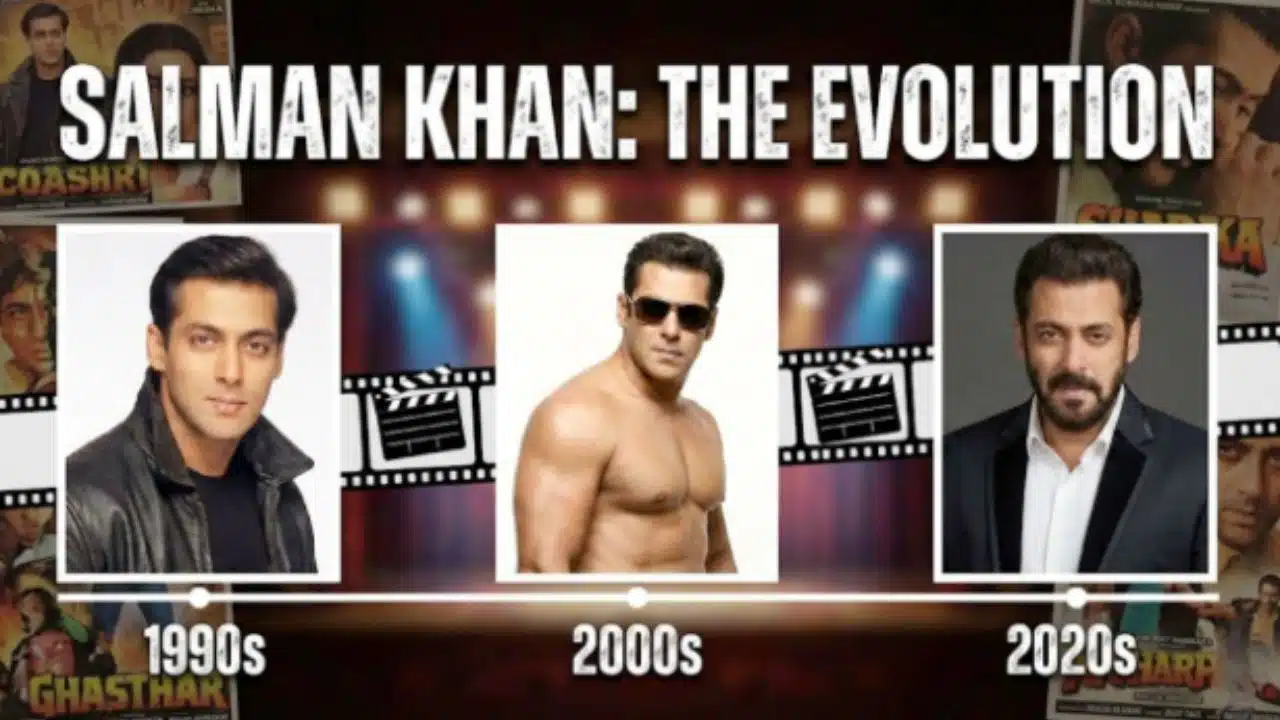
Salman Khan is one of the few Hindi film stars who has stayed “mainstream” for almost four decades. Encyclopaedia Britannica notes that he has appeared in more than 100 movies and remains deeply linked with popular culture in India.
Fans often explain his long journey through two famous on-screen identities: Prem and Chulbul Pandey. Prem is gentle, romantic, and family-first. Chulbul is bold, funny, and larger than life. This article explains the Salman Khan evolution in a clear way, using simple language and useful tables, so you can understand how his roles, style, and audience connect changed over time.
Salman Khan evolution: a simple roadmap from Prem to Chulbul
Salman’s screen image did not change in one step. It changed in phases. Each phase matched what audiences wanted at that time. It also matched what Bollywood was selling most.
Encyclopaedia Britannica describes him as one of the three most successful male stars of Bollywood since the 1990s (along with Shah Rukh Khan and Aamir Khan). That kind of long success usually needs reinvention.
At-a-glance: career phases
| Phase | Rough period | Core image | What audiences got |
| “Prem” foundation | late 1980s–1990s | romantic, sincere, family-friendly | love stories + family values |
| Expansion years | late 1990s–2000s | mix of romance, drama, comedy, action | variety + stronger screen persona |
| Mass-action reset | 2009 | sharper action hero | comeback energy + crowd moments |
| Pop-culture peak | 2010 onward | iconic “mass” hero (Chulbul-style) | swagger + comedy + action |
| Multi-platform stardom | 2010 onward | movie + TV + public identity | bigger reach and constant visibility |
Why this evolution matters in Bollywood
Bollywood runs on audience taste. When taste changes, stars must adapt.
Salman’s career matters as a case study because:
- He held a strong family audience in the 1990s.
- He rebuilt a mass-action identity in the late 2000s.
- He created a character (Chulbul Pandey) that became a pop-culture shorthand.
Encyclopaedia Britannica also notes he is a film producer and a television host, which matters because modern stardom is not only about films.
Why this story is worth reading
| Reason | What it shows | Why it helps readers |
| Longevity | decades of relevance | explains how stars survive change |
| Reinvention | image updates over time | shows how branding works in cinema |
| Culture impact | characters become trends | explains why some roles last longer |
| Industry shifts | romance → action-event films | maps Bollywood’s mainstream changes |
The “Prem Era” — the romantic hero template
How the Prem image started
Salman Khan’s breakout as a leading man is strongly tied to Maine Pyar Kiya (1989). The Filmfare site notes that he won the Filmfare Award for Best Male Debut for the film.
This is also the period where the “soft hero” image formed: warm smile, gentle romance, and a story that families could watch together.
What “Prem” meant to audiences
“Prem” was not only a name. It became a type of hero:
- polite
- emotional, but not heavy
- respectful in love
- rooted in family spaces (weddings, rituals, home drama)
This is where the Salman Khan evolution begins: he first builds trust and affection through romance and family values.
Key Prem-era milestone: Hum Aapke Hain Koun..!
Hum Aapke Hain Koun..! (1994) is one of the biggest examples of the family-romance template. Box Office India’s note calls it “the highest grossing film of all time” at that point and says it broke the records of Sholay, which had stood for 19 years.
That is a huge signal. It means the “Prem-style” hero did not just work. It worked at the highest level possible in its era.
Prem era at a glance
What the Prem era gave him (simple list)
- a wide family fanbase
- a “clean” hero identity
- strong recall value (songs, romance, celebrations)
- repeat viewings and long runs (common for family hits)
The transition phase — from romance to a wider screen identity
After the early base, Salman moved through mixed genres. This phase is important because it prevented him from being locked into only romance.
This is also when the screen persona becomes “bigger.” The character is still important, but the star’s presence becomes a key selling point.
What changed in this phase
- Tone: from soft romance to sharper emotion
- Energy: more attitude and stronger “entry” framing
- Genre mix: comedy + action + drama combinations grew
What stayed consistent
- strong screen presence
- comfort with music and dance
- emotional pull in family scenes
Transition phase at a glance
| What you notice | Earlier years | Transition years |
| Dialogue style | softer, sweet | sharper, more punch |
| Body language | gentle, open | more swagger, more confidence |
| Film tone | romance-led | mixed tone (romance + action + comedy) |
| Audience promise | family love story | wider “entertainer” package |
The superstar blueprint — the mass entertainer era takes over
By the late 2000s, Hindi cinema leaned hard into “event films.” These films were designed for big openings and crowd response.
Wanted (2009): the reset moment
Encyclopaedia Britannica describes Wanted (2009) as the film that “supercharged” his career and marked a strong comeback after weaker box office years.
In simple terms: Wanted helped audiences see him again as a crowd-pulling action lead. This is a key pivot in the Salman Khan evolution.
Why Wanted worked (simple explanation)
- action-forward plot
- fast pace and punchy hero scenes
- strong “mass” framing of the lead
For global context, Box Office Mojo lists a worldwide gross figure for Wanted (2009) (with region breakdown).
Wanted at a glance
| Item | Detail |
| Release year | 2009 |
| Type | Hindi action thriller |
| Why it matters | comeback + action identity strengthened |
| Worldwide gross (Mojo) | Listed by Box Office Mojo |
Chulbul Pandey in Dabangg (2010) — the pop culture explosion
If Wanted reopened the door, Dabangg turned the comeback into a full wave.
Wikipedia’s film page notes that Dabangg released on 10 September 2010, during Eid, in nearly 2,100 cinemas worldwide.
Encyclopaedia Britannica also highlights the character and the film’s huge popularity.
Why the Chulbul Pandey character felt fresh
Chulbul is built on contrast. He can be funny and dangerous in the same scene. He can tease, fight, and still land an emotional moment without breaking the film’s tone.
This mix is important in mass cinema. People want:
- laughs
- action
- a hero who feels “unstoppable”
- enough emotion to feel invested
Style and real-world impact
Britannica describes how Chulbul Pandey’s styling influenced pop culture, including the well-known sunglasses-on-collar look.
Awards proof: National Film Award
Multiple credible outlets reported Dabangg winning the National Film Award for Best Popular Film Providing Wholesome Entertainment:
- India Today reported the win at the 58th National Film Awards.
- NDTV also reported the award win.
Box office numbers (trade reporting)
For quick numbers, Bollywood Hungama’s box office page lists Dabangg at about ₹221.14 crore worldwide, and includes India net and overseas breakdown.
Dabangg at a glance
Prem vs Chulbul — the simplest comparison
This helps if you want a quick understanding in 15 seconds.
Prem vs Chulbul
| Feature | Prem | Chulbul Pandey |
| Core vibe | sweet and sincere | swagger + humour |
| Setting | family, romance, celebrations | action, rivalry, public power |
| Dialogue | soft and emotional | punchy and playful |
| Audience feeling | comfort and warmth | cheering, whistles, repeat scenes |
| Pop culture | songs and romance memories | gestures, look, “mass” moments |
Beyond characters — how his brand grew outside cinema
A big star today is also a constant public figure.
Bigg Boss and TV presence
Wikipedia’s page for Bigg Boss Season 4 lists:
- Presenter: Salman Khan
- First aired: 3 Oct 2010
- Last aired: 8 Jan 2011
- Days: 97
That weekly visibility matters. It keeps the star in homes even when films are not releasing.
Being Human Foundation
The official Being Human site states it is a registered charitable trust established in 2007, working in education and healthcare for the underprivileged.
This is also part of his public identity. It adds a “real world” layer beyond films.
This is another key part of the Salman Khan evolution: the star identity grows across cinema, TV, and public initiatives.
Brand pillars at a glance
| Area | What it does for public image |
| TV hosting (Bigg Boss) | constant visibility + mass connect |
| Being Human Foundation | public-facing charity identity |
| Film producer role | more control and business presence |
The craft behind the persona — what actually changed on screen
Even in simple commercial films, screen craft matters. Salman’s shift from romance to mass action also shows technique shifts.
1) Body language
- Prem stands softer and more open.
- Chulbul leans into swagger and control of space.
2) Dialogue rhythm
Mass cinema likes shorter, repeatable lines. The delivery becomes tighter and more “beat-based.”
3) Style as storytelling
The look is not only fashion. It becomes part of the character’s identity. Britannica notes the cultural spread of Chulbul’s styling.
4) Emotion still matters
Even when the films get louder, the emotional core often stays simple. This helps family audiences stay connected.
Craft checklist
| Craft area | Prem-era feel | Chulbul-era feel |
| Movement | gentle, calm | swagger, bold |
| Dialogue | soft, emotional | punchy, crowd-ready |
| Styling | clean, simple | iconic and “copyable” |
| Emotional beats | romance and family | family + righteous anger + humour |
Legacy — what this journey says about Bollywood
Salman’s story mirrors larger Bollywood patterns:
- 1990s: romance + family dramas with strong music
- later: action-comedy entertainers and big holiday releases
- now: franchise thinking, “event film” marketing, and star-led openings
Britannica explains why he sits at the top of modern Bollywood: long career span, huge film count, and sustained popularity.
Legacy snapshot
| Legacy area | What it means |
| Career longevity | staying relevant across decades |
| Character impact | roles become cultural shorthand |
| Bollywood shift | romance hero → mass entertainer |
| Brand building | films + TV + public identity |
Quick “real-time” update from the web (as of Dec 27, 2025)
To keep this article current, here are a few web-reported updates connected to his present-day visibility.
- News outlets reported Salman Khan turned 60 on 27 December 2025.
- Trade and business press reported chatter around his upcoming project Battle of Galwan, including release-date planning and industry schedule movement.
Current context
| Item | What’s being reported |
| 60th birthday | Dec 27, 2025 coverage |
| Battle of Galwan talk | schedule / teaser-related reporting |
What to watch next — a Salman Khan starter watchlist
If you want to “see” the shift instead of only reading about it, use this simple watch plan.
Watchlist (quick table)
| Mood | Start with | Why |
| Pure romance + innocence | Maine Pyar Kiya | early romantic template + major debut win |
| Big family celebration film | Hum Aapke Hain Koun..! | record-breaking family blockbuster note |
| Action comeback bridge | Wanted | Britannica calls it a comeback supercharge |
| Full mass-pop culture impact | Dabangg | National Award + huge box office listing |
Takeaways
The Prem-to-Chulbul story is not just fan talk. It shows how a mainstream Hindi film star can change with the industry while keeping a familiar core. The Salman Khan evolution starts with trust and warmth in the romance era, then pivots into action-led crowd cinema, and finally lands in pop culture through a character like Chulbul Pandey, backed by awards, trade success, and lasting recall.
FAQs on Salman Khan’s Evolution: Prem to Chulbul Pandey
Why is “Prem” so closely linked to him?
Because that early romantic image became a repeatable template that audiences trusted, and it was strengthened by huge family hits and awards-linked debut success.
Why did Wanted matter so much?
Britannica describes it as a strong comeback that restarted his mass-action run.
Did Dabangg really win a National Film Award?
Yes. India Today and NDTV both reported it winning Best Popular Film Providing Wholesome Entertainment at the 58th National Film Awards.





















