

The war enters its fifth year, and the conflict in Ukraine has hardened into a deadly operational deadlock characterized by high-intensity attrition and rapid technological evolution. This Russia-Ukraine War Situation analysis outlines a pivotal moment: while Russia has secured its most significant territorial gains since the opening months of the invasion, Kyiv is instigating a massive command overhaul to stem the tide.
President Volodymyr Zelenskyy has signaled a decisive shift away from conventional trench warfare by appointing his Intelligence Chief, Kyrylo Budanov, as his new Chief of Staff, placing asymmetric warfare doctrine at the very heart of the Ukrainian state.
The mood in Kyiv is grim but determined. The new year broke not with a ceasefire, but with a “heinous” missile strike on a residential district in Kharkiv that has left dozens of civilians dead or wounded. Simultaneously, rumors of a “90% ready” US-brokered peace deal circulate through diplomatic channels, yet the fighting on the ground, particularly in the Donbas “meat grinder”, shows no sign of de-escalating.
Key Takeaways
- Territorial Shift: Russia gained ~5,600 sq km in 2025, the most significant advance since 2022, but at the cost of nearly 420,000 casualties.
- Political Pivot: The appointment of “Spymaster” Budanov as Chief of Staff signals a more aggressive, unconventional Ukrainian strategy for 2026.
- Civilian Toll: The war remains brutal for civilians, evidenced by the Jan 2 Kharkiv strike killing children and destroying homes.
- Tech Escalation: The war has moved beyond conventional jamming; “fiber-optic” drones and AI systems are now the deciding factors on the frontline.
Battlefield Dynamics: The High Cost of Ground
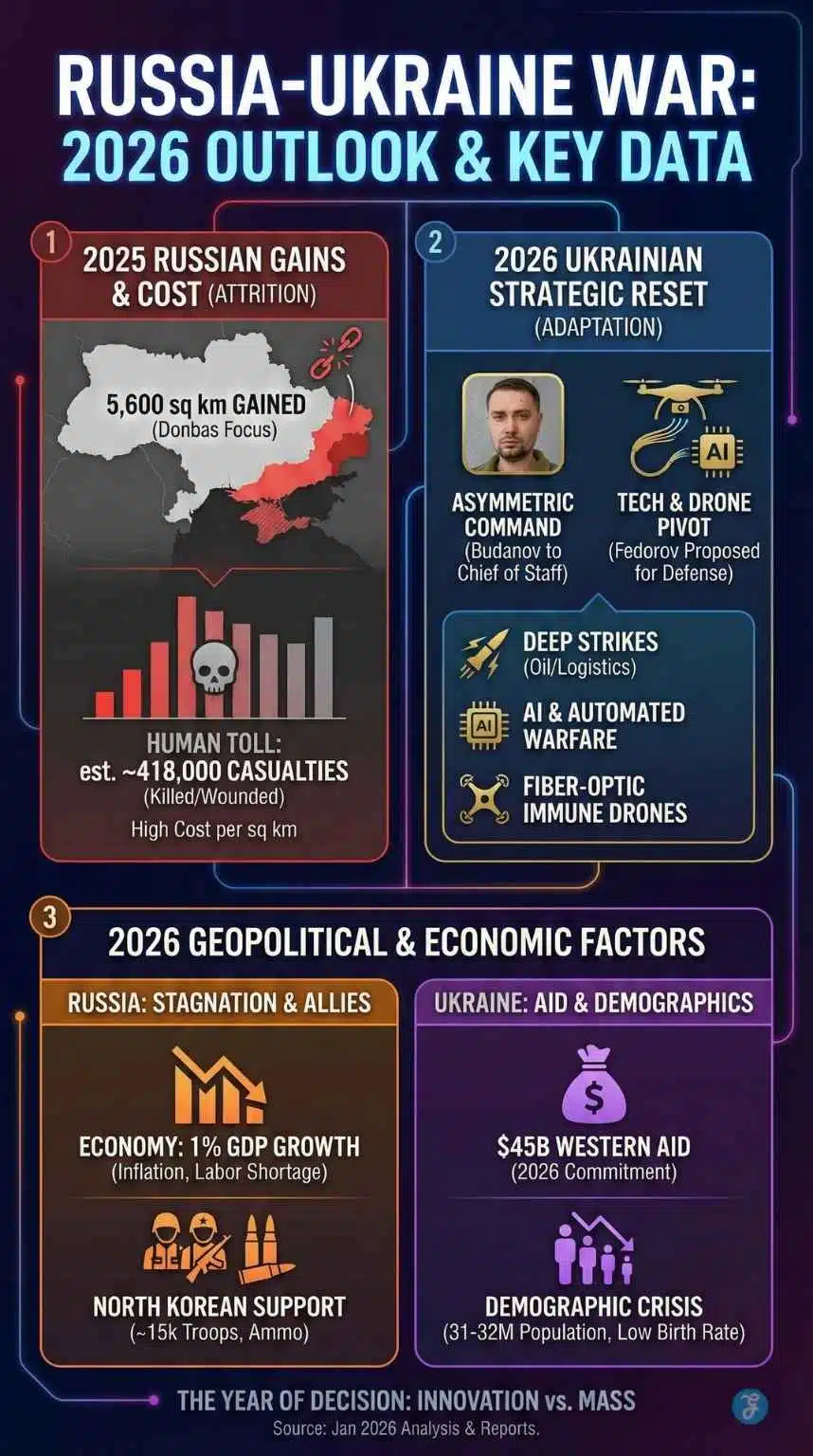
The 2025 campaign season has officially closed with a grim statistic for Ukraine: Russian forces have captured approximately 5,600 square kilometers of territory over the last 12 months. This figure, confirmed by AFP and Institute for the Study of War (ISW) analysis, represents nearly 1% of Ukraine’s total landmass, a gain larger than the previous two years combined.
The “Pokrovsk” Crisis
The epicenter of the conflict remains the Pokrovsk direction in the Donetsk region. Once a rear logistics hub, Pokrovsk is now the frontline.
- Tactical Shift: Russian success here is attributed to a shift from mechanized columns to “infiltration tactics”, mass, small-group infantry assaults that probe for weak points 24/7.
- Current Status: As of Jan 3, the Ukrainian General Staff reports 116 combat engagements in the last 24 hours alone, with the heaviest concentration around Pokrovsk. The loss of this sector would threaten the logistical spine of Ukraine’s defense in the remaining free Donbas.
The War Economy: Stagnation vs. Subsistence
While Russian troops advance, the Russian economy is hitting a wall. 2025 marked the end of Moscow’s “military Keynesianism” sugar rush. After two years of war-driven growth, the Russian economy is projected to stagnate in 2026 with barely 1% GDP growth.
- The Inflation Trap: The Kremlin’s massive injection of cash into the defense sector has triggered labor shortages and inflation that the Central Bank’s 16% interest rates cannot tame.
- Ukraine’s Lifeline: Conversely, Ukraine’s economy has stabilized at a low equilibrium, largely thanks to the $45 billion aid package secured for 2026. However, with a debt-to-GDP ratio climbing, Kyiv is now entirely dependent on the “financial lung” of Western donors to keep the lights on.
The “Meat Grinder” Mathematics
Moscow’s gains have come at a staggering human cost. Analysis indicates that Russian forces suffered approximately 416,570 to 418,000 casualties (killed and wounded) in 2025.
- Exchange Rate: This equates to roughly 78 Russian casualties for every square kilometer seized.
- Strategic implication: While Russia is trading blood for land, the rate of advance has accelerated. In November 2025 alone, Russian forces seized over 700 sq km, their fastest monthly pace since March 2022.
The Air War & Strategic Strikes
The air war has intensified, with Russia aiming to break Ukrainian civilian morale through targeted strikes on infrastructure and residential zones.
The Jan 2 Kharkiv Tragedy
On the second day of 2026, two Russian ballistic missiles slammed into a multi-story apartment complex in the Kyivskyi district of Kharkiv.
- Casualties: At least 2 people were confirmed dead, including a 3-year-old boy. Over 30 others were injured, with rescue crews still combing the smoldering rubble as of this morning.
- The Narrative War: The Russian Ministry of Defense denied the strike, claiming the explosion was caused by a “Ukrainian ammunition depot” detonating—a standard denial used throughout the war.
Drone Warfare Evolution
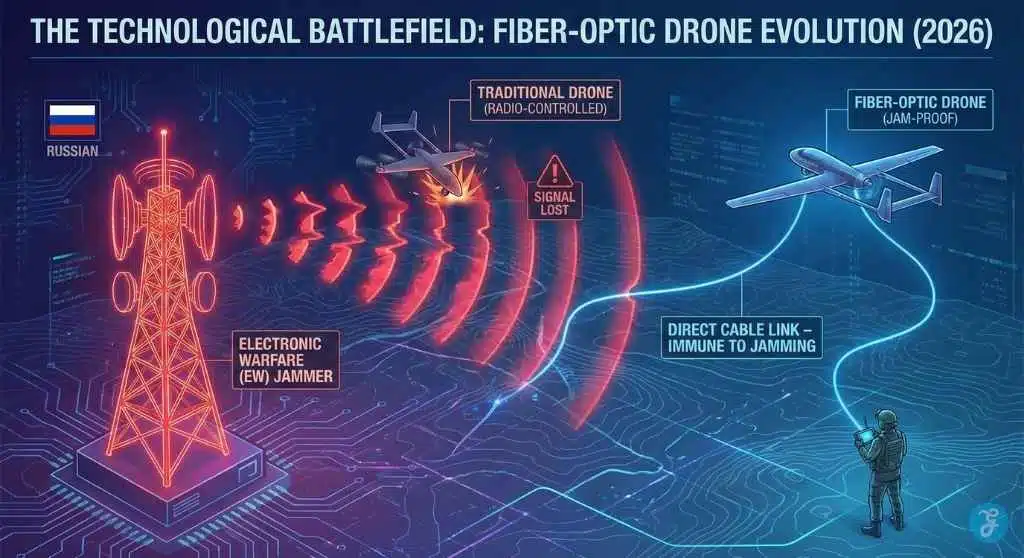
2025 saw a complete transformation in drone warfare. Russian forces have begun mass-deploying “fiber-optic” drones. These wire-guided units are immune to traditional Electronic Warfare (EW) jamming, rendering many of Ukraine’s defensive jammers obsolete. In response, Ukraine has ramped up strikes on Russian rear logistics, hitting oil refineries and command posts with increased frequency.
The “Spiderweb” Front
The most terrifying innovation of 2026 isn’t a missile, but a wire. Russian forces have mass-deployed “fiber-optic” FPV drones that trail miles of thin micro-cables.
- Immunity to Jamming: Unlike radio-controlled drones, these cannot be jammed by Electronic Warfare (EW) systems because the signal travels through a physical wire.
- The Consequence: This has rendered Ukraine’s “Dome” EW defenses—which cost millions to develop—temporarily obsolete. Frontline reports describe villages literally draped in “spiderwebs” of spent fiber-optic cables, a haunting visual of the new technological stalemate.
Political Reshuffle: The “Budanov Doctrine”
Perhaps the most significant development of early 2026 is the political earthquake in Kyiv. Following the resignation of Andriy Yermak in November 2025 amidst a corruption probe, President Zelenskyy has restructured his inner circle to align with a “Total War” footing.
The New Chief of Staff: Kyrylo Budanov
Zelenskyy has appointed Lt. Gen. Kyrylo Budanov (formerly head of the GUR military intelligence) as his Chief of Staff.
- Significance: Budanov is the architect of Ukraine’s most daring cross-border raids and deep strikes. His move to the President’s side suggests Ukraine’s 2026 strategy will prioritize asymmetric operations—sabotage, assassinations, and deep drone strikes inside Russia, over static defense.
The Tech Pivot: Fedorov to Defense
Reports confirm Zelenskyy intends to replace Defense Minister Denys Shmyhal (who held the post for just six months) with Mykhailo Fedorov, the current Minister of Digital Transformation.
- The Goal: Fedorov is the father of Ukraine’s “Army of Drones.” His appointment would signal a definitive pivot toward Automated Warfare, using AI and robotics to offset Russia’s manpower advantage.
| Position | New Appointee | Strategic Signal |
| Chief of Staff | Kyrylo Budanov | Shift to intelligence-driven, asymmetric warfare. |
| Defense Minister | Mykhailo Fedorov (Proposed) | Prioritization of AI, Drones, and Tech over legacy systems. |
The Autocrats’ Alliance: The North Korean Factor
The war has internationalized. In his New Year’s address to Kim Jong Un, Vladimir Putin hailed 2025 as a “pivotal” year for Russia-DPRK relations. This is not empty rhetoric:
- Boots on the Ground: Intelligence confirms that nearly 15,000 North Korean troops are now operating in rear-guard and engineering roles in occupied Ukraine, freeing up Russian contract soldiers for the meat-grinder assaults in Pokrovsk.
- The Ammunition Pipeline: North Korean artillery shells now account for an estimated 30% of all rounds fired by Russia, a logistical lifeline that has allowed Moscow to maintain a 5:1 artillery advantage despite Western sanctions.
Diplomatic Frontiers & The “90%” Peace Deal
Despite the violence, diplomatic gears are grinding. High-level security talks are underway in Kyiv today, attended by national security advisors from ~15 nations, including EU and NATO representatives.
- The “90% Deal”: In his New Year’s address, President Zelenskyy tantalizingly claimed a US-brokered peace framework was “90% ready.” However, the remaining 10% contains the hardest hurdles: the status of occupied territories and security guarantees for Ukraine.
- Summit in France: A leaders’ summit for the “coalition of the willing” is scheduled for next week in France to discuss long-term security commitments, attempting to “Trump-proof” aid packages for the year ahead.
The Silent Crisis: A Demographic Abyss
Beyond the daily casualty reports lies a darker reality: Ukraine is facing the sharpest population decline in modern European history.
- The Numbers: From a pre-war population of ~42 million, estimates suggest only 31-32 million people currently reside in government-controlled territories.
- The Future: With birth rates plummeting to world-record lows (approx. 0.7 children per woman), Ukraine is fighting not just for its land, but for its biological survival. Even if the war ends tomorrow, the “missing generation” will haunt the nation’s economy for decades.
Frequently Asked Questions
Is the war ending in 2026?
While rumors of a peace deal are circulating, the reality on the ground contradicts them. Russia’s accelerated offensive in the Donbas and Ukraine’s aggressive command reshuffle suggest both sides are preparing for a decisive year of fighting, not immediate de-escalation.
Who is Kyrylo Budanov, and why does his appointment matter?
Budanov was Ukraine’s military intelligence chief, known for high-risk operations against Russia. His appointment as Zelenskyy’s right-hand man means the entire government will likely adopt his high-risk, high-reward philosophy, focusing on hurting Russia internally rather than just holding defensive lines.
What is the “Pokrovsk Direction”?
Pokrovsk is a key city in the Donetsk region that serves as a vital logistics hub for Ukrainian forces. If it falls, it becomes much harder for Ukraine to supply its troops in the east, potentially forcing a retreat to less favorable defensive positions.
How much territory does Russia occupy now?
Russia currently occupies just under 20% of Ukraine. While they gained ~1% more in 2025, the vast majority of the country remains under Kyiv’s control, though the frontline is slowly creeping westward.
What are “fiber-optic” drones?
These are drones controlled by a physical spool of thin wire rather than radio waves. This makes them impossible to “jam” with electronic warfare devices, which had previously been Ukraine’s main defense against Russian drones.
Final Thought: The Year of the Gamble
2026 begins not with hope, but with a hardening of resolve. By promoting his spymaster and his digital architect to the highest offices, Zelenskyy is betting that innovation and intelligence can defeat mass and attrition. Russia has the numbers, but Ukraine is rewriting the rules of engagement.
The question for the coming year is simple: Can Ukraine’s new “tech-war” strategy break the Russian army before the sheer weight of Russian numbers breaks the Ukrainian line?





















