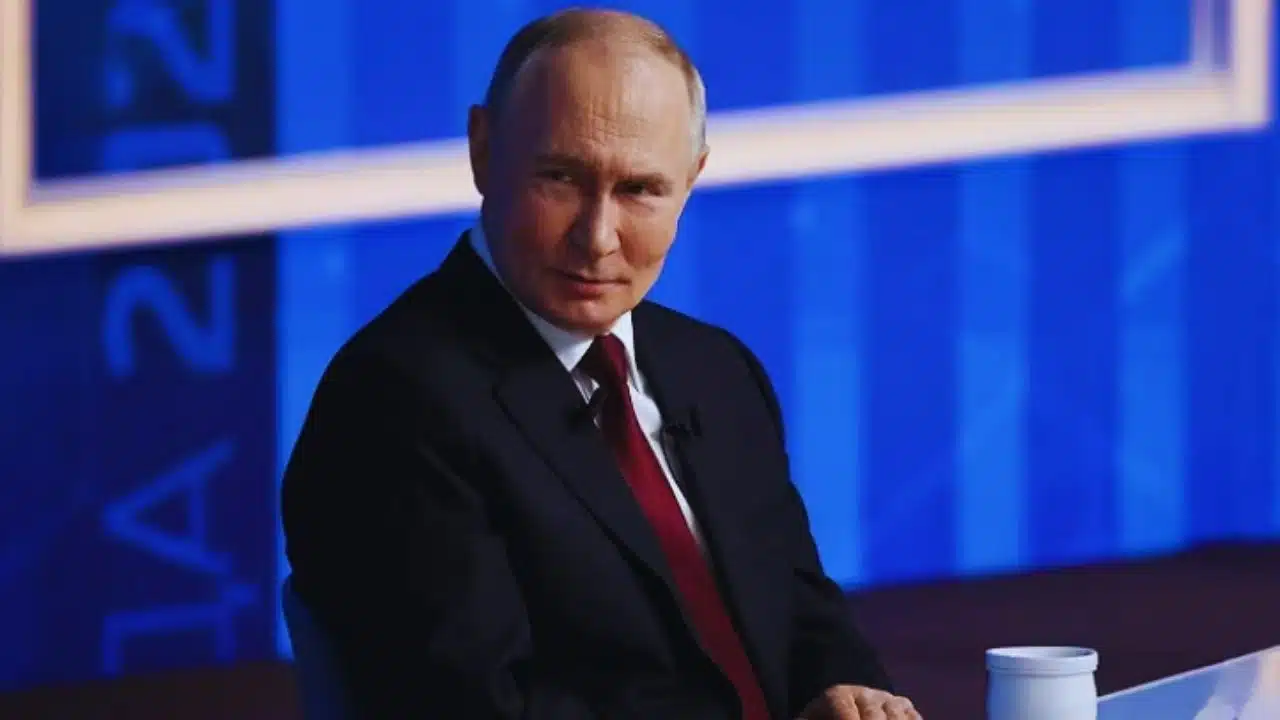
Putin demands Ukraine territory acceptance as a precondition for peace talks, repeating in Moscow on Dec. 19, 2025 that any deal must recognize Russia’s claims and Ukraine must accept strict security limits.
What Putin demanded and why he says it matters?
Russian President Vladimir Putin used his annual year-end news conference and call-in show in Moscow on Dec. 19, 2025 to restate his core message on the war: Russia is prepared to negotiate, but only if Ukraine and its partners accept what Moscow calls the “realities on the ground.”
In practical terms, that means Putin wants any peace process to begin from Russia’s territorial claims. Moscow says it annexed Ukraine’s Crimea in 2014 and later declared four more Ukrainian regions—Donetsk, Luhansk, Zaporizhzhia, and Kherson—as part of Russia in 2022. Ukraine and most of the international community reject those claims as illegal.
Putin’s position is not presented by the Kremlin as a bargaining opening. It is framed as a foundation. Russian officials argue that because Russia says these territories are now part of the Russian state, they should be treated as non-negotiable in any final settlement.
Alongside territory, Putin again linked peace to a broader set of political and military requirements. Russia’s stated approach has typically included:
- Ukraine staying outside NATO and not becoming a long-term military platform for the West
- Limits on Ukraine’s armed forces and military infrastructure
- A settlement that addresses what Moscow calls the “root causes” of the conflict, including NATO’s posture near Russia’s borders
At the Dec. 19 event, Putin also projected confidence about Russia’s battlefield position. He said Russian forces are advancing and that Moscow can continue the war if its conditions are not met. This messaging serves two audiences: domestically, it is designed to signal control and endurance; internationally, it is intended to strengthen Russia’s negotiating posture by suggesting time favors Moscow.
Ukraine and allies reject the territorial ultimatum
Ukraine’s position remains consistent: it will not recognize territory seized by force. Ukrainian officials have argued that formalizing territorial loss would not create lasting peace. Instead, they say it would create a pause that Russia could use to regroup before applying pressure again.
For Kyiv, the territorial issue is not only about national identity. It affects security, economics, and the credibility of any future agreement. A settlement that validates annexation would, from Ukraine’s view, reduce deterrence by showing that military conquest can be rewarded.
This is why Ukraine has emphasized security guarantees as a central requirement in any peace framework. In late 2025 discussions with the United States and consultations with European partners, Ukraine has pushed for guarantees strong enough to prevent a renewed attack—whether that means long-term military assistance, binding commitments, or a monitored security architecture that would make another invasion far more costly.
European governments, while differing in detail, have broadly supported two principles: Ukraine must be included in any negotiations, and borders should not be changed by force. Many officials also argue that any ceasefire without credible enforcement could simply freeze the conflict rather than end it.
At the same time, Western capitals face competing pressures: the desire to reduce casualties and stabilize Europe’s security environment, and the concern that a deal on Russia’s terms could weaken international rules meant to prevent wars of conquest.
Why “territory” is the hard barrier: control on the ground and international law?
Territory is at the center of this war because it determines who controls people, infrastructure, ports, industry, and supply lines—and because it shapes the security map of Eastern Europe.
Russia’s territorial claims go beyond what it fully controls militarily. Even in the four regions Moscow says it annexed in 2022, Russian forces do not necessarily hold every district or city. That creates a major negotiation problem: Russia’s maximal claims are larger than its current frontline in several areas, meaning Ukraine could be asked to concede land it still governs.
Another major barrier is legal. The United Nations has passed resolutions rejecting attempted annexations and affirming Ukraine’s territorial integrity. Many states view recognition of annexed territory as incompatible with the UN Charter principle that countries should not acquire land through force. This legal position shapes what many governments can support without undermining international norms they rely on elsewhere.
Snapshot: what each side says it needs?
| Core issue | Russia’s stated demand | Ukraine’s stated stance | Main implication |
| Sovereignty over occupied areas | Recognition of Russia’s claims over Crimea and four regions | No recognition of annexation; sovereignty must be restored | This is the primary deadlock |
| Security alignment | Ukraine must remain outside NATO and accept strict limits | Ukraine seeks guarantees strong enough to deter future invasion | Guarantees require enforcement mechanisms |
| Sequence of a deal | Terms-first approach that locks in conditions | Talks possible, but rejects ultimatums; wants security first | Timing and trust are major obstacles |
Timeline of key reference points
| Date | Event | Why it matters to today’s demands |
| 2014 | Russia took control of Crimea | Sets the precedent Moscow wants recognized |
| Feb. 24, 2022 | Full-scale invasion began | The war’s modern phase and the basis for later annexation claims |
| Sept. 2022 | Russia declared annexation of four regions | Forms the “non-negotiable” territorial package Russia repeats |
| Dec. 19, 2025 | Putin reiterates conditions publicly | Signals no visible softening on territory in late-2025 diplomacy |
This context explains why the same demand keeps resurfacing. For Moscow, territory is the prize that validates the war’s goals. For Kyiv, conceding territory is seen as weakening the state and making another war more likely.
The diplomatic track in late 2025: security frameworks, draft points, and money
While Putin repeated his conditions in Moscow, parallel diplomatic efforts continued in the United States and Europe to explore a framework for ending or pausing the war.
Ukraine has taken part in new rounds of discussions with the U.S. side focused on long-term security guarantees and what a broader settlement might require. Ukrainian officials have described progress on multiple documents, but they have also signaled that the territorial question remains unresolved and is the most politically sensitive element.
The U.S. track has been paired with European consultations, since any durable security arrangement for Ukraine would likely depend on European participation—whether through security forces, training and arms support, monitoring, or other long-term commitments. Different models have been discussed publicly in recent months, including some form of European security presence and a monitored ceasefire mechanism, but the details depend on political consent across many capitals and on whether Russia would accept such terms.
At the same time, the economic dimension is growing more urgent. Ukraine’s war economy needs reliable support for basic state functions, reconstruction planning, and long-term debt sustainability. European leaders have continued debating major financial packages, including large-scale loans, while also grappling with legal and political disputes over whether—and how—frozen Russian assets could be used.
Putin, for his part, has repeatedly warned that Western use of frozen Russian assets would have long-term consequences for trust in Western financial systems. Western governments have argued they need mechanisms to support Ukraine over the long haul, particularly if the war continues or if a ceasefire requires major stabilization funding.
Another complication is assessment of Russia’s strategic aims. Public reporting in late 2025 has highlighted that U.S. intelligence assessments have not necessarily aligned with optimistic claims that Russia is ready to end the war on terms acceptable to Ukraine. That gap matters, because it influences how much risk Western governments believe they can take when designing guarantees and determining what to concede.
In short, diplomacy is active, but it is not yet converging. Talks can produce draft language, but the territorial gap and the enforcement question remain wide.
What to watch next and what could change?
Putin’s Dec. 19 statement reinforces a reality that has defined the conflict for years: Russia still presents its peace terms as a package built around territorial recognition and Ukraine’s reduced security options. Ukraine still sees those demands as incompatible with sovereignty and long-term safety.
What happens next will likely depend on whether negotiators can find a structure that reduces violence without forcing immediate legal recognition of territorial seizure. A ceasefire that freezes lines without resolving sovereignty claims is one possible path, but it raises difficult questions: who monitors it, what happens after violations, and what guarantees prevent renewed war.
The next weeks may bring three developments worth watching:
- Whether U.S.-Ukraine talks produce a publicly described framework for security guarantees
- Whether European governments unify around a concrete enforcement model that is politically sustainable
- Whether Russia shows any willingness to discuss sequencing—such as a monitored ceasefire first—without demanding upfront recognition of territory
For now, Putin’s posture suggests Moscow believes it can either win more on the battlefield or use endurance as leverage at the negotiating table. Ukraine and its partners, meanwhile, continue to insist that any deal must protect sovereignty and make a future invasion harder, not easier.