

For decades, the “Digital Divide” has been a defining feature of the modern economy. Urban centers enjoyed fiber-optic speeds, while rural communities struggled with spotty 3G or expensive satellite connections. But as we settle into 2026, a seismic shift has occurred. Rural 5G coverage is no longer a futuristic promise; it is an operational reality in vast swathes of the globe, from the frozen forests of Scandinavia to the humid soy plantations of Brazil.
This isn’t just about faster Netflix streaming for farmhouses. The deployment of rural 5G is fundamentally reshaping global agriculture, healthcare, and education. Powered by low-band spectrums that travel for miles and Fixed Wireless Access (FWA) technology that bypasses the need for cables, telecom operators have finally cracked the code for profitable rural connectivity.
In this deep dive, we explore the technology making this possible and examine 8 specific regions where the rural 5G revolution is already underway.
Key Takeaways
-
FWA is Key: Fixed Wireless Access is the primary technology replacing expensive fiber in rural areas.
-
Global Leaders: India, China, and the Nordics are currently leading the race in rural coverage statistics.
-
Agriculture Drives Demand: The need for “Precision Agriculture” (IoT, drones) is the biggest commercial driver for rural 5G.
-
700 MHz Spectrum: This low-band frequency is the “workhorse” of rural coverage due to its long range.
The Tech Behind the Transformation: Why Now?

Before examining the regions, it is crucial to understand the technological breakthroughs that allowed rural 5G coverage to explode in late 2025. Previously, 5G was associated with “mmWave” (millimeter wave) technology—super-fast but short-range signals that couldn’t penetrate trees or travel more than a few city blocks. Two key innovations changed everything.
1. Fixed Wireless Access (FWA): The “Air Fiber”
FWA has emerged as the “killer app” for rural internet. Instead of digging expensive trenches to lay fiber-optic cables to every remote farmhouse, operators beam high-speed internet wirelessly from a nearby cell tower to a receiver on the customer’s roof. By early 2026, FWA accounts for over 20% of all new broadband connections globally, primarily in rural areas where cable infrastructure was deemed too costly.
2. Low-Band Spectrum (The “Golden” 700 MHz)
The hero of the rural rollout is the 700 MHz frequency band. Unlike the high-frequency bands used in cities, low-band 5G waves are long. They can travel over 10 kilometers from a single tower and easily penetrate walls, barns, and thick foliage. While not as fast as city speeds, they provide a stable, “always-on” layer of connectivity (typically 50–100 Mbps) that is revolutionary for areas that previously had zero signal.
| Feature | Urban 5G (High-Band/mmWave) | Rural 5G (Low-Band/700 MHz) |
| Range | < 500 meters | > 10 kilometers |
| Penetration | Blocked by trees/walls | Penetrates buildings/foliage |
| Speed | 1 Gbps+ | 50 – 150 Mbps |
| Primary Use | Dense crowds, stadiums | Farming, remote homes, roads |
The 8 Rural Regions Leading the Charge (2026 Global Case Studies)
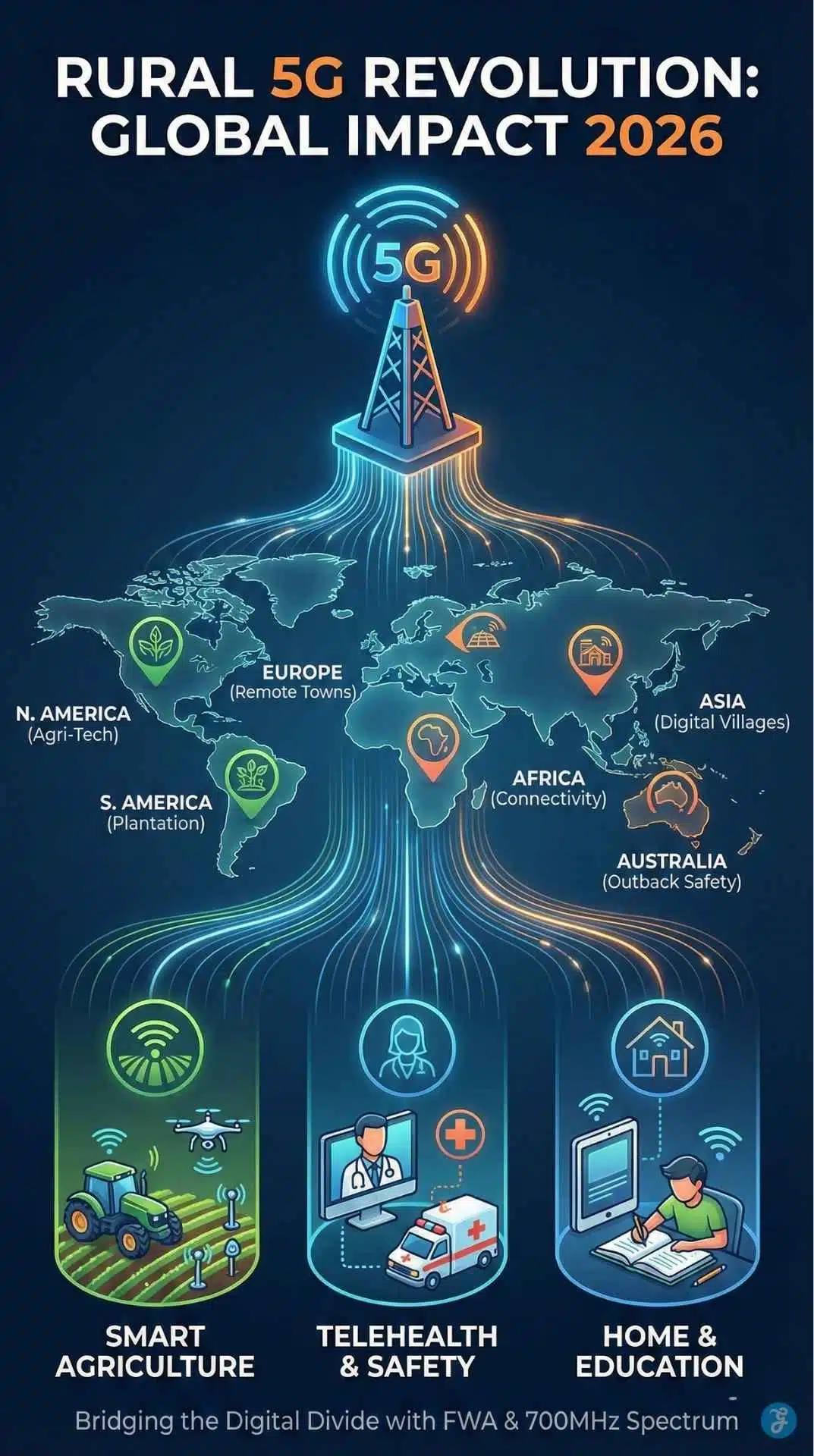
These eight regions have moved beyond pilot programs into full-scale commercial adoption, proving that the digital gap can be bridged.
1. India’s Rural Districts: The “Bharat” Connectivity Miracle
India has executed perhaps the most ambitious rural 5G rollout in human history. Driven by the government’s “Digital India” initiative and fierce competition between telecom giants Jio and Airtel, the country has achieved coverage that seemed impossible just three years ago.
-
The Status (2026): As of early 2026, 5G services have reached 99.6% of all districts in India. Over 469,000 5G Base Transceiver Stations (BTS) have been installed, with a massive percentage dedicated to non-urban areas.
-
The Impact: In states like Bihar, Uttar Pradesh, and Odisha, where physical bank branches and hospitals are scarce, rural 5G has enabled a fintech revolution. Farmers now use UPI (Unified Payments Interface) for instant transactions in local markets, and “Tele-Law” services allow villagers to consult lawyers via video link without traveling to district courts.
-
Key Insight: India skipped the “fiber-to-the-home” phase for many villages, jumping directly to 5G FWA (marketed as “AirFiber”) to connect millions of rural households.
2. The Nordic “High North” (Sweden, Norway, Denmark)
The Scandinavian nations have long been leaders in connectivity, but their recent focus has been on the “High North”—the sparsely populated, freezing regions within the Arctic Circle.
-
The Status (2026): Regulatory bodies in Sweden and Norway imposed strict coverage obligations on 5G spectrum licenses. Operators were not just handed licenses; they were legally required to cover specific “prioritized rural areas.” By late 2025, Norway achieved 99% population coverage for 5G, including the remote Svalbard archipelago.
-
The Impact: The primary beneficiaries are the forestry and energy sectors. In Sweden’s deep forests, autonomous logging trucks now communicate via 5G to coordinate movements and prevent accidents on single-lane logging roads. Additionally, 5G drones connect search-and-rescue teams looking for lost hikers in Norway’s mountains, transmitting high-def thermal video where no human could hike.
3. The US Heartland (Iowa & The Midwest)
While the US coasts (New York, LA) received the first hype, the “Breadbasket” of America has quietly built one of the most sophisticated functional 5G networks in the world, specifically designed for agriculture.
-
The Status (2026): The ARA Wireless Living Lab in central Iowa serves as the global blueprint for rural broadband. Supported by the National Science Foundation, it has deployed a massive swath of “agri-centric” 5G. Commercial carriers like T-Mobile and Verizon have also aggressively expanded their 5G Home Internet services, becoming the primary ISP for millions of rural Midwest residents.
-
The Impact: “Precision Agriculture” is the reality here. John Deere autonomous tractors, connected via 5G, till fields with centimeter-level accuracy. Soil sensors transmit moisture data in real-time, allowing automated irrigation systems to water only the dry patches of a 5,000-acre farm, saving millions of gallons of water annually.
4. China’s “Digital Villages”
China’s approach to rural 5G coverage is driven by sheer infrastructure volume and state mandate. The “Broadband Village” project has ensured that even the most mountainous administrative villages are not left offline.
-
The Status (2026): Latest data indicates that over 90% of China’s administrative villages now have 5G access. The country houses over 3.8 million 5G base stations, more than the rest of the world combined.
-
The Impact: The rise of “Taobao Villages”, rural communities where the local economy is based entirely on e-commerce, has been supercharged. Farmers in remote Yunnan province livestream their harvest of tea and mushrooms directly to buyers in Shanghai and Beijing, bypassing middlemen. This “farm-to-stream” economy relies entirely on the high upload speeds provided by 5G.
5. The UK’s “Not-Spots” (Dorset & Scottish Highlands)
The United Kingdom has spent the last five years battling “not-spots”—geographic areas with zero mobile signal. The solution was the Shared Rural Network (SRN), a unique collaboration where rival operators (EE, O2, Three, Vodafone) share masts to cut costs.
-
The Status (2026): The SRN has successfully expanded 4G and 5G coverage to cover 88% of the UK landmass, with a target of 90% by 2027. Remote areas in the Scottish Highlands and coastal Dorset, previously dead zones, now have a reliable signal.
-
The Impact: In Dorset, the “5G RuralDorset” project has used the tech to monitor coastal erosion with connected buoys and cliff sensors. In agriculture, “smart collars” for dairy cows transmit health data (eating habits, pregnancy status) directly to the farmer’s phone, improving milk yields and animal welfare.
6. Regional Australia (The Bush)
Australia faces the “tyranny of distance” like no other nation. Yet, the push to cover “The Bush” has accelerated due to the closure of 3G networks and the need for safety on long, empty highways.
-
The Status (2026): Telstra and Optus have expanded 5G into regional centers and “fringe” towns. Telstra’s network now covers over 85% of the population with 5G, extending deep into mining regions and farming belts. The “Blue Tick” certification for phones (indicating superior reception in rural areas) now applies to 5G devices.
-
The Impact: Beyond mining logistics, 5G is vital for “Telehealth” in the outback. Remote clinics in Queensland can now connect to specialists in Sydney for high-def video consultations, reducing the need for the Royal Flying Doctor Service to make physical trips for non-emergencies.
7. Southern Europe’s Countryside (Rural Spain & Italy)
In Southern Europe, the challenge isn’t just distance; it’s terrain and history. Ancient hilltop towns with narrow, cobbled streets cannot be dug up for fiber cables.
-
The Status (2026): Spain’s UNICO-Demanda Rural program has been instrumental, aiming for 100% population connectivity. Spain has become a European leader in 5G Standalone (SA) deployment, using the 700 MHz band to blanket rural areas without relying on older 4G infrastructure.
-
The Impact: This has revitalized the “Empty Spain” (España Vaciada), rural areas suffering from depopulation. With robust 5G, digital nomads are moving back to these historic villages, working for companies in Madrid or London while enjoying the rural lifestyle.
8. Brazil’s Agro-Industrial Belt
Brazil is the world’s superpower in soy and coffee, and its 5G rollout has been explicitly tailored to support this “Agro-Industrial” belt.
-
The Status (2026): Recent 5G spectrum auctions included obligations to cover thousands of kilometers of federal highways and rural localities. Pilot projects with Huawei and Nokia in states like Goiás have transitioned into full commercial networks.
-
The Impact: Large plantations use private 5G networks to control fleets of drones that spray pesticides with pinpoint accuracy. For the workers living in these agrarian towns, 5G FWA provides the first true broadband experience, allowing for education and entertainment previously accessible only in São Paulo.
The Real-World Benefits of Rural 5G
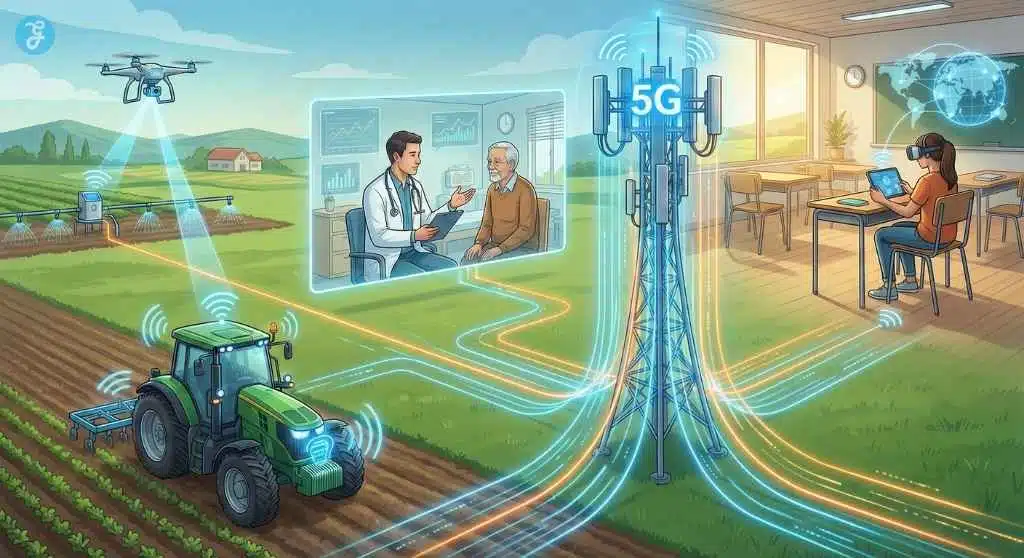
The expansion of rural 5G coverage is not just an infrastructure upgrade; it is a socio-economic catalyst.
1. Smart Farming (Precision Agriculture)
This is the most immediate economic driver.
-
IoT Sensors: Measure soil moisture, nitrogen levels, and temperature every minute.
-
Livestock Monitoring: Connected bio-trackers detect illness in cattle before it spreads.
-
Automation: Tractors and harvesters operate autonomously 24/7 during harvest season.
2. Telehealth & Safety
-
Remote Surgery: While still niche, robotic surgery arms controlled by surgeons hundreds of miles away are becoming feasible in rural clinics due to 5G’s low latency.
-
Ambulance Connectivity: Connected ambulances can send high-res patient data (scans, vitals) to the hospital while en route, allowing doctors to prep the ER before the patient arrives.
3. Education & Equity
-
The Homework Gap: Rural students no longer need to sit in McDonald’s parking lots to use Wi-Fi. 5G FWA brings the classroom to the living room, leveling the playing field with urban students.
Challenges That Remain
Despite the progress, the road to 100% coverage is not without potholes.
-
Power Supply: Remote towers require power. In areas with unstable grids, telecom operators must rely on diesel generators or solar/battery hybrids, adding cost and maintenance complexity.
-
Device Affordability: While the signal might be there, the 5G-enabled smartphones and routers required to use it are often more expensive than 4G devices, which can be a barrier for low-income rural populations.
-
Backhaul Logistics: Connecting the cell tower back to the core network usually requires fiber. Digging fiber to a tower in the middle of a forest is expensive. Many operators are now using “Integrated Access and Backhaul” (IAB) or satellite links (like Starlink) to connect these remote towers.
Final Thought: A Connected Future
As we look at the state of rural 5G coverage in 2026, it is clear that we have passed the tipping point. The convergence of government will, technological maturity (FWA and 700 MHz), and economic necessity (agriculture) has forced the networks outward.
From the wheat fields of Kansas to the rice paddies of Bihar, the invisible waves of 5G are knitting the world closer together. We are no longer building two internets—one for the city and one for the country. We are finally building one.
Frequently Asked Questions (FAQ)
1. Is rural 5G as fast as city 5G?
Generally, no. Rural 5G typically uses “low-band” spectrum (like 700 MHz) to prioritize range over raw speed. You can expect speeds of 50–150 Mbps, which is excellent for streaming and work, but slower than the 1Gbps+ speeds seen in downtown city centers using “mmWave.”
2. How does 5G differ from Starlink or satellite internet?
Starlink uses satellites in space, while 5G uses towers on the ground. 5G generally offers lower latency (lag) than satellite, making it better for Zoom calls and gaming. However, satellites work in the middle of the ocean or deserts where no towers exist. They are often complementary technologies.
3. Will 3G and 4G stop working in rural areas?
3G is already being shut down in most developed nations to free up airwaves for 5G. 4G will remain operational for many years as a backup layer, but eventually, your device will need to be 5G-compatible to get a signal.
4. Is 5G safe for rural wildlife and cattle?
Yes. Extensive research by the World Health Organization (WHO) and radioprotection agencies globally has found no adverse health effects from 5G radio waves on animals or humans. The frequencies used (especially low-band) are very similar to TV and radio signals that have existed for decades.
5. Can I get 5G Home Internet in my rural area?
Likely, yes. Carriers like T-Mobile, Verizon, Jio (India), and EE (UK) have massive coverage maps for 5G Home Internet. It is often cheaper and faster than legacy DSL or satellite connections. Check your local operator’s coverage map.





















