

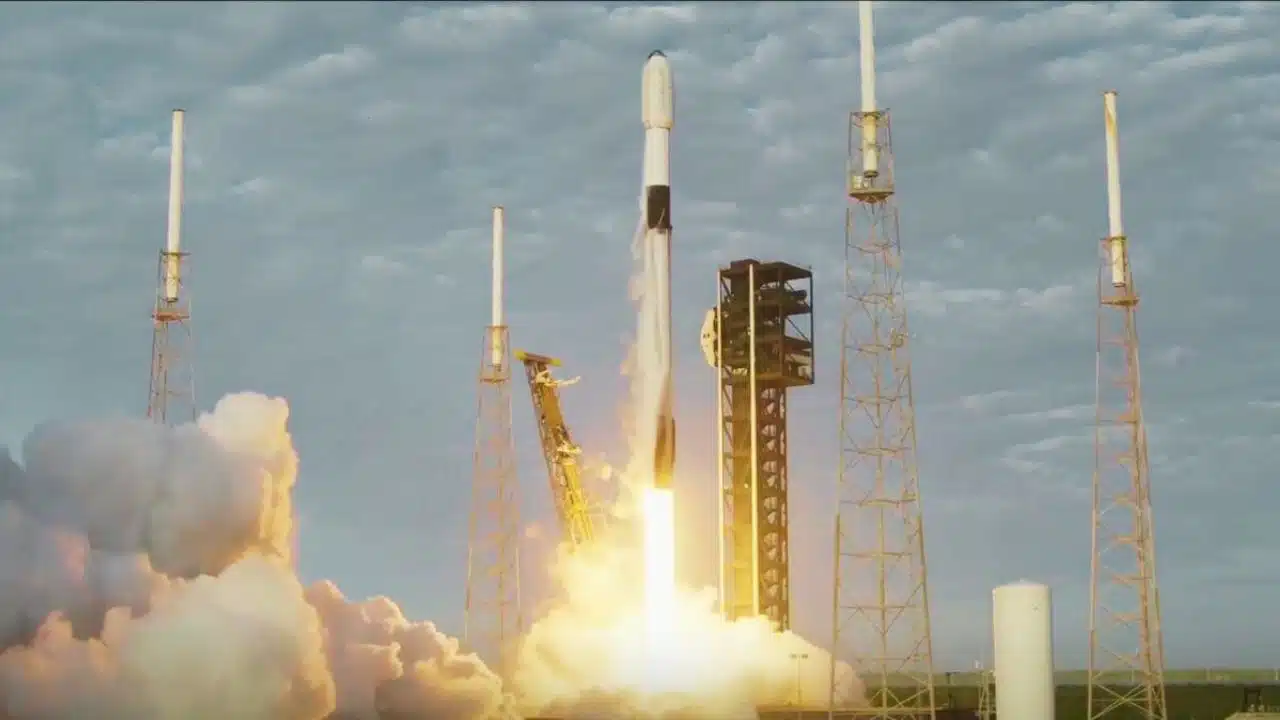
SpaceX has launched a Falcon 9 rocket carrying 28 new Starlink internet satellites into low Earth orbit, adding fresh capacity to its rapidly expanding global broadband constellation. The night-time mission lifted off from Vandenberg Space Force Base in California and featured a brand-new first-stage booster that returned for a drone-ship landing in the Pacific Ocean.
Night launch from California coast
The Falcon 9 rocket lifted off from Space Launch Complex 4 East (SLC‑4E) at Vandenberg Space Force Base at 12:48 a.m. Pacific time on Sunday, November 23, 2025. The vehicle followed a south‑easterly track down the California coast, targeting a low Earth orbit inclined about 53 degrees to the equator for the new Starlink satellites.
The launch had been delayed from an earlier November slot, but weather and technical conditions were favorable for the eventual overnight liftoff. Spectators along parts of the West Coast reported clear views of the rocket’s bright plume as it climbed away from the pad.
Brand-new Falcon 9 joins the fleet
This flight marked the debut of Falcon 9 booster B1100, the eighth new first stage to join SpaceX’s lineup in 2025 as the company balances high launch cadence with fleet renewal. After powering the rocket through the first phase of ascent, the booster separated and executed a controlled descent toward the Pacific.
Roughly eight and a half minutes after liftoff, the booster touched down on the autonomous droneship “Of Course I Still Love You,” stationed downrange off the California coast. The successful landing sets up the booster for future missions, continuing SpaceX’s strategy of rapid reusability to cut launch costs and sustain frequent Starlink deployments.
Deployment of 28 Starlink V2 Mini satellites
The payload comprised 28 Starlink V2 Mini satellites, SpaceX’s newer, heavier generation of spacecraft designed to deliver higher bandwidth and improved performance compared with earlier versions. These satellites were released from the Falcon 9’s upper stage a little over an hour into the mission, completing a carefully timed deployment sequence in low Earth orbit.
The new batch, designated as part of the Starlink “Group 11” series, will gradually raise their orbits and begin on‑orbit checkouts before joining the operational network. Each satellite carries upgraded propulsion and communications hardware intended to boost capacity and support more users per spacecraft.
Expanding a massive broadband constellation
With this flight, Starlink now consists of more than 9,000 satellites launched since 2019, with over 8,700 currently in orbit and supporting millions of customers worldwide. SpaceX recently reported that Starlink has surpassed 8 million customers globally, reflecting fast growth in both consumer and enterprise markets.
The V2 Mini satellites operate in low Earth orbit to reduce signal delay and extend service to remote regions, ships at sea, aircraft, and underserved rural communities. SpaceX has filed plans for tens of thousands of future satellites, signaling that launches like this 28‑satellite mission are part of a long‑term push toward a truly global broadband infrastructure.
A busy year for SpaceX and Starlink
The 28‑satellite mission from Vandenberg is one of more than a hundred Starlink launches already completed in 2025, underscoring SpaceX’s dominance in the commercial launch market. From both California and Florida, Falcon 9 rockets have been flying at a pace of several missions per week, many of them carrying Starlink payloads.
Vandenberg itself has seen more than 60 orbital launches and missile tests so far this year, with at least two additional liftoffs planned before the end of November, including a rideshare Transporter mission. As SpaceX continues adding Starlink batches from both U.S. coasts, each launch like this 28‑satellite flight further cements the company’s role at the center of global space-based connectivity.





















