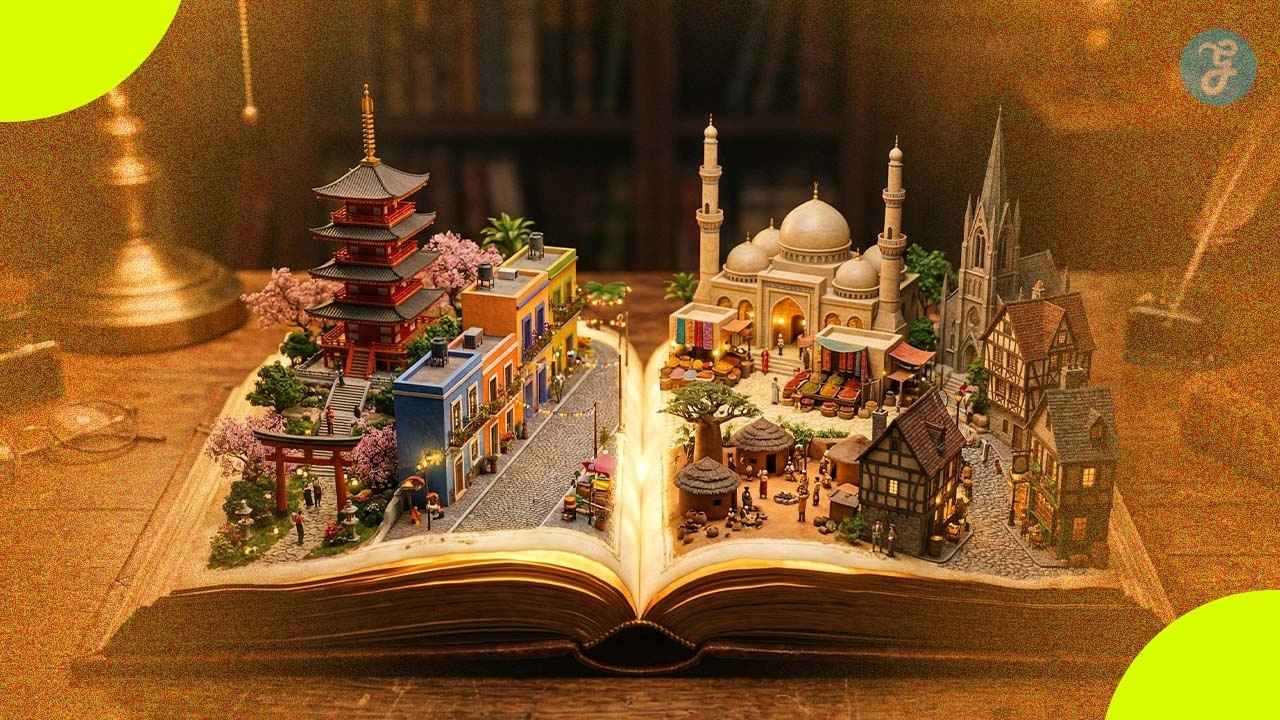
Have you ever looked at your bookshelf and realized almost every author sounds exactly like the ones you studied in school? It is a common experience for many of us. We grow up analyzing Shakespeare and Hemingway, completely missing out on incredible stories from Africa, Asia, and Latin America. This gap means you are only getting half the picture of what great writing actually is. The Rise of World Literature: Stories Beyond The Western Canon opens doors to narratives you never knew existed, changing how you see books forever.
Here is a detail that surprised me: more than 80 percent of books translated into English come from just a handful of countries in Europe and North America. That means thousands of brilliant authors from other parts of the world stay invisible to English readers. Your reading list reflects this problem, but you can change it today.
Grab a comfortable chair, and let’s explore this together. I am going to show you exactly how to find these hidden gems and why they will transform your reading habit.
Understanding The Rise of World Literature: Stories Beyond The Western Canon
World literature stretches far beyond the required reading lists from high school English class. Stories from every corner of the globe shape how we see ourselves, each other, and the world around us.
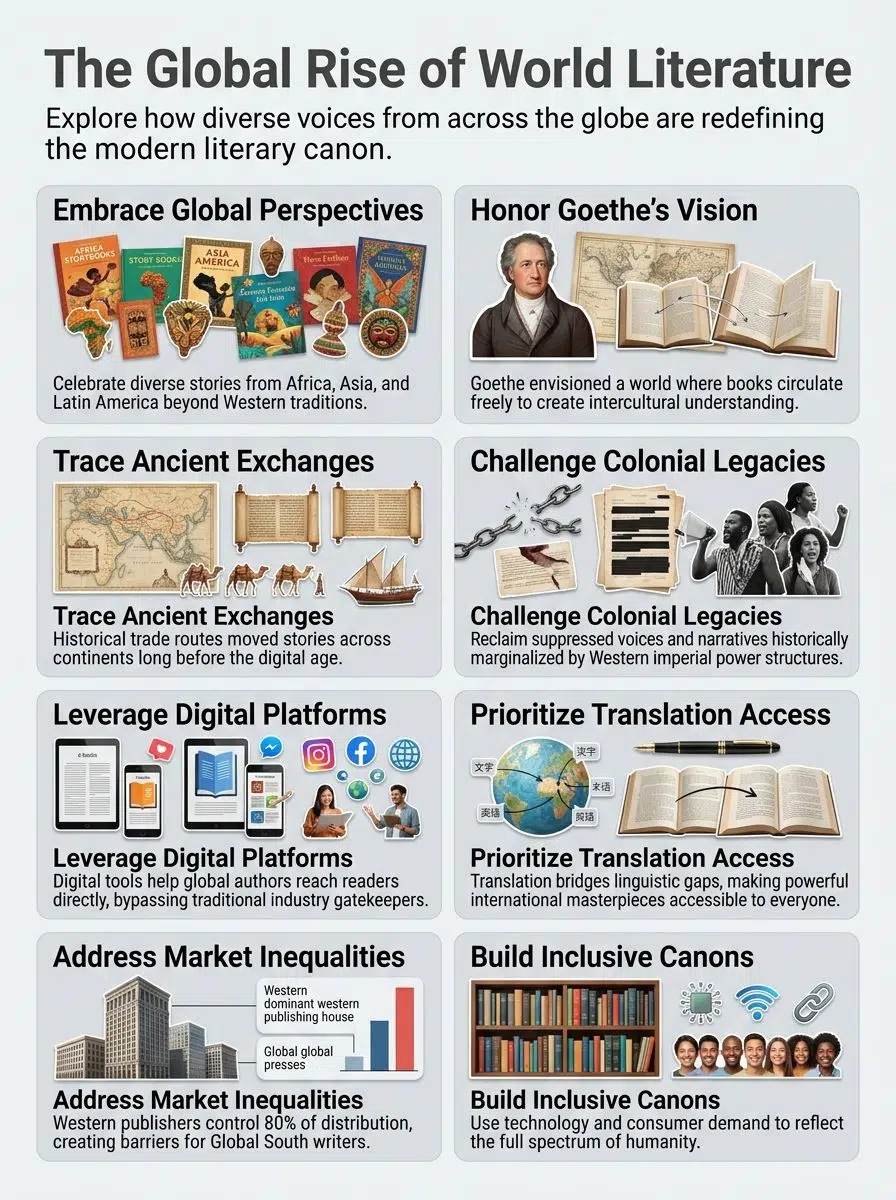
Definition and Origins of World Literature
Literature is the most beautiful way to express what it means to be human across all borders and cultures.
Global literature refers to stories, poems, and plays that come from many different countries and cultures around the globe. This literary movement breaks free from the idea that only Western books matter.
Instead, it celebrates narratives from Africa, Asia, Latin America, the Middle East, and other regions. Stories from non-Western literature offer fresh perspectives, different values, and new ways of seeing the world.
If you look at the US market, finding these stories takes a bit of effort. Data from organizations like ALTA Language Services shows that only about 3 percent of all books published in the United States are works in translation.
Because that number is so low, you have to know where to look. To find the best literary diversity, I recommend checking out independent US publishers who make it their mission to bridge this gap:
- Archipelago Books: This non-profit press focuses exclusively on bringing international voices to English readers.
- Deep Vellum: Based in Texas, they actively seek out underrepresented writers from around the planet.
- Europa Editions: They are famous for introducing US readers to global bestsellers and highlighting the art of translation.
The Concept of Weltliteratur by Johann Wolfgang von Goethe
Johann Wolfgang von Goethe, a German writer and thinker, introduced the concept of Weltliteratur, or world literature, in the early 1800s. Goethe saw that stories crossed borders and oceans, connecting people across different nations and cultures.
He believed that great books from all corners of the globe deserved attention and respect. Goethe pushed for intercultural dialogue through literary works, arguing that readers should explore narratives far beyond their own homelands.
His vision challenged the idea that only European literature held value. Instead, Goethe championed a more inclusive approach to what people read.
Goethe’s ideas planted seeds that would grow into today’s movement toward non-Western literature and postcolonial criticism. His influence shaped how we now think about global literature and the need to break free from Eurocentrism.
Historical Evolution of World Literature
Stories traveled across oceans, deserts, and mountains long before the internet connected us all. Different cultures shaped each other’s tales through trade routes, invasions, and migrations that rewrote literary history itself.
Early Literary Exchanges Across Cultures

The world is a book, and those who do not travel read only one page. – Saint Augustine
Merchants, travelers, and scholars moved stories across continents long before modern publishing existed. The Silk Road carried more than silk and spices; it transported tales, poems, and ideas between Asia, Africa, and Europe.
A perfect example of this is the Panchatantra. This ancient collection of Indian fables, written around 200 BCE, traveled the Silk Road and became one of the most translated non-religious texts in history. It was translated into Pahlavi, Syriac, Arabic, and eventually Latin, heavily influencing European folklore like Aesop’s fables.
These early literary exchanges created bridges between distant civilizations. They allowed readers to experience worldviews radically different from their own. This process of literary exchange revealed a fundamental truth. Great books transcend borders, languages, and centuries.
Influence of Colonial Empires on Global Literature
Colonial powers shaped global literature in profound ways. European empires controlled trade routes, printing presses, and publishing houses across Africa, Asia, and the Americas. This control meant that stories from colonized regions faced massive barriers to reaching wider audiences. The suppression of local voices was often a direct policy.
For instance, in 1835, British politician Thomas Macaulay issued his “Minute on Indian Education,” famously declaring that a single shelf of a good European library was worth the whole native literature of India and Arabia. This policy established English as the only medium of higher education, suppressing native Sanskrit and Arabic storytelling traditions.
This legacy helps explain why we must actively work toward canon expansion today. Here is how colonial rule shifted the bookshelves:
- Language Dominance: English, French, and Spanish became the mandatory languages of literary power.
- Erasure of Tradition: Indigenous storytelling traditions faced erasure as colonial authorities promoted Western literary forms.
- Unequal Distribution: Publishers in wealthy nations controlled which books received translation and global distribution.
The Modern Paradigm of World Literature
Stories now move across borders faster than ever before, thanks to instant digital connections. Readers today can access tales from Tokyo, Lagos, and São Paulo on the same day those stories hit shelves.
Shifts in Global Literary Circulation in the 21st Century
Digital platforms transformed how readers discover books from around the world. Apps, social media, and indie publishing sites put global literature directly into your hands.
A great example is the translation trend on BookTok. Toshikazu Kawaguchi’s novel Before the Coffee Gets Cold became a massive hit in the US specifically because younger readers on social media actively recommended the translated Japanese work.
Translation technology and increased funding accelerated this movement. Readers actively seek out global literature, pushing sales for translated works to record highs.
Here are a few modern tools making global stories easier to find:
- The Libby App: This app connects directly to your local US library, allowing you to filter and download international literature and translated audiobooks for free.
- Social Media Communities: Platforms like Goodreads and Instagram have dedicated groups that focus entirely on reading books from the Global South.
- Direct-to-Reader Subscriptions: Independent presses now offer monthly subscription boxes that deliver a newly translated international book right to your door.
The Role of Translation in Expanding Access to Stories
Translation acts as the bridge that carries stories across borders. Without translators, countless masterpieces from Africa, Asia, Latin America, and the Middle East would remain locked away from millions of people. A skilled translator does far more than convert words. They capture the soul of a story, preserving its voice while making it resonate with a fresh audience.
The literary world is finally starting to treat translation as an art form. The prestigious International Booker Prize, for example, now divides its £50,000 prize money equally between the author and the translator, proving that translation is a form of co-authorship.
When readers access translated works, they gain new perspectives and challenge their assumptions. It is a truly global conversation about what stories matter most.
Stories Beyond the Western Canon
For decades, Western stories dominated global bookshelves and classrooms, leaving countless voices unheard. Today, readers across the planet discover powerful narratives from Africa, Asia, Latin America, and the Middle East.
Contributions from the Global South
Writers from Africa, Asia, Latin America, and the Middle East have reshaped global literature in powerful ways. Authors like Chimamanda Ngozi Adichie from Nigeria and Gabriel García Márquez from Colombia bring fresh voices to literary discourse.
These authors write about their own cultures, histories, and struggles with an authenticity that Western writers simply cannot replicate.
The critical acclaim for these regions is growing rapidly. Han Kang’s 2024 Nobel Prize in Literature win was a monumental shift, proving that stories from South Korea and the wider Global South are not just niche interests. They are recognized as the most important literary works of our time.
To really appreciate these contributions, I recommend exploring different regions directly:
- Read a Nobel Winner: Pick up works by Han Kang to see modern South Korean literature at its finest.
- Explore the Booker International Lists: Use the International Booker Prize shortlists as a guide for the best new fiction from the Global South.
- Follow Indie Translators: Look for the names of specific translators you enjoy and follow their future projects.
Celebrating Non-Western Literary Traditions
Non-Western literature offers stories that challenge everything the Western canon taught us. These storytellers bring fresh perspectives to universal themes like love, loss, and survival.
Literary heritage from non-Western regions reveals narrative forms and storytelling traditions that Western readers rarely encounter. A novel from Nigeria might use oral history techniques passed down for generations, blending myth and reality in ways you won’t see in an American novel.
A poet from India might blend ancient Sanskrit traditions with modern concerns. These multicultural narratives teach us that great books come from everywhere, not just Europe or North America.
Celebrating these traditions means actively choosing them and recommending them to friends. It is about building spaces where cross-cultural themes become central to how we discuss literature.
Key Themes in World Literature
Stories from across the globe tackle big questions about who we are and where we belong. Writers everywhere share common struggles, dreams, and rebellions that readers recognize instantly.

Identity and Cultural Exchange
Literature acts as a mirror for how people see themselves and their communities. Authors from Africa, Asia, Latin America, and the Middle East craft narratives that explore what it means to belong and to thrive in their own contexts.
These non-Western narratives reveal identities that Western readers rarely encounter in mainstream publishing. A Nigerian author might write about family honor in ways that challenge American assumptions.
Reading these specific stories actually changes how your brain works. A famous study from the New School for Social Research found that reading literary fiction improves your Theory of Mind, which is your ability to understand and empathize with others’ emotions.
Translation opens doors that geography and language once kept locked. This intercultural dialogue transforms the global literary canon into a bustling marketplace of ideas.
Resistance and Revolution in Literature
Writers across the globe use stories as weapons against oppression. Authors from Africa, Asia, and Latin America craft narratives that challenge power structures and expose injustice. Chinua Achebe’s Things Fall Apart dismantles colonial stereotypes about African societies. Arundhati Roy’s The God of Small Things reveals class struggles in India.
Resistance takes many forms in global literature. Some authors explore quiet defiance, while others take a very loud stand regarding language itself.
Here are a few ways authors show resistance:
- Language Reclamation: Kenyan author Ngũgĩ wa Thiong’o famously detailed his decision to stop writing in English and write only in his native Gikuyu in his 1986 book Decolonising the Mind.
- Preserving Ancestral Wisdom: Storytelling traditions in Indigenous communities preserve knowledge that colonizers actively tried to erase.
- Political Allegory: Many Latin American authors weave political turmoil into magical realism to bypass strict censorship laws.
Challenges in Expanding World Literature
Getting global literature to readers takes real work. Barriers stand in the way, from language gaps to unfair market systems that favor Western voices.
Linguistic Barriers and Translation Gaps
Language differences create real obstacles for global literature. Translators must convert not just words, but cultural meanings, humor, and wordplay.
This is especially true for “untranslatable” words. A translator has to figure out how to convey the Portuguese concept of Saudade, a deep emotional state of nostalgic longing, or the Japanese word Tsundoku, the act of buying books and letting them pile up unread.
Publishers face tough choices about which books deserve translation resources. Many stories from Asia, Africa, and Latin America never reach English-speaking audiences because translation costs money and time.
Canon expansion requires more investment in translating diverse storytelling traditions. We need more readers willing to engage with unfamiliar narrative forms.
Unequal Representation in Global Literary Markets
Translation efforts open doors to stories worldwide, yet a persistent gatekeeping system still controls which voices actually reach your local bookstore. Publishing houses, bookstores, and literary awards remain concentrated in wealthy nations.
Data from the University of Rochester’s Three Percent project highlights that roughly 3 percent of books published in the US are translated works. This power imbalance shapes what stories get told, celebrated, and remembered across the world.
| Market Dominance & Publishing Control | Key Data & Examples |
|---|---|
| Western publishers control approximately 80% of global book distribution. Major publishing houses operate primarily from New York, London, and other Western cities. These decision makers choose which manuscripts get translated, promoted, and distributed to international audiences. | The “Big Five” publishing companies hold a majority stake in English-language markets. African authors represent only 3% of books translated into English annually. Indian writers struggle to reach Western readers despite producing thousands of titles yearly. |
| Translation Investment Disparities | Specific Challenges |
| Publishers invest heavily in translating European literature. Stories from Asia, Africa, and Latin America receive minimal translation funding. Economic incentives favor established Western authors over emerging Global South voices. | Only 3% of books published in America come from translations. French publishers translate far more works than American publishers do. Asian literature faces particular difficulty entering mainstream Western markets. |
| Literary Awards & Recognition Gaps | Impact on Writer Visibility |
| Prestigious awards like the Booker Prize have historically favored Western-educated writers. International recognition remains difficult for authors writing in non-English languages. Award winners receive disproportionate media coverage, sales boosts, and cultural prestige. | Chimamanda Ngozi Adichie gained prominence after Western recognition. Arundhati Roy’s “God of Small Things” succeeded partly through award wins. Many talented writers remain invisible without such institutional validation. |
| Retail & Distribution Networks | Real-World Consequences |
| Bookstores stock shelves based on profit projections and publisher relationships. Major retailers emphasize Western titles for visibility and shelf space. Independent bookstores often lack the resources to source diverse international titles. | Bookstore “World Literature” sections typically contain 10-15% actual global representation. Publishers receive better shelf positioning through marketing partnerships. Authors from smaller markets struggle to secure retail distribution. |
| Economic Barriers for Writers | Systemic Inequality Effects |
| Writers from poorer nations earn significantly less from book sales. International copyright enforcement protects Western authors more effectively than others. Piracy rates spike in regions where legitimate books remain too expensive. | A Nigerian author earns roughly one-tenth what a comparable American author makes. Publishing advances rarely cover living expenses for Global South writers. Many talented storytellers leave writing due to financial impossibility. |
| Digital Platforms & Emerging Solutions | New Opportunities Emerging |
| Self-publishing platforms expand access to global audiences. Social media creates direct author-to-reader connections, bypassing traditional publishers. Online communities support translated works that major publishers ignore. | Amazon’s Kindle Direct Publishing removes geographical publishing barriers. BookTok and Goodreads create grassroots literary movements. Subscription services expand access to diverse titles at lower costs. |
Readers deserve access to the full spectrum of human storytelling, not just narratives filtered through Western commercial interests.
The Future of World Literature
Digital tools and technology reshape how readers discover stories from every corner of the globe. Writers, translators, and readers now collaborate across continents to build a literary world that truly reflects all of humanity.
The Role of Digital Humanities and Technology
Technology reshapes how we access global literature. Online platforms, databases, and digital archives make these stories accessible to anyone with an internet connection.
Artificial intelligence assists translators in converting complex texts faster. Tools like DeepL do not replace human translators, but they speed up the initial drafting phase, allowing more books from marginalized communities to reach publishers quickly.
Universities now digitize rare manuscripts, making literary heritage available for study. Technology enables readers to engage with multicultural narratives in real time.
Here are three ways technology is changing the landscape:
- AI Translation Assistance: Speeds up the raw translation process, freeing humans to focus on cultural nuances.
- Digital Archives: Preserves fragile, historical texts from the Global South for everyone to read online.
- Global E-Book Distribution: Allows an author in Kenya to sell an e-book directly to a reader in California instantly.
Potential for a More Inclusive Global Canon
A more inclusive global canon starts with readers like you demanding different voices. Publishers, librarians, and educators hold real power to shift what gets printed, shelved, and taught.
The University of Rochester’s Three Percent project is a great example of this advocacy in the US. They actively track, review, and promote translated literature to ensure these books get the attention they deserve.
African authors, Asian storytellers, and Latin American writers deserve the exact same spotlight that European and American authors receive. Schools can add works from postcolonial criticism and transnational literature into their curricula today.
The shift toward multicultural narratives reflects what readers actually want. This momentum creates space for fresh voices to reshape what we call great books.
The Bottom Line
Global literature matters because it shatters the walls we built around storytelling. Stories from Africa, Asia, Latin America, and the Middle East carry voices that Western publishing has ignored for centuries.
These narratives challenge what we thought we knew about great books and literary heritage. Translation opens doors that gatekeepers once locked tight. Canon expansion is not about erasing Shakespeare or Austen; it is about making room for everyone at the table. Literary diversity strengthens our collective understanding of what it means to be human.
The future of global literature rests in our hands, not in dusty university halls. Readers like you drive the demand for non-Western literature and transnational storytelling.
The Rise of World Literature: Stories Beyond the Western Canon is not just a trend. It is a reckoning with whose stories matter and why.
Frequently Asked Questions (FAQs) on Rise of World Literature
1. What does “world literature” mean, and how is it different from the Western canon?
World literature includes stories from every continent, covering voices from Asia, Africa, Latin America, and beyond. The Western canon focuses mainly on European and American writers like Shakespeare, Dickens, and Hemingway. You’re getting a much wider view of human experience when you step outside that traditional list.
2. Why are stories beyond the Western canon important?
These stories show you how people live and dream in cultures very different from your own. According to UNESCO, less than 3% of books published in the US are translations, so reading world literature actively expands what most readers see.
3. How has world literature changed what people read today?
Readers are now choosing books from countries like Nigeria, Japan, and Chile, with bookstores stocking novels set in bustling Lagos markets or quiet Peruvian villages.
4. Can reading global stories help us understand each other better?
Absolutely! A 2016 study from The New School found that reading literary fiction improves your ability to understand what others are thinking and feeling, whether they’re sharing a meal in Mumbai or playing soccer in Cairo.