

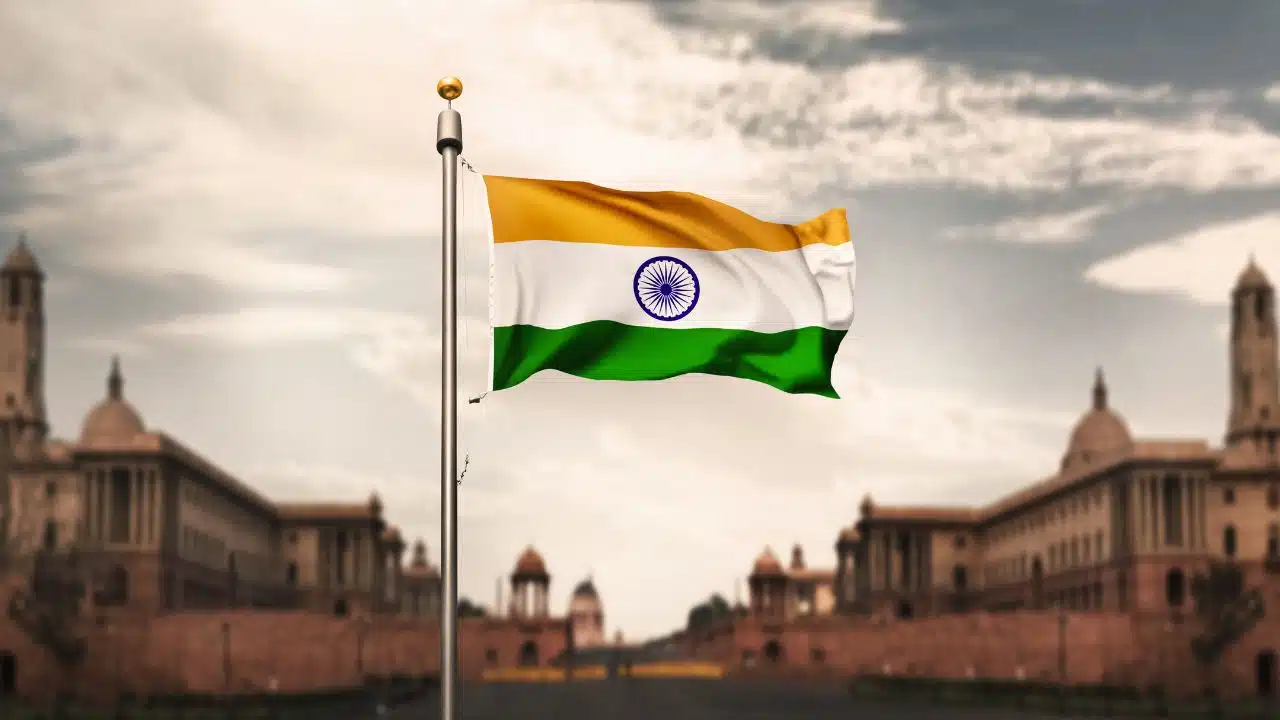
Republic Day in India is observed on January 26 each year, marking a momentous occasion in the nation’s history.
This date commemorates the adoption of the Indian Constitution in 1950, a pivotal moment when India transitioned into a sovereign, democratic republic. But why was January 26 chosen for this historic milestone? Let’s dive into the story behind this significant date.
The Significance of January 26
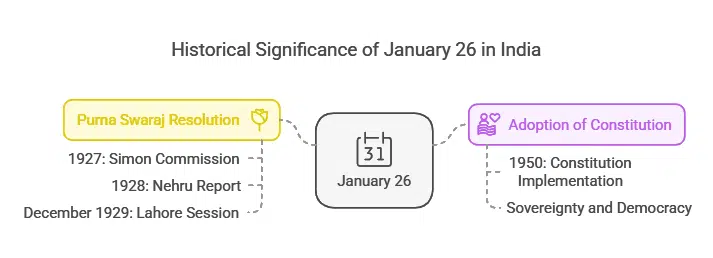
The decision to celebrate Republic Day on January 26 is deeply rooted in India’s freedom struggle. It was on this day in 1930 that the Indian National Congress declared the Purna Swaraj Resolution, or complete independence from British rule. This declaration was a defiant rejection of British dominion status and a powerful assertion of self-rule.
By choosing January 26 as the day to implement the Constitution in 1950, India honored the legacy of the Purna Swaraj movement and reinforced its commitment to sovereignty and democracy.
Key Events Leading to Purna Swaraj Declaration:
| Date | Event |
| 1927 | Appointment of the Simon Commission by the British government, excluding Indian representation, leading to widespread protests. |
| 1928 | Submission of the Nehru Report, demanding self-governance under dominion status within the British Empire. |
| December 1929 | Lahore Session of the Indian National Congress, where the Purna Swaraj resolution was adopted. |
| January 26, 1930 | Declaration of Purna Swaraj, marking the day as India’s Independence Day. |
By adopting the Constitution on January 26, 1950, India paid homage to this significant date, reinforcing its dedication to the ideals of complete independence and democratic governance.
How Did the Indian Constitution Come Into Effect?
Historical Background
India gained independence on August 15, 1947, after a long struggle against colonial rule. However, at the time of independence, the nation operated under the Government of India Act of 1935, which was a legacy of British administration. To truly establish itself as a sovereign and democratic republic, India needed its own governing document that represented its diverse population and guaranteed equal rights to all citizens.
Drafting the Constitution
In 1946, a Constituent Assembly was formed to draft the Indian Constitution. This assembly included representatives from various political parties and communities, ensuring that the document would reflect the diverse voices of the nation.
The drafting process, led by Dr. B.R. Ambedkar and his committee, was thorough and inclusive. The first draft was presented in November 1947, and after nearly three years of debates and revisions, the final Constitution was adopted on November 26, 1949.
Why January 26 Was Chosen?
Although the Constitution was adopted in November 1949, its enforcement was delayed until January 26, 1950. This deliberate decision was made to honor the Purna Swaraj Resolution of 1930, aligning the new republic’s birth with a date that symbolized India’s aspiration for complete self-rule.
The Legal and Social Impact of Republic Day
Becoming a Sovereign Republic
On January 26, 1950, India officially became a sovereign, democratic republic. This marked the end of India’s status as a dominion within the British Commonwealth and the beginning of a new era of self-governance.
The Constitution established a framework for governance, defined the roles of the executive, legislature, and judiciary, and guaranteed fundamental rights to all citizens, irrespective of religion, caste, or gender.
Key Changes Post-Republic Day:
| Aspect | Before January 26, 1950 | After January 26, 1950 |
| Political Status | British Dominion | Sovereign Republic |
| Head of State | British Monarch represented by the Governor-General | President of India |
| Governing Document | Government of India Act 1935 | Constitution of India |
| Legal Authority | British Parliament | Indian Parliament |
Celebrating Diversity
India’s Constitution was designed to accommodate its multicultural and multi-religious population. It ensured that every citizen, regardless of their background, would have equal rights and opportunities. This was a landmark achievement, as it laid the foundation for a secular and inclusive democracy.
Republic Day Celebrations
Republic Day is celebrated with grandeur and patriotism across the country. The centerpiece of the celebrations is the Republic Day Parade in New Delhi, where India showcases its military might, cultural diversity, and technological achievements. The President of India presides over the event, symbolizing the unity and integrity of the nation.
In addition to the parade, various states organize cultural programs, flag-hoisting ceremonies, and public events to honor the sacrifices of the freedom fighters and celebrate the principles enshrined in the Constitution.
Main Highlights of the Celebrations:
| Event | Description |
| Republic Day Parade | Held in New Delhi, featuring marching contingents from the armed forces, cultural tableaux from various states, and performances by school children. |
| Chief Guest | Each year, a foreign dignitary is invited to attend the celebrations, symbolizing India’s diplomatic relations. |
| Beating Retreat Ceremony | Conducted on January 29 at Vijay Chowk, marking the formal conclusion of Republic Day festivities with performances by the bands of the armed forces. |
A Legacy of Freedom and Democracy
Republic Day is more than just a national holiday—it is a reminder of the struggles and sacrifices that paved the way for India’s freedom and self-governance. By choosing January 26 to implement the Constitution, India reaffirmed its commitment to the ideals of justice, liberty, equality, and fraternity.
As we celebrate Republic Day each year, we honor the vision of the leaders who fought for independence and laid the foundation of modern India. It is a day to reflect on our responsibilities as citizens and uphold the values enshrined in the Constitution.
Republic Day stands as a testament to India’s journey from colonial rule to becoming a proud, sovereign republic. The significance of January 26 lies not just in the adoption of the Constitution but also in its connection to the Purna Swaraj Resolution, which continues to inspire the nation. As we commemorate this day, let’s pledge to preserve the ideals of democracy, equality, and justice that form the bedrock of our republic.
























