

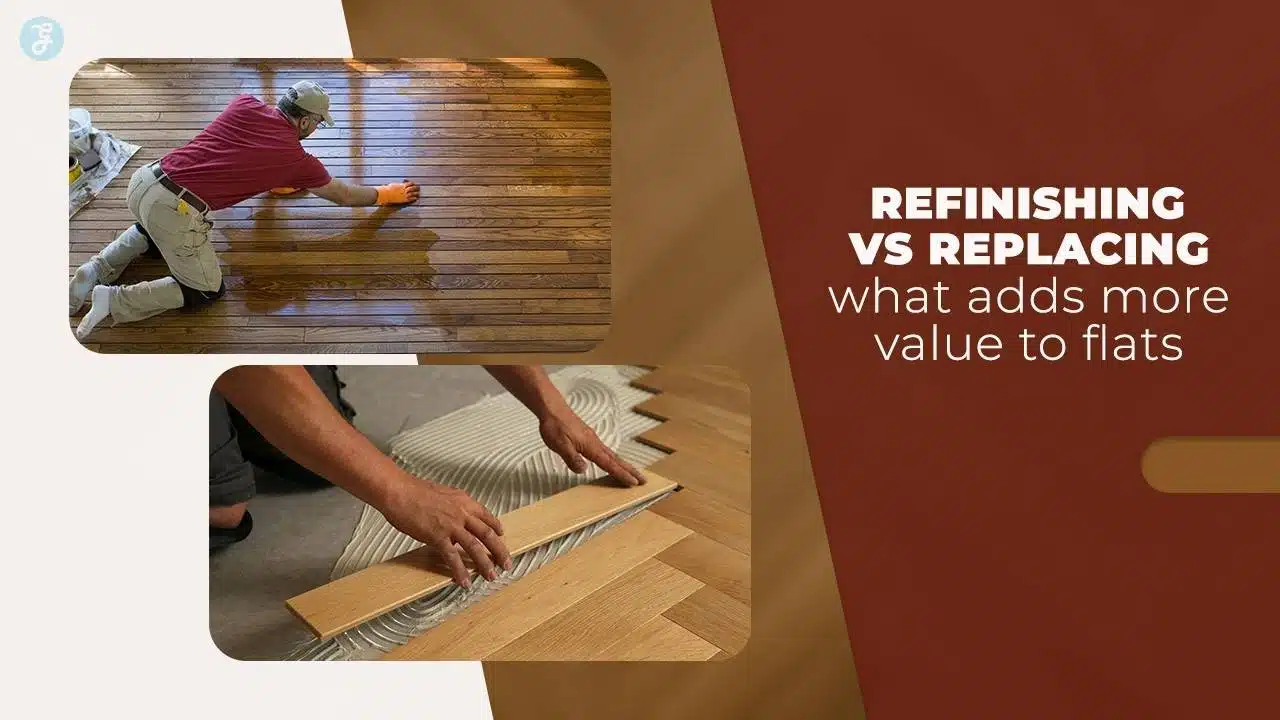
In the high-stakes game of London property, the smartest investors know that spending more doesn’t always mean selling for more. With the current cost of labor and materials in the capital, the “strip it back to brick” approach often leads to over-capitalization, spending more on renovations than the value they add to the property. If you are looking to maximize your Renovation ROI for London Flats, the golden rule is simple: restore the character, replace the hygiene.
London buyers, particularly in period conversions across boroughs like Islington, Hackney, or Kensington, are currently paying a premium for “authentic charm” combined with modern reliability. This guide breaks down the financial reality of Refinishing vs. Replacing, helping you navigate the decision-making process to ensure every pound spent returns a profit.
Key Takeaways
-
Do the Math: Before ripping anything out, calculate the replacement cost vs. the refinishing cost. If refinishing is <30% of replacement, it’s usually the better ROI.
-
Respect the Era: In London period flats, original floors and windows are assets. Don’t replace them with generic modern alternatives.
-
Hygiene Matters: Never refinish a bathroom or boiler. Buyers pay for “new” in these specific areas.
-
Kitchens are for Spraying: Unless the layout is broken, spray the cabinets and change the worktop. It’s the highest ROI project you can do.
The “Turn-Key” vs. “Project” Dilemma
Before you pick up a hammer, you must understand who you are selling to. The current London buyer profile has shifted dramatically. With higher mortgage rates shrinking their monthly disposable income, few buyers have the cash reserves left over to fund a renovation after they get the keys.
This has created a two-tier market:
-
The “Project” Flat: Priced low, these properties sit on the market longer because buyers are terrified of undefined renovation costs.
-
The “Turn-Key” Flat: These command a significant premium because they are “mortgageable” and ready for immediate living.
This is your ROI sweet spot. Your goal isn’t to make the flat brand new; it is to remove the perception of work for the buyer. Refinishing does this brilliantly. A sanded floor says “move-in ready” just as loudly as a new floor, but it costs you significantly less. By refinishing the aesthetics (floors, cabinets, windows) and only replacing the critical failures (leaky taps, broken boilers), you present a “Turn-Key” product without paying the “New Build” price tag.
The “Hidden” Bureaucracy Tax: Leaseholds & Party Walls

In London, you rarely own the building; you own the “lease” to the air inside it. Ignorance of this legal structure is the single fastest way to destroy your renovation ROI. A £10,000 profit can instantly vanish into legal fees if you skip these two steps.
1. The “License to Alter” Trap
Most London leases strictly prohibit structural changes or alterations to floor coverings without the Freeholder’s written consent.
-
The Cost: Gaining a “License to Alter” typically costs £1,500 – £3,000. You must pay for the Freeholder’s solicitor and surveyor, plus your own.
-
The Risk: If you remove a wall or change flooring without this license, you are in breach of your lease. When you eventually sell, the buyer’s solicitor will demand to see the license. If you don’t have it, you will be forced to pay retrospective consent fees (often double) or, in nightmare scenarios, reinstate the original layout.
-
The Refinishing Advantage: Sanding existing floorboards or spraying existing cabinets rarely requires a license. Replacing them often does.
2. The Party Wall Act
London’s terraced housing stock means you likely share a wall with a neighbor. If you plan to cut into this wall (for steel beams) or dig near it (for extensions), you must serve a Party Wall Notice.
-
The “Agreed” Route: If your neighbor consents quickly, it costs practically nothing.
-
The “Dissented” Route: If they dissent, you must pay for a surveyor for them and one for you.
-
Cost Impact: £1,000 – £2,500. This adds zero value to your property but is legally mandatory.
Investor Insight: The “Bureaucracy Tax” is another financial argument against major structural work. A cosmetic refurbishment (painting, spraying, re-grouting) bypasses the Party Wall Act and often the License to Alter entirely, keeping your profit in your pocket.
The Economics of the Kitchen: Spray vs. Swap
The kitchen is often cited as the most valuable room in the house, but it is also the easiest place to lose money. In London, a full kitchen replacement is a significant financial undertaking.
The “New Kitchen” Trap
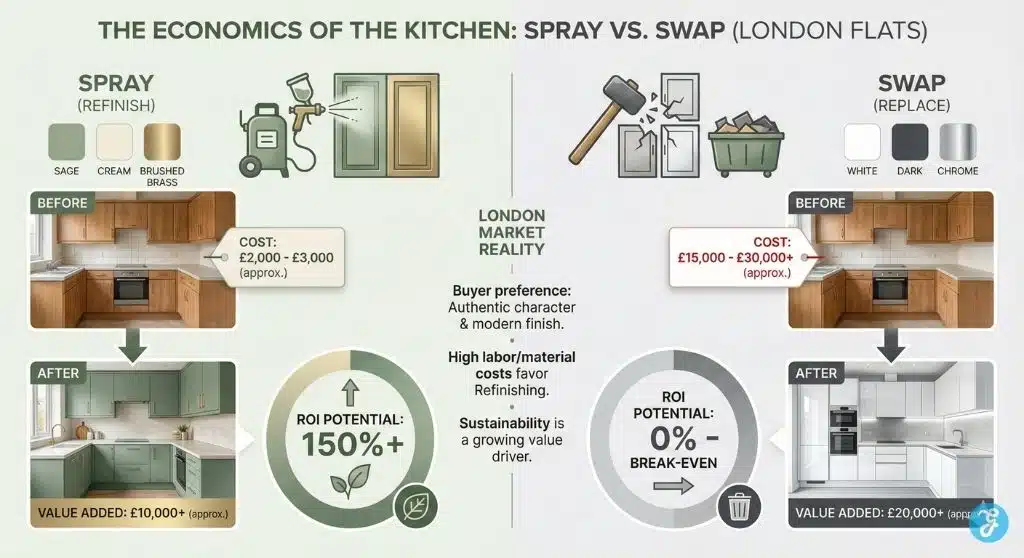
A standard mid-range kitchen replacement in London (including labor, tiling, and appliances) now averages between £15,000 and £30,000.
-
Value Added: While a new kitchen makes a property sell faster, data suggests it rarely adds more than its cost to the final sale price unless the previous kitchen was unusable.
-
The Verdict: If you spend £20,000 to add £20,000 in value, your ROI is 0%.
The “Respray” ROI Winner
If your cabinetry “carcasses” (the internal boxes) are structurally sound, professional spraying is the superior financial move.
-
Cost: Professional on-site spraying of doors, drawers, and plinths typically costs £1,500 – £2,500.
-
The Result: A high-quality polyurethane finish that looks factory-new. Combined with new handles (£100) and perhaps a new worktop (£1,000), the total spend is under £4,000.
-
The Verdict: If this “new look” kitchen increases your offer price by just £10,000, you have achieved a 150%+ ROI.
| Feature | Action | Est. Cost (London) | Est. Value Add | ROI Potential |
| Dated but Functional Kitchen | Professional Respray | £2,000 – £3,000 | £10,000+ | Excellent |
| Broken Layout / Rot | Full Replacement | £15,000 – £30,000 | £20,000+ | Break-even |
Pro Tip: London buyers value “Turn-key” readiness. They don’t care if the cupboard boxes are 10 years old; they care that the fronts are sage green, chip-free, and feature modern brass handles.
Why “Character” is a Financial Asset
In the London flat market, “Period Features” are a distinct asset class. Standardizing a Victorian flat with generic modern finishes can actively devalue it.
Flooring: The Original Board Premium
Beneath the carpets of many London flats lie original pine floorboards.
-
Refinishing: Sanding, staining, and sealing original boards costs approximately £30 – £40 per m². For a 50m² flat, that’s roughly £1,500 – £2,000.
-
Replacing: Installing high-quality engineered oak (essential to match the “period feel”) costs £80 – £120 per m² fitted.
-
The Math: Refinishing costs 25% of the price of replacing and often appeals more to buyers looking for “authentic London living.”
Windows: The Conservation Area Trap
Replacing timber sash windows with plastic uPVC is a financial error in Zones 1-3.
-
Valuation Hit: Estate agents often report that plastic windows in a period building can lower the perceived value by £10,000 – £15,000 because they ruin the “kerb appeal.”
-
Restoration: Draft-proofing and overhauling original sashes (replacing cords, weights, and resin-repairing rot) costs significantly less than a high-quality timber replacement and preserves the property’s historic integrity.
Where to Spend Big: The “Hygiene” ROI
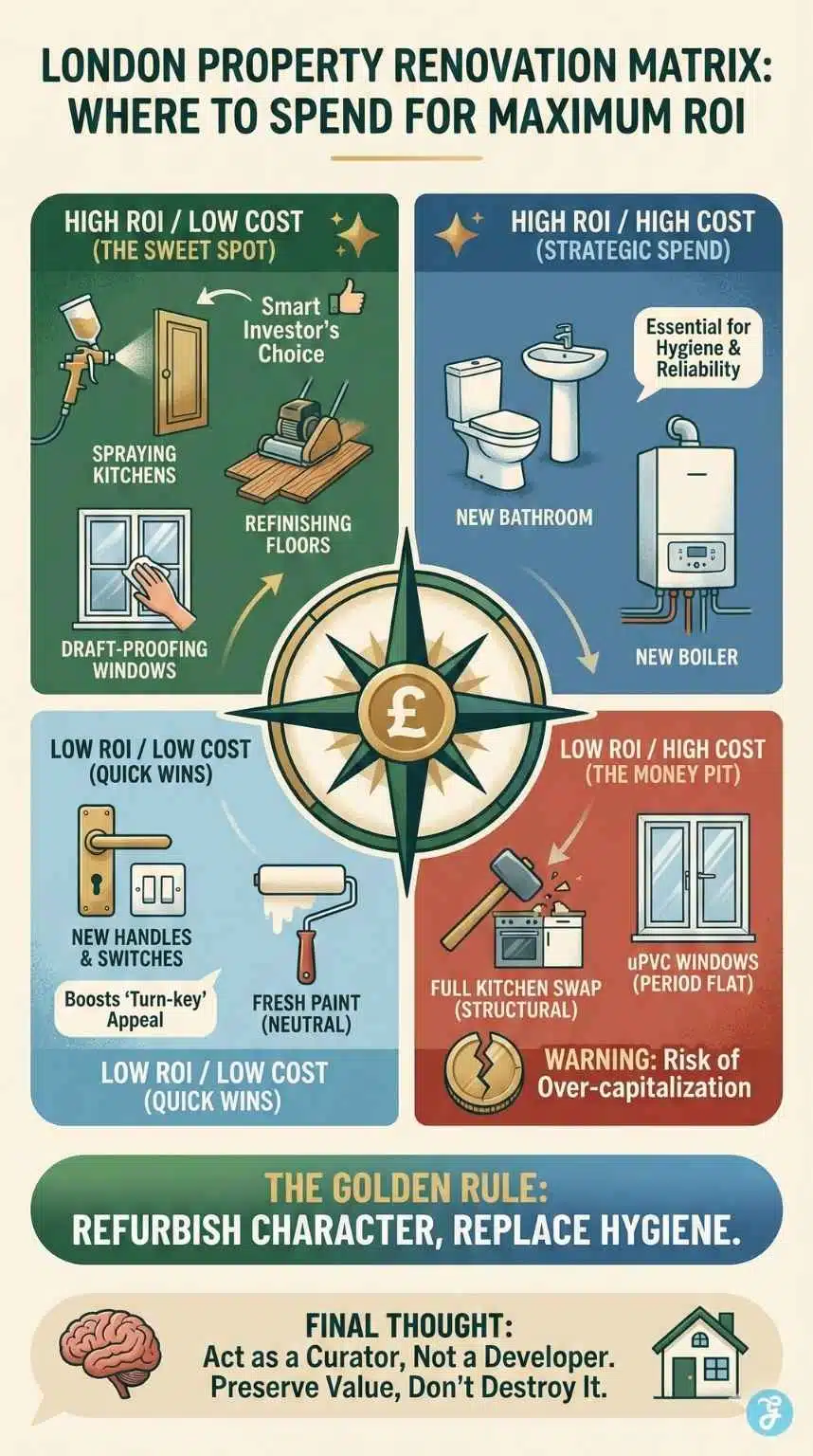
While refinishing wins in living areas, it fails in bathrooms. This is the one area where “Capital Appreciation” is driven by the newness of the fixtures.
The Bathroom Exception
Buyers view bathrooms as sanitary spaces. A re-enameled bathtub or painted tiles often signal “cheap flip” to a savvy London purchaser.
-
The Strategy: Rip it out.
-
The Cost: A full bathroom replacement in London averages £6,000 – £12,000.
-
The Return: A sparkling, modern bathroom implies the plumbing is reliable—a major anxiety for leasehold flat buyers. This reliability justifies a higher asking price.
Boilers and Heating
Never try to “refurbish” an old boiler. If a buyer sees a beige boiler from 2005, they will mentally deduct £4,000 from their offer (twice the cost of a new boiler). Installing a new, energy-efficient boiler is a defensive spend: it protects your asking price.
2026 Market Reality: The “Cosmetic Uplift” Strategy
Current market conditions—high mortgage rates and expensive skilled labor—favor the Cosmetic Uplift over the structural overhaul.
Smart “Cosmetic” Spending List:
-
High-End Ironmongery: Replace hollow, cheap door handles with heavy, solid brass or matte black ones. Cost: £300. Value perception: High.
-
Lighting: Swap generic pendants for statement fixtures.
-
Switches & Sockets: Replace white plastic with screwed metal finishes (brushed steel or brass).
These small “touch points” suggest a high-spec renovation to the subconscious mind of the buyer, increasing the perceived Turn-key Premium.
Energy Efficiency: The “EPC C” Value Driver
In 2025, an Energy Performance Certificate (EPC) is no longer just a piece of paper; it is a price signal. With energy prices stabilizing at high levels, London buyers are actively filtering out “drafty” period flats.
The “Green Premium”
Data suggests that properties with an EPC rating of C or above command a premium of approximately 3-5% over equivalent D/E rated flats. For a £500,000 London flat, that is a £25,000 value swing.
Smart “EPC” Upgrades
You don’t need solar panels to improve your rating. Strategic, low-cost interventions yield the best ROI.
| Upgrade | Approx. Cost | ROI Benefit |
| Smart Thermostat (e.g., Nest/Hive) | £250 | High. Adds “Tech Appeal” and boosts EPC points slightly for low cost. |
| LED Lighting Overhaul | £200 | Medium. 100% low-energy lighting is an easy “tick box” on the EPC survey. |
| Secondary Glazing | £600/window | High. Cheaper than double glazing, permitted in Listed buildings, and stops noise. |
| Underfloor Insulation (Suspended Timber) | £500 (DIY) | High. If refinishing floors, adding wool insulation between joists transforms comfort. |
The 2030 Rental Standard:
If you plan to rent out your flat, be aware that the government is targeting a minimum EPC C rating for all rentals by 2030. Upgrading now “future-proofs” your asset, making it attractive to buy-to-let investors who want to avoid upcoming regulations.
Frequently Asked Questions (FAQs)
1. Does refinishing hardwood floors really add value compared to new laminate?
Absolutely. In the London market, laminate flooring is often seen as a “cheap” fix that buyers will plan to rip out. Refinished original wood (even with imperfections) is viewed as a premium “period feature.” It adds character that laminate simply cannot replicate.
2. Is it worth replacing single-glazed sash windows with double-glazed ones?
If you are in a Conservation Area, you might not be allowed to. Even if you are, the cost is astronomical (£2,000+ per window). A better ROI is often “secondary glazing” or professional draft-proofing restoration, which improves energy efficiency without the massive capital outlay.
3. Can I spray my kitchen if the doors are plastic-wrapped?
Yes, professional sprayers can remove the peeling vinyl wrap and spray the MDF underneath, or use special primers for intact vinyl. The finish is durable and looks like a factory-painted kitchen.
4. How much should I spend on a bathroom renovation for a rental flat?
For a rental, focus on durability over luxury. A budget of £5,000 – £7,000 is healthy. Use large tiles (fewer grout lines to clean) and branded taps (easier to find spare parts). Do not over-capitalize with marble or underfloor heating unless it is a luxury let.
5. What is the single best “cheap” renovation to increase value?
Painting. But specifically, painting strategically. Use modern, neutral “heritage” colors (like off-whites or light greys) rather than brilliant white. It makes a flat feel “designed” rather than just “clean,” justifying a higher price bracket.
Final Thought: The Curator’s Mindset
Ultimately, the most profitable approach to renovating a London flat is not to act as a developer, but as a curator. The “Developer Mindset” sees a period property as a blank canvas to be erased and modernized. This is expensive, wasteful, and often results in a generic product that competes with thousands of new-build apartments.
The “Curator Mindset” asks a different question: What is already here that I can polish?
When you choose to refinish a Victorian pine floor rather than cover it with laminate, you aren’t just saving £1,000; you are preserving the soul of the building. When you choose to spray a kitchen rather than landfill it, you are appealing to the modern buyer’s desire for sustainability.
In the current economic climate, profit is found in the margins. It is found in the money you didn’t spend on a skip, the weeks you didn’t spend waiting for a party wall surveyor, and the structural “bones” you didn’t destroy. Look at your flat again. The value is likely already there, hidden under a layer of old carpet or orange varnish, just waiting to be revealed.





















