


On this day, we remember and celebrate the life of one of Bangladesh’s most beloved literary figures, Humayun Ahmed. Known for his deep connection to Bangladeshi culture, his whimsical characters, and the relatable stories that have become staples in Bangladeshi households, Humayun Ahmed’s legacy remains vibrant and alive.
Through his novels, screenplays, and dramas, he captured the essence of Bangladeshi life, touching on themes of love, identity, family, and the universal human experience. Today, we pay tribute to the man who changed the landscape of Bangladeshi literature and who still holds a special place in the hearts of millions.
Early Life and Beginnings
Humayun Ahmed was born on November 13, 1948, in the small town of Netrokona, Bangladesh. His mother was well-known for her storytelling, and his father was a police officer with a passion for literature, so a rich cultural background influenced his early years. This environment likely fueled Ahmed’s imagination and interest in stories from a young age.
Ahmed completed his schooling in Sylhet and later graduated in Chemistry from Dhaka University, eventually becoming a lecturer. Despite his career in academics, his heart was always with literature. In 1972, he published his first novel, Nondito Noroke (In Blissful Hell), which was immediately well received.
This novel showcased Ahmed’s ability to blend realism with subtle layers of emotion and philosophy, themes that would become trademarks of his writing style. Ahmed quickly gained popularity among readers because they recognized a fresh voice that was aware of Bangladeshi culture.
His Rise as a Literary Icon
Humayun Ahmed’s career took off with unprecedented success. Over the years, he became one of the most prolific and popular authors in Bangladesh, penning over 200 novels, numerous short stories, dramas, and screenplays. His stories, often focusing on the everyday lives of Bangladeshi people, resonated deeply with readers.
Unlike many authors of his time, Ahmed had a unique ability to connect with people across generations. Whether he was exploring the simplicity of rural life, the challenges of love, or the bonds within families, his storytelling felt intimate and relatable.
His books quickly became fixtures in Bangladeshi homes, with readers eagerly awaiting each new release. Many found comfort, laughter, and nostalgia in his stories, feeling seen and understood through the characters he created. By bringing universal human experiences into a distinctly Bangladeshi context, Ahmed made an indelible mark on the nation’s literary landscape.
Misir Ali and Himu: Characters that Defined Generations
Among Humayun Ahmed’s numerous literary achievements, his characters Misir Ali and Himu stand out as cultural icons in Bangladesh. Misir Ali, the introspective psychologist with a penchant for solving mysteries, became a fan favorite for his analytical mind and his realistic, almost philosophical approach to life’s mysteries.
Misir Ali’s character explored human psychology, often touching on supernatural themes yet grounded in rationalism. Ahmed used Misir Ali to delve into themes of fear, faith, and the unknown, allowing readers to explore complex emotions through the eyes of this intelligent and slightly mysterious figure.
In stark contrast to Misir Ali’s logic-driven persona, Himu is a free spirit known for wandering around aimlessly in yellow Punjabi. Himu’s character challenged conventional thinking, embracing spontaneity and living a life free of material attachments. He spoke with a philosophical simplicity, often bewildering those around him while offering readers a sense of liberation.
Through Himu, Ahmed gave his audience a character who lived without rules, one who saw life’s beauty in the ordinary. To this day, Himu’s yellow Punjabi remains symbolic of a carefree spirit that many aspire to, especially the youth.
Remembering Humayun Ahmed: Influence on Bangladeshi Media

Humayun Ahmed’s contributions extended beyond novels into the world of television and film, where he left an equally significant legacy. In the 1980s and 1990s, he transformed Bangladeshi television dramas, creating popular series like Bohubrihi, Ayomoy, and Kothao Keu Nei. These shows captured the nuances of Bangladeshi society, portraying family dynamics, social issues, and everyday struggles with authenticity and humor.
His foray into film was no less impactful. Ahmed directed several films that became national classics, including Aguner Poroshmoni, which depicted the 1971 Liberation War, and Srabon Megher Din, a tender portrayal of love and loss set against the backdrop of rural Bangladesh. His films often presented deep social messages while telling stories of ordinary people.
Through both television and film, Ahmed introduced a new storytelling style that was visually rich and emotionally resonant, setting a standard for Bangladeshi media.
A Master of Blending Realism with Magic
A distinct element of magical realism is present in Humayun Ahmed’s writing. While many of his stories are grounded in the everyday realities of Bangladeshi life, he often infused them with hints of the supernatural or whimsical, which added a mystical dimension to his storytelling. This blend of realism with magic allowed Ahmed to explore the boundaries between the known and the unknown, the real and the surreal.
Through characters who experienced strange occurrences or expressed philosophical thoughts, Ahmed used magical realism to delve into deeper truths about life, death, and the human soul. For example, characters like Misir Ali explored the supernatural with a logical perspective, while Himu’s mystique gave readers a sense of boundless possibility.
This style allowed him to address complex themes in an accessible way, adding a layer of enchantment to otherwise everyday narratives.
Themes of Love, Family, and Humanity
Humayun Ahmed’s works were known for their exploration of universal themes, particularly love, family, and humanity. His stories often depicted families navigating complex relationships and the joys and challenges of love. Whether it was a young couple dealing with misunderstandings or siblings supporting each other through tough times, Ahmed’s portrayal of familial bonds resonated deeply with readers.
Love, in his stories, was not merely romantic but extended to friendships, sibling relationships, and even self-love. Ahmed’s characters often struggled, learned, and grew through these relationships, embodying the highs and lows of human experience. His ability to capture these emotional nuances gave his work a timeless quality, drawing readers into a world where they felt connected to the characters and their journeys.
Humayun Ahmed’s Impact on Bangladeshi Readers and Writers
Humayun Ahmed’s influence on Bangladeshi readers and writers is profound. His relatable characters and accessible language opened doors for readers who may not have previously engaged with literature. For many young people, his novels served as a bridge into the world of books, sparking a lifelong love for reading.
Ahmed’s approachable style and vibrant characters became a benchmark for new writers who sought to tell stories that spoke to the heart of Bangladeshi life.
Many of today’s Bangladeshi writers cite Humayun Ahmed as an inspiration, crediting him with changing their perceptions of what Bangladeshi literature could be. Readers and viewers continue to celebrate his characters, stories, and influence long after his passing, mirroring his influence on popular culture.
His Legacy: Why Humayun Ahmed’s Works Still Matter Today
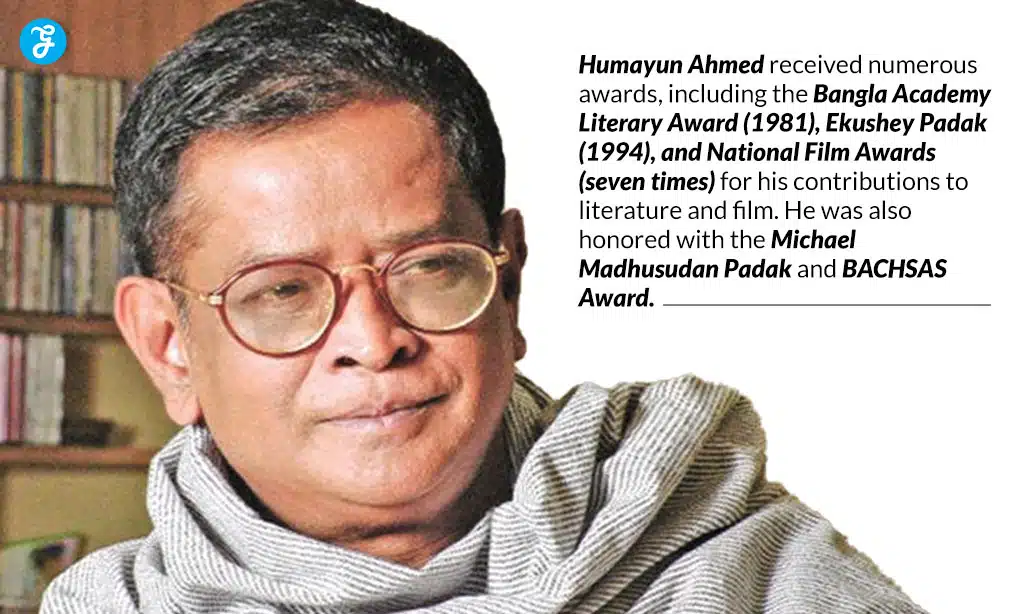
Years after his death, Humayun Ahmed’s work continues to hold a special place in the hearts of Bangladeshis. His stories, though deeply rooted in Bangladeshi culture, touch on themes that are universal and timeless. Love, loss, hope, and resilience are constants in the human experience, and Ahmed’s ability to portray these emotions makes his work enduringly relevant.
Fans who find solace and familiarity in his characters and plots return to his books, movies, and television dramas. Schools still teach his work, families pass down his books, and his films are celebrated across generations. Humayun Ahmed remains a cultural icon, a beloved storyteller whose work will continue to captivate and inspire for years to come.
Takeaways
Humayun Ahmed was more than a writer; he was a voice for Bangladesh, capturing the essence of a people, a culture, and a landscape. His legacy lives on in his stories, his characters, and the hearts of those he touched. For fans old and new, exploring Humayun Ahmed’s works is a journey through the soul of Bangladesh, a world of vibrant characters, profound truths, and unforgettable moments.
On his birthday, we are remembering Humayun Ahmed and celebrate the life and legacy of a literary giant whose words continue to echo across time, connecting us to our shared humanity.






















