

The internet is often viewed as “weightless,” but the reality is that every search, email, and stream is powered by physical servers that consume vast amounts of electricity and water. To Reduce digital carbon footprint impacts, we must rethink our daily interactions with technology.
Choosing the right strategy to Reduce digital carbon footprint emissions is essential in an era where data centers are projected to match the energy consumption of entire nations. As of 2026, the global digital footprint has expanded significantly due to the rise of agentic AI and high-resolution media, making “digital sobriety” a necessary skill.
By adopting a few simple habits, you can significantly decrease the CO2 emissions associated with your online activity. This guide explores the most impactful changes you can make today.
Overview: Traditional vs. Sustainable Digital Habits
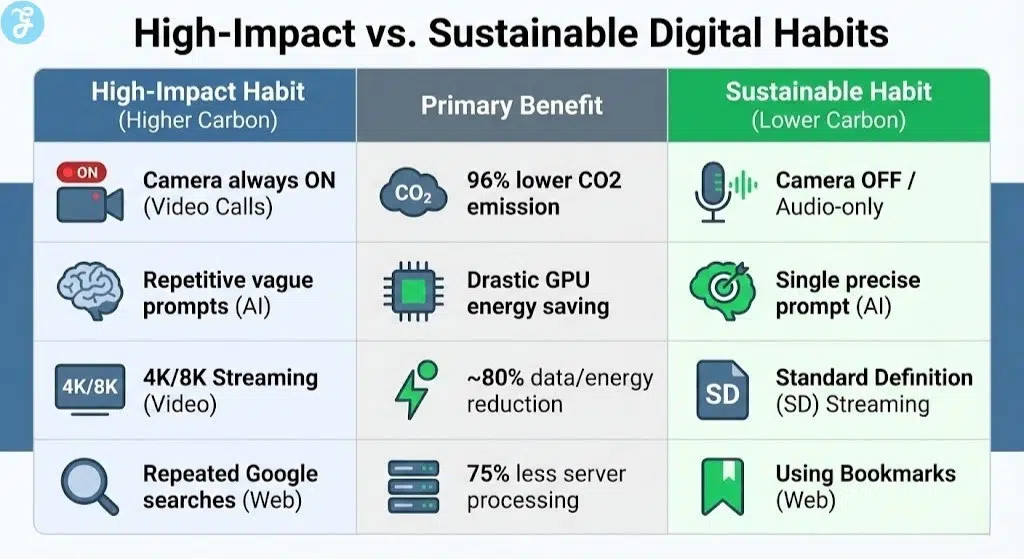
Understanding the difference between high-impact and low-impact digital behaviors is the first step toward a smaller footprint. This table highlights how small shifts in behavior can lead to large energy savings.
| Digital Activity | High-Impact Habit | Low-Impact Habit | Sustainability Win |
| Emailing | Sending large attachments | Sharing cloud links | Lower server storage load |
| Streaming | 4K/8K Auto-play | Standard Definition (SD) | ~75% energy reduction |
| Search | Frequent repetitive queries | Using “Bookmarks” | Less data center processing |
| Connectivity | 5G Mobile Data | Home Wi-Fi | 80% lower energy use |
| AI Usage | Multiple vague prompts | One specific prompt | Lower GPU/Compute demand |
Transitioning to these sustainable habits is a powerful way to align your digital life with your environmental values.
Before we dive into the full list, let’s look at why these specific strategies were chosen.
What Things Did We Consider When Choosing Our List?
To provide you with the most effective advice to Reduce digital carbon footprint levels, we evaluated various digital habits based on current 2026 energy consumption data and technological trends.
When selecting these 7 strategies, we weighed the following factors:
-
Energy Intensity: We focused on activities that consume the most electricity, such as high-resolution video and AI processing.
-
Scalability: We chose actions that are easy for anyone to implement regardless of their technical skill level.
-
Longevity: We prioritized habits that extend the life of your hardware, reducing the need for high-carbon manufacturing.
-
Data Center Impact: We selected strategies that specifically reduce the “idle” storage load on global servers.
With these criteria in mind, here are the seven best ways to clean up your digital presence.
7 Essential Ways to Reduce Your Digital Carbon Footprint
Managing your environmental impact requires a conscious approach to how you consume and store data. It isn’t about using the internet less, but about using it more efficiently.
The following list provides a comprehensive roadmap for anyone looking to Reduce digital carbon footprint emissions through smarter technology use.
1. Optimize Your Video Streaming Settings
Video streaming accounts for over 75% of global data traffic. High-definition (4K) streams require significantly more bandwidth and energy than standard definition. By simply lowering your resolution when watching on smaller screens, you can drastically cut the energy used by data centers.
-
Best For: Mobile users and casual viewers who don’t require cinematic quality for every video.
-
What We Liked: It is a “set it and forget it” change that has a massive aggregate impact on global energy demand.
-
Things to Consider: You may notice a slight drop in sharpness, but on a phone or tablet, the difference is often negligible.
2. Practice “Prompt Engineering” for AI Queries
In 2026, AI usage is a major contributor to digital carbon. A single query to a Large Language Model (LLM) can use up to 10 times more energy than a standard Google search. By writing clear, specific prompts the first time, you avoid the need for multiple follow-up “refining” queries.
-
Best For: Students, researchers, and professionals who use AI tools daily.
-
What We Liked: It improves your productivity while simultaneously lowering the computational load on AI servers.
-
Things to Consider: Taking an extra 30 seconds to think through your prompt can save minutes of back-and-forth and several grams of CO2.
3. Declutter Your Cloud Storage and Email
Every “zombie” email or blurry photo sitting in your cloud storage requires 24/7 power to keep the servers active. Deleting old files and unsubscribing from junk mail reduces the physical hardware needed in data centers.
-
Best For: Individuals with large backlogs of unread emails or redundant cloud backups.
-
What We Liked: It provides a mental “declutter” while reducing the carbon cost of long-term data maintenance.
-
Things to Consider: It can be time-consuming to sort through years of data, so consider using a “search and delete” strategy for specific years or senders.
4. Use Bookmarks Instead of Search Engines
Every time you type a URL into a search engine (like searching for “Facebook” instead of going to facebook.com), you trigger a chain of energy-intensive server requests. Using bookmarks allows you to navigate directly to your destination, bypassing the search engine’s massive processing power.
-
Best For: Frequently visited news sites, social media, and work portals.
-
What We Liked: It makes your browsing experience faster and more efficient while cutting out the “middleman” server.
-
Things to Consider: It requires a one-time effort to organize your bookmarks bar, but saves energy every day thereafter.
5. Extend the Lifespan of Your Hardware
The manufacturing of a single laptop or smartphone accounts for the majority of its lifetime carbon footprint. By repairing your devices, replacing batteries, and keeping software updated, you delay the carbon-heavy process of mining and manufacturing a new replacement.
-
Best For: Tech enthusiasts who feel the urge to upgrade to every new model.
-
What We Liked: It saves a significant amount of money and is the most effective way to reduce the “embedded carbon” of your digital life.
-
Things to Consider: Software updates can sometimes slow down older devices, so look for “lite” versions of apps when possible.
6. Prioritize Wi-Fi Over 5G/Mobile Data
Connecting to a home or office Wi-Fi network is significantly more energy-efficient than using a 4G or 5G mobile network. Mobile towers require massive amounts of power to transmit signals over long distances, whereas Wi-Fi routers operate at much lower power levels.
-
Best For: Remote workers and anyone who spends significant time in a fixed location.
-
What We Liked: It often provides a more stable connection and helps your phone battery last longer throughout the day.
-
Things to Consider: Public Wi-Fi can have security risks, so ensure you use a VPN if you aren’t on a trusted home network.
7. Send Links Instead of Large Attachments
Sending a 10MB file to ten people via email creates ten separate copies of that file on various servers. Sharing a link to a single cloud-hosted file allows everyone to access the data without multiplying the storage and transmission energy required.
-
Best For: Office environments and collaborative projects involving large documents or images.
-
What We Liked: It ensures everyone is looking at the most recent version of a file while minimizing “data bloat.”
-
Things to Consider: Ensure your cloud sharing permissions are set correctly so recipients don’t have to ask for access.
How to Choose the Best Habit for Your Lifestyle
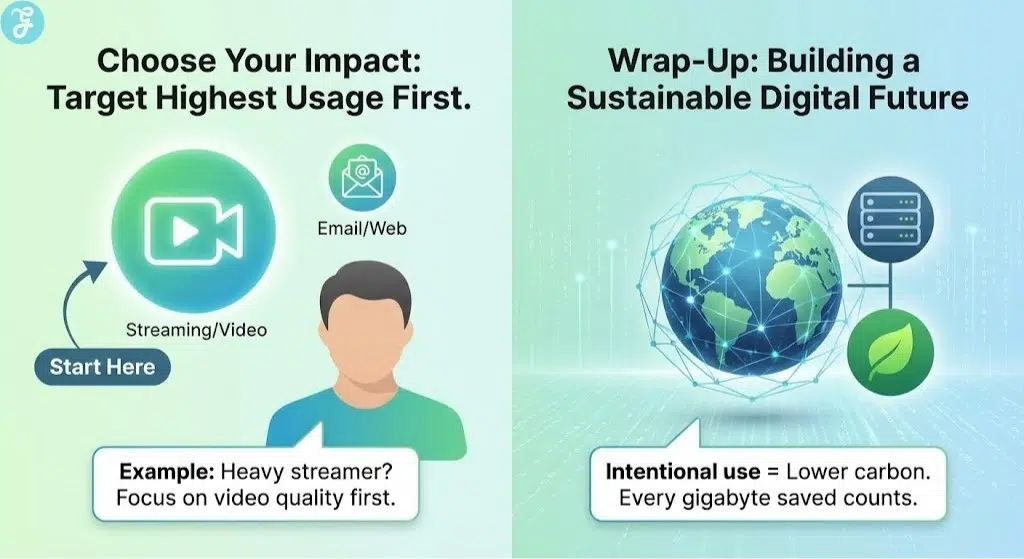
The best way to reduce digital carbon footprint emissions is to start where your usage is highest. If you are a heavy gamer or movie buff, focus on streaming settings. If you work in an office, focus on email and attachment habits.
Small, consistent changes across millions of users are what drive real environmental progress in the digital age.
If you want to start today without a complete lifestyle overhaul, these three changes offer the highest “effort-to-impact” ratio.
-
Best Streaming Hack: Turn off “Auto-play” on YouTube and Netflix to prevent mindless data consumption.
-
Best Communication Hack: Unsubscribe from three commercial newsletters that you never open.
-
Best Device Hack: Switch your phone and computer to “Dark Mode” to save battery and energy on OLED screens.
Wrap-Up: Building a Sustainable Digital Future
Learning how to reduce digital carbon footprint habits is a modern necessity. Our digital lives are no longer separate from the physical environment, and the energy we save behind the screen has a real impact on the world around us. By being more intentional with how we search, stream, and store, we can enjoy the benefits of technology without compromising the planet’s health.





















