Decentralization is a transformative movement shaping the future of industries, governance, and financial systems. Across multiple sectors, decentralized systems are revolutionizing transparency, security, efficiency, and autonomy. With its increasing adoption, decentralization is becoming an integral part of global innovation.
This article will explore 5 Reasons Why Decentralization Is Key to the Future, delving into how it strengthens security, builds trust, promotes financial and economic freedom, enhances efficiency, and empowers communities. Understanding the reasons why decentralization is key to the future will help individuals and organizations leverage its full potential.
In an era dominated by digital transformation, decentralization has emerged as a revolutionary force reshaping industries, governance, and financial systems.
The shift from centralized structures to decentralized networks is fostering transparency, security, efficiency, and autonomy. Whether in finance, governance, technology, or social structures, decentralization is proving to be an essential framework for the future.
This article will explore 5 Reasons Why Decentralization Is Key to the Future and how it is influencing various industries. We’ll examine how decentralized systems enhance security, trust, economic freedom, efficiency, and empowerment, driving innovation across the globe.
Understanding Decentralization and Its Importance
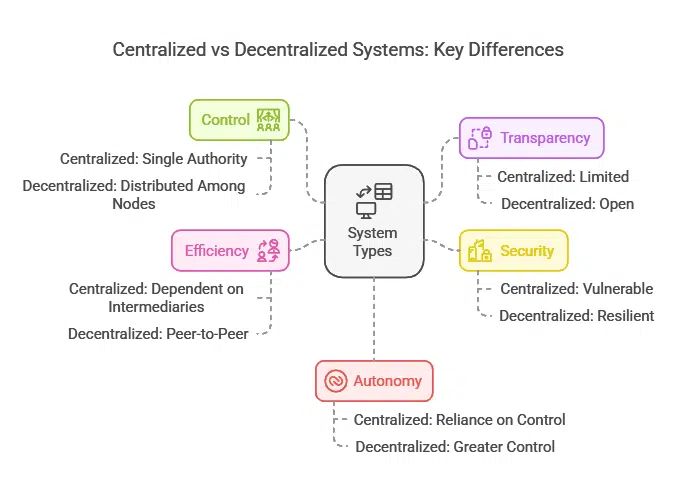
Decentralization refers to the distribution of authority, control, and decision-making from a central entity to a network of nodes or participants. Unlike traditional centralized systems, where a single entity governs and controls operations, decentralized networks function through consensus mechanisms, ensuring a more equitable and transparent framework.
Key Differences Between Centralized and Decentralized Systems
| Feature | Centralized Systems | Decentralized Systems |
| Control | Single authority | Distributed among nodes |
| Transparency | Limited and restricted | Open and verifiable |
| Security | Vulnerable to single points of failure | Resilient and encrypted |
| Efficiency | Dependent on intermediaries | Peer-to-peer, reducing delays |
| Autonomy | Users rely on centralized control | Users have greater control and ownership |
Why Is Decentralization the Future?
As technological advancements continue to progress, the world is seeing a rapid shift toward decentralization. Whether in finance, governance, or digital infrastructures, decentralized networks ensure fairness, security, and operational efficiency.
The reasons why decentralization is key to the future are evident as blockchain technology, decentralized finance (DeFi), and decentralized autonomous organizations (DAOs) reshape industries. Governments, businesses, and individuals recognize the benefits of reducing monopolistic control and fostering a more equitable, transparent system.
The increasing adoption of blockchain technology, decentralized finance (DeFi), and decentralized autonomous organizations (DAOs) showcases the inevitable shift towards decentralization.
Governments, businesses, and individuals are embracing decentralized models to reduce monopolistic control, enhance security, and empower communities with greater control over their assets and decisions.
5 Reasons Why Decentralization Is Key to the Future
As we move deeper into the digital age, decentralization is emerging as a game-changer in industries ranging from finance to governance. The shift away from centralized control is revolutionizing how data, assets, and decision-making power are distributed.
This transformation is not just theoretical; real-world applications are proving its value daily. Whether through blockchain technology, decentralized finance (DeFi), or peer-to-peer networks, decentralization is laying the foundation for a more transparent, secure, and efficient future.
1. Enhanced Security and Privacy
Security breaches, data leaks, and cyber threats have plagued centralized systems for years. By decentralizing control, data is distributed across multiple nodes, eliminating single points of failure and making it significantly harder for hackers to compromise an entire system.
Additionally, decentralized systems operate on encrypted protocols, ensuring user data remains private and protected from unauthorized access. With cybercrime expected to cost the world $10.5 trillion annually by 2025, decentralized networks provide a secure alternative to traditional systems.
How Decentralization Improves Security:
- Elimination of Single Points of Failure – Unlike centralized systems where one breach can compromise an entire database, decentralized networks distribute data, making them more resilient.
- Blockchain Encryption – Cryptographic security measures protect decentralized networks, ensuring tamper-proof transactions.
- Decentralized Identity Management – Users control their identities instead of relying on centralized databases susceptible to breaches.
| Security Factor | Centralized System | Decentralized System |
| Risk of Hacking | High due to single control point | Low due to distributed control |
| Data Breach Impact | Affects entire system | Limited to compromised node |
| User Control | Minimal | High |
| System Downtime | Frequent due to attack vulnerability | Rare due to distributed nature |
Example: The Bitcoin blockchain has never been hacked due to its decentralized structure, proving the security potential of decentralization.
2. Increased Transparency and Trust
Transparency is a critical factor in building trust between entities. Decentralized systems offer an open, verifiable framework where all participants can view and validate transactions.
This approach minimizes corruption, ensures accountability, and enhances public trust in institutions relying on decentralized models. A 2023 study by the Transparency International Organization found that blockchain-based systems reduced corruption risks by 46% in financial transactions.
How Decentralization Promotes Transparency:
- Public Ledgers – Blockchain technology ensures all transactions are recorded and immutable.
- Smart Contracts – Automated, self-executing contracts that execute based on pre-defined conditions, reducing the need for trust in intermediaries.
- Open Source Governance – Decentralized autonomous organizations (DAOs) allow transparent decision-making where every vote is recorded and publicly verifiable.
| Transparency Factor | Centralized System | Decentralized System |
| Data Visibility | Limited | Open and Verifiable |
| Trust Level | Low due to opaque structures | High due to transparency |
| Governance | Controlled by few | Community-driven |
| Fraud Risk | High | Low due to immutable records |
Example: Ethereum’s decentralized applications (DApps) operate on transparent smart contracts, reducing fraud and corruption.
3. Greater Financial and Economic Freedom

Decentralization is revolutionizing financial systems, enabling borderless transactions, reducing reliance on traditional banks, and providing access to financial services for the unbanked population. According to the World Bank, over 1.7 billion adults remain unbanked, and DeFi solutions offer an opportunity to include them in the global economy.
How Decentralization Drives Financial Freedom:
- No Need for Intermediaries – Decentralized finance (DeFi) removes banks and payment processors, reducing fees and increasing efficiency.
- Inclusive Financial Services – Anyone with internet access can participate in decentralized financial ecosystems.
- Control Over Personal Finances – Users have full ownership of their assets without fear of centralized authority intervention.
| Financial Factor | Centralized Finance | Decentralized Finance |
| Transaction Fees | High | Low |
| Accessibility | Limited | Open to all |
| Control Over Assets | Banks hold funds | Users own assets |
| Remittance Cost | High fees on transfers | Minimal transaction costs |
Example: DeFi platforms like Uniswap and Aave provide lending and borrowing opportunities without requiring a traditional bank account.
4. Improved Efficiency and Resilience
Traditional systems often suffer from bureaucratic inefficiencies and bottlenecks. Decentralization enables streamlined operations by reducing dependency on central entities.
Decentralized networks operate 24/7, enabling faster and more reliable services. Data from the Global Innovation Index indicates that decentralized networks are 30% more efficient in processing transactions compared to traditional financial systems.
5. Empowerment of Individuals and Communities
Decentralization fosters autonomy and empowers individuals to participate in decision-making processes without external control.
From user-controlled data to decentralized governance, it ensures fair participation and equal opportunities for all. Research from Harvard Business Review suggests that decentralized governance models increase public engagement by 40%, leading to more equitable outcomes.
Example: DAOs like MakerDAO enable token holders to vote on governance proposals, ensuring community-driven decision-making.
Takeaways
The reasons why decentralization is key to the future are undeniable. From enhanced security and privacy to greater financial freedom and efficiency, decentralization is reshaping the global landscape. As industries increasingly embrace decentralized models, the benefits will extend to individuals, businesses, and entire economies.
Moving forward, the continued adoption of decentralized systems will bring about new innovations and improvements in various sectors. Embracing decentralization will not only provide a more secure and transparent system but will also ensure a more inclusive and equitable future for all. The shift is already happening—are you ready for the decentralized future?
Decentralization is more than just a technological trend—it’s a fundamental shift in how we operate in the digital world.
As we move toward a decentralized future, security, transparency, financial freedom, efficiency, and community empowerment will play pivotal roles in shaping a more open and equitable global landscape.
The coming years will witness even more industries embracing decentralization, leading to a more secure, autonomous, and innovative world. Are you ready for a decentralized future?