
High achievers, intelligent professionals, and ambitious leaders often fall into subtle traps that undermine their daily output. Intelligence does not automatically protect you from bad habits. In fact, smart people often build overly complex work habits that look like high performance on the surface while silently burning away time and mental energy.
Identifying these productivity mistakes to avoid is essential for building a sustainable, high-impact career. When high performers focus on refining their daily execution rather than adding more tasks to their schedules, they achieve significantly greater output with less cognitive fatigue.
Here are 15 critical productivity errors smart professionals make and how to fix them.
15 Critical Productivity Mistakes to Avoid
1. Over-Engineering Complex Systems
Intelligent individuals often love creating intricate digital dashboards, multi-tiered tagging protocols, and elaborate color-coded schedules.
Spending hours tweaking tools, moving digital cards, or setting up complex databases gives a false sense of accomplishment. When system maintenance takes more effort than executing real work, the system becomes a bottleneck. Keep your task management framework simple enough to require less than five minutes of daily maintenance.
2. Mistaking Busyness for Real Impact
Checking off twenty low-priority items in a day can feel rewarding, but it rarely moves core projects forward.
Failing to distinguish between active effort and actual results is one of the most common productivity mistakes to avoid. Answering routine emails, reorganizing file folders, and sitting through low-value meetings keep you busy while stalling progress on critical business targets. Prioritize tasks by their long-term value, not their immediate visibility.
3. Relying on Willpower Instead of Environmental Design
Smart people often believe they can simply out-think distraction through sheer discipline.
Willpower is a finite cognitive resource that drains continuously throughout the day. Attempting to resist notifications, open tabs, or noisy environments purely through mental discipline leads to cognitive fatigue. Restructure your physical and digital workspace to make focus automatic and distractions difficult to access.
4. Succumbing to the Planning Fallacy
Highly capable professionals frequently underestimate how long tasks will take, leading to crammed schedules and missed deadlines.
The planning fallacy occurs when you estimate timelines based on a best-case scenario where nothing goes wrong. In reality, unexpected calls, administrative hurdles, and technical issues always occur. Multiply your initial time estimates by 1.5 to build realistic buffer periods into your day.
5. Falling Into the Perfectionism Trap
Perfectionism is often procrastination disguised as high standards.
Spending three extra hours polishing a presentation that is already 95% complete yields diminishing returns. Smart people frequently over-deliver on low-visibility tasks out of a desire for flawless output. Recognize when a deliverable has met its practical standard so you can redirect your energy to the next high-value project.
6. Context-Switching Between Deep and Shallow Work
Checking messages while drafting a technical report fragments your focus and destroys cognitive efficiency.
Every time you switch between writing a complex document and glancing at an incoming chat alert, a portion of your attention remains stuck on the previous task. This phenomenon, known as attention residue, lowers your operational capacity. Divide your day into distinct blocks dedicated strictly to deep concentration or shallow administration.
7. Over-Optimizing Minor Workflow Details
Searching for the absolute best keyboard shortcuts, email clients, or note-taking applications often yields minimal results.
Spending dozens of hours researching digital tools to save two seconds per action is an inefficient trade-off. Focus your optimization efforts on core high-leverage activities, such as strategic planning, skill development, and decision-making, rather than minor administrative tools.
8. Treating Rest as a Reward Instead of an Operational Requirement
Working to the point of exhaustion destroys creative output and leads to poor decision-making.
High performers often view breaks as something to be earned only after complete depletion. In reality, planned rest is a core driver of peak performance. Cognitive energy drops sharply after continuous exertion. Scheduled breaks keep your focus sharp and protect against long-term operational burnout.
9. Accumulating an Infinite Backlog
Maintaining a master task list with hundreds of deferred items creates constant, background mental stress.
When a to-do list becomes an endless repository for every idea you have ever considered, it loses its value as a daily action guide. Routinely audit your backlog and delete low-priority items. If an idea is not worth scheduling within the next month, archive or discard it completely.
10. Failing to Say No to Low-Value Commitments
Agreeing to every invitation, committee, or request dilutes your attention across too many priorities.
Smart professionals are routinely asked to assist with various initiatives because they deliver quality results. However, every time you say yes to a secondary project, you implicitly say no to your primary goals. Establish clear parameters for what aligns with your core objectives before accepting new responsibilities.
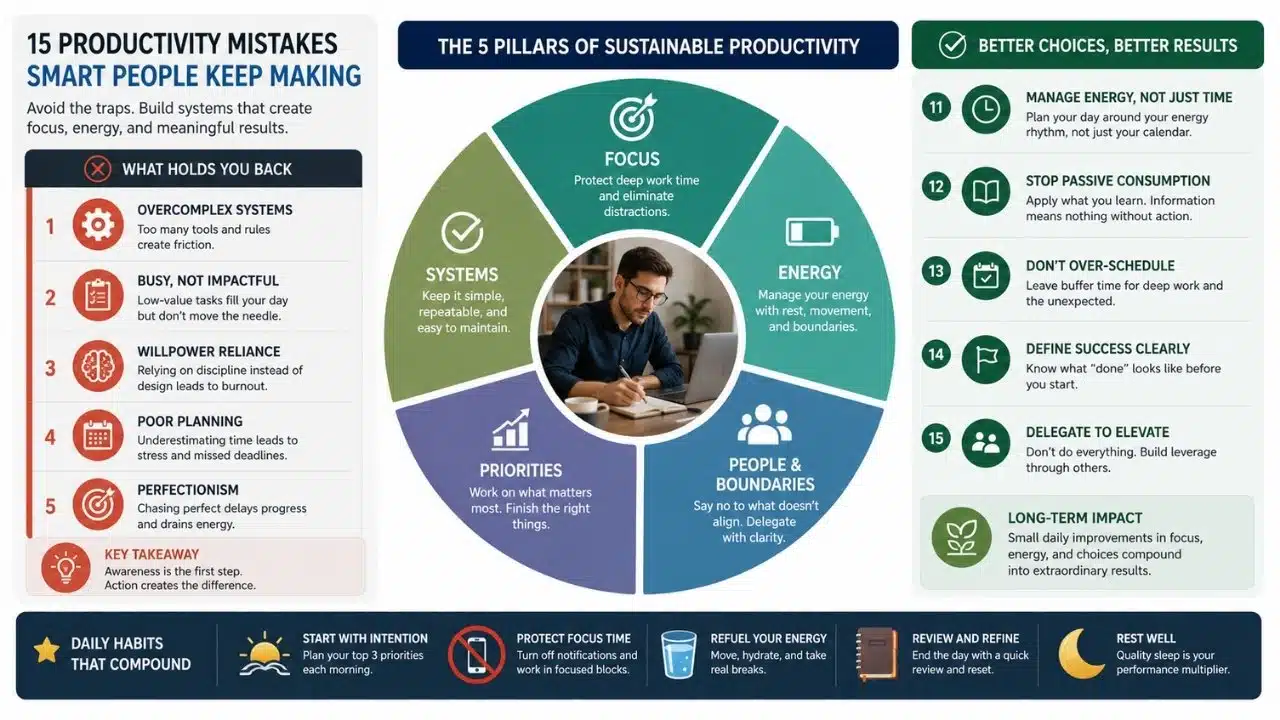
11. Ignoring Personal Cognitive Energy Cycles
Scheduling heavy analytical work during an afternoon energy slump leads to slow execution and unnecessary frustration.
Productivity is not just about managing time; it is about managing energy. Identify your peak hours of mental clarity, whether early in the morning or mid-day, and reserve those windows for your hardest analytical challenges. Save routine communication and file management for lower-energy periods.
12. Consuming Information Without Immediate Execution
Reading books, listening to podcasts, and taking online courses without applying the material creates a false sense of growth.
Information hoarding consumes valuable hours while producing zero tangible results. Limit information intake to knowledge you can implement immediately on an active project. Learning is most effective when combined directly with practical application.
13. Over-Scheduling Every Minute of the Calendar
Creating a schedule with no open space leaves you vulnerable when unexpected issues arise.
When your calendar is packed end-to-end with back-to-back meetings and tasks, a single urgent call can derail your entire day. Leave 20% of your daily schedule open as buffer time to handle unexpected operational demands without pushing your major goals into the night.
14. Working Without Clear Success Metrics
Starting a project without defining what “done” looks like leads to endless revisions and bloated project scopes.
When criteria for success are vague, smart people continue adding features, text, or analysis long after the primary objectives are met. Before launching any major task, write down the specific benchmarks that signal completion. Once those benchmarks are hit, conclude the work and move on.
15. Working Alone Instead of Delegating
Insisting on doing everything yourself because “it is faster than explaining it” severely limits your potential output.
While training someone else requires an initial investment of time, holding onto low-complexity tasks restricts your focus to operational execution instead of high-level strategy. Delegate repeatable workflows so you can direct your energy toward high-value growth initiatives.
Why High Performers Fall for These Productivity Traps
Intelligent individuals often rely on talent and extra effort to overcome inefficient habits during the early stages of their careers. Because hard work overcomes minor inefficiencies early on, poor habits become embedded in daily routines.
As workload complexity increases, brute-force effort reaches its limit. The strategies that worked for simple tasks fail when managing cross-functional teams, multi-tier projects, or high-level strategic planning. Transitioning from working harder to working cleaner requires actively identifying these productivity mistakes to avoid and replacing complex routines with simple, scalable systems.
Productivity Mistake Correction Matrix
Use this framework to identify common execution traps and deploy immediate solutions:
| Common Mistake | Underlying Cause | Immediate Structural Fix |
| Complex Systems | Craving perfection and control | Limit daily management tools to one physical notebook or basic app. |
| Context-Switching | Fear of missing out on messages | Batch communications into two fixed daily review windows. |
| Infinite Backlogs | Inability to discard secondary ideas | Delete or archive any item older than 30 days that lacks a due date. |
| Over-Scheduling | Overestimating daily capacity | Leave two 30-minute buffer blocks unassigned on your daily calendar. |
Final Thoughts
Peak performance is not about doing more things; it is about eliminating friction and focusing on actions that move the needle. By recognizing these common productivity mistakes to avoid, you build a streamlined workflow that protects your focus, maintains high quality, and sustains performance over time.
Frequently Asked Questions (FAQs) About Productivity Mistakes
What is the single most common productivity mistake smart people make?
The most frequent error is confusing busyness with real impact. Intelligent people often complete numerous low-priority, administrative tasks because it creates a quick feeling of accomplishment, while delaying difficult, high-value projects that require deep concentration.
How can I simplify my productivity system if it is already over-engineered?
Strip your workflow back to basics for two weeks. Use a single list of three daily priorities alongside a calendar for fixed appointments. Remove automated tags, color codes, and complex folder structures until your core execution habits are stable.
Is perfectionism always bad for productivity?
Perfectionism is useful during critical execution stages where error margins are minimal, such as legal compliance or technical security. However, applying perfectionist standards to routine internal communication or early project drafts creates unnecessary friction and delays overall execution.