
The Benefits of Prior Learning Assessments (PLAs) for Returning Students

Prior Learning Assessments (PLAs) for Returning Students

Going back to college as an adult can feel like starting over. But what if you didn’t have to? 

For many returning students, Prior Learning Assessments [PLAs] can offer a powerful shortcut to earning a degree faster and more affordably. PLAs allow adult learners to receive college credit for knowledge gained through work, training, military service, certifications, volunteer work, or other real-life experiences. If you’re returning to college with years of experience under your belt, PLAs can help you get credit for what you already know, bringing you one step closer to graduation and career advancement.

What Are Prior Learning Assessments?

A Prior Learning Assessment is a process used by colleges and universities to evaluate a student’s existing knowledge and skills for academic credit. This credit can count toward a degree just like the credit you’d earn in a traditional class.

PLAs come in a few different forms:

  • Portfolio assessments – You submit documentation of your professional or personal learning experiences along with a reflective narrative.
  • Standardized exams – You take tests like CLEP or DSST to demonstrate your knowledge in specific subjects.
  • Challenge exams – Some schools offer custom exams for particular courses, allowing you to test out of them.
  • Evaluated training programs – If you’ve completed training at work or through the military, you may be eligible for credit if that training is recognized by ACE [American Council on Education].

Saving Time and Money

One of the biggest advantages of PLAs is that they can significantly reduce the time it takes to finish your degree. For working adults with family or financial responsibilities, this can be a game-changer. Instead of sitting through an entire semester learning concepts you already use every day at work, PLAs give you the chance to skip ahead.

Saving time also means saving money. The cost of submitting a PLA portfolio or taking a CLEP exam is generally much lower than the tuition for a full course. That means fewer classes to pay for—and a quicker return on your investment in education.

Recognizing Real-World Experience
Recognizing Real-World Experience

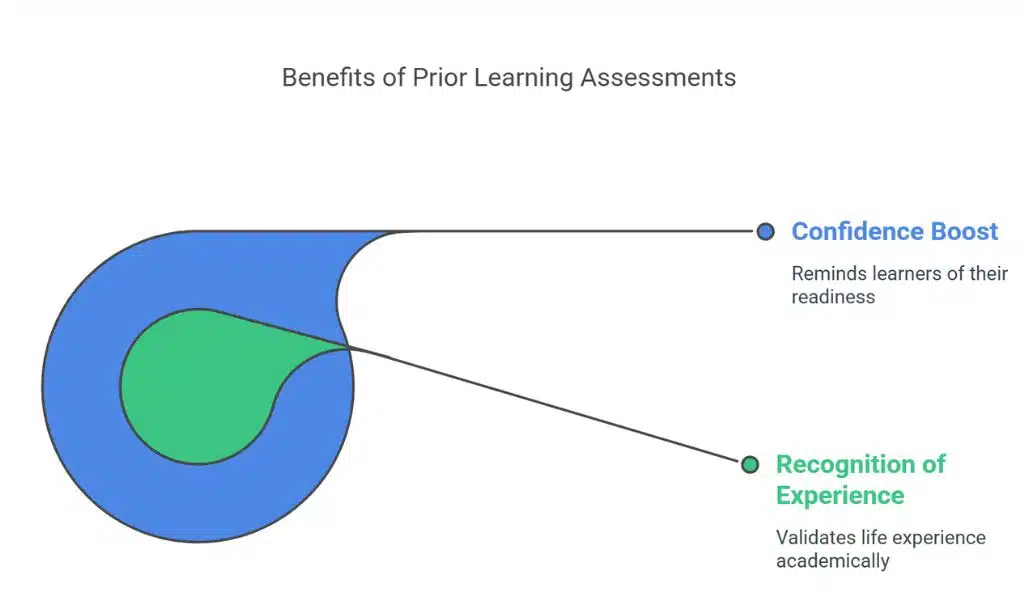
Many adult learners bring a wealth of real-world experience to the table. Whether you’ve worked in business, education, healthcare, the military, or any other field, chances are you’ve developed skills and knowledge that align with college-level learning. PLAs give that experience the recognition it deserves, validating your hard-earned expertise in a formal academic setting.

This process can also boost your confidence. If you’ve been out of the classroom for a while, seeing your life experience translated into academic credit can remind you that you’re more than ready for this next step.

A Path Toward Career Advancement

Earning a degree is often the key to unlocking new opportunities for career advancement, whether you’re aiming for a promotion, planning to switch fields, or looking to increase your earning potential. By using PLAs to speed up the process, you can reach your goals sooner.

Employers also tend to value candidates who can demonstrate both experience and education. When you use a PLA to turn your professional background into college credit, you’re showing future employers that you’re not only capable of learning, but that you already have.

Getting Started with PLAs

Every college has its own policies regarding PLAs, so the first step is to talk to an admissions advisor or academic counselor. They can help you understand which types of PLA your target school accepts, how to submit documentation, and what deadlines to keep in mind.

You’ll also want to reflect on your work history, training, and life experiences. Think about projects you’ve managed, software you’ve mastered, certifications you’ve earned, or leadership roles you’ve held. All of these can potentially translate into credit.



Subscribe to Our Newsletter

Related Articles

Top Trending

Complete Guide on Game Programgeeks
Game Programgeeks: A Complete Guide on PC, Game Dev, and Tech
ImagineLab.art vs Canva for Non-Technical Marketers
ImagineLab.art vs Canva for Non-Technical Marketers: Which One Fits the Real Workflow?
red flags in saas contracts
10 Dangerous Red Flags in SaaS Contracts and How to Avoid Them
Diagram of 10 essential social media metrics that matter for digital marketing strategy and analytics
10 Social Media Metrics That Actually Mean Something
AI in University Assessments
How Universities Are Redesigning Assessment for the AI Era

Technology & AI

Complete Guide on Game Programgeeks
Game Programgeeks: A Complete Guide on PC, Game Dev, and Tech
ImagineLab.art vs Canva for Non-Technical Marketers
ImagineLab.art vs Canva for Non-Technical Marketers: Which One Fits the Real Workflow?
AI in University Assessments
How Universities Are Redesigning Assessment for the AI Era
AI marketing profitability illustrated by balancing faster campaign production against editing time, software costs, and revisions.
AI Marketing Profitability: The Hidden Costs Crushing Agency Margins
automations students can build with free tools
9 Best Automations Students Can Build With Free Tools

GAMING

Complete Guide on Game Programgeeks
Game Programgeeks: A Complete Guide on PC, Game Dev, and Tech
Online Color Game Philippines
Online Color Game Philippines: What Every Beginner Should Know Before Playing
Ways to Reduce Game Development Costs
12 Ways Studios Cut Game Development Costs
NFT game development cost
How Much Does NFT Game Development Cost? A Realistic Budget Breakdown
Reasons Why You No Longer Need the Best Roblox AI Scripter
Forget Best Roblox AI Scripter: 10 Reasons Why You No Longer Need It

Business & Marketing

AI marketing profitability illustrated by balancing faster campaign production against editing time, software costs, and revisions.
AI Marketing Profitability: The Hidden Costs Crushing Agency Margins
cut company saas spend
How to Cut Company SaaS Spend: 10 Proven Tactics
Best Communities for SaaS Founders
12 Best Communities for SaaS Founders to Find Mentors and Peers
Bootstrapping vs VC for SaaS founders reviewing growth and burn trends, showing how funding choices can affect control, spending, and sustainable company growth
Bootstrapping vs VC for SaaS: How To Evaluate Capital Strategy
Sentiment analysis for business dashboard showing customer feedback trends, emotion signals, and performance charts in a modern workspace, helping readers quickly understand how companies turn raw feedback into practical business insights
Top 8 High-Impact Ways to Leverage Sentiment Analysis for Business Growth

EdTech & E-Learning

AI in University Assessments
How Universities Are Redesigning Assessment for the AI Era
Selecting edtech tools through a structured review of learning value, privacy, usability, integration, and cost.
Selecting EdTech Tools: 7 Questions School Leaders Must Ask Before Buying
Alphabet Recognition and Why It Matters
What Is Alphabet Recognition and Why Does It Matter
Assistive Technology for Diverse Learners
How Assistive Technology Supports Diverse Learners
VR and AR in Classrooms
How VR and AR Are Actually Being Used in Classrooms Today

Software & Apps

ImagineLab.art vs Canva for Non-Technical Marketers
ImagineLab.art vs Canva for Non-Technical Marketers: Which One Fits the Real Workflow?
automations students can build with free tools
9 Best Automations Students Can Build With Free Tools
ImagineLab.art vs adobe for design team
ImagineLab.art vs Adobe for Professional Design Teams: Which One Fits the Real Workflow?
Best SaaS Integration Platforms to Connect Apps
10 Best SaaS Integration Platforms to Connect Your Apps
Choosing a Cloud Provider for SaaS Product
How to Choose a Cloud Provider for Your First SaaS Product