

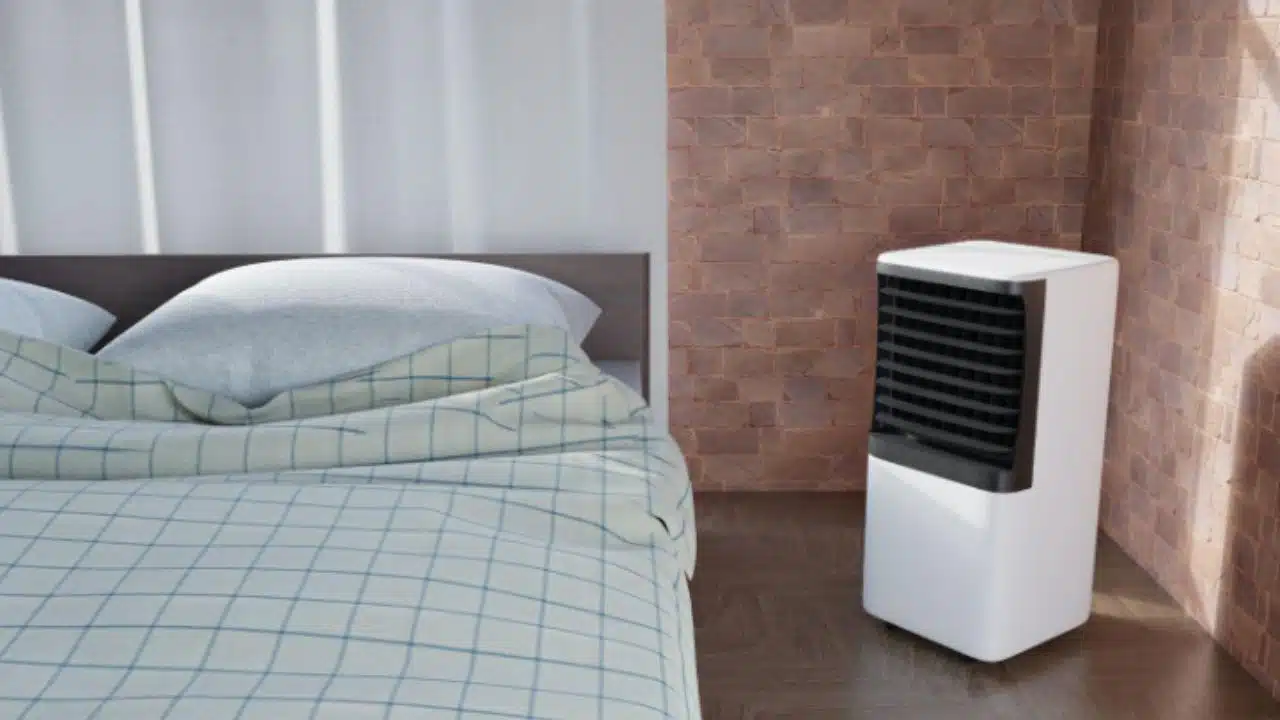
In India, where summer temperatures sometimes rise to beyond 40° Celsius. In these kinds of situations, having a good cooling mechanism is now absolutely essential.
Although air conditioners are efficient, installation and running expenses can be somewhat significant. Portable air coolers step in as an economical and energy-saving option.
We will explore in detail the key aspects to keep in mind when choosing a portable air cooler.
Understanding How Portable Air Coolers Work
Before we dive into the features, let’s understand how portable air coolers operate. Portable air coolers rely on a natural mechanism known as evaporative cooling, unlike air conditioners that run refrigerants.
The actual process is hot air passing water-saturated pads. The water evaporates as the air flows across, lowering the temperature and producing a cool, delightful breeze.
The fan, which distributes the cool air, the cooling pads for optimal efficiency, and the water reservoir to keep the pads moist are the main components of the cooler. It’s a simple yet really effective strategy that provides a natural approach to remaining cool.
Why Choose a Portable Air Cooler?
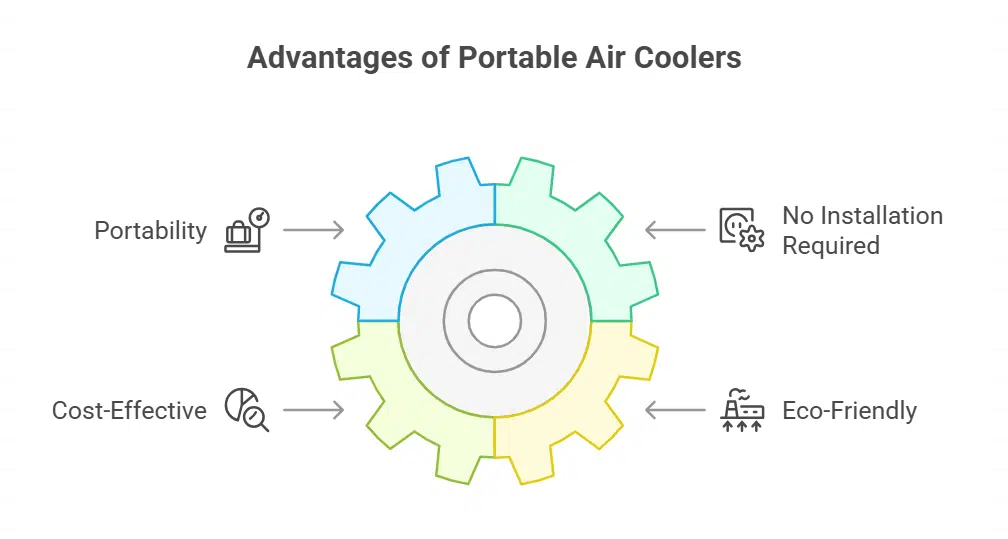
For all the right reasons, portable air coolers have gained popularity. Here is why portable air coolers are a wise decision:
- Portability: On travels, pack the coolers and effortlessly transport them from one room to another.
- No Installation Required: Easy to set up. Just connect and operate, no need to do go through a complicated installation process.
- Cost-Effective: Compared to air conditioners, air coolers come with reduced initial and operational expenses.
- Eco-Friendly: It runs using less energy and water instead of chemical refrigerants.
Key Features to Consider When Buying a Portable Air Cooler
#1 Cooling Capacity and Room Size
The dimensions of the space you want to cool with the air cooler should be taken into consideration first. Portable air coolers in various capacities are available, measured by airflow or CFM (Cubic Feet per Minute).
As a rule of thumb:
- Small rooms (up to 150 square feet) should search for personal coolers with 1000 – 1500 CFM capacity.
- 150–300 square foot medium-sized rooms call for a cooler with 2000 – 3000 cubic feet.
- Large areas (300+ square feet) use either high-performance portable coolers with 3500+ CFM or desert coolers.
Always check the manufacturer’s recommended room size and air throw, the distance or area the cool air can reach, to ensure effective and even cooling.
#2 Water Tank Capacity
Since portable air coolers depend on water to function, tank capacity plays a crucial role. Personal coolers hold 15 – 25L, tower coolers 20 – 40L, and desert coolers 40 – 60+L. For areas with power cuts or water issues, opt for a larger tank or a model with auto-refill for uninterrupted cooling.
#3 Cooling Pad Quality
The efficiency of a portable air cooler is significantly influenced by the cooling pads. They reduce their temperature through evaporation by taking in water and letting warm air flow through. The design of these pads significantly affects the lifetime, frequency of required maintenance, and efficiency of your cooler, as well as their appearance. In portable air coolers, cooling pads fall into two primary categories:
A. Honeycomb Pads (Cellulose Pads)
Constructed from sturdy cellulose, featuring a beehive-inspired structure for enhanced water retention and extended cooling. They demand minimal upkeep and are perfect for city dwellings aiming for efficiency and lasting value. Perfect for Indian conditions, they offer better cooling and a longer lifespan while keeping the running cost low.
B. Wood Wool Pads (Aspen Pads)
Made from thin wood shavings and synthetic fibres, these pads have a fibrous, grass-like appearance. They provide exceptional cooling in arid and extremely hot areas. Ideal for smaller spaces with good ventilation.
#4 Airflow and Fan Speed
Higher air delivery ensures faster cooling. A good portable cooler should offer strong air throw and multi-directional air swing for uniform cooling. Look for adjustable louvres and oscillating features that help cover every corner of the room. Features like 4-way air deflection and high air throw distance ensure even distribution of cool air.
#5 Energy Efficiency
As they typically consume a lot less energy than air conditioners, portable air coolers are both economically and ecologically beneficial. Look for versions that are compatible with inverters to save even more electricity. Check for the cooler’s wattage rating, lower wattage means less power consumption.
#6 Noise Level
Sound can be a deal-breaker, particularly in bedrooms or study environments. Verify the decibel (dB) levels, if accessible. Ideally, the cooler should function below 60 dB for a quieter experience.
#7 Additional Features
- Remote Control: Offers ease of operation, especially during the night.
- Digital Display: For easy monitoring of settings and temperature.
- Ice Chamber: For extra cooling in peak summer.
- Dust Filters: Improve air quality, especially useful in metro cities.
- Empty Tank Alarm & Overflow Indicator: Prevents dry running and water spillage.
#8 Maintenance and Cleaning
Select models featuring filters and pads that are simple to detach and washable for effortless maintenance. Basic upkeep prolongs your cooler’s lifespan and maintains peak performance.
#9 Brand Reputation and After-Sales Support
In India’s hot and dusty climate, air coolers need regular maintenance. Choosing a trusted brand with a robust service network is key. Such value additions make a real difference over time.
Budget and Portable Air Cooler Price Range in India
One major benefit of portable coolers is their low cost. Here’s a broad summary of the price range for portable air coolers in India:
| Cooler Type | Approximate Price Range (INR) |
| Personal Coolers | ₹4,000 – ₹7,000 |
| Tower Coolers | ₹6,000 – ₹12,000 |
| Desert Coolers | ₹8,000 – ₹18,000 |
Prices differ based on brand, size, and specifications.
Final Thoughts: Make an Informed Choice
Your first choice for a reasonably priced, efficient, and ecologically friendly solution might be a portable air chiller. However, occasionally you must concentrate on how to maximise the value of your investment rather than appearances or price range. Consider what truly counts, including room size, required cooling, and amenities fit for your way of life. Above all, you have to choose a reliable brand that guarantees strong performance, long-lasting durability, and robust after-sales support.
Indian families often choose Orient Electric’s portable air coolers because of their innovative design, modern cooling technologies, and reasonable price range. With a wide range of models suited for different needs, whether it’s compact personal coolers or high-capacity desert coolers, Orient ensures there’s a perfect match for every Indian home. Their strong reputation for quality, easy maintenance, and dependable customer service further makes them a preferred choice among buyers.
Frequently Asked Questions (FAQs)
Q1. How do I know what room size a portable air cooler is best for?
Ans. It comes down to the model and its cooling power. Smaller coolers (mostly up to 20 liters) can be ideal for compact spaces around 150 sq. ft. On the other hand, larger areas, up to 400 sq. ft., you’ll need a bigger unit with at least 35 – 50 litres capacity for effective cooling.
Q2. Honeycomb vs. wood wool pads, which is the better option?
Ans. Honeycomb pads are the modern pick; they last longer, cool better, and need less upkeep. They’re made of cellulose with a unique pattern that holds water efficiently. Wood wool pads, made from wood shavings, are budget-friendly but need frequent changes and offer decent but not exceptional cooling.






















