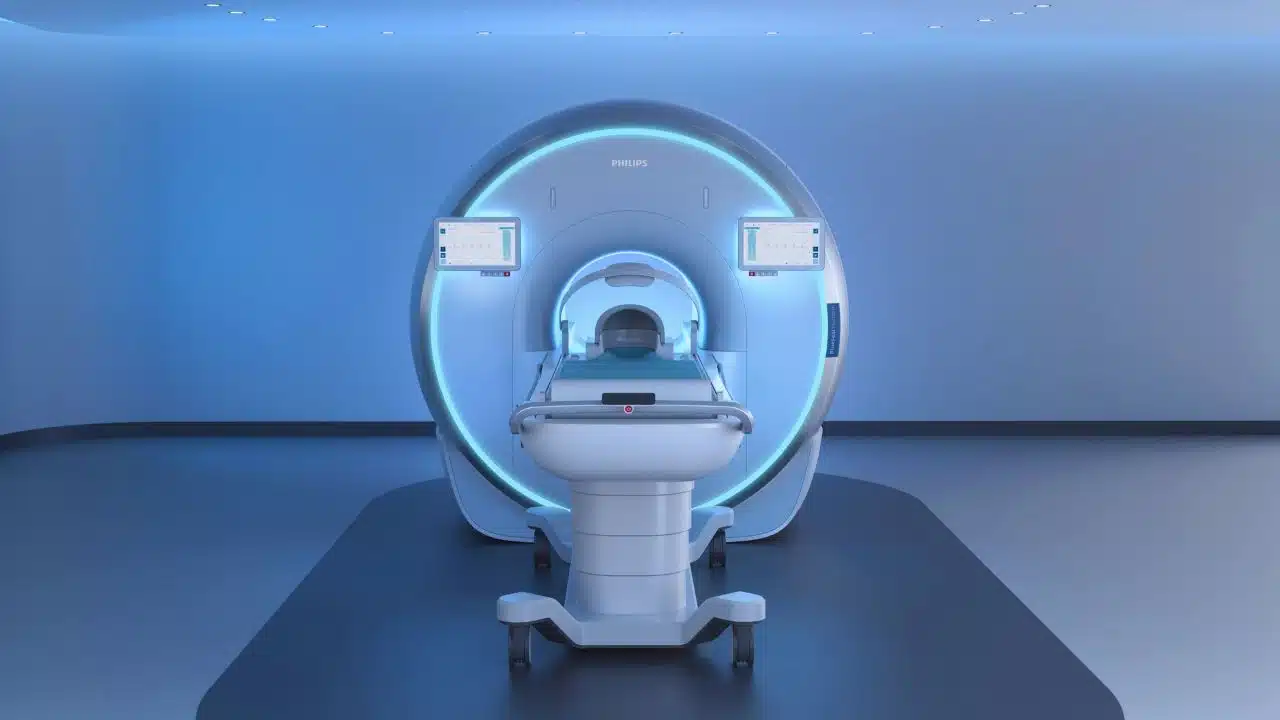
Royal Philips has introduced BlueSeal Horizon, marking a significant milestone in medical imaging as the industry’s first helium-free 3.0T MRI platform. The system was unveiled at the Radiological Society of North America (RSNA) 2025 annual meeting in Chicago, showcasing a combination of sustainable magnet technology and advanced artificial intelligence capabilities designed to transform high-field magnetic resonance imaging.
The announcement represents Philips’ expansion of its proven BlueSeal helium-free technology into the more powerful 3.0 Tesla segment, a move that addresses both environmental concerns and operational challenges that have long plagued healthcare facilities relying on traditional MRI systems.
The Technology Behind BlueSeal Horizon
BlueSeal Horizon employs a revolutionary sealed-magnet design that permanently encloses approximately 7 liters of helium within a fully sealed cryogenic cooling circuit. This represents a dramatic reduction compared to conventional 3.0T MRI systems, which typically require 1,500 liters of liquid helium and need periodic refills throughout their operational lifetime.
The system’s cryogenic architecture ensures that the small amount of helium remains sealed within the magnet housing for the entire duration of the scanner’s operational life, eliminating the need for helium replenishment, vent pipes, and the complex infrastructure traditionally required to support MRI operations. This engineering achievement translates into a fundamentally different installation footprint and maintenance profile for healthcare facilities.
Why 3.0T Matters for Clinical Imaging
The 3.0 Tesla field strength represents the most advanced MRI magnet technology in widespread clinical use today. These high-field systems deliver superior signal-to-noise ratio and enhanced spatial resolution compared to 1.5T scanners, making them particularly valuable for demanding clinical applications including advanced neurological imaging, detailed musculoskeletal studies, vascular assessments, and research protocols.
The higher magnetic field enables clinicians to visualize smaller anatomical structures, detect subtle pathological changes, and perform specialized imaging techniques such as functional MRI, high-resolution spectroscopy, and advanced diffusion imaging with greater precision. By bringing helium-free operations to the 3.0T platform, Philips is making these advanced diagnostic capabilities more accessible and sustainable for healthcare institutions worldwide.
Environmental and Economic Impact
Philips reports that its existing BlueSeal footprint, which includes more than 2,000 installed 1.5T systems globally, has already saved an estimated 6 million liters of helium compared to previous-generation magnets. With helium being a finite natural resource facing supply constraints and price volatility, this conservation effort carries both environmental and economic significance.
The helium-free design eliminates recurring costs associated with helium boil-off, refills, and emergency replenishment during supply shortages. Healthcare facilities that have experienced helium supply disruptions understand the operational risk posed by traditional MRI systems, which can face unplanned downtime or reduced performance when helium levels drop. BlueSeal Horizon removes this vulnerability entirely from the operational equation.
Beyond helium conservation, the system’s simplified infrastructure requirements reduce the carbon footprint associated with MRI installation and operation, aligning with healthcare sustainability initiatives and corporate environmental goals increasingly prioritized by hospital systems.
Simplified Installation and Siting
Traditional 3.0T MRI systems require extensive facility modifications including reinforced floors to support magnet weight, specialized HVAC systems, helium vent pipes extending through building roofs, and complex quench pipe installations to safely exhaust helium in emergency scenarios. These requirements add substantial cost, extend construction timelines, and limit placement options within healthcare facilities.
BlueSeal Horizon’s design eliminates the need for helium vent infrastructure and significantly reduces siting complexity. Installation timelines are shortened, renovation costs are reduced, and facilities gain greater flexibility in scanner placement, including previously impractical locations within existing buildings. For healthcare systems expanding imaging capacity or replacing aging equipment, these advantages can accelerate project timelines and reduce total capital expenditure beyond the scanner acquisition cost itself.
AI-Powered Performance Enhancement
Philips has integrated a comprehensive artificial intelligence software stack into BlueSeal Horizon, positioning the platform as not merely a helium-free alternative but as a next-generation system designed to address workflow efficiency and image quality simultaneously.
SmartSpeed Precise
The SmartSpeed Precise technology represents a dual-AI approach that Philips claims can enable scans up to three times faster while delivering images up to 80 percent sharper compared to conventional acquisition and reconstruction methods. This performance leap addresses one of the most persistent challenges in MRI: the inherent trade-off between scan time, image resolution, and signal quality.
Faster scanning directly improves patient experience by reducing time spent in the confined magnet bore, decreases motion artifacts from restless or uncomfortable patients, and increases daily scanner throughput, allowing facilities to serve more patients with existing equipment. The simultaneous improvement in image sharpness ensures that speed gains do not compromise diagnostic quality.
SmartPlanning
SmartPlanning automates the traditionally labor-intensive process of scan protocol setup, reportedly completing planning tasks in as little as 30 seconds. This AI-driven automation reduces technologist workload, minimizes variability between operators, and accelerates patient positioning and scan initiation.
For facilities facing technologist shortages or training new staff, automated planning tools can help maintain consistent imaging quality while reducing the expertise required for routine examinations. Experienced technologists benefit from reduced cognitive load and can redirect their expertise toward complex cases and patient care.
Real-Time Scan Preview
Leveraging NVIDIA’s accelerated computing architecture, Real-Time Scan Preview brings faster image reconstruction, advanced denoising, and artifact reduction capabilities directly to the scanner console. This real-time processing enables technologists to assess image quality immediately during acquisition, identify problems before the patient leaves the scanner, and make informed decisions about whether additional sequences are needed.
The immediate feedback loop reduces callback rates, improves first-pass examination success, and prevents the frustrating scenario where inadequate images are discovered only after the patient has departed, requiring rescheduling and repeating portions of the examination.
SmartReading
SmartReading extends AI integration beyond acquisition into the interpretation phase, bringing cloud-based AI reading and reporting tools into the MR workflow. This integration supports radiologists with automated measurements, standardized reporting templates, and AI-assisted detection algorithms that can highlight potential abnormalities for physician review.
As radiologist workloads continue to increase and imaging volumes grow, AI-assisted reading tools help maintain interpretation quality and speed while reducing physician fatigue.
Clinical Applications and Use Cases
The BlueSeal Horizon platform targets the full spectrum of clinical applications typically performed on high-field MRI systems. The 3.0T field strength and advanced gradient systems support neurological protocols for detecting subtle brain lesions, characterizing tumors, evaluating neurodegenerative diseases, and mapping brain function.
Musculoskeletal imaging benefits from the enhanced resolution and specialized coils, enabling detailed visualization of cartilage, ligaments, tendons, and subtle bone marrow abnormalities important for orthopedic diagnosis and surgical planning. Vascular imaging applications include non-contrast and contrast-enhanced angiography for assessing arterial and venous anatomy throughout the body.
The system also supports cardiac imaging protocols, abdominal and pelvic examinations, breast MRI, and the specialized sequences required for research applications and clinical trials. The AI acceleration features are particularly valuable in body imaging, where breath-holding requirements and motion artifacts have historically limited scan speed and image quality.
Track Record and Market Context
Philips’ BlueSeal helium-free technology is not entirely new to the market. The company has successfully deployed more than 2,000 helium-free 1.5T MRI systems globally, establishing a proven track record for the fundamental magnet technology. This installed base provides confidence that the sealed helium approach can deliver reliable long-term performance in diverse clinical environments.
What distinguishes BlueSeal Horizon is the extension of this proven technology to the more demanding 3.0T platform, combined with the latest AI software capabilities that were not available when earlier BlueSeal systems were introduced. The RSNA unveiling positions Philips as the first major manufacturer to offer a commercially-oriented helium-free solution at the 3.0T field strength, potentially establishing a competitive advantage in sustainability-conscious markets.
Regulatory Status and Commercial Availability
Philips has explicitly classified BlueSeal Horizon as a work-in-progress system that is not currently available for sale in any jurisdiction, including the United States, pending regulatory clearances. The company has cautioned that future commercial availability cannot be guaranteed and will depend on obtaining necessary market authorizations from regulatory bodies including the FDA in the United States and comparable agencies in other markets.
This regulatory positioning is standard for new medical imaging platforms unveiled at conferences before formal market approval. The RSNA presentation serves to generate clinical interest, gather feedback from radiologists and administrators, and establish market positioning ahead of commercial launch. Philips has not disclosed specific timelines for regulatory submissions or anticipated approval dates, though such timelines typically span 12 to 24 months from initial submission depending on the regulatory pathway and device classification.
Industry Significance and Future Outlook
The introduction of a helium-free 3.0T platform reflects broader industry trends toward sustainable medical technology, operational cost reduction, and AI integration across healthcare equipment categories. As healthcare systems face pressure to reduce environmental impact while maintaining or improving clinical capabilities, technologies that deliver both sustainability and performance benefits are increasingly valued.
The BlueSeal Horizon announcement may accelerate competitive development, prompting other MRI manufacturers to advance their own helium-reduction initiatives or alternative approaches to addressing supply and sustainability challenges. While other manufacturers have explored helium recycling systems and reduced-helium designs, Philips’ fully sealed approach represents a distinct engineering philosophy that eliminates helium management rather than merely reducing it.
For the broader MRI market, widespread adoption of helium-free systems could reshape installation planning, reduce barriers to MRI access in facilities where traditional systems were impractical, and shift lifecycle cost calculations in favor of higher capital investment in exchange for dramatically reduced operational expenses. Healthcare economists and equipment planners will closely watch early adoption patterns and long-term performance data as the platform moves from unveiling to commercial deployment.
The integration of comprehensive AI workflows alongside the helium-free hardware also signals an industry evolution where scanner hardware and intelligent software are increasingly treated as inseparable components of imaging system value rather than separate purchase decisions.