
History is not just a collection of dusty dates; it is the living, breathing narrative of human triumph, tragedy, innovation, and survival. Every single day on the calendar holds a mirror to our past, reflecting the countless events that have shaped the world we live in today. When we flip the pages of history to September 16, we uncover a fascinating mosaic of global turning points. From the departure of religious pilgrims seeking a new world to explosive acts of political defiance, and from the birth of musical legends to the fall of kings, this date is etched deeply into the human timeline.
In this comprehensive editorial exploration, we will travel across the globe—from the politically charged detention camps of colonial Bengal to the bustling, terror-struck financial district of Wall Street. We will look at the visionaries born on this day and bid farewell to the titans who took their last breath. Whether you are a history buff, a cultural anthropologist, or just someone looking for incredible dinner-table trivia, this in-depth guide offers a detailed look at what happened on September 16 throughout history.
The Bangalee Sphere & Indian Subcontinent
While global history books often heavily emphasize Western events, the Indian subcontinent—and the Bangalee sphere in particular—holds a rich, often turbulent history of anti-colonial resistance, immense cultural contributions, and scientific excellence. September 16 marks days of immense sacrifice and the celebration of legendary talent in this region.
Historical Events: The Hijli Firing (1931)
One of the darkest and most significant chapters in Bengal’s anti-colonial struggle occurred on September 16, 1931. The British colonial government had established the Hijli Detention Camp in Midnapore, West Bengal, to hold political prisoners without trial. The conditions were notoriously harsh, and the detainees—many of whom were passionate young revolutionaries fighting for India’s independence—frequently clashed with the authorities.
On this fateful night, British sentries, allegedly provoked by an earlier minor dispute, opened indiscriminate fire on the unarmed detainees in their cells. The brutal attack resulted in the deaths of two prominent freedom fighters: Santosh Kumar Mitra and Tarakeswar Sengupta. Dozens of others were severely injured. This blatant act of state violence sent shockwaves throughout the subcontinent. The incident was so appalling that Nobel Laureate Rabindranath Tagore, despite his failing health, organized and addressed a massive public protest rally at the Calcutta Monument. Subhas Chandra Bose personally went to Midnapore to claim the bodies of the martyrs. Today, the former Hijli Detention Camp has been repurposed and stands within the campus of the Indian Institute of Technology (IIT) Kharagpur, serving as a solemn museum dedicated to the freedom struggle.
The Battle of Baliadanga (1971)
Fast-forward forty years to the Bangladesh Liberation War. On September 16, 1971, the Mukti Bahini (the Bengali freedom fighters) launched a fierce offensive against a heavily fortified Pakistani military Border Observation Post at Kakdanga, near Baliadanga village. While this specific assault was met with intense retaliation and did not immediately capture the post, it was a vital part of the broader Sector 8 military strategy. The continued guerrilla pressure in this region eventually wore down the occupying forces, contributing significantly to the eventual liberation of Bangladesh in December.
Famous Births & Deaths in the Subcontinent
To give you a quick overview of the notable figures from the region associated with this date, here is a reader-friendly table:
| Name | Year | Event | Profession / Legacy |
| M.S. Subbulakshmi | 1916 | Birth | Legendary Carnatic classical vocalist. The first musician ever to be awarded the Bharat Ratna (India’s highest civilian honor). |
| Santosh Kumar Mitra | 1931 | Death | Bengali revolutionary and freedom fighter martyred in the Hijli Detention Camp firing. |
| Tarakeswar Sengupta | 1931 | Death | Bengali revolutionary and freedom fighter martyred alongside Mitra at Hijli. |
International Observances & Holidays
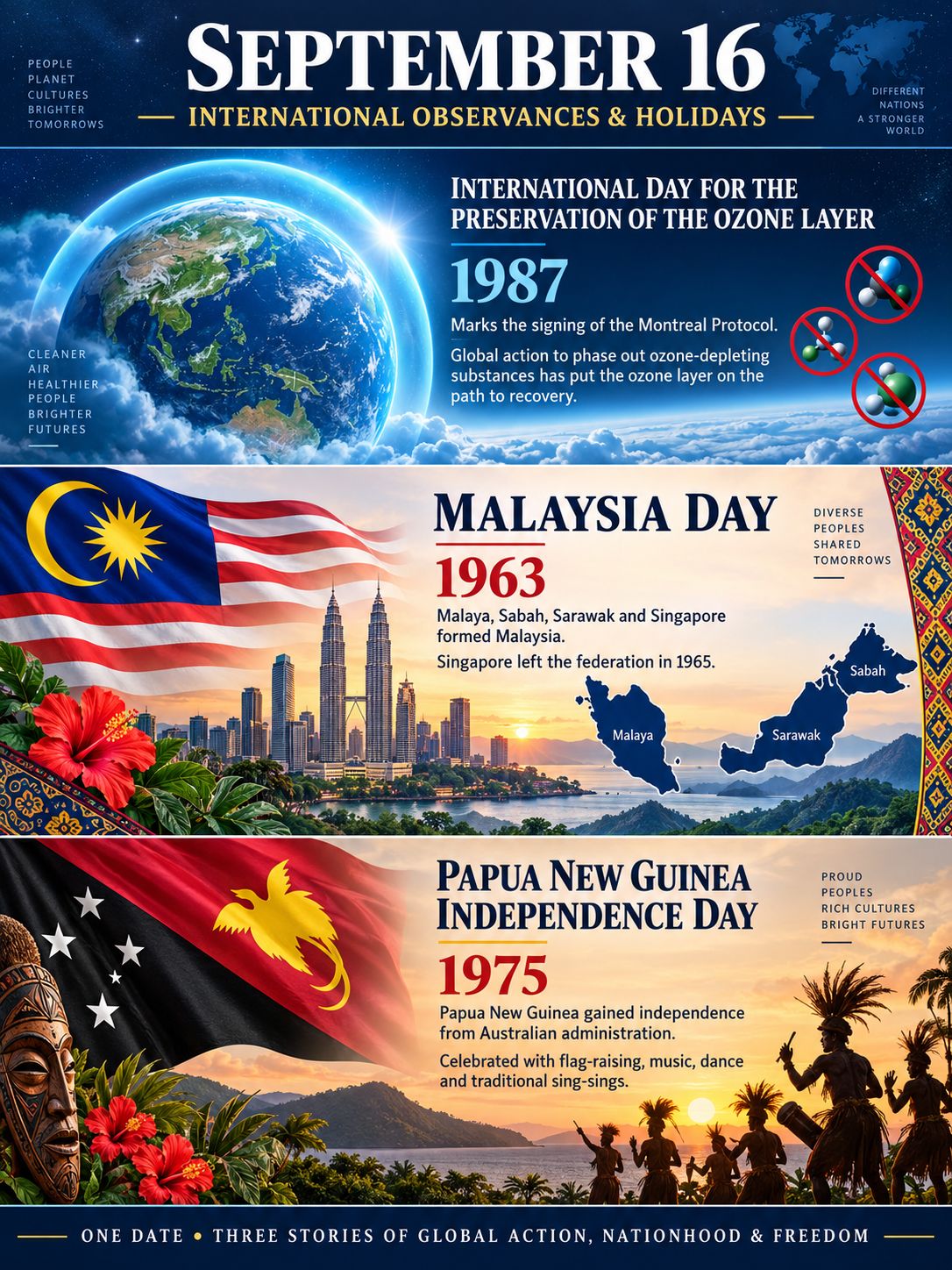
September 16 is marked by the United Nations as a day of vital environmental importance, while simultaneously serving as a day of immense national pride for several countries in the Asia-Pacific region.
International Day for the Preservation of the Ozone Layer
Proclaimed by the United Nations General Assembly, this day commemorates the signing of the Montreal Protocol on Substances that Deplete the Ozone Layer in 1987. The Montreal Protocol is widely considered the most successful environmental treaty in history. Before its signing, the widespread use of chlorofluorocarbons (CFCs) in aerosols and refrigerants had torn a massive hole in the Earth’s ozone layer, threatening global ecosystems with harmful ultraviolet radiation. Thanks to the global cooperation formalized on this date, the ozone layer is currently on track to fully recover by the middle of the 21st century.
Malaysia Day (Hari Malaysia)
While Malaysia gained its independence from British rule on August 31, 1957, September 16, 1963, marks the day the modern nation was truly formed. The Federation of Malaya merged with the former British colonies of North Borneo (Sabah), Sarawak, and Singapore to create the new nation of Malaysia. (Singapore would later separate from the federation in 1965 to become an independent city-state). Malaysia Day is celebrated with grand parades, patriotic songs, and cultural showcases that highlight the country’s incredible ethnic and cultural diversity.
Papua New Guinea Independence Day
On this day in 1975, Papua New Guinea officially gained full independence from Australian administration. Unlike many other post-colonial transitions, this was achieved peacefully. The day is celebrated with vibrant traditional sing-sings (festivals of music and dance), the raising of the striking red and black national flag featuring the bird-of-paradise, and nationwide festivities.
Global History
Beyond the subcontinent, September 16 has been a pivot point for revolutions, tragic massacres, economic crashes, and monumental journeys.
United States: Terror on Wall Street and the Draft
-
1620 – The Departure of the Mayflower: On this day (according to the Old Style calendar), the Mayflower set sail from Plymouth, England, carrying 102 passengers. These men, women, and children—a mix of religious Separatists seeking freedom and secular colonists seeking economic opportunity—braved a treacherous transatlantic crossing. They were originally bound for the Colony of Virginia but were blown off course, eventually landing in what is now Massachusetts. Their journey fundamentally shaped the foundational mythos and early colonization of North America.
-
1920 – The Wall Street Bombing: In what was the deadliest terrorist act on American soil up to that time, a horse-drawn wagon packed with 100 pounds of dynamite and 500 pounds of heavy cast-iron weights detonated outside the J.P. Morgan & Co. headquarters in New York’s financial district. The massive lunchtime blast killed 38 people and injured hundreds more. Despite a massive investigation, the crime was never officially solved, though historians widely attribute the attack to the Galleanists, a group of radical Italian anarchists.
-
1940 – The First Peacetime Draft: As World War II tore through Europe, President Franklin D. Roosevelt signed the Selective Training and Service Act. This established the first peacetime military draft in American history, requiring men between the ages of 21 and 36 to register. It was a controversial move in a largely isolationist country, but it prepared the U.S. military for its eventual entry into the war following the attack on Pearl Harbor a year later.
The Americas: The Cry of Dolores
-
1810 – The Mexican War of Independence Begins: In the early hours of September 16, a progressive Catholic priest named Miguel Hidalgo y Costilla rang the bell of his church in the small town of Dolores, Mexico. He delivered a passionate speech known as the Grito de Dolores (Cry of Dolores), urging his congregation to revolt against the oppressive Spanish colonial government. This spark ignited a brutal, decade-long war that ultimately resulted in Mexico’s independence. Today, September 16 is celebrated as Mexico’s Independence Day, marked by the President ringing the same historic bell in Mexico City.
United Kingdom & Europe: Black Wednesday
-
1992 – Black Wednesday: In a massive blow to the British government’s economic prestige, the UK was forced to abruptly withdraw the pound sterling from the European Exchange Rate Mechanism (ERM). Currency speculators, most famously George Soros (who famously “broke the Bank of England”), aggressively short-sold the pound. Despite raising interest rates to a staggering 15% in a single day, the government could not artificially inflate the currency’s value. The disaster cost the UK treasury billions, deeply scarred the Conservative Party’s reputation for economic competence, and fostered a deep-seated British skepticism toward European financial integration that eventually paved the way for Brexit.
Asia, Africa, and the Middle East: Tragedy and Protest
-
1982 – The Sabra and Shatila Massacre: In the midst of the Lebanese Civil War, right-wing Christian Phalangist militias entered the Sabra and Shatila Palestinian refugee camps in Beirut. Over the next two days, the militias slaughtered between 1,500 and 3,000 unarmed Palestinian refugees and Lebanese civilians. The camps were surrounded by the Israeli Defense Forces (IDF), who fired flares to illuminate the night sky but did not intervene. The massacre triggered global outrage and profound geopolitical fallout in the Middle East.
-
2022 – The Death of Mahsa Amini: In a modern tragedy that shook the world, 22-year-old Mahsa Jina Amini died in a hospital in Tehran, Iran, after being detained by the nation’s “morality police” for allegedly wearing her hijab improperly. Her death sparked an unprecedented wave of nationwide protests under the banner of “Woman, Life, Freedom.” The movement saw women burning their headscarves in the streets, resulting in a brutal government crackdown and permanently altering the sociopolitical landscape of modern Iran.
Notable Births & Deaths (Global)
September 16 has welcomed brilliant artists, revolutionary thinkers, and scientific pioneers into the world, while also marking the departure of kings, musical icons, and groundbreaking psychologists.
Famous Births on September 16
| Name | Year of Birth | Nationality | Profession / Fame |
| B.B. King | 1925 | American | Legendary blues guitarist, singer, and songwriter. Known for naming his guitar “Lucille.” |
| Lauren Bacall | 1924 | American | Iconic Hollywood actress famous for her sultry voice and film noir classics. |
| Nick Jonas | 1992 | American | Pop singer, songwriter, and actor; member of the globally famous Jonas Brothers. |
| David Copperfield | 1956 | American | World-renowned illusionist known for making the Statue of Liberty “disappear.” |
| Richard Marx | 1963 | American | Multi-platinum pop/rock singer-songwriter and producer (“Right Here Waiting”). |
Why They Matter Today:
B.B. King (1925–2015) didn’t just play the blues; he defined the genre for a global audience. Born on a plantation in Mississippi, Riley B. King rose from the grueling “chitlin’ circuit” to become the undisputed “King of the Blues.” His unique style of single-string soloing and smooth vibrato influenced virtually every rock and blues guitarist that followed, from Eric Clapton to John Mayer.
Lauren Bacall (1924–2014) burst onto the screen in 1944’s To Have and Have Not, famously delivering the line, “You know how to whistle, don’t you, Steve? You just put your lips together and blow.” Her intense gaze (dubbed “The Look”) and smoky voice made her a titan of Hollywood’s Golden Age.
Famous Deaths on September 16
| Name | Year of Death | Nationality | Cause / Legacy |
| Maria Callas | 1977 | Greek-American | One of the most renowned and influential opera sopranos of the 20th century; died of a heart attack. |
| Jean Piaget | 1980 | Swiss | Pioneering developmental psychologist who transformed our understanding of how children learn. |
| Marc Bolan | 1977 | English | Lead singer of T. Rex and pioneer of the Glam Rock movement; died in a car crash just before his 30th birthday. |
| Daniel Gabriel Fahrenheit | 1736 | Polish/German | Physicist who invented the mercury-in-glass thermometer and the Fahrenheit scale. |
| Louis XVIII | 1824 | French | King of France who took the throne after the fall of Napoleon; died of various ailments. |
Why They Matter Today:
Maria Callas (1923–1977), known as La Divina, possessed a vocal range and dramatic intensity that completely revolutionized modern opera. Her personal life, including her tumultuous relationship with shipping magnate Aristotle Onassis, kept her in the tabloids, but it was her absolute mastery of bel canto technique that cemented her artistic immortality.
Jean Piaget (1896–1980) fundamentally shifted the global educational paradigm. Before Piaget, psychology largely viewed children merely as less competent adults. Piaget’s theory of cognitive development proved that children think in strikingly different ways than adults, moving through distinct developmental stages. His work is still the foundational bedrock of early childhood education worldwide today.
“Did You Know?” Trivia
If you find yourself at a dinner party on September 16, here are three fascinating, lesser-known facts to share:
-
The Origin of Your Thermometer: The man who quite literally set the standard for temperature in the United States, Daniel Gabriel Fahrenheit, died on this day in 1736. He didn’t just invent the temperature scale that bears his name; he was the first person to successfully create a precise mercury-in-glass thermometer, revolutionizing experimental science.
-
An Incredible Act of Heroism: On September 16, 1976, Shavarsh Karapetyan, a 23-year-old Armenian champion finswimmer, was completing a 20-kilometer run near a reservoir in Yerevan. He suddenly witnessed a crowded trolleybus crash and sink 33 feet into the freezing, sewage-filled water. Karapetyan dove in, kicked out a window in the submerged bus, and made repeated dives, ultimately dragging 20 unconscious people to safety. His heroism cost him his athletic career, as the raw sewage and deep cuts left him hospitalized with pneumonia and sepsis for weeks.
-
American Education Abroad: The very first American educational institution established outside the borders of the United States was founded on this day in 1863. Robert College was opened in Istanbul, Turkey, by American philanthropist Christopher Robert and missionary Cyrus Hamlin, standing as a unique bridge between American pedagogy and Ottoman culture.
Quote of the Day
“The beautiful thing about learning is nobody can take it away from you.”
— B.B. King (Born September 16, 1925)
This profound sentiment perfectly captures the spirit of history. As we look back on the events, the lives lost, and the visionaries born on this day, the knowledge we gather enriches our understanding of the human condition.
Final Thoughts
September 16 is a remarkable cross-section of human existence. It is a day that carries the heavy weight of tragic massacres in Lebanon and the sting of colonial brutality in Bengal, yet it is also a day that celebrates the liberation of Mexico and Papua New Guinea. It is the day the world was gifted the soulful blues of B.B. King and the day we lost the operatic genius of Maria Callas.
History is a continuous web. The events that occurred on this day—whether political, cultural, or scientific—have sent ripples through time, influencing the world we navigate today. By remembering the sacrifices of freedom fighters, learning from economic blunders, and honoring the artists who brought beauty into the world, we ensure that the past is never truly lost. As we mark another September 16, we are reminded that we, too, are participating in the daily drafting of history.