History is not simply a collection of dates and facts; it is a continuously flowing river of human triumph, tragedy, innovation, and resilience. Every single day on the calendar holds a mirror to the past, reflecting the moments that have fundamentally shaped the modern world. October 9 is an exceptionally dense date in the historical record. From the establishment of world-renowned educational institutions to devastating natural disasters, and from the births of generational musical icons to the passing of formidable global leaders, the events of this day echo across centuries.
Whether you are a student of history, a trivia enthusiast, or simply someone curious about the footprints left by our ancestors, this comprehensive dive into October 9 will provide you with a profound understanding of the day’s significance. We will traverse the globe, starting from the culturally rich Bangalee sphere, moving through essential international observances, and venturing deep into the political and social milestones of nations worldwide.
Here is your complete, in-depth guide to everything that happened on October 9.
The Bangalee Sphere (Bangladesh & India)
The Indian subcontinent, encompassing modern-day Bangladesh and India, has a history marked by colonial resistance, cultural renaissance, and deep intellectual contributions to the world. October 9 stands as a significant date for the region, reflecting both the birth of great visionaries and the loss of towering industrial and cultural titans.
Historical Events & Milestones
In the aftermath of India’s independence, the newly sovereign nation recognized the need for a robust, civilian-backed defense framework to protect its vast borders and maintain internal stability. On October 9, 1949, the Indian Territorial Army was officially inaugurated by C. Rajagopalachari, the first Indian Governor-General. This pivotal moment allowed regular citizens from various professional backgrounds to receive military training, serving as a vital second line of defense and fostering a profound sense of national duty among the populace. The Territorial Army has since played crucial roles in various conflicts and natural disasters, embodying the spirit of citizen-soldiers.
Famous Births
-
Gopabandhu Das (Born 1877): Widely revered as Utkalamani (The Jewel of Utkal), Das was a fierce Indian journalist, poet, and social activist. He became a towering figure in the Indian independence movement, using his powerful literature to ignite patriotic fervor in Odisha. His selflessness and dedication to the downtrodden left a lasting legacy in East Indian social reform.
-
M. Bhaktavatsalam (Born 1897): A prominent Indian lawyer, politician, and the 6th Chief Minister of Madras State. He was deeply involved in the Indian independence movement and later played a crucial role in the state’s post-colonial administration, focusing heavily on educational reforms and agricultural development.
-
Qazi Motahar Hossain (Born 1897): A legendary Bangladeshi author, scientist, statistician, and pioneering chess player. His intellectual footprint in the Bengali cultural awakening is immeasurable. He was a champion of rationalism and secularism in Bengali literature and science.
-
Amjad Ali Khan (Born 1945): One of the undisputed masters of the sarod. This legendary Indian classical musician took the soulful, complex melodies of Indian classical music to the global stage. Born into a musical family of the Bangash lineage, his immense contributions earned him India’s second-highest civilian honor, the Padma Vibhushan.
Famous Deaths
-
Ratan Tata (Died 2024): A colossal loss to the Indian industrial landscape. As the former chairman of Tata Sons, Ratan Tata transformed his family’s business into a global powerhouse while maintaining an unprecedented commitment to philanthropy. Under his leadership, the Tata Group acquired major global brands like Jaguar Land Rover and Tetley, yet he remained known for his humility and ethical business practices.
-
Mohammad Farhad (Died 1987): A leading Bangladeshi politician who played an instrumental role in the nation’s political evolution during the post-liberation era. As the general secretary of the Communist Party of Bangladesh, he was a key figure in organizing the democratic movements of the 1980s.
International Observances & Holidays
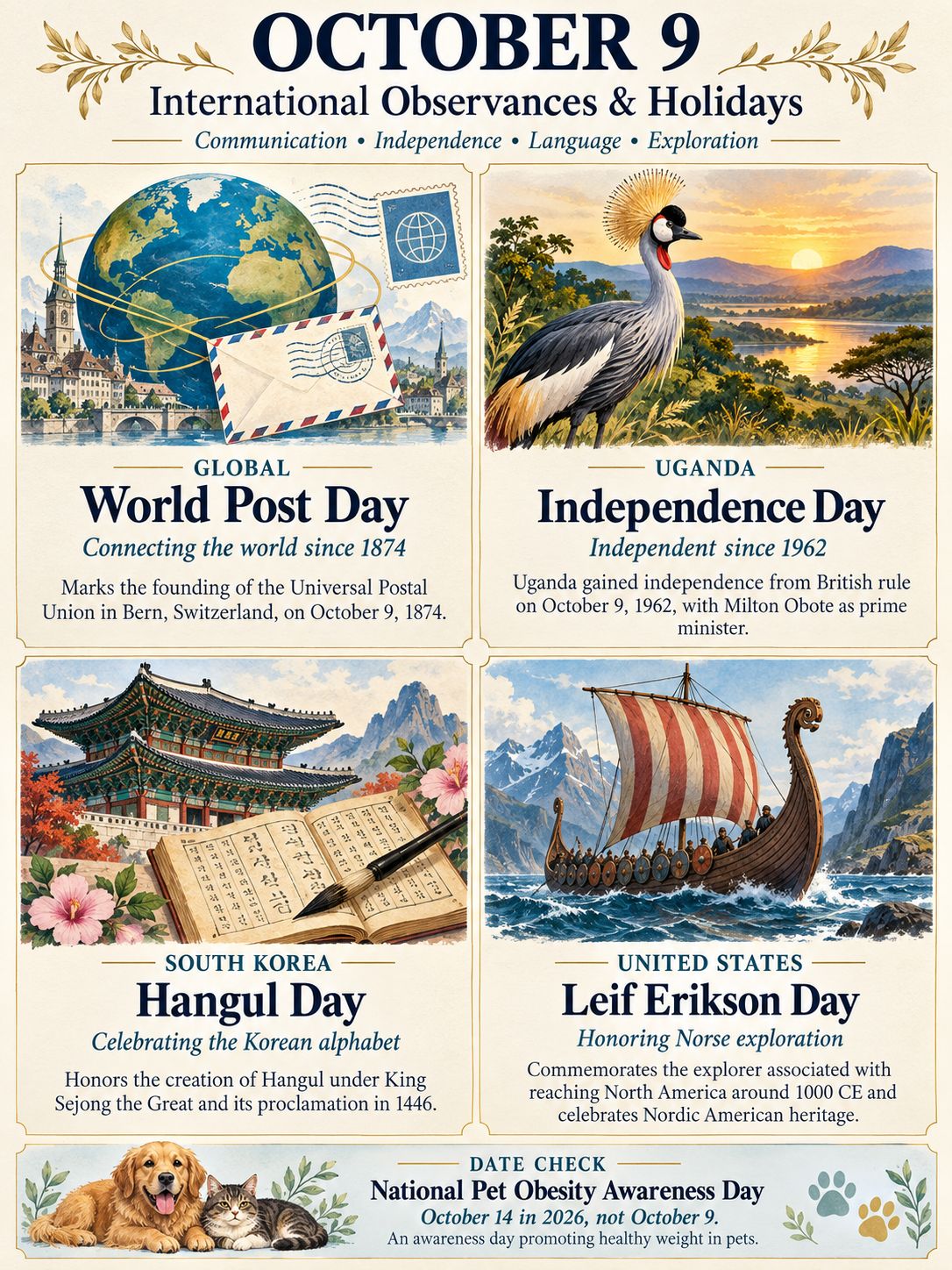
Across the globe, October 9 is designated to honor international cooperation, national sovereignty, and the nuances of daily life.
Major International Days
-
World Post Day: Celebrated globally to mark the exact day in 1874 when the Universal Postal Union (UPU) was established in Bern, Switzerland. Before the UPU, sending a letter across international borders was a chaotic, unreliable, and highly expensive ordeal requiring multiple treaties. World Post Day honors the invisible, global network that first connected humanity long before the internet existed, standardizing global mail and ensuring the right to communication.
-
National Pet Obesity Awareness Day: An increasingly important observance dedicated to educating pet owners about the severe health risks associated with overfeeding domesticated animals, promoting healthier lifestyles for our companions.
National Days
-
Uganda Independence Day (1962): On this day, Uganda finally broke free from the chains of British colonial rule. The nation transitioned into an independent sovereign state with Milton Obote serving as its very first Prime Minister. The day is marked by national pride, vibrant parades in Kampala, and reflections on the country’s turbulent yet resilient journey since 1962.
-
Hangul Day (South Korea): A national Korean commemorative day marking the invention and the proclamation of Hangul, the alphabet of the Korean language, by the 15th-century Korean monarch Sejong the Great. It is celebrated for the democratization of literacy in the Korean peninsula.
-
Leif Erikson Day (United States): A day dedicated to the legendary Norse explorer who, around the year 1000 CE, became the first known European to set foot on North American soil—beating Christopher Columbus to the continent by almost 500 years.
Global History
October 9 is a date etched deeply into the chronicles of global history. It has been a day of technological marvels, devastating catastrophes, and monumental political shifts.
United States
-
1701 – The Chartering of Yale University: Originally known as the Collegiate School of Connecticut, this institution received its official charter on October 9. Founded by colonial clergymen who wanted to educate local youth for public and church service, it was later renamed Yale University. It eventually evolved into one of the most prestigious and influential Ivy League academic institutions on the planet.
-
1888 – The Washington Monument Opens: After construction was notoriously stalled for decades due to a lack of funds and the outbreak of the American Civil War, the iconic 555-foot marble obelisk honoring George Washington finally opened its doors to the public.
-
1936 – Hoover Dam Transmits Power: A triumph of modern engineering during the Great Depression, the Hoover Dam began transmitting electricity to the booming city of Los Angeles, 266 miles away. This massive infrastructural feat permanently altered the development, economy, and water management of the American West.
Russia
-
1989 – The Voronezh UFO Incident: During the twilight years of the Soviet Union, the official state news agency, TASS, published a shocking report claiming that a UFO had landed in a park in Voronezh. The report detailed tall, three-eyed extraterrestrials and a small robot exiting the craft to collect soil samples. While skeptics and scientists dismissed it as mass hysteria, the global broadcast highlighted the relaxed press censorship (Glasnost) under Mikhail Gorbachev, showing a Russia suddenly willing to publish sensational, unverified stories.
China
-
1911 – The Hankou Bomb Explosion: In a clandestine safe house in Hankou (modern-day Wuhan), revolutionaries who had been plotting against the imperial government accidentally detonated a bomb while making explosives. The resulting police raid exposed their roster and plans, forcing the revolutionaries to launch the Wuchang Uprising ahead of schedule the very next day. This single accident effectively triggered the Xinhai Revolution, culminating in the complete collapse of the Qing Dynasty and the end of over two millennia of imperial rule.
United Kingdom
-
1940 – St. Paul’s Cathedral Bombed: During the terrifying nighttime air raids of the Blitz, a German Luftwaffe bomb pierced the roof of St. Paul’s Cathedral in London, destroying the high altar. The structural survival of the iconic dome amidst the burning city—captured in famous photographs—became a defining symbol of British wartime resilience and defiance against fascism.
-
1986 – The Phantom of the Opera Debuts: Andrew Lloyd Webber’s theatrical masterpiece debuted in London’s West End at Her Majesty’s Theatre. Starring Michael Crawford and Sarah Brightman, it would go on to become one of the highest-grossing and longest-running entertainment events in human history, shifting the landscape of musical theater forever.
Europe
-
1963 – The Vajont Dam Disaster (Italy): One of the most catastrophic man-made environmental disasters in history occurred when a massive landslide plunged into the reservoir of the Vajont Dam, one of the tallest dams in the world at the time. The impact displaced the water, sending a 250-meter high megatsunami over the top of the dam. The wave completely obliterated several villages in the Piave valley below, killing over 2,000 people in a matter of minutes. The tragedy led to massive changes in how geological surveys are conducted before infrastructural projects.
-
1989 – The Leipzig Protests (Germany): Over 70,000 East German citizens marched peacefully through Leipzig, demanding democratic reforms and freedom to travel. The Communist regime’s unprecedented decision to hold their fire and not disperse the crowds with military force proved to be a fatal blow to Soviet control in East Germany. The success of this peaceful Monday demonstration paved the way for the fall of the Berlin Wall exactly one month later.
Rest of the World (Asia, Africa, Americas)
-
1967 – The Execution of Che Guevara (Bolivia): A day after being captured by CIA-assisted Bolivian army forces, the famous Argentine-Cuban revolutionary Ernesto “Che” Guevara was summarily executed in the village of La Higuera. His death cemented his legacy as a deeply polarizing global icon of anti-imperialist rebellion, with his image continuing to adorn t-shirts and protest banners worldwide to this day.
-
2004 – Historic Elections in Afghanistan: Defying intense Taliban security threats and logistical nightmares, Afghanistan held its first-ever direct democratic presidential election. Over 10 million citizens cast their ballots, with women making up an inspiring 41% of the voters, marking a massive milestone for the war-torn nation’s attempt at building a democratic government.
-
2012 – Assassination Attempt on Malala Yousafzai (Pakistan): Taliban gunmen boarded a school bus in the Swat Valley and shot 15-year-old education activist Malala Yousafzai in the head. She miraculously survived the targeted assassination attempt, sparking global outrage and catapulting her into an international symbol for female education rights, eventually leading to her becoming the youngest Nobel Prize laureate in history.
Notable Births & Deaths (Global)
October 9 has been the entry and exit point for some of the most influential minds across the spectrums of arts, sciences, politics, and humanitarianism.
Famous Births
-
Camille Saint-Saëns (Born 1835, France): A true musical prodigy and romantic era composer. He is universally celebrated for enchanting compositions such as The Carnival of the Animals, Danse Macabre, and his Symphony No. 3 (Organ Symphony). His work bridged the gap between traditional French musical styles and modern innovations.
-
Hermann Emil Fischer (Born 1852, Germany): A brilliant chemist who revolutionized our understanding of organic chemistry. His groundbreaking work on the structure of sugars and purines earned him the Nobel Prize in Chemistry in 1902.
-
John Lennon (Born 1940, UK): The iconic English singer, songwriter, and impassioned peace activist. As the co-founder, co-lead vocalist, and rhythm guitarist of The Beatles, his artistic genius fundamentally rewired global pop culture. His solo masterpieces, particularly the song “Imagine,” continue to serve as global anthems for peace and unity.
-
Guillermo del Toro (Born 1964, Mexico): The visionary, Academy Award-winning filmmaker. Recognized as a master of modern fantasy and horror, he seamlessly blends dark, macabre imagery with profound emotional depth and political allegory in cinematic triumphs like Pan’s Labyrinth, The Shape of Water, and Hellboy.
-
PJ Harvey (Born 1969, UK): A fiercely independent British singer-songwriter and poet. Known for her raw, genre-defying sound and unapologetic lyrics, she remains the only artist to have won the prestigious Mercury Prize twice.
Famous Deaths
-
Pope Pius XII (Died 1958, Vatican City): Served as the head of the Catholic Church from 1939 until his passing in 1958. His papacy, which spanned the entirety of World War II, remains a subject of intense historical study, debate, and controversy regarding the Church’s wartime diplomacy and its public stance during the Holocaust.
-
Che Guevara (Died 1967, Argentina/Bolivia): As noted in the events above, his execution in the Bolivian jungle transformed him into a permanent martyr for leftist political movements globally.
-
Oskar Schindler (Died 1974, Germany): A Sudeten German industrialist and member of the Nazi Party who, in a profound turn of conscience, risked everything—including his own life and fortune—to save approximately 1,200 Jews during the horrors of the Holocaust by employing them in his enamelware and ammunitions factories. His story was immortalized in Steven Spielberg’s film Schindler’s List.
-
Jacques Brel (Died 1978, Belgium): A masterful singer-songwriter, poet, and actor whose deeply theatrical and emotive chansons profoundly influenced international pop and folk music, inspiring covers by artists like David Bowie and Nina Simone.
-
Felix Wankel (Died 1988, Germany): A brilliant mechanical engineer who invented the rotary (Wankel) engine. This innovative, compact, and high-revving engine design was widely utilized by automakers like Mazda in high-performance sports and specialty cars.
“Did You Know?” Trivia
To cap off our historical journey, here are a few fascinating, lesser-known facts that occurred on October 9—perfect for your next dinner table conversation!
-
The Peekskill Meteorite Car Crash (1992): The odds of a meteorite hitting a populated area, let alone a specific vehicle, are astronomically low. But on October 9, 1992, thousands of people across the US East Coast witnessed a brilliant fireball streaking across the sky. A 13-kilogram fragment survived the fiery descent and smashed directly into the trunk of a parked 1980 Chevy Malibu in Peekskill, New York. The owner, 18-year-old Michelle Knapp, had just bought the car for $400. It instantly became one of the most famous meteorite collisions on record, and the dented car was later sold to collectors for around $10,000, while the rock itself was sold for even more.
-
The Creation of Hangul (1446): Before 1446, Koreans had to rely on highly complex Chinese characters (Hanja) to write. Because this required years of intense study, literacy was reserved almost exclusively for the wealthy, educated male elite. On October 9, King Sejong the Great officially published the Hunminjeongeum, introducing the Hangul alphabet. It was a revolutionary phonetic alphabet explicitly designed around the shapes the mouth makes when pronouncing the letters, making it so logically brilliant and easy to learn that it was said a wise man could learn it in a morning, and a fool could learn it in ten days.
-
Google Buys YouTube (2006): In a move that forever altered the landscape of the internet, Google announced on October 9, 2006, that it was purchasing a relatively new, rapidly growing video-sharing website called YouTube for $1.65 billion in stock. At the time, many analysts thought Google was wildly overpaying for a platform filled with amateur home videos and copyright issues. Today, it stands as one of the most consequential, lucrative, and culture-defining tech acquisitions in history.
Quote of the Day
“You may say I’m a dreamer, but I’m not the only one. I hope someday you’ll join us. And the world will live as one.”
— John Lennon (Born October 9, 1940).
Final Thoughts
October 9 is a powerful testament to the duality and sheer density of human existence. It is a day that gave the world the lasting musical genius of John Lennon, the technological breakthrough of the rotary engine, and the unparalleled humanitarian bravery of Oskar Schindler standing against the darkness of the Holocaust. Simultaneously, it stands as a solemn reminder of the terrifying power of nature and human error, as seen in the Vajont Dam disaster, and the violent, earth-shaking consequences of political ideology across the globe.
By looking back at “On This Day” histories, we do much more than just memorize trivia to impress our peers. We actively contextualize our present moment. Recognizing the struggles, innovations, artistic leaps, and triumphs of those who came before us provides a vital blueprint for the future.