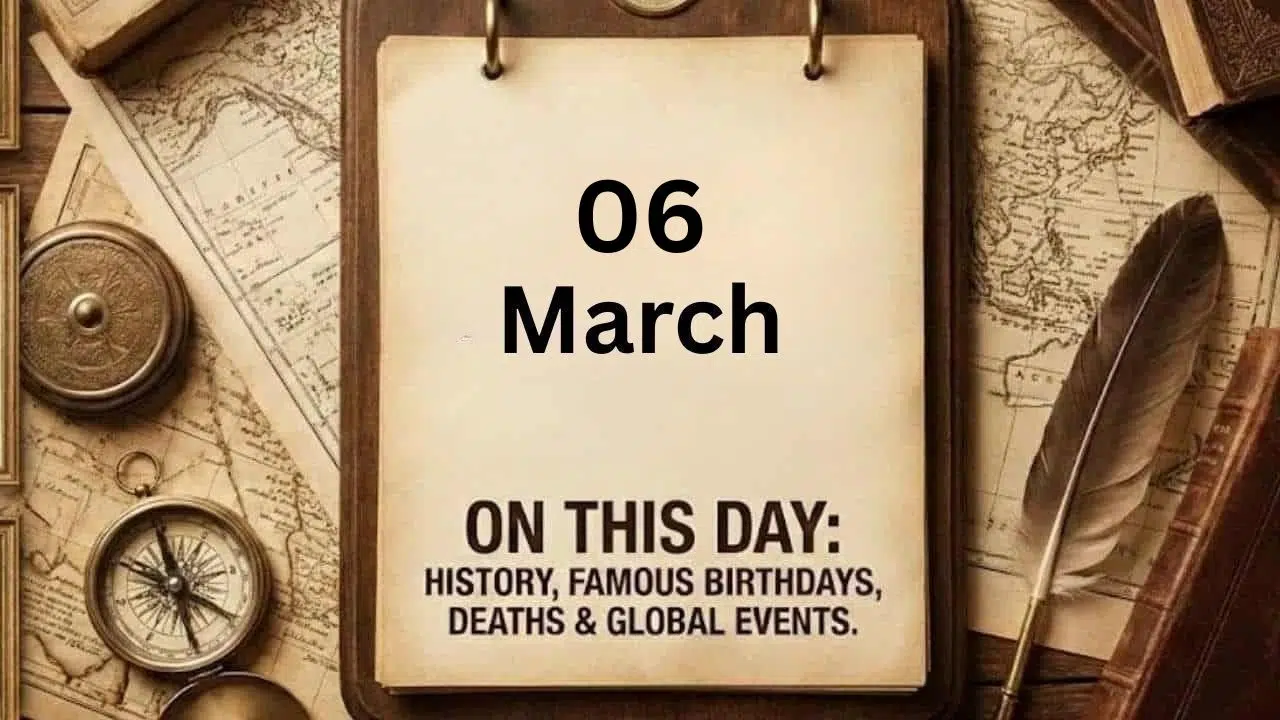
History provides a clear record of human progress and conflict. March 6 is a date marked by critical turning points across the globe. On this specific day, new nations have claimed their independence, groundbreaking scientific discoveries have been shared with the public, and massive political movements have reached their boiling points.
The following guide provides an in-depth archive of the events that occurred on March 6. The information is organized by region and category. This structure allows you to quickly locate key facts and understand their long-term impact on our modern society.
The Bangalee Sphere
The history of the Indian subcontinent is defined by its long struggle against colonial rule and its fierce defense of cultural identity. March 6 holds particular weight regarding the birth of Bangladesh and the legacy of regional revolutionaries.
The Eve of the March 7 Speech (1971)
March 6, 1971, was a day of intense pressure and mass mobilization in East Pakistan. The Bangalee population was protesting the military junta’s aggressive refusal to transfer political power to the newly elected civilian representatives.
On this day, President Yahya Khan delivered a radio address announcing that the National Assembly session would convene on March 25. He accompanied this announcement with severe threats directed at the Bangalee political leadership. In a direct act of defiance, the staff of Radio Pakistan Dhaka officially renamed their station to Dhaka Betar Kendra. The entire nation was positioned on the edge of a massive revolution, waiting for Bangabandhu to deliver his decisive directives at the Racecourse Maidan the following afternoon. This 24-hour window was a psychological turning point that escalated a political dispute into an organized liberation struggle.
Key Figures: Births and Deaths Ambika Chakrabarty (Died March 6, 1962):
He was a prominent anti-British revolutionary operating primarily in Bengal. He played a crucial leadership role in the famous 1930 Chittagong armoury raid alongside Masterda Surya Sen. Chakrabarty survived brutal crackdowns by the British police and was eventually imprisoned in the Cellular Jail in the Andaman Islands. Following the independence of India, he transitioned from an armed revolutionary to a dedicated public servant, serving as a member of the West Bengal Legislative Assembly.
International Observances and National Holidays
Global observances serve to unify different cultures under shared themes of historical reflection and celebration. March 6 is primarily recognized for a massive milestone in African history.
Ghana Independence Day (1957)
On March 6, 1957, the region known as the Gold Coast officially severed its colonial ties with the British Empire. It emerged as the fully independent nation of Ghana. Led by the visionary political strategist Kwame Nkrumah, Ghana made history by becoming the very first sub-Saharan African country to achieve full sovereignty.
This monumental event was not just a local victory. It triggered a massive wave of decolonization across the entire African continent. Nkrumah’s success proved that colonial powers could be peacefully and legally dismantled. His administration immediately began supporting other African nationalist movements, cementing Ghana’s status as the foundational pillar of modern Pan-Africanism.
European Day of the Righteous
Established by the European Parliament, this day is dedicated to honoring individuals who risked their own lives to protect vulnerable populations during times of extreme totalitarianism and genocide. The observance promotes the universal values of human dignity and moral courage across all European nations.
Global History: The Non-Bangalee World
Historical events outside the Indian subcontinent on March 6 have dramatically reshaped legal systems, global economies, and scientific understanding.
United States 1820: The Missouri Compromise is Signed
President James Monroe officially signed this critical piece of legislation to maintain the fragile political balance of power between slave-holding states and free states. The act admitted Missouri into the Union as a slave state and Maine as a free state. It also drew an explicit line across the western territories, prohibiting slavery north of the 36°30′ parallel. While it temporarily prevented a national fracture, the compromise merely delayed the inevitable outbreak of the American Civil War.
1857: The Dred Scott Decision
The United States Supreme Court delivered one of the most controversial and damaging rulings in its institutional history. Chief Justice Roger Taney authored the 7 to 2 decision declaring that African Americans, whether enslaved or free, were not American citizens. The court further ruled that the federal government had no constitutional authority to regulate slavery in the federal territories. This aggressive ruling completely enraged anti-slavery advocates in the North and rapidly accelerated the nation’s descent into armed conflict.
Russia 1869: The Periodic Table is Presented
Russian chemist Dmitri Mendeleev formally presented his groundbreaking periodic table of elements to the Russian Chemical Society. Mendeleev organized the known chemical elements according to their atomic mass and observed a clear repeating pattern in their properties. More importantly, he left intentional blank spaces in his table, accurately predicting the eventual discovery and exact properties of elements like gallium and germanium. This presentation laid the permanent foundational blueprint for modern chemistry.
United Kingdom 1984: The UK Miners Strike Begins
Workers at the Cortonwood Colliery in Yorkshire officially walked off the job. This localized protest immediately initiated a bitter, year-long national strike against the planned closure of state-owned coal mines by Prime Minister Margaret Thatcher’s conservative government. The conflict involved violent clashes between police and picketing miners. The ultimate defeat of the miners’ union fundamentally altered the British economic landscape, breaking the political power of organized labor and shifting the UK toward a service-based economy.
Rest of the World 1836: The Fall of the Alamo (Republic of Texas)
Following a grueling and bloody thirteen-day siege, Mexican military forces led by General Antonio Lopez de Santa Anna successfully breached the Alamo mission in San Antonio. The Texian defenders, heavily outnumbered, were completely wiped out. Instead of crushing the rebellion, the brutal defeat became a legendary symbol of resistance. The phrase “Remember the Alamo” became the primary rallying cry that eventually led to the Texian victory and the independent Republic of Texas.
Famous Global Births
The individuals born on March 6 have left permanent marks on art, literature, economics, and popular culture. The table below highlights the most notable historical figures born on this date.
| Name | Year of Birth | Nationality | Key Contribution and Historical Legacy |
| Michelangelo | 1475 | Italian | A titanic and unmatched figure of the High Renaissance. He sculpted the famous Statue of David and painted the ceiling of the Sistine Chapel in Rome. |
| Alan Greenspan | 1926 | American | A highly influential economist who served as the Chairman of the Federal Reserve of the United States from 1987 to 2006, shaping global monetary policy. |
| Gabriel Garcia Marquez | 1927 | Colombian | A brilliant Nobel Prize-winning author who popularized the literary style of magical realism with his masterpiece novel “One Hundred Years of Solitude”. |
| Valentina Tereshkova | 1937 | Russian | A pioneering Soviet cosmonaut and engineer. She holds the historic distinction of being the very first woman to travel into outer space. |
| David Gilmour | 1946 | English | A legendary musician, singer, and primary guitarist for the highly influential progressive rock band Pink Floyd. |
| Shaquille O’Neal | 1972 | American | One of the most physically dominant and recognizable basketball players in sports history. He later transitioned into a prominent global media personality and investor. |
Famous Global Deaths
March 6 also marks the passing of several notable individuals who revolutionized their respective industries and fields of study. The table below outlines their lasting impact.
| Name | Year of Death | Nationality | Cause of Death and Historical Legacy |
| Gottlieb Daimler | 1900 | German | He died of heart disease. He was a pioneer of the internal-combustion engine and an early inventor of the modern automobile, co-founding what became Mercedes-Benz. |
| John Philip Sousa | 1932 | American | He died of heart failure. He was a legendary composer and conductor known as the “March King,” famous for military and patriotic marches like “The Stars and Stripes Forever.” |
| Pearl S. Buck | 1973 | American | She died of lung cancer. She was a Pulitzer and Nobel Prize-winning author renowned for her novels detailing life in rural China, most notably “The Good Earth.” |
| Ayn Rand | 1982 | Russian-American | She died of heart failure. She was a deeply controversial philosopher and novelist who developed the highly individualized theory of Objectivism through books like “Atlas Shrugged.” |
| Georgia O’Keeffe | 1986 | American | She died of natural causes at the age of 98. She was a legendary modern artist known for her vibrant, large-scale paintings of enlarged flowers and arid New Mexico landscapes. |
| Hans Bethe | 2005 | German-American | He died of congestive heart failure. He was a Nobel Prize-winning theoretical physicist who helped shape classical and quantum physics, and contributed to the Manhattan Project. |
| Nancy Reagan | 2016 | American | She died of congestive heart failure. She was a highly influential First Lady of the United States during the 1980s, known for her “Just Say No” campaign. |
Fascinating March 6 Trivia
Historical timelines often contain fascinating secondary details that impact our daily lives. Here are three lesser-known facts connected to this specific date.
- The Naming of Aspirin (1899) The German pharmaceutical giant Bayer officially registered the trademark “Aspirin” for the chemical compound acetylsalicylic acid. Developed primarily by chemist Felix Hoffmann, this simple compound rapidly transformed modern medicine. It quickly became the most widely used and recognizable daily painkiller in the entire world.
- The Birth of the Oreo (1912) The National Biscuit Company, now globally recognized as Nabisco, introduced the very first Oreo cookie to the commercial market. It was originally created as a direct copy of a competitor’s cookie named Hydrox. However, the Oreo completely dominated the market through superior marketing and remains the best-selling commercial cookie on the planet today.
- Muhammad Ali Claims His Name (1964) The recently crowned heavy-weight boxing champion of the world formally discarded his birth name, Cassius Clay. Influenced heavily by his friendship with Malcolm X, he joined the Nation of Islam. On March 6, the organization’s leader, Elijah Muhammad, officially bestowed the permanent name Muhammad Ali upon him, signaling a massive cultural shift in American sports.
Quote of the Day
“What matters in life is not what happens to you but what you remember and how you remember it.” (Gabriel Garcia Marquez, Born March 6, 1927)
Final Thoughts
March 6 stands as a reminder of how individual moments can shape the course of history. From groundbreaking events and significant achievements to the births and legacies of influential figures, this day reflects the diverse stories that continue to shape our world. Each milestone recorded on March 6 offers insight into humanity’s progress, struggles, and cultural evolution.
By looking back at these historical moments, we gain a deeper appreciation for the people and events that have influenced society across generations. Remembering what happened on this day not only preserves the past but also inspires us to understand the present and build a more informed future.