Every calendar date serves as a quiet repository of human triumphs, geopolitical transformations, scientific revolutions, and cultural evolution. August 25 stands out as an extraordinary day in the global historical archive. Across the centuries, this date has witnessed moments that redefined the boundaries of science—from Galileo Galilei presenting his first astronomical telescope to Venetian leaders in 1609, to humanity’s robotic emissary, Voyager 1, crossing into interstellar space in 2012.
It is a day of profound geopolitical turning points, marking the liberation of Paris from Nazi occupation in 1944, the declaration of Uruguayan independence in 1825, and devastating humanitarian tragedies like the 1931 Yangtze River flood in China and the 2017 Rohingya exodus into Bangladesh. It is also the date on which brilliant minds were born—such as conductor Leonard Bernstein and tennis pioneer Althea Gibson—and when giants of philosophy, science, and human exploration, from David Hume and Friedrich Nietzsche to Michael Faraday and Neil Armstrong, took their final rest.
Here is an exhaustive, global, and culturally expansive chronicle of August 25 across human history.
The Bangalee Sphere & South Asian Subcontinent
The history of South Asia is defined by resilient struggles against oppression, rich cultural movements, and complex humanitarian shifts. August 25 holds solemn historical significance and cultural remembrance across the subcontinent.
The 2017 Rohingya Influx and Genocide Remembrance Day
On August 25, 2017, coordinated attacks by insurgent groups on Myanmar security posts in Rakhine State triggered a premeditated, brutal military crackdown—termed “clearance operations”—by the Myanmar Armed Forces (Tatmadaw). The resulting violence, characterized by widespread human rights abuses, arson of entire villages, and mass atrocities, forced an estimated 750,000 Rohingya civilians to flee across the border into Cox’s Bazar, Bangladesh.
For Bangladesh, this sparked one of the largest and fastest-moving humanitarian operations in modern history. The government and local communities opened their borders, establishing Kutupalong and neighboring areas as the largest refugee settlement complex on Earth. Internationally, August 25 is commemorated annually as Rohingya Genocide Remembrance Day by human rights organizations and refugee communities, who gather to demand accountability before international tribunals (such as the International Court of Justice), seek dignified repatriation rights, and remember the thousands who perished.
Regional Cultural Milestones: S. G. Kittappa (Born August 25, 1906)
In the wider subcontinent, August 25 marks the birth of Shenkottai G. Kittappa (1906–1933) in the Kingdom of Travancore. Kittappa emerged as a transformative figure in early 20th-century South Indian stage theatre (Tamil Isai and Sangeetha Natakam). Endowed with an extraordinary vocal range, Kittappa broke the rigid boundaries of elite Carnatic music halls, bringing classical ragas to the rural and working-class masses through popular theatre. Alongside his wife, the celebrated artist K. B. Sundarambal, Kittappa’s recordings shaped early gramophone culture across pre-partition India and Southeast Asia.
International Observances & National Days
August 25 features significant national sovereignty milestones that reshaped political maps in the Americas and Asia.
Independence Day of Uruguay (Día de la Independencia)
On August 25, 1825, the assembly of Florida, convened by the revolutionary group known as the Treinta y Tres Orientales (Thirty-Three Orientals) under Juan Antonio Lavalleja, declared the territory of the Banda Oriental (modern-day Uruguay) independent from the Empire of Brazil and aligned with the United Provinces of the Río de la Plata. This act ignited the Cisplatine War, which culminated three years later in the 1828 Treaty of Montevideo, establishing Uruguay as a fully recognized sovereign republic. Today, August 25 is celebrated nationwide with civic parades, military honors, and cultural festivals.
Day of Songun (Democratic People’s Republic of Korea)
In North Korea, August 25 is observed as an official state holiday known as the Day of Songun. The holiday commemorates August 25, 1960, when Kim Jong-il visited the Seoul Ryu Kyong Su Guards 105th Armored Division, an event officially cited as the birth of the nation’s “Military-First” doctrine, which prioritized the armed forces in all state affairs and economic resource distribution.
Global History: Decisive Events That Shaped the World
Scientific Revolutions & Explorations
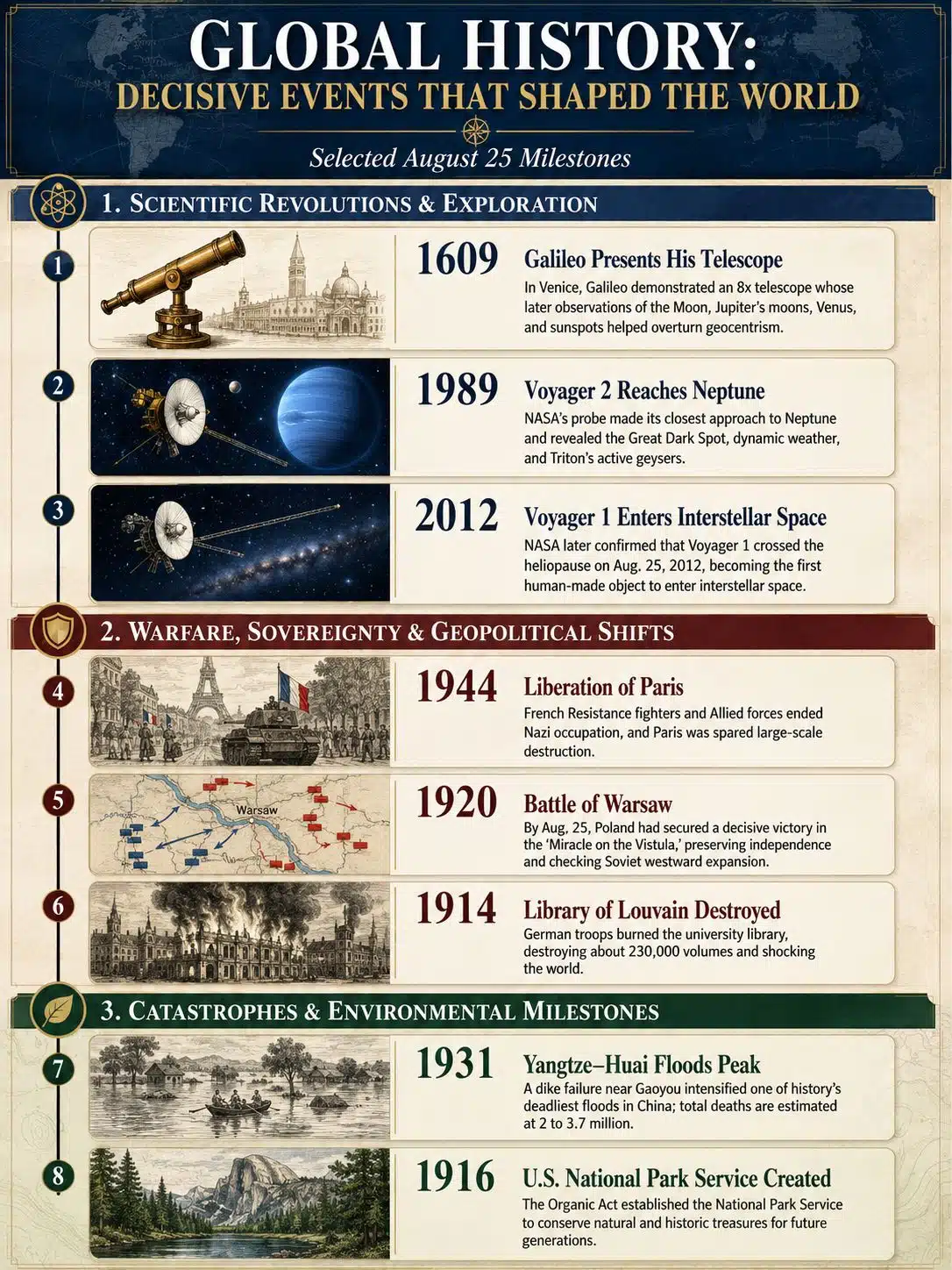
1609: Galileo Galilei Presents His Telescope to Venice
In the late summer of 1609, Italian polymath Galileo Galilei demonstrated his modified eight-power refracting telescope to the Venetian Senate atop the bell tower of St. Mark’s Basilica. Recognizing its strategic maritime and military value, the Senate granted Galileo a lifetime professorship at the University of Padua. More importantly, Galileo soon turned his improved lenses toward the night sky, discovering the mountainous topography of the Moon, the four largest moons of Jupiter, the phases of Venus, and sunspots. These direct observational proofs dealt a fatal blow to Ptolemaic geocentrism and laid the foundations of modern observational astronomy.
1989 & 2012: The Golden Age of Deep Space Exploration
August 25 holds a unique double honor in deep-space exploration:
-
1989: NASA’s Voyager 2 made its closest approach to Neptune and its frozen moon Triton, sending back the first high-resolution imagery of the dynamic azure atmosphere, Great Dark Spot, and active cryogeysers on Triton.
-
2012: Its sister probe, Voyager 1, officially crossed the heliopause—the outer boundary where solar wind meets the interstellar medium—approximately 121 astronomical units (18 billion kilometers) from Earth. It became the first human-made object to navigate interstellar space, carrying the Golden Record as a message to potential extraterrestrial civilizations.
Warfare, Sovereignty, and Geopolitical Shifts
1944: The Liberation of Paris
After more than four years of harsh Nazi military occupation, Paris was liberated on August 25, 1944. Days of armed insurrection by the French Forces of the Interior (FFI) culminated in the entry of General Philippe Leclerc’s French 2nd Armored Division (Division Blindée), backed by the U.S. 4th Infantry Division.
The German military commander of Greater Paris, General Dietrich von Choltitz, surrendered at the Hôtel Meurice, defying Adolf Hitler’s explicit “scorched-earth” orders to blow up the bridges of the Seine and raze the historic architecture of Paris to the ground. The following day, General Charles de Gaulle walked triumphantly down the Champs-Élysées, restoring sovereign French governance.
1920: The “Miracle on the Vistula” (Battle of Warsaw)
During the Polish-Soviet War, the Battle of Warsaw reached its decisive climax on August 25, 1920. Polish forces, commanded by Marshal Józef Piłsudski, executed a daring counter-flanking maneuver that completely shattered the advancing Red Army led by Mikhail Tukhachevsky. Often termed the “Miracle on the Vistula,” this victory preserved Polish independence following World War I and halted the immediate westward spread of Soviet communism into Weimar Germany and Central Europe.
1914: The Destruction of the Library of Louvain
During the opening month of World War I, invading German troops occupied the Belgian city of Louvain (Leuven). Amid tensions and alleged sniper activity, German soldiers engaged in punitive retaliation from August 25 to 28, burning the historic Catholic University of Louvain and its world-renowned library. More than 230,000 volumes, including rare medieval manuscripts, incunabula, and Gothic archives, were turned to ash. The “Sack of Louvain” became a rallying point for international outrage, accelerating Allied anti-war condemnation and fundamentally altering international norms concerning the protection of cultural property in wartime.
Catastrophes and Environmental Milestones
1931: The Peak of the Yangtze-Huai River Floods in China
Throughout the summer of 1931, central China experienced excessive snowmelts followed by record-breaking monsoon downpours and multiple cyclones. On August 25, 1931, the catastrophic flooding reached its peak when the major dike systems along the Grand Canal near Gaoyou failed during the night, washing away thousands of communities along the Yangtze and Huai rivers. An estimated 140,000 people drowned directly in the surge, with subsequent epidemics of cholera, typhoid, and widespread famine raising the overall death toll of the 1931 floods to between 2 million and 3.7 million people. It remains one of the deadliest natural disasters in recorded human history.
1916: Establishment of the U.S. National Park Service
Recognizing the rapid industrial encroachment on America’s pristine wilderness, President Woodrow Wilson signed the National Park Service Organic Act on August 25, 1916. The act established a unified federal agency tasked with managing dozens of national parks and monuments—including Yellowstone, Yosemite, and the Grand Canyon—with the dual mandate to conserve scenery and wildlife for public enjoyment while preserving them unimpaired for future generations.
Notable Birth Anniversaries
August 25 marks the birthdays of foundational monarchs, Nobel laureates, artistic trailblazers, and cinema legends.
Spotlight Biographies: Figures Who Shaped Culture & Science
Leonard Bernstein (1918–1990)
Born in Lawrence, Massachusetts, Leonard Bernstein rose to become one of the most charismatic, versatile, and influential musicians of the 20th century. As the longtime music director of the New York Philharmonic, he broke cultural barriers through his televised Young People’s Concerts, introducing classical symphonic structures to millions of households. His compositions bridged Broadway and classical concert halls, producing iconic works such as West Side Story, Candide, and On the Waterfront.
Althea Gibson (1927–2003)
Born in Silver, South Carolina, during the height of the Jim Crow era, Althea Gibson shattered the racial color barrier in international tennis. In 1956, she became the first African American athlete to win a Grand Slam title (the French Championships), following it with back-to-back singles titles at Wimbledon and the U.S. Nationals in 1957 and 1958. Her grace, athletic power, and resilience paved the path for future generations of athletes of color, including Arthur Ashe, Venus Williams, and Serena Williams.
Sir Sean Connery (1930–2020)
Born in Edinburgh, Scotland, Connery rose from humble working-class origins to global cinematic immortality as the definitive, suave portrayer of Ian Fleming’s secret agent James Bond in seven films, beginning with Dr. No (1962). Beyond the 007 franchise, Connery enjoyed a celebrated dramatic career, winning an Academy Award for Best Supporting Actor for The Untouchables (1987) and starring in classics like The Name of the Rose, The Hunt for Red October, and Indiana Jones and the Last Crusade.
Hans Adolf Krebs (1900–1981)
German-born British biochemist Sir Hans Adolf Krebs unraveled the central chemical reactions that drive all cellular respiration. Fleeing Nazi persecution in 1933, Krebs continued his work in Britain, where he identified the metabolic pathway through which carbohydrates, fats, and proteins are converted into cellular energy (ATP)—known universally today as the Krebs Cycle (Citric Acid Cycle). He was awarded the Nobel Prize in Physiology or Medicine in 1953.
Notable Death Anniversaries
The roll call of figures who passed away on August 25 includes thinkers and innovators whose ideas continue to shape modern philosophy, industrial mechanics, physics, and exploration.
Spotlight In Memoriam: Legacies That Endure
David Hume (1711–August 25, 1776)
David Hume, one of the central figures of the Scottish Enlightenment, passed away in Edinburgh at the age of 65. Hume’s philosophical works, including A Treatise of Human Nature and An Enquiry Concerning Human Understanding, championed rigorous philosophical empiricism, skepticism, and naturalism. He argued that human knowledge derives strictly from sensory experience, deeply influencing Immanuel Kant, utilitarianism, and modern cognitive philosophy.
James Watt (1736–August 25, 1819)
The Scottish mechanical engineer whose radical modifications to the Newcomen atmospheric engine revolutionized the use of steam power died on this day in 1819. By introducing a separate condenser, Watt dramatically improved fuel efficiency and mechanical capability, enabling steam power to drive factories, locomotives, and ships. His work catalyzed the Industrial Revolution, and the SI unit of power—the watt (W)—was named in his honor.
Michael Faraday (1791–August 25, 1867)
Michael Faraday rose from a humble apprentice bookbinder to become one of the most prolific experimental scientists in history. His discovery of electromagnetic induction (1831), diamagnetism, and the laws of electrolysis made the widespread generation and transmission of electric power feasible. Albert Einstein famously kept a portrait of Faraday on his study wall alongside Isaac Newton and James Clerk Maxwell.
Friedrich Nietzsche (1844–August 25, 1900)
The German philosopher and cultural critic passed away in Weimar at the threshold of the 20th century. Nietzsche’s devastating critiques of traditional Christian morality, his declaration that “God is dead,” and his concepts of the Will to Power, the Übermensch, and Eternal Recurrence sent shockwaves through philosophy, psychology, existentialism, and 20th-century literature.
Neil Armstrong (1930–August 25, 2012)
American naval aviator, test pilot, and aeronautical engineer Neil Alden Armstrong passed away in Cincinnati, Ohio, at the age of 82. As Commander of the Apollo 11 lunar landing mission, Armstrong piloted the Lunar Module Eagle to the Sea of Tranquility on July 20, 1969, becoming the first human being to step onto the surface of an extraterrestrial body. His historic declaration—”That’s one small step for [a] man, one giant leap for mankind”—remains one of the defining utterances of human civilization.
“Did You Know?” Historical Trivia for August 25
-
The Great Moon Hoax of 1835: On August 25, 1835, the New York Sun published the first in a six-part satirical series claiming that famed astronomer Sir John Herschel had built a massive telescope that observed lunar oceans, bipedal beavers, unicorns, and winged humanoids (Vespertilio-homo). The publication caused a sensation, vastly increasing the newspaper’s daily circulation before the reporting was exposed as an elaborate scientific parody.
-
The Invention of Instant Ramen (1958): In post-World War II Osaka, Japanese inventor Momofuku Ando spent months experimenting in a backyard shed to develop an affordable, non-perishable noodle that could quickly rehydrate in boiling water. On August 25, 1958, his company, Nissin Food Products, brought “Chikin Ramen” to Japanese grocery shelves, inaugurating the multi-billion-dollar global instant noodle industry.
-
Captain Cook’s Departure (1768): On this day in 1768, British explorer Lieutenant James Cook set sail from Plymouth harbor aboard the HMS Endeavour. Commissioned by the Royal Society to observe the 1769 transit of Venus from Tahiti and search for the hypothetical southern continent (Terra Australis Incognita), the voyage led to the first detailed European charting of New Zealand and the eastern coast of Australia.
Quotes of the Day
“Mystery creates wonder and wonder is the basis of man’s desire to understand.”
— Neil Armstrong (Died August 25, 2012)
Final Thoughts
August 25 represents a vibrant, multifaceted cross-section of world history. From the early optical discoveries of Galileo in 1609 to Voyager 1 reaching beyond the boundaries of our solar system in 2012, this date is deeply linked to humanity’s quest to understand the universe. It marks the preservation of human heritage through the founding of the U.S. National Park Service, the resilience of liberty seen in the Liberation of Paris and Uruguayan sovereignty, and the enduring influence of visionary creators like Leonard Bernstein, Althea Gibson, and Sean Connery.
At the same time, the date carries the solemn memory of catastrophic natural disasters like the 1931 Yangtze deluge and modern humanitarian challenges like the 2017 Rohingya displacement. Reflecting on August 25 offers a comprehensive look at the past, illustrating how scientific curiosity, cultural expression, and collective resilience continue to guide the human journey.