Every calendar date carries its own quiet weight, but August 23 stands out as a day that has repeatedly shifted the trajectory of human civilization. It is a date marked by the fiery spark of anti-colonial revolution, the clandestine ink of geopolitics that catalyzed global warfare, the peaceful defiance of millions demanding freedom, and mankind’s triumph in reaching unexplored celestial frontiers.
From the moonlit plantations of Saint-Domingue in 1791 to the rugged lunar craters of the Moon’s South Pole in 2023, August 23 connects centuries of human courage, tragedy, intellectual brilliance, and technological breakthrough. This comprehensive archival guide explores the historical milestones, iconic birthdays, solemn farewells, and international observances that make August 23 one of the most transformative days on the world calendar.
The Bangalee Sphere & South Asian Subcontinent
The South Asian subcontinent, particularly Bengal and the broader Indian landscape, holds a deep reservoir of political, cultural, and scientific milestones on August 23.
Historic Scientific & Political Milestones
India Touches the Lunar South Pole with Chandrayaan-3 (2023)
On August 23, 2023, the Indian Space Research Organisation (ISRO) etched its name into the record books when the Vikram lander of the Chandrayaan-3 mission executed a historic, flawless soft landing near the Moon’s uncharted south pole. This historic achievement made India the first nation on Earth to reach the lunar south polar region and only the fourth country to achieve a soft lunar landing. Across West Bengal, Bangladesh, and the broader Indian subcontinent, millions watched live as the lander touched the regolith, demonstrating cost-effective, world-class space exploration engineered domestically.
The Naval Sabotage Operations of the Mukti Bahini (1971)
During the height of the Bangladesh Liberation War in 1971, late August marked a critical escalation in coordinated naval guerrilla operations, widely recognized under the umbrella of Operation Jackpot. Around August 23, naval commandos of the Mukti Bahini infiltrated strategic waterways, planting limpet mines and disrupting maritime supply chains between Chittagong, Mongla, Narayanganj, and Chandpur. These daring strikes severely crippled the West Pakistani military’s logistical reinforcements and supply lines across the riverine delta.
Cultural & Intellectual Figures of the Region
-
Radhagovinda Kar (Born August 23, 1850 – Died December 19, 1918): Born in Howrah, Bengal Presidency, Dr. R.G. Kar was a visionary physician and medical educator during British colonial rule. Recognizing that indigenous Indian students faced systemic discrimination in colonial medical institutions, he mobilized private donations to establish the Calcutta School of Medicine in 1886. Later renamed the R.G. Kar Medical College and Hospital in Kolkata, this institution stood as a bastion of self-reliant medical education in pre-independence India.
-
Arati Saha (Died August 23, 1994): Born in Kolkata, Arati Saha was a trailblazing long-distance swimmer who became the first Asian woman to successfully swim across the English Channel on September 29, 1959. In 1960, she became the first female sportsperson to receive the prestigious Padma Shri. Her passing on August 23, 1994, marked the departure of an athlete who broke profound gender barriers in South Asian sports.
-
S. Wajid Ali (Died August 23, 1951): An esteemed Bengali essayist, nationalist, and barrister, Syed Wajid Ali championed secularism and harmonious cultural synthesis. Educated at Cambridge, his essays and stories critically examined liberal Bengali identity, advocating for progressive unity between Hindu and Muslim communities across greater Bengal.
Global History: Epochs That Defined Continents
Across centuries and continents, August 23 has witnessed moments of profound transformation, upheaval, and human triumph.
The Americas
1791 – The Haitian Revolution Ignites
On the night of August 22–23, 1791, enslaved men and women across the northern plains of the French colony of Saint-Domingue rose in an organized revolt, catalyzed by the historic Vodou ceremony at Bois Caïman led by Dutty Boukman and Cécile Fatiman.
This uprising developed into the Haitian Revolution—the only revolt by enslaved people in human history that successfully founded an independent, sovereign republic free of chattel bondage (1804). The rebellion shattered the economic architecture of the transatlantic slave trade and inspired abolitionist movements across the globe.
1864 – Union Forces Capture Fort Morgan (American Civil War)
In the culmination of the Battle of Mobile Bay, Confederate forces at Fort Morgan, Alabama, surrendered to Union Admiral David Farragut and land troops. This decisive Union victory permanently shut down the Confederacy’s last major open port in the Gulf of Mexico east of the Mississippi, crippling southern supply operations and accelerating the collapse of the Confederate war effort.
Europe & The Mediterranean
1305 – The Execution of Sir William Wallace
Scottish patriot and military leader Sir William Wallace, who led the resistance against King Edward I during the Wars of Scottish Independence, was executed at Smithfield, London, on August 23, 1305. Wallace was convicted of treason—a charge he vehemently rejected, famously asserting that he had never sworn allegiance to the English king. His martyrdom galvanized Robert the Bruce and unified the Scottish nobility, ultimately leading to Scottish independence at the Battle of Bannockburn in 1314.
1572 – The St. Bartholomew’s Day Massacre (France)
In the early hours of August 23–24, 1572, targeted assassinations of Huguenot (French Calvinist Protestant) leaders expanded into widespread, mob-driven sectarian slaughter throughout Paris. Instigated amid the French Wars of Religion under the reign of King Charles IX and his mother Catherine de’ Medici, the violence spread to provincial towns over the following weeks, claiming the lives of tens of thousands of Protestants and hardening religious divides across Europe for generations.
1939 – The Molotov-Ribbentrop Pact
In Moscow, Soviet Foreign Minister Vyacheslav Molotov and German Foreign Minister Joachim von Ribbentrop signed the German-Soviet Non-Aggression Pact. Beneath its public pledge of neutrality lay a secret protocol dividing Poland, Lithuania, Latvia, Estonia, Finland, and parts of Romania into totalitarian spheres of influence.
This diplomatic maneuver freed Adolf Hitler to invade Poland nine days later on September 1, 1939, officially launching World War II in Europe.
1989 – The Baltic Way (The Human Chain for Freedom)
On the 50th anniversary of the Molotov-Ribbentrop Pact, approximately two million people joined hands across Estonia, Latvia, and Lithuania to form a continuous human chain spanning over 675 kilometers (420 miles).
Known as The Baltic Way, this peaceful protest demonstrated the unified desire of the Baltic republics for national sovereignty, capturing global attention and accelerating the eventual dissolution of the Soviet Union.
Russia & Eastern Europe
1942 – The Siege of Stalingrad Begins
Nazi Germany’s Sixth Army launched its devastating assault on the Soviet industrial city of Stalingrad. The Luftwaffe dropped more than 1,000 tons of high-explosive and incendiary bombs on August 23, reducing the city to rubble and killing thousands of civilians in a single afternoon. The ensuing multi-month urban battle became the bloodiest engagement in human warfare, resulting in roughly two million casualties and marking the strategic turning point of World War II against Nazi Germany.
1991 – The Collapse of the Soviet Hardline Coup
Following the failed August Coup orchestrated by hardline communist factions against Soviet President Mikhail Gorbachev, Russian Federation President Boris Yeltsin took decisive action on August 23, 1991. Addressing the Russian Supreme Soviet, Yeltsin signed a decree suspending the activities of the Communist Party of the Soviet Union (CPSU) on Russian soil, effectively terminating seven decades of monolithic party governance and paving the path for the formal dissolution of the USSR four months later.
Asia & Oceania
1839 – British Capture of Hong Kong
Amid intensifying tensions over the illegal opium trade and diplomatic sovereignty, British naval forces under Captain Charles Elliot occupied the harbor and anchorages of Hong Kong on August 23, 1839. This skirmish served as an opening prelude to the First Opium War (1839–1842), which culminated in the Treaty of Nanking and the formal cession of Hong Kong Island to the British Empire.
1958 – The Second Taiwan Strait Crisis
The Chinese People’s Liberation Army (PLA) initiated an intense artillery bombardment against the Republic of China (Taiwan) military garrisons stationed on the Kinmen (Quemoy) and Matsu islands. The crisis pushed the United States and the People’s Republic of China to the brink of direct military engagement before settling into a prolonged, intermittent standoff that defined Cold War geopolitical fault lines in the Pacific.
1966 – The Wave Hill Walk-Off (Australia)
In the Northern Territory of Australia, Vincent Lingiari, an elder of the Gurindji people, led 200 Indigenous pastoral workers, stockmen, and their families on a historic strike and walk-off from the British-owned Wave Hill cattle station.
While initially sparked by severe wage discrimination and squalid living conditions, the strike evolved into an eight-year campaign for Indigenous land rights. The protest culminated in 1975 when Prime Minister Gough Whitlam symbolically poured Gurindji soil through Lingiari’s hands, returning legal ownership of their ancestral homelands and laying the cornerstone for Australia’s modern Native Title legislation.
International Observances & Global Days
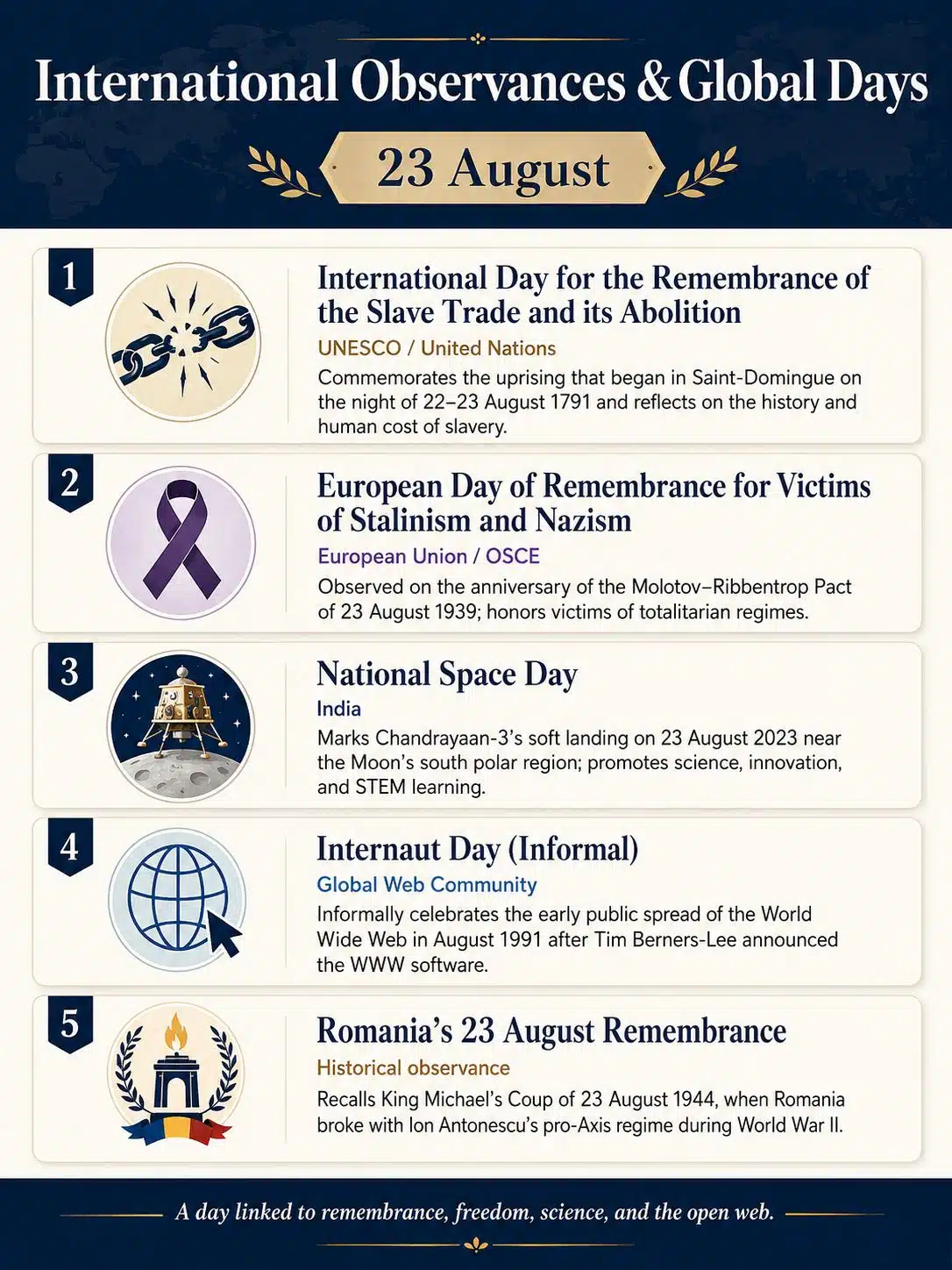
August 23 is recognized globally by several United Nations agencies, sovereign governments, and cultural bodies for human rights advocacy, historical remembrance, and scientific achievement.
| Observance / Holiday | Sponsoring Organization / Nation | Purpose & Historical Significance |
| International Day for the Remembrance of the Slave Trade and its Abolition | United Nations / UNESCO | Commemorates the 1791 Saint-Domingue uprising; educates on the human costs and history of chattel slavery |
| European Day of Remembrance for Victims of Stalinism and Nazism (Black Ribbon Day) | European Union / Organization for Security and Co-operation in Europe (OSCE) | Marks the anniversary of the 1939 Molotov-Ribbentrop Pact; honors victims of 20th-century totalitarian regimes |
| National Space Day | Republic of India | Commemorates the 2023 soft landing of Chandrayaan-3 on the Moon’s South Pole; promotes STEM education |
| Internaut Day | International Tech Community | Commemorates August 23, 1991, when the World Wide Web was opened to the general public by CERN and Tim Berners-Lee |
| National Liberation Day | Romania | Commemorates King Michael’s 1944 coup against the pro-Axis regime of Ion Antonescu during WWII |
Notable Births on August 23
The twenty-third of August has produced pioneering thinkers, monarchs, Hollywood trailblazers, and athletic legends whose contributions have left enduring footprints across their respective fields.
King Louis XVI of France (1754 – 1793)
Born at the Palace of Versailles, Louis XVI ascended the French throne in 1774. His reign was marked by severe financial debt exacerbated by French financial support for the American Revolutionary War, mounting structural inequality, and the outbreak of the French Revolution in 1789. Convicted of high treason by the National Convention following the abolition of the monarchy, he was executed by guillotine in January 1793, marking the end of France’s Ancien Régime.
Georges Cuvier (1769 – 1832)
A French naturalist, anatomist, and zoologist, Baron Georges Cuvier is widely regarded as the founding father of comparative anatomy and vertebrate paleontology. Cuvier established beyond scientific doubt the reality of biological extinction—a revolutionary concept at the time—by comparing fossilized elephant skeletons with living species, creating the structural framework for modern earth sciences and geology.
Gene Kelly (1912 – 1996)
Eugene Curran Kelly transformed the landscape of the Hollywood musical with his athletic, physical style of dance and groundbreaking choreography. Directing and starring in timeless cinematic treasures such as Singin’ in the Rain (1952) and An American in Paris (1951), Kelly integrated ballet, tap, and street movement, taking cinematic dance out of restrictive theater settings into kinetic, outdoor urban environments.
River Phoenix (1970 – 1993)
Considered one of the most gifted actors of his generation, River Jude Phoenix captured critical acclaim in iconic coming-of-age and indie dramas such as Stand by Me (1986), Running on Empty (1988), and My Own Private Idaho (1991). His raw, vulnerable screen presence earned him an Academy Award nomination at age 18 before his life was tragically cut short at the age of 23.
Kobe Bryant (1978 – 2020)
Born in Philadelphia, Pennsylvania, Kobe Bean Bryant spent his entire 20-year career with the Los Angeles Lakers, winning five NBA Championships, two Olympic Gold Medals, and an NBA Most Valuable Player Award (2008). Renowned for his relentless work ethic, known worldwide as the “Mamba Mentality,” Bryant also won an Academy Award in 2018 for his animated short film Dear Basketball, cementing his legacy as a global sports and cultural icon.
Notable Deaths on August 23
The loss of monumental historical figures on this date has repeatedly shaped political borders, legal frameworks, and artistic movements.
Charles-Augustin de Coulomb (1736 – 1806)
The French military engineer and physicist passed away in Paris on August 23, 1806. Coulomb formulated Coulomb’s Law, which mathematically defines the electrostatic force of attraction and repulsion between electrically charged particles. The SI unit of electric charge, the coulomb, was named in his honor, cementing his place in the foundations of classical electromagnetism.
Rudolph Valentino (1895 – 1926)
Italian actor and silent screen heartthrob Rudolph Valentino died unexpectedly at age 31 in New York City from complications of peritonitis and perforated ulcers. Known globally as the “Latin Lover” for his roles in The Sheik and Blood and Sand, his sudden death triggered unprecedented mass grief across the world, with tens of thousands of fans lining the streets of Manhattan for his funeral.
Nicola Sacco & Bartolomeo Vanzetti (Executed August 23, 1927)
Italian immigrant anarchists Nicola Sacco and Bartolomeo Vanzetti were executed by electric chair in Massachusetts for the 1920 murder of a paymaster and guard at a shoe factory.
Their trial and appeals became an international cause célèbre, drawing fierce criticism from legal scholars, civil libertarians, and intellectuals worldwide who argued the men were convicted due to anti-immigrant and anti-radical prejudice rather than conclusive evidence. On the 50th anniversary of their execution in 1977, Massachusetts Governor Michael Dukakis issued an official proclamation exonerating their names.
“Did You Know?” Trivia & Curiosities
-
The Psychological Birth of “Stockholm Syndrome” (1973): On August 23, 1973, an escaped convict entered the Sveriges Kreditbank in Stockholm, Sweden, taking four bank employees hostage inside a vault for six straight days. Over the course of their captivity, the hostages developed an emotional bond with and defended their captors against the police. The phenomenon was studied by criminologist Nils Bejerot, who coined the term Stockholm Syndrome.
-
The World’s First Photograph of Earth from Lunar Orbit (1966): On August 23, 1966, NASA’s robotic spacecraft Lunar Orbiter 1 captured the first photograph of Earth rising above the lunar horizon while on its 16th orbit around the Moon. Transmitted to the NASA tracking station at Robledo de Chavela near Madrid, Spain, this image provided humanity with its first view of our planet from deep space.
-
The Public Launch of the World Wide Web (1991): While Tim Berners-Lee invented the World Wide Web at CERN in 1989, it remained restricted to internal researchers until August 23, 1991, when access was officially opened to the global public for the first time. The date is now celebrated worldwide by tech enthusiasts as Internaut Day.
Quotes of the Day
“The most important thing is to try and inspire people so that they can be great in whatever they want to do.”
— Kobe Bryant (Born August 23, 1978)
Final Thoughts
August 23 is far more than an arbitrary turn of the calendar page; it is an enduring mirror of human history across the centuries. On this single day, we witness the full spectrum of our collective story—the brutality of colonial exploitation set against the courage of the Haitian revolutionaries who rose to dismantle it; the dark machinations of the Molotov-Ribbentrop Pact contrasted with the peaceful power of two million citizens linking hands across the Baltic Way.
It is a date that reminds us of our relentless drive to push boundaries, whether that means daring to swim the English Channel, opening digital networks that unite the planet on Internaut Day, or guiding robotic probes to touch down on the unexplored craters of the lunar south pole. Looking back at August 23 reveals where we have stumbled, how we have persevered, and the heights human ingenuity can reach when we look beyond the horizon.