

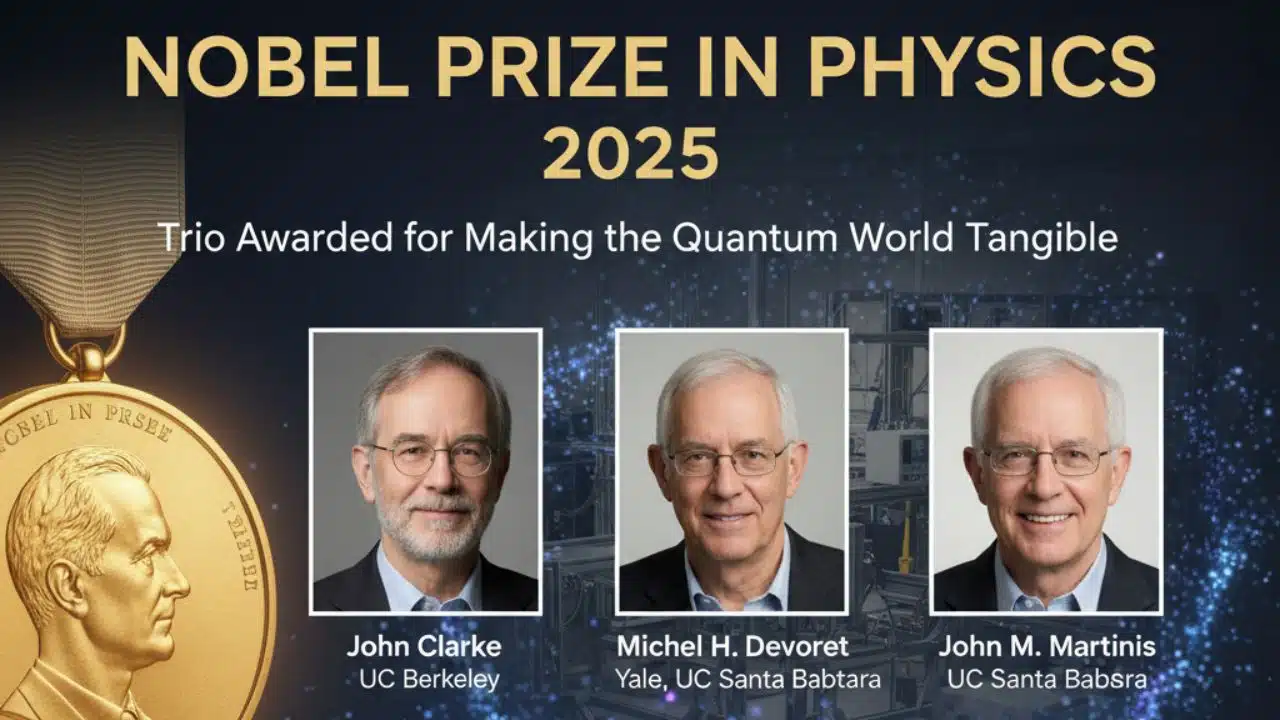
Three US-based scientists, John Clarke, Michel H. Devoret, and John M. Martinis, were awarded the 2025 Nobel Prize in Physics today for their pioneering experiments that revealed the strange rules of the quantum world at a scale large enough to be seen and controlled. Their work, conducted in the mid-1980s, established that electrical circuits, under the right conditions, could exhibit quantum behaviors like tunneling and energy quantization, bridging the gap between the microscopic realm of atoms and the tangible, human-made world.
The Royal Swedish Academy of Sciences announced the prize in Stockholm, citing the trio’s “discovery of macroscopic quantum mechanical tunnelling and energy quantisation in an electric circuit.” Their foundational research, performed at the University of California, Berkeley, did not just confirm a profound physical theory but also laid the essential groundwork for today’s revolution in quantum technology, directly enabling the development of powerful quantum computers, ultra-sensitive sensors, and secure communication systems.
The laureates will share the prize money of 11 million Swedish kronor (approximately $1 million). Their experiments proved that a collective of billions of particles acting in unison within a superconducting circuit could behave as a single quantum object, a concept that has become a cornerstone of modern physics and advanced computing.
Key Facts & Quick Take
- Who Won: John Clarke (University of California, Berkeley), Michel H. Devoret (Yale University), and John M. Martinis (University of California, Santa Barbara).
- For What: Groundbreaking experiments in the 1980s demonstrating that quantum mechanical effects, like tunneling, can be observed in macroscopic electrical circuits.
- The Big Idea: They engineered a superconducting circuit, known as a Josephson junction, cooled to near absolute zero. They observed this circuit “tunneling” out of a trapped state and absorbing energy in discrete packets (quanta), proving that quantum mechanics isn’t just for single atoms but can govern larger, engineered systems.
- Why It Matters Now: This discovery is the bedrock of superconducting quantum computing. It enabled the creation of qubits—the basic units of quantum information—and paved the way for machines being built by companies like Google and IBM to solve problems beyond the reach of classical computers.
- Prize Details: The award includes a gold medal, a diploma, and a shared sum of 11 million Swedish kronor ($1 million USD), to be presented on December 10, 2025.
Context: From a Ghostly Theory to a Physical Reality
For much of the 20th century, quantum mechanics was a theory of the vanishingly small. Its bizarre principles—particles existing in multiple states at once (superposition) or instantly passing through impenetrable barriers (tunneling)—were thought to be confined to individual electrons or atoms. A central question in physics was whether these counter-intuitive effects could ever be coaxed out of a larger, “macroscopic” system.
It was this challenge that the three laureates confronted. Working together at UC Berkeley, with Clarke as the experienced professor, Devoret as a theoretically-inclined postdoctoral researcher, and Martinis as a hands-on graduate student, they designed an experiment that would become a landmark in physics.
“It is wonderful to be able to celebrate the way that century-old quantum mechanics continually offers new surprises,” said Olle Eriksson, Chair of the Nobel Committee for Physics, during the announcement.
The Prizewinning Experiment: What Happened?
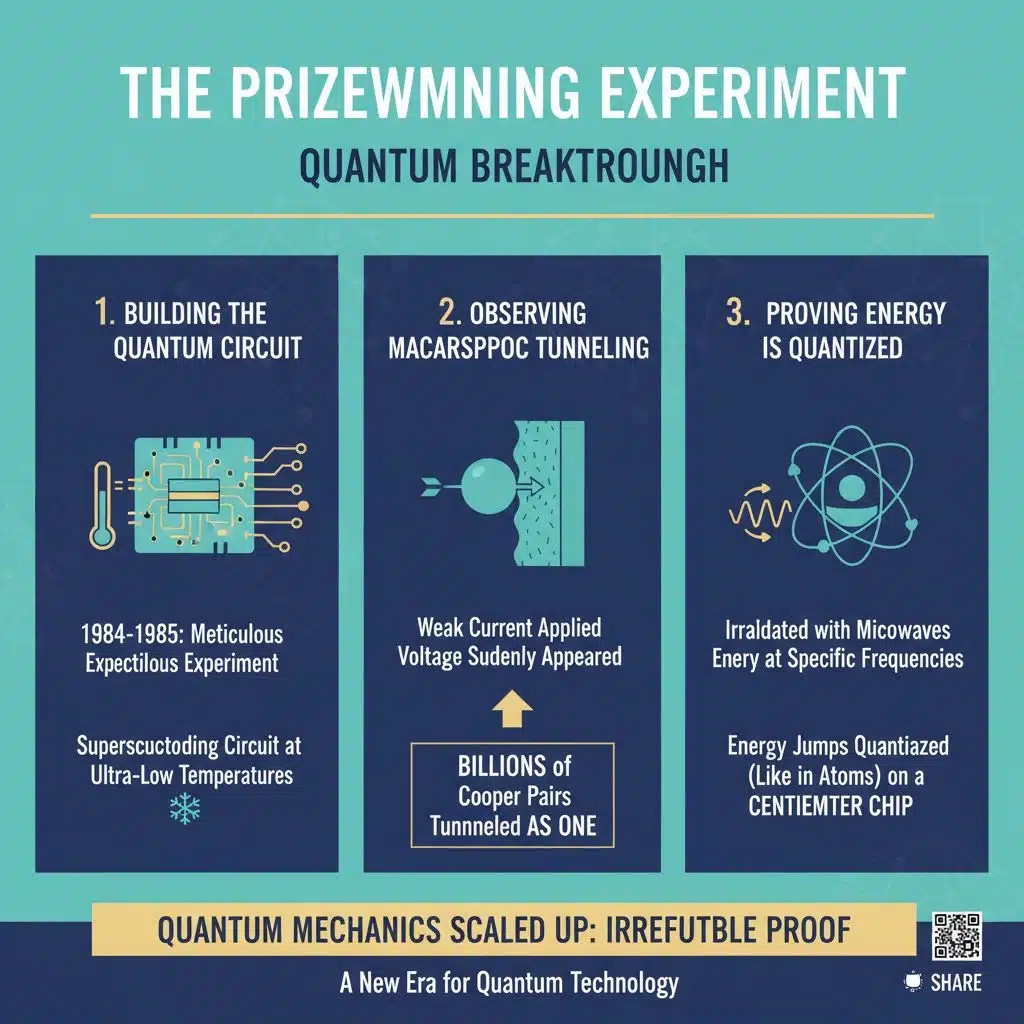
The team’s breakthrough centered on a device called a Josephson junction, which consists of two superconducting materials separated by a razor-thin insulating barrier. In a superconductor, electrons pair up (forming Cooper pairs) and flow without any resistance. Brian Josephson, a 1973 Nobel laureate, had predicted that these Cooper pairs could “tunnel” through the insulating barrier without applying any voltage.
1. Building the Quantum Circuit
In a series of meticulous experiments between 1984 and 1985, Clarke, Devoret, and Martinis constructed a high-precision circuit containing a Josephson junction. By cooling it to extremely low temperatures, they minimized thermal “noise” that could destroy any delicate quantum effects. The setup was designed to trap the system in a state where no voltage was present. According to classical physics, it should have remained stuck there.
2. Observing Macroscopic Tunneling
The team then applied a weak electrical current. After a certain period, they observed a voltage suddenly appearing across the junction. This was evidence of macroscopic quantum tunneling: the entire system, comprising billions of Cooper pairs acting as a single entity, had tunneled out of its trapped, zero-voltage state. It was as if a ball had passed through a solid wall instead of rolling over it.
3. Proving Energy is Quantized
To further confirm the quantum nature of their circuit, they irradiated it with microwaves of varying frequencies. They found that the system would only absorb energy and jump to a higher energy state when the microwave frequency precisely matched the energy difference between the levels—a hallmark of quantum mechanics known as energy quantization. This was the same principle observed in atoms, but now demonstrated in a tangible, engineered chip about a centimeter in size.
This two-fold demonstration—macroscopic tunneling and quantized energy levels—was irrefutable proof that quantum mechanics could be scaled up.
Official Responses and Laureate Voices
Upon hearing the news, John Clarke, now a Professor of the Graduate School at Berkeley, expressed his astonishment. “To put it mildly, it was the surprise of my life,” he told reporters by phone during the announcement press conference. He emphasized the collaborative nature of the work, stating that the contributions of Devoret and Martinis were “just overwhelming.”
Reflecting on the legacy of their discovery, Clarke noted its profound impact on modern technology. “Our discovery in some ways is the basis of quantum computing… One of the underlying reasons that cellphones work is because of all this work,” he added.
The laureates brought complementary skills to the project. Clarke was a world-renowned expert in superconductors and highly sensitive SQUID magnetometers. Devoret, who came from France, brought deep theoretical insights. Martinis was the brilliant experimentalist who built and refined the complex apparatus until it could yield a clear signal from the quantum world.
Impact on People: The Dawn of the Quantum Age
The abstract findings of a physics lab in the 1980s have now blossomed into a multi-billion dollar global industry. The ability to build, control, and measure macroscopic quantum states is the fundamental principle behind superconducting qubits, the leading technology in the race to build a fault-tolerant quantum computer.
- Quantum Computing: John Martinis would later go on to lead the team at Google that, in 2019, claimed to have achieved “quantum supremacy”—performing a specific calculation on a quantum processor far faster than the most powerful classical supercomputer could. This milestone was a direct descendant of the Berkeley experiments. Michel Devoret, at Yale, became a leading figure in the field of circuit quantum electrodynamics (cQED), which is the science of controlling quantum information in circuits.
- Advanced Sensing: The principles from their work have also led to the development of extremely sensitive detectors of magnetic fields and other physical quantities, with applications in medicine (like magnetoencephalography to map brain activity) and fundamental physics research.
- Secure Communications: Their work underpins quantum cryptography, a method for creating unhackable communication channels based on the laws of quantum mechanics.
What to Watch Next
The field is now focused on scaling these systems. While today’s quantum processors have dozens or hundreds of qubits, the goal is to build machines with millions of high-quality qubits. The challenges are immense: quantum states are incredibly fragile and prone to errors from the slightest disturbance. However, the fundamental science established by Clarke, Devoret, and Martinis provides the roadmap. Their discovery transformed an esoteric theory into an engineering discipline, and the world is now beginning to reap the technological rewards of that monumental achievement.






















