April 21 is a date that has consistently rewritten the narrative of human history. From the mythological foundations of ancient empires to the birth of modern monarchs and the passing of literary giants, the twenty-first of April serves as a fascinating cross-section of human achievement, tragedy, and revolution. Whether you are a historian looking to connect the dots of the past, or simply curious about the legends who share your birthday, the events of this day echo through time.
Moving beyond the broad strokes of history, we can see exactly how global power dynamics shifted on this specific date. Every civilization has moments that define its trajectory, and for many, those moments fell precisely on this day in the calendar year.
Major Historical Events That Shaped April 21
The timeline of April 21 is packed with battles that defined borders, political uprisings that demanded democracy, and royal ascensions that changed the course of religion and state. Exploring these events gives us a profound understanding of how our modern geopolitical landscape was forged.
Below is a comprehensive look at the historical milestones that took place on April 21 across the globe, providing a snapshot of the day’s global impact.
| Year | Region | Event Summary | Significance |
| 753 BC | Europe | Romulus founds the city of Rome. | Marked the legendary beginning of the Roman Empire, which would dominate the Western world for centuries. |
| 899 BC | China | The “Double Dawn” solar eclipse is recorded. | Allowed modern astronomers to perfectly synchronize ancient Chinese historical texts with the modern calendar. |
| 1509 | UK | Henry VIII ascends to the English throne. | His reign led to the English Reformation and the separation of the Church of England from papal authority. |
| 1836 | USA | The Battle of San Jacinto takes place. | General Sam Houston defeated Mexican forces in 18 minutes, securing the independence of the Republic of Texas. |
| 1856 | Australia | Melbourne stonemasons march for worker rights. | Successfully established one of the world’s first legally recognized eight-hour workdays. |
| 1898 | USA / Spain | The Spanish-American War officially begins. | Resulted in the US emerging as a Pacific power and marked the end of the Spanish Empire in the Americas. |
| 1918 | Europe | Manfred von Richthofen (The Red Baron) is killed. | The death of WWI’s most feared and successful fighter ace signaled a shift in aerial warfare dominance. |
| 1944 | France | French women are granted the right to vote. | A massive leap forward for civil rights and gender equality in post-war European politics. |
| 1960 | Brazil | Brasília is officially inaugurated as the capital. | Shifted the nation’s economic and political focus from the coast to the interior, showcasing modernist architecture. |
| 1967 | Greece | A right-wing military coup seizes power. | Established the oppressive “Regime of the Colonels,” suspending democratic institutions until 1974. |
| 1989 | China | 100,000 students gather in Tiananmen Square. | The peaceful gathering to mourn Hu Yaobang catalyzed the historic pro-democracy protests. |
To truly appreciate the weight of these dates, we must look closer at the individual events that sent shockwaves through history. The founding of Rome in 753 BC, for instance, is more than just a mythological tale of twin brothers raised by a wolf; it represents the birth of a civilization that would invent modern republican government, revolutionary architectural techniques like concrete, and a legal system that forms the basis of many modern democracies.
Similarly, the Battle of San Jacinto in 1836 was a turning point for the North American continent. Lasting only 18 minutes, the ambush led by General Sam Houston not only secured Texas’s independence from Mexico but eventually paved the way for the United States’ westward expansion. Decades later, the skies over Europe witnessed the fall of Manfred von Richthofen, the legendary “Red Baron,” in 1918. His death marked a psychological turning point in World War I, proving that even the most seemingly invincible figures of the Central Powers could be brought down.
These geopolitical shifts highlight how a single day can alter the trajectory of entire nations. Just as these events birthed new eras, this date is equally renowned for bringing some of history’s most influential figures into the world.
Notable Births: Legends Who Arrived on April 21
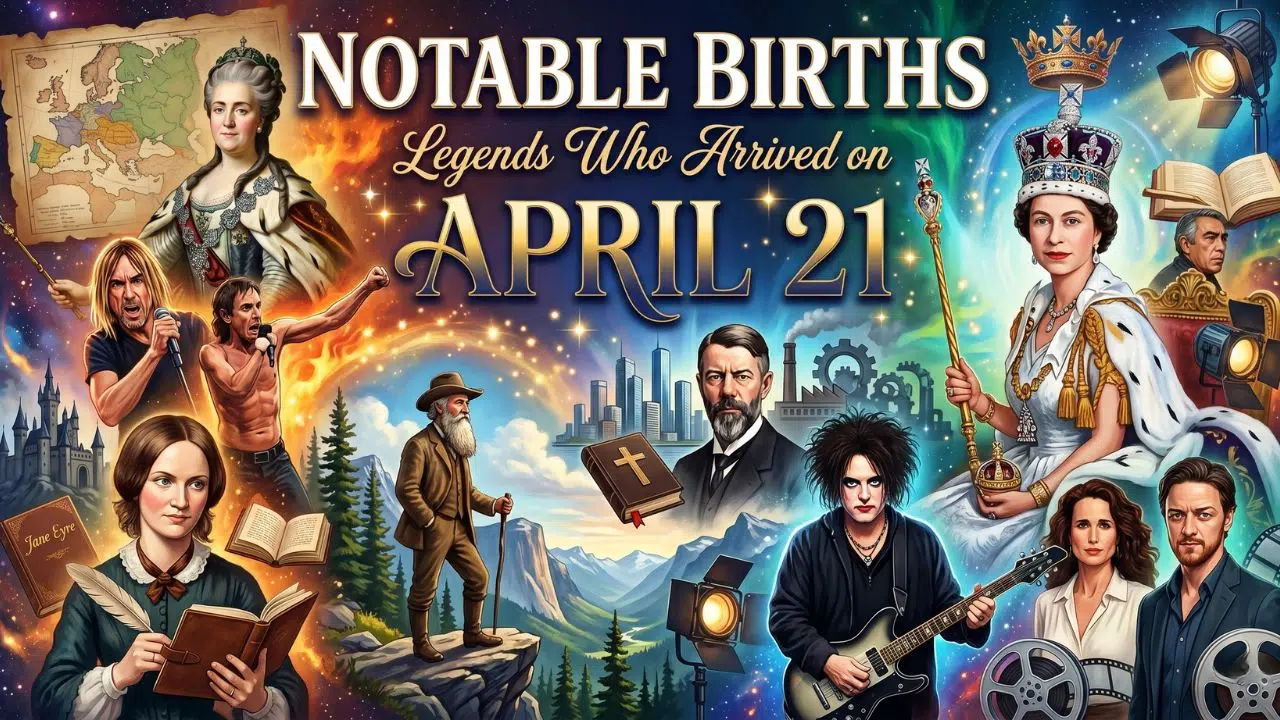
The individuals born on this day span the realms of royalty, literature, sociology, and rock and roll. Their contributions have fundamentally altered how we understand nature, how we govern ourselves, and how we experience art.
The following table highlights the brilliant minds and powerful leaders born on April 21, summarizing their lasting impact on the world.
| Year | Name | Nationality | Profession / Legacy |
| 1729 | Catherine the Great | Russian | Empress of Russia; expanded the empire and led a cultural golden age. |
| 1816 | Charlotte Brontë | English | Novelist and poet; author of the literary masterpiece Jane Eyre. |
| 1838 | John Muir | Scottish-American | Naturalist and writer; known as the “Father of the National Parks.” |
| 1864 | Max Weber | German | Sociologist; famously linked the Protestant ethic to modern capitalism. |
| 1915 | Anthony Quinn | Mexican-American | Two-time Academy Award-winning actor (Zorba the Greek, Lawrence of Arabia). |
| 1926 | Queen Elizabeth II | British | The longest-reigning monarch in British history, serving for 70 years. |
| 1947 | Iggy Pop | American | Musician and singer; widely recognized as the “Godfather of Punk.” |
| 1958 | Andie MacDowell | American | Acclaimed actress (Groundhog Day, Four Weddings and a Funeral). |
| 1959 | Robert Smith | English | Lead singer and primary songwriter for the iconic rock band The Cure. |
| 1979 | James McAvoy | Scottish | Celebrated stage and screen actor (Atonement, X-Men series). |
Delving into the lives of these figures reveals the massive cultural and political footprints they left behind. Queen Elizabeth II, born in 1926, became an unparalleled symbol of stability. Over her 70-year reign, she guided the British monarchy through the dissolution of the British Empire, the Cold War, the advent of the digital age, and a global pandemic. She provided a sense of continuity for the United Kingdom during decades of radical social and technological transformation.
On the other side of the Atlantic, the birth of John Muir in 1838 would eventually change the physical landscape of the United States. A fiercely dedicated naturalist and philosopher, Muir’s extensive writings and impassioned lobbying led to the creation of the National Park system. His efforts directly resulted in the preservation of Yosemite Valley and Sequoia National Park, ensuring that these pristine natural wonders were protected from rapid industrialization and logging for future generations to experience.
While we celebrate the visionaries who arrived on this date, we must also pause to reflect on the monumental figures who departed.
Remembering the Departed: Famous Deaths on April 21
The twenty-first of April has witnessed the passing of voices that defined generations. From the father of American literature to the architect of modern macroeconomics, the world lost immense talent on this day.
Below is a detailed record of the iconic figures who passed away on April 21, noting the legacies they left behind.
| Year | Name | Nationality | Cause of Death / Lasting Legacy |
| 1073 | Pope Alexander II | Italian | Papal legacy; played a key role in the Norman conquest of England. |
| 1142 | Peter Abelard | French | Renowned philosopher, theologian, and logician of the Middle Ages. |
| 1509 | Henry VII | English | King of England; ended the Wars of the Roses and founded the Tudor dynasty. |
| 1699 | Jean Racine | French | One of the most important playwrights of 17th-century France. |
| 1910 | Mark Twain | American | Heart attack; legendary humorist and author of The Adventures of Huckleberry Finn. |
| 1918 | Manfred von Richthofen | German | Killed in action; WWI fighter ace known as the “Red Baron” with 80 victories. |
| 1938 | Muhammad Iqbal | British Indian | Unknown illness; visionary poet and philosopher whose ideas led to the creation of Pakistan. |
| 1946 | John Maynard Keynes | English | Heart attack; revolutionized economic theory regarding government intervention. |
| 2003 | Nina Simone | American | Breast cancer; iconic jazz singer and fierce civil rights activist. |
| 2016 | Prince | American | Accidental overdose; legendary musician and pop culture icon. |
The death of Mark Twain in 1910 marked the end of an era for American literature. Born during the appearance of Halley’s Comet in 1835, he famously predicted he would die when it returned—a prediction that came true. His sharp satirical mind and masterful storytelling in works like The Adventures of Huckleberry Finn provided a deeply critical yet humorous mirror for American society.
In the realm of music and culture, the unexpected passing of Prince in 2016 sent shockwaves globally. A fiercely independent artist and virtuosic multi-instrumentalist, Prince broke down boundaries of genre, gender presentation, and industry norms. His legacy as an advocate for artists’ rights to own their master recordings continues to influence the music industry today. Similarly, the loss of Nina Simone in 2003 silenced one of the most powerful voices of the American Civil Rights Movement. Her music was inextricably linked to the fight for racial equality, blending classical training with jazz, blues, and folk to create an entirely unique and deeply political sound.
The global impact of these individuals is immense, and this pattern of profound historical significance is equally mirrored when we narrow our focus to specific regional histories.
The Bangalee Sphere and Subcontinent Milestones
The history of the Indian subcontinent and the Bangalee sphere is deeply intertwined with the dates of April 21, marking significant political transitions, births of national heroes, and the loss of intellectual giants.
Here are the critical moments from Bangladesh and India that occurred on this day, showcasing the rich historical fabric of the region.
| Year | Event / Figure | Category | Details and Significance |
| 1924 | Dr. Karni Singh | Birth | Born in Bikaner, he was a Maharaja and the first Indian shooter to win the Arjuna Award. |
| 1938 | Muhammad Iqbal | Death | Passed away in Lahore. His philosophical writings in Urdu and Persian heavily influenced the subcontinent’s geopolitical future. |
| 1977 | Ziaur Rahman | Event | Formally assumed the presidency of Bangladesh, laying the groundwork for a shift toward an open-market economy. |
| 2013 | Shakuntala Devi | Death | The brilliant mathematician famously known as the “Human Computer” passed away at age 83. |
Global Observances and Cultural Holidays
April 21 is not just a day for looking backward; it is a day of active global observance. Various nations and international bodies use this date to celebrate independence, honor public servants, and promote forward-thinking ideas.
The table below outlines the major holidays and observances taking place globally on April 21, highlighting the diverse ways this day is celebrated.
| Holiday / Observance | Region | Purpose of Celebration |
| World Creativity and Innovation Day | International (UN) | Raises awareness about the role of creativity in problem-solving and sustainable development. |
| Tiradentes Day | Brazil | Honors Joaquim José da Silva Xavier, a martyr of the 1789 movement for Brazilian independence. |
| Civil Service Day | India | Dedicated to honoring the labor and dedication of public administrators across the country. |
| San Jacinto Day | Texas, USA | Celebrates the final, decisive battle of the Texas Revolution in 1836. |
| Natale di Roma | Rome, Italy | A civic celebration commemorating the legendary founding of Rome in 753 BC. |
| National Tea Day | United Kingdom | A cultural observance celebrating the deep-rooted British affection for tea. |
Whether it is the solemn honoring of civil servants in India, a vibrant civic festival recognizing the ancient birth of Rome, or the United Nations championing the need for global innovation, these observances prove that April 21 remains an active, vital date in contemporary culture.
Echoes of April 21 Through Time
Whether it is the clang of stonemasons’ tools demanding fair labor in Australia, the roar of crowds in Tiananmen Square, or the quiet passing of literary geniuses, April 21 is a masterclass in the human experience. It is a date where empires have both begun and crumbled, and where the voices of both monarchs and revolutionaries have resonated across the globe.
By understanding what happened on this day, we gain a clearer, more nuanced picture of the world we inhabit today, recognizing that the history of tomorrow is being written right now.