

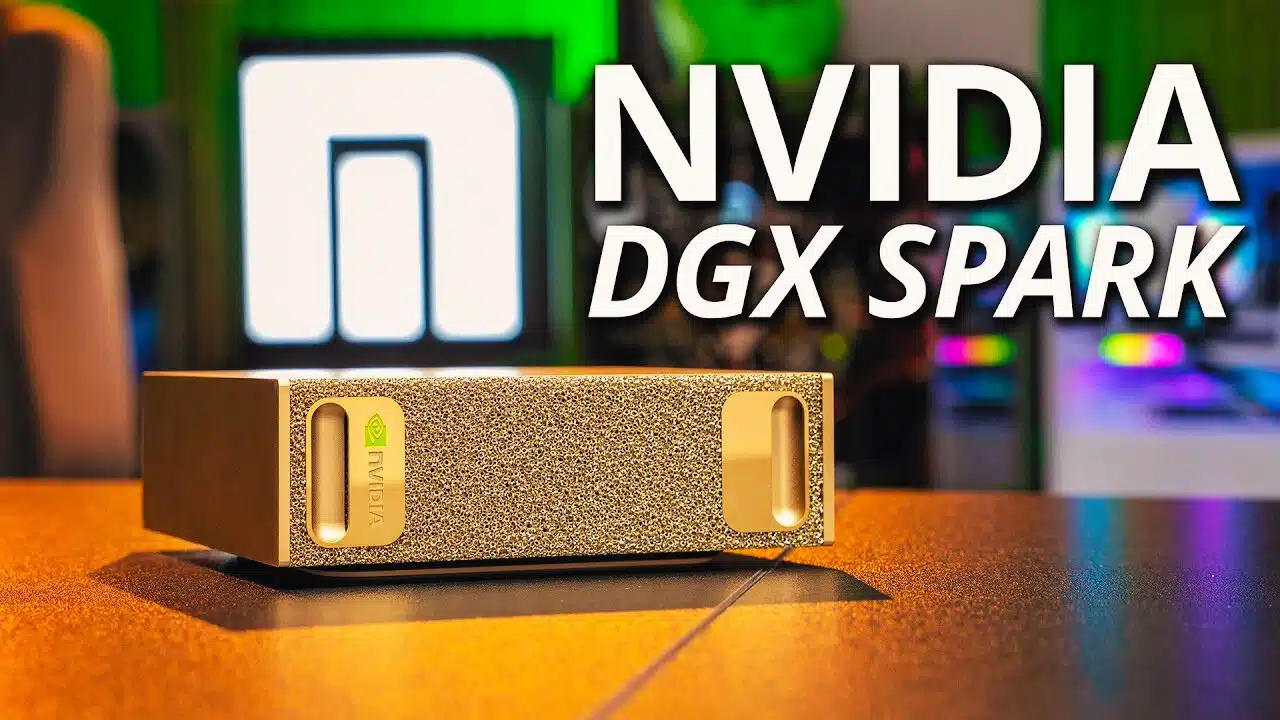
In a move poised to democratize access to high-performance artificial intelligence, Nvidia today officially launched the Nvidia DGX Spark desktop AI supercomputer. This compact powerhouse, priced at $3,999, is designed to bring the capabilities of a data center directly to the desks of researchers, developers, and students, fundamentally altering the landscape of AI development.
The DGX Spark, hailed as the “world’s smallest AI supercomputer,” packs a petaflop of AI performance into a form factor that can be powered by a standard wall outlet. This development is set to accelerate innovation by removing the barriers of cost and accessibility that have traditionally confined cutting-edge AI research to large corporations and well-funded institutions.
Key Facts / Quick Take
- Product: Nvidia DGX Spark, a personal AI supercomputer.
- Launch Date: Available for purchase starting October 15, 2025.
- Price: $3,999 in the United States.
- Performance: Delivers up to 1 petaflop of AI performance, capable of handling AI models with up to 200 billion parameters.
- Core Technology: Powered by the Nvidia GB10 Grace Blackwell Superchip, featuring a 20-core ARM-based Grace CPU and a Blackwell GPU.
- Key Feature: 128GB of unified memory, allowing for seamless data sharing between the CPU and GPU.
A New Class of Computing Power on the Desktop
The launch of the DGX Spark marks a significant milestone in the evolution of personal computing. Previously, the computational power required to train and run sophisticated AI models was the exclusive domain of large, energy-intensive data centers. The DGX Spark, however, miniaturizes this power, making it accessible to a much broader audience.
At the heart of the DGX Spark is the groundbreaking Nvidia GB10 Grace Blackwell Superchip. This integrated chip combines a powerful 20-core ARM-based Grace CPU with a state-of-the-art Blackwell GPU. This architecture, coupled with 128GB of unified LPDDR5x memory, allows for unprecedented performance on a desktop machine. The unified memory architecture is a key innovation, enabling the CPU and GPU to share data without the performance bottlenecks typically associated with transferring large datasets between separate memory pools.
According to Nvidia, the DGX Spark is capable of performing a staggering one million billion calculations per second (Nvidia Newsroom, October 13, 2025). This level of performance enables developers to work with complex AI models of up to 200 billion parameters locally, a task that was previously unthinkable on a personal computer.
Democratizing AI for a Wider Audience
The implications of the DGX Spark’s launch extend far beyond raw technical specifications. By making high-performance AI accessible at a relatively affordable price point, Nvidia is poised to fuel a new wave of innovation across a multitude of fields.
In an official statement, Nvidia CEO Jensen Huang emphasized this vision: “Putting an AI supercomputer on the desks of every data scientist, AI researcher, and student empowers them to engage and shape the future of AI” (Indian Express, October 14, 2025).
This sentiment is echoed by early adopters and industry experts. The ability to iterate on and test complex AI models locally will significantly speed up the development cycle. For researchers, this means faster experimentation and discovery. For students, it provides an invaluable tool for learning and hands-on experience with cutting-edge technology.
Technical Specifications and Ecosystem
The Nvidia DGX Spark is more than just a powerful piece of hardware; it is a complete platform for AI development.
Key Specifications:
| Feature | Specification |
| Processor | Nvidia GB10 Grace Blackwell Superchip |
| CPU | 20-core ARM-based Grace CPU |
| GPU | Blackwell architecture |
| Memory | 128GB LPDDR5x unified memory |
| Storage | Up to 4TB NVMe SSD |
| Performance | Up to 1 petaflop of AI performance |
| Connectivity | Wi-Fi 7, 4x USB-C, HDMI |
| Operating System | Nvidia DGX OS (a custom version of Ubuntu Linux) |
The system comes pre-loaded with Nvidia’s DGX OS, a customized version of Ubuntu Linux that is optimized for AI workloads. This includes the full Nvidia AI software stack, providing developers with a rich ecosystem of tools, libraries, and pre-trained models to accelerate their work.
Partner Ecosystem and Market Impact
Nvidia is not going it alone with the DGX Spark. The company has announced partnerships with a host of major PC manufacturers, including Acer, Asus, Dell, Gigabyte, HP, Lenovo, and MSI. These partners will release their own customized versions of the DGX Spark, ensuring a wide variety of options for consumers. Acer has already announced a comparable model, the Veriton GN100, which will also be priced at $3,999 (PCMag, October 13, 2025).
This broad partner ecosystem is expected to drive rapid adoption of the DGX Spark platform and further fuel competition and innovation in the personal AI computing market. The launch of the DGX Spark is a direct challenge to the dominance of cloud-based AI development, offering a powerful and secure local alternative.
What to Watch Next
The launch of the Nvidia DGX Spark is a seminal moment for the AI industry. The coming months will be crucial in determining its long-term impact.
Key areas to watch include:
- Adoption rates: How quickly will the DGX Spark be adopted by its target audience of developers, researchers, and students?
- Application development: What new and innovative AI applications will be developed on the DGX Spark platform?
- Competitive response: How will other players in the AI hardware and software market respond to Nvidia’s move?
- The next iteration: The DGX Spark sets a new benchmark for personal AI computing. All eyes will be on Nvidia to see how they will build upon this success with future generations of the platform.
The Nvidia DGX Spark is more than just a new product; it is a paradigm shift. By placing the power of a supercomputer on the desktop, Nvidia is not only accelerating the pace of AI innovation but also empowering a new generation of creators and problem-solvers. The ripples of this launch will be felt across every industry, heralding a new era of accessible and democratized artificial intelligence.





















