

Nvidia, the world’s most valuable semiconductor company, has reportedly ordered some of its component suppliers to suspend work on the H20 AI chip, a model designed exclusively for the Chinese market. According to The Information and later confirmed by Reuters, the decision came this week as the company grapples with growing regulatory and political pressures surrounding its China-focused chip business.
The suppliers affected include:
- Amkor Technology, an Arizona-based semiconductor packaging and testing company responsible for advanced packaging of the H20 chips.
- Samsung Electronics of South Korea, which has been providing high-bandwidth memory (HBM) modules essential for the chip’s performance.
Reports also suggest that other contract manufacturers, such as Foxconn, may be indirectly affected, given their role in China’s electronics supply chain. Neither Amkor nor Samsung immediately issued a public response to requests for comment.
China’s Regulatory Concerns Over H20 Purchases
The halt comes just days after Chinese regulators summoned major domestic technology firms—including Tencent, ByteDance, Alibaba, and Baidu—to express concerns over purchases of Nvidia’s H20 chips.
Chinese authorities reportedly raised issues about potential “information risks” and national data security, fearing that reliance on foreign AI hardware could leave critical systems exposed. This follows a pattern in which Beijing has been urging its domestic companies to pivot more strongly toward homegrown chip solutions as part of its long-term self-sufficiency strategy.
The Cyberspace Administration of China (CAC) and the Ministry of Industry and Information Technology (MIIT) have been particularly vocal in their warnings, highlighting the sensitivity of AI computing infrastructure and its importance for China’s digital economy and national security.
Nvidia’s Position: Commercial Chip, Not Military
In a statement, an Nvidia spokesperson defended the chip’s intended use, stressing that the H20 is not designed for military or government infrastructure. The company emphasized that the product is meant purely for commercial AI and cloud computing applications, such as powering large language models and data analytics.
Nvidia further argued that both the U.S. and Chinese governments understand that neither country would rely on each other’s semiconductors for critical government operations. This was intended to reassure regulators that the H20 did not pose a direct national security risk, but the explanation has not yet calmed concerns in Beijing.
U.S.–China Tech Tensions: The Bigger Picture
The suspension highlights the broader U.S.–China technology rivalry, especially in the field of artificial intelligence and advanced semiconductors.
- In 2022 and 2023, the U.S. imposed strict export controls preventing Nvidia from selling its top-performing chips (like the A100 and H100) to Chinese customers, citing concerns that the chips could be used in military applications.
- To comply, Nvidia introduced “watered-down” versions of its AI accelerators for China—among them the A800, H800, and most recently, the H20.
- These chips were designed with reduced performance specifications to meet U.S. export rules but still allow Nvidia to maintain its dominant position in China’s AI hardware market.
However, despite these adjustments, Chinese regulators now appear reluctant to allow large-scale adoption, especially as domestic alternatives like Huawei’s Ascend series of AI processors gain traction.
Financial Impact and Market Reactions
Nvidia’s decision has not gone unnoticed on Wall Street. Following the reports of suspended production, Nvidia’s stock slipped between 1% and 3%, extending what has already been a two-week losing streak. Investors are increasingly concerned about Nvidia’s exposure to the Chinese market, which historically accounted for nearly 20–25% of the company’s data center revenue.
The timing is particularly sensitive: Nvidia is set to release its second-quarter earnings on August 27, and analysts are expecting China’s regulatory climate to play a major role in investor discussions. Any indication of long-term disruption to Nvidia’s China business could weigh heavily on revenue forecasts for the remainder of 2025.
CEO Jensen Huang’s Visit to Taiwan and Next Steps
Amid the turbulence, Nvidia CEO Jensen Huang is currently in Taipei, where he is meeting with TSMC (Taiwan Semiconductor Manufacturing Company), Nvidia’s key chip fabrication partner. Speaking with media, Huang admitted that a backlog of H20 chips already exists, but future sales remain uncertain given China’s tougher stance.
Importantly, Huang revealed that Nvidia is in active talks with U.S. authorities regarding a new successor chip for China, tentatively known as the B30A, which would be based on Nvidia’s cutting-edge Blackwell architecture. The company hopes this new chip will gain regulatory approval and eventually replace the H20 in the Chinese market.
What Makes the H20 Different?
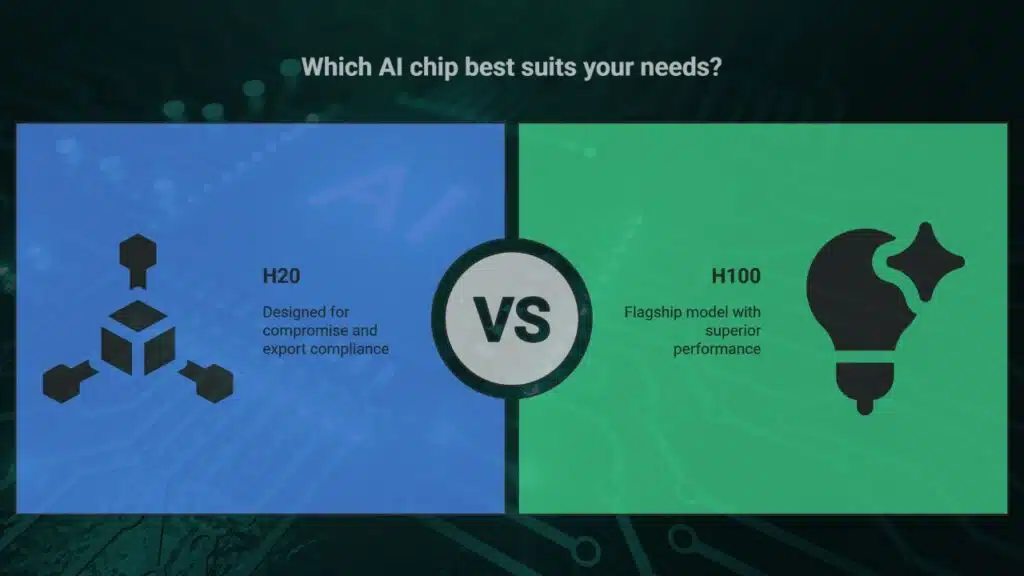
The H20 was engineered as a compromise product to meet U.S. export restrictions while still appealing to Chinese AI developers. Its key features include:
- 96 GB of HBM3 memory
- 4.0 TB/s memory bandwidth
- Performance of roughly 296 TFLOPs, significantly lower than the H100’s peak of 1,000+ TFLOPs
Despite being less powerful than Nvidia’s flagship models, the H20 was designed to handle large language model (LLM) training and AI inference tasks. Demand was initially strong—Nvidia reportedly ordered 300,000 units from TSMC in July 2025—but enthusiasm has cooled amid new political and regulatory uncertainties.
Outlook: Uncertainty Ahead for Nvidia in China
At present, Nvidia faces a delicate balancing act:
- Navigating U.S. regulations that restrict what technology it can sell in China.
- Addressing Beijing’s concerns about foreign dependence and national security risks.
- Competing with rising domestic chipmakers like Huawei and Biren Technology, which are being strongly supported by Chinese state funding.
While the H20’s production halt may be temporary, analysts warn it could mark the beginning of a longer-term retreat of Nvidia’s influence in China. The company’s next move—particularly whether the B30A chip gains approval—will be critical in shaping Nvidia’s role in one of the world’s largest AI markets.
The Information is Collected from AOL and CNBC.





















