
In a groundbreaking achievement that has captured global attention, Chinese AI startup DeepSeek has developed a revolutionary artificial intelligence (AI) model that rivals some of the best AI technologies in the world. What makes this accomplishment truly remarkable is that DeepSeek built this AI with an investment of just 8 billion yuan (approximately $1.2 billion)—a fraction of the cost typically required for such cutting-edge technology.
However, the most surprising aspect is not just the technological leap itself but what it represents: China’s ability to develop world-class AI independently, without relying on foreign talent or resources. DeepSeek’s success is a testament to China’s homegrown AI ecosystem, which is rapidly emerging as a major global force, competing head-to-head with Silicon Valley’s most advanced research labs.
A Visionary Leader and a Young, Homegrown AI Team
At the heart of this breakthrough is Liang Wenfeng, the 40-year-old founder of DeepSeek. Liang’s journey is unlike many of his peers in the AI industry. While top AI leaders often pursue education or work experience in the U.S. or Europe, Liang never studied abroad. Instead, he earned his computer engineering degree from Zhejiang University, one of China’s top institutions, and stayed in China to build his expertise.
Rather than recruiting engineers from major corporations or relying on professionals trained overseas, Liang took a bold and unconventional approach—he assembled a team of 139 young engineers, many of whom had only one to three years of experience. These engineers were trained and educated entirely within China, proving that China has the capability to develop high-level AI talent without depending on foreign expertise.
This goes against the common belief that only elite minds from Silicon Valley or major Western universities can lead AI innovation. DeepSeek’s achievement signals a shift in global AI dominance, showing that China has built a powerful AI ecosystem that is entirely self-sufficient.
China’s Rapid Rise as a Global AI Powerhouse
DeepSeek’s success is not an isolated event. It is a direct result of China’s strategic push to dominate AI by focusing on education, research, and large-scale investment in AI talent.
China Leads the World in AI Talent Production
One of the key reasons behind China’s AI boom is its commitment to training and producing AI researchers at an unprecedented scale.
- According to a 2022 report, China accounted for 47% of the world’s top AI researchers, whereas the U.S. accounted for only 18%.
- Since 2018, China has introduced more than 2,000 undergraduate AI programs, ensuring that thousands of students graduate every year with specialized AI skills.
- China produces around 80,000 Ph.D. graduates annually in AI-related fields, including science, technology, engineering, and mathematics (STEM). This massive pipeline of talent ensures that China can continuously feed its AI industry with top-level researchers, engineers, and developers.
A Growing AI Workforce and Research Ecosystem
China is now home to:
- Over 410,000 AI researchers, making it one of the largest AI talent pools in the world.
- More than 4,300 AI-focused companies, working across various industries such as autonomous driving, robotics, cloud computing, and generative AI.
- The world’s second-highest number of AI patent filings, demonstrating its commitment to intellectual property and innovation.
By combining state-backed research programs, university-led AI education, and aggressive investments in startups, China has created an AI ecosystem that is rapidly catching up to, and in some cases surpassing, Silicon Valley’s AI research capabilities.
DeepSeek: The First of Many AI Breakthroughs from China
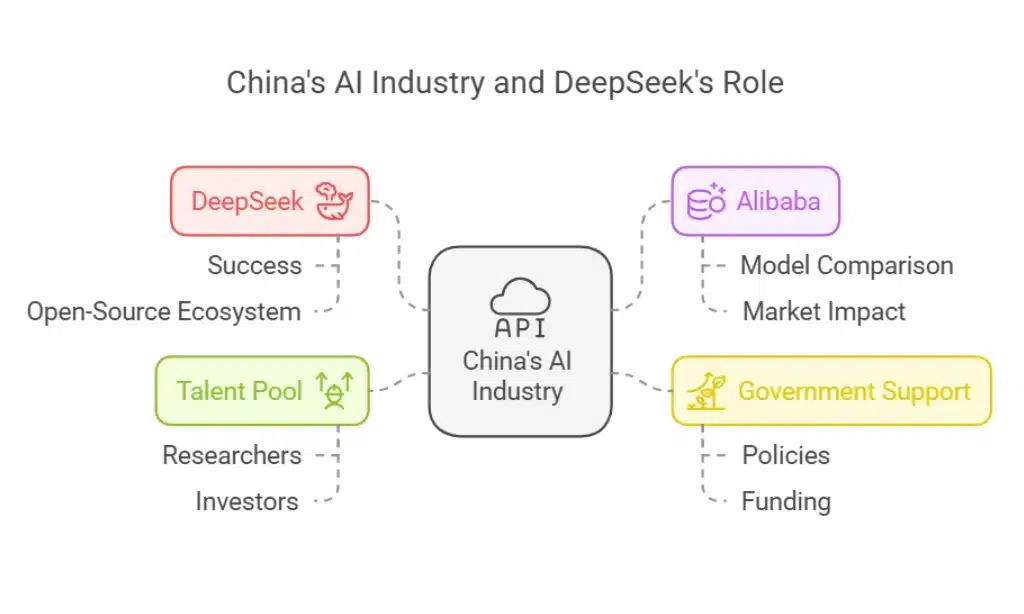
DeepSeek is just one of China’s top seven AI companies making waves in the industry. Even before the excitement around DeepSeek could settle, Alibaba unveiled an AI model that it claims surpasses OpenAI’s ChatGPT.
China’s AI industry is moving at an unprecedented pace, and DeepSeek’s success is likely just the beginning. With the combination of a massive talent pool, strong government support, and a rapidly expanding AI industry, we can expect many more DeepSeek-like breakthroughs in the near future.
Furthermore, if DeepSeek successfully builds an open-source AI ecosystem, it could attract global talent, researchers, and investors, solidifying China’s position as the world’s leading AI hub.
South Korea’s Struggles in the AI Race
While China is rapidly advancing in AI, South Korea is struggling to keep up. The country has ambitions of becoming an AI powerhouse, but the reality is proving to be more challenging than expected.
Talent Shortages in Key Tech Sectors
One of South Korea’s biggest hurdles is its shortage of skilled AI and tech professionals. Despite efforts to promote AI and semiconductor industries, the country faces several major problems:
- Brain Drain: Over the past decade, 340,000 STEM professionals have left South Korea for better opportunities abroad, particularly in the U.S. and China.
- Preference for Medical Fields: Many of South Korea’s brightest students prefer to pursue careers in medicine, leading to a lack of interest in AI and engineering.
- Declining Interest in Semiconductors: Even semiconductor engineering departments struggle to attract students, despite offering full scholarships and guaranteed jobs.
A Need for Nationwide AI Development Strategies
Unlike China, which has taken a top-down approach by introducing AI-focused university programs and investing heavily in research, South Korea has yet to implement a nationwide strategy to foster AI talent at the scale needed to compete with global AI leaders.
Without a serious commitment to nurturing AI engineers, investing in AI startups, and fostering a culture of innovation, South Korea risks falling behind in the global tech race—especially as China and the U.S. continue to push forward with AI advancements.
The Future of AI Belongs to Those Who Invest in Talent and Innovation
DeepSeek’s breakthrough is not just a victory for the company—it is a powerful signal that China is rapidly emerging as a dominant force in AI.
By building a vast AI talent pool, fostering homegrown innovation, and making strategic investments in cutting-edge technology, China has positioned itself as a global leader in artificial intelligence.
As AI continues to shape the future of technology, the countries that invest in AI education, research, and innovation will lead the next technological revolution. DeepSeek’s success proves that China is well on its way to becoming the world’s AI superpower—and this is likely just the beginning.