

The nuclear sovereignty double standard defines the modern geopolitical landscape. On February 5, 2026, the global security architecture lost its final major safety net when the New START treaty officially expired. This expiration removed the last legally binding constraints on the strategic arsenals of the United States and Russia. The world now faces an unconstrained arms race. Yet recognized nuclear powers continue to demand absolute non-proliferation from developing nations while actively expanding their own doomsday weapons.
This systemic failure creates an urgent crisis as the world approaches the 11th NPT Review Conference scheduled for April 27 to May 22, 2026. Developing nations are running out of patience with the current nuclear hierarchy. The expectation that global South countries must perfectly comply with non-proliferation demands while superpowers endlessly modernize their arsenals is fundamentally unsustainable.
2026 Global Nuclear Security Snapshot
| Key Metric | 2026 Status Data | Strategic Implication |
| New START Treaty | Expired February 5, 2026 | No limits on US or Russian strategic arsenals |
| 11th NPT RevCon | April 27 to May 22, 2026 | Rising tensions between nuclear and non-nuclear states |
| China’s Arsenal | 600 warheads, current estimate | Projected to reach 1,000 warheads by 2030 |
| Article VI Compliance | Zero practical disarmament | Severe damage to NPT’s moral authority |
The Broken Grand Bargain of the NPT
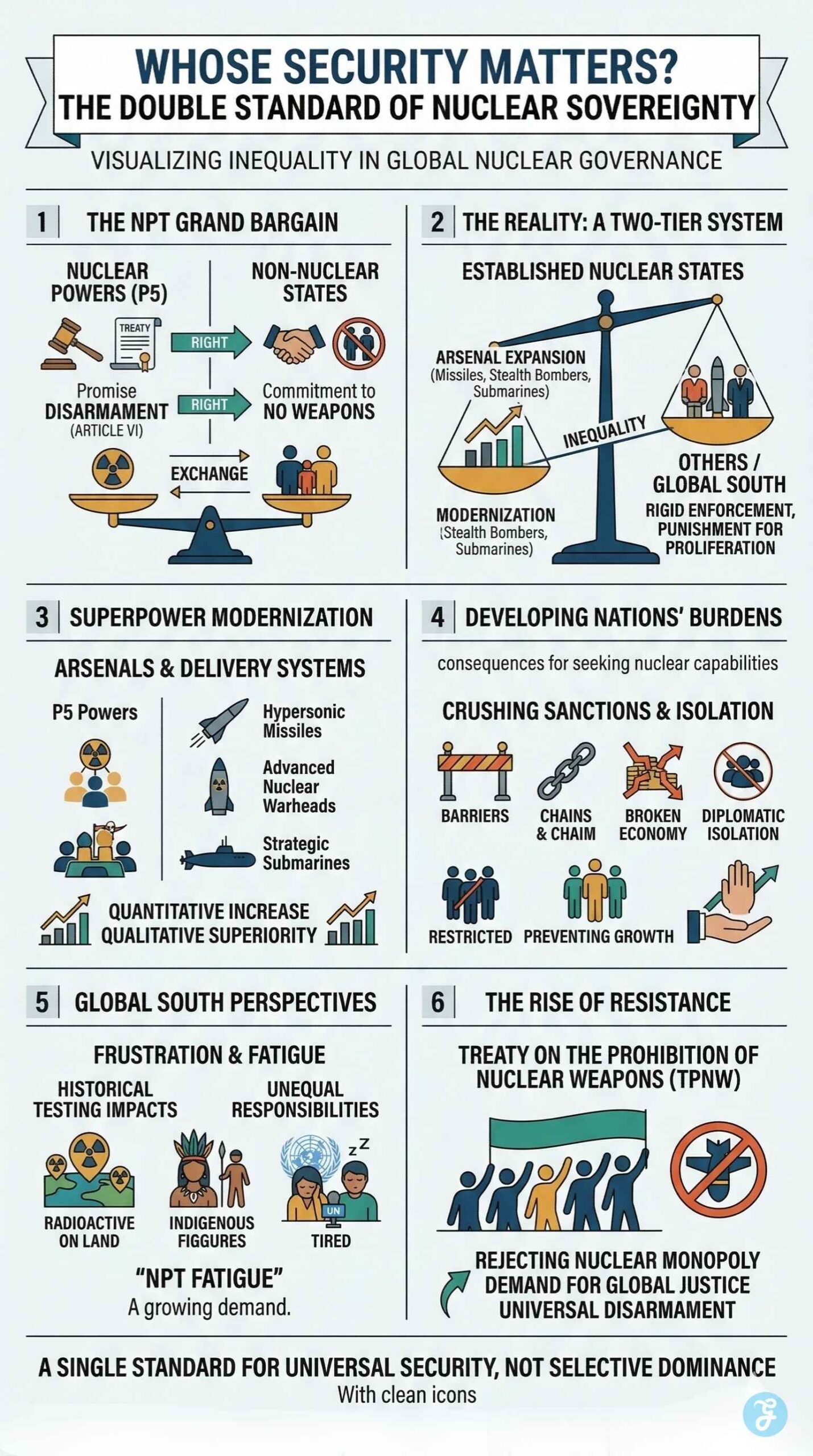
The global nuclear order relies entirely on a grand bargain established by the Treaty on the Non-Proliferation of Nuclear Weapons in 1970. Non-nuclear states agreed to permanently forfeit their right to build weapons to make the world safer. They accepted intrusive inspections and strict regulatory oversight of their civilian nuclear energy programs. This sacrifice was made based on a distinct legal promise.
Article VI Obligations
Article VI of the NPT legally requires the recognized nuclear powers to actively pursue total disarmament. The United States, Russia, China, France, and the United Kingdom committed to negotiating the elimination of their arsenals. More than fifty years later, this promise remains entirely unfulfilled.
The superpowers have spent decades ignoring this legal obligation. Instead of disarming, these nations are investing trillions of dollars into modernizing their delivery systems. They are building stealth bombers, advanced submarines, and hypersonic glide vehicles. This blatant hypocrisy exposes a deeply flawed international system.
The Penalty Imbalance
A severe penalty imbalance exists today. When a developing nation from the Global South seeks nuclear deterrence capabilities, they face crushing economic sanctions and diplomatic isolation. The international community swiftly mobilizes to punish any unauthorized proliferation. However, there is zero accountability when recognized nuclear states expand their arsenals or conduct new testing protocols.
The Financial Hypocrisy of Modernization
The nuclear sovereignty double standard is not just a legal issue. It is a massive financial contradiction. While the Global South struggles with compounding debt, climate disaster recovery, and energy crises, recognized nuclear powers are funneling unprecedented wealth into weapons of mass destruction.
According to the groundbreaking report released by the International Campaign to Abolish Nuclear Weapons in mid 2025, global nuclear weapons spending shattered previous records. The nine nuclear-armed states spent a staggering $100 billion on their arsenals in a single year. This represents an 11 percent increase from the prior year. The United States alone accounted for $56.8 billion of this total, while China followed with $12.5 billion.
This financial reality exposes a brutal truth about global priorities. The $100 billion spent in a single year could have funded the entire United Nations budget almost 28 times over. It could have provided critical climate adaptation infrastructure for the most vulnerable nations on the planet. Instead, this capital was diverted to defense contractors and lobbying groups to maintain systems that can never actually be used without ending human civilization.
Developing nations are told there is no money for global debt relief or climate reparations. Yet superpowers easily find billions to upgrade stealth bombers and intercontinental ballistic missiles. This glaring financial disparity proves that the global architecture prioritizes the destructive capacity of a few over the survival of the many.
Financial Priorities Fact Check
- Global Nuclear Spend: $100 billion in a single year.
- Per Minute Burn Rate: Roughly $190,151 spent every minute on nuclear weapons globally.
- The Beneficiaries: Over $40 billion generated by private sector defense contractors in a single year.
The 2026 Collapse of Arms Control
The geopolitical landscape experienced a seismic shift in early 2026. Life after the expiration of New START looks incredibly dangerous. The immediate fallout includes the total loss of mutual verification regimes. During the treaty’s lifespan, the United States and Russia conducted hundreds of on-site inspections and exchanged tens of thousands of data notifications.
The End of Verification
The end of verification creates a terrifying vacuum of trust. Without data exchanges, military planners rely on worst-case scenario estimates. This inevitably fuels a rapid buildup of forces. The world has transitioned from a managed Cold War arms race to a highly unpredictable and unconstrained nuclear environment involving multiple global players.
The New Unconstrained Arms Race
The rapid expansion of the Chinese nuclear stockpile complicates the traditional two-power dynamic. Recent estimates from early 2026 indicate that China currently possesses around 600 nuclear warheads. Supported by Russian assistance to their CFR-600 fast breeder reactors, Beijing is on track to produce enough fissile material for 1,000 nuclear warheads by 2030.
This rapid Chinese expansion forces the United States and Russia to reconsider their own numerical limits. A three-way unconstrained arms race is unprecedented in human history. The major powers are accelerating their weapons programs while simultaneously lecturing non-nuclear states about the dangers of proliferation.
The AI Integration Threat and Autonomous Armageddon
The collapse of traditional arms control is now colliding with rapid technological advancement. In 2026, the global security community faces a terrifying new frontier. Recognized nuclear states are actively racing to integrate artificial intelligence into their Nuclear Command, Control, and Communications systems. This development terrifies non-nuclear states and civil society organizations worldwide.
Artificial intelligence fundamentally alters the timeline of nuclear deterrence. Machine learning algorithms process early warning radar data and satellite imagery faster than any human brain. While military planners argue this provides better situational awareness, the reality is that AI severely compresses the window for human decision making.
In a crisis scenario, human leaders will be forced to trust algorithmic threat assessments. Deterrence requires careful deliberation and human judgment to prevent a false alarm from triggering a global catastrophe. AI systems incentivize rapid reactions. Handing the fate of humanity over to self-taught machines is what global disarmament advocates accurately call irresponsible madness.
The nuclear sovereignty double standard is highly visible in this technological race. Superpowers refuse to adopt legally binding international treaties that would ban AI from nuclear launch decisions. They hide behind classified military infrastructure and claim transparency would ruin their strategic advantage. Once again, the Global South is forced to live under the constant threat of annihilation, only this time the trigger might be pulled by a hallucinating algorithm rather than a human leader.
The Risks of AI in Nuclear Systems
- Decision Compression: AI drastically reduces the time human leaders have to verify a threat.
- Automation Bias: Operators are highly likely to trust a machine learning alert even if it is a false positive.
- The Transparency Paradox: Superpowers refuse to allow independent safety audits of their military algorithms.
The Ally Exception and Selective Enforcement
The double standard becomes overwhelmingly obvious when examining how major powers treat their strategic allies. Geopolitical loopholes dictate that friendly proliferation is treated entirely differently from adversarial proliferation. Recognized nuclear states fiercely condemn weapons programs in rival nations while actively engaging in sensitive technology sharing with their friends.
Geopolitical Loopholes
Recent debates surrounding South Korea and Saudi Arabia highlight this exact contradiction. Both nations are currently pushing for domestic fissile material production capabilities. They cite regional security threats as justification. Major powers frequently offer tacit support or look the other way when their strategic partners seek advanced nuclear infrastructure.
Technology sharing agreements further blur the non-proliferation lines. The AUKUS submarine pact involves the transfer of highly enriched uranium technology to a non-nuclear state. While legally permissible under specific treaty loopholes, these actions undermine the spirit of the non-proliferation regime. Rival nations view these transfers as undeniable proof that the rules do not apply equally to everyone.
Nuclear sovereignty is currently treated as an exclusive privilege for strategic partners rather than a universal danger to humanity. Superpowers use the non-proliferation regime as a tool to manage their adversaries while protecting their own sphere of influence. This selective enforcement destroys the credibility of international arms control institutions.
The Global South Reaches the Breaking Point
Non-Aligned Movement countries are experiencing immense frustration regarding the unequal distribution of sovereign rights. The upcoming 11th NPT Review Conference in New York will serve as a massive diplomatic battleground. Preparatory committee meetings led by Vietnamese Ambassador Do Hung Viet have already revealed deep divisions between nuclear haves and have-nots.
Developing nations increasingly view the NPT as a mechanism for enforcing a global caste system. The treaty was designed to prevent the spread of nuclear weapons, but has instead legitimized a permanent nuclear monopoly. Global South diplomats are openly questioning the value of participating in a system that demands their perfect compliance while granting superpowers total immunity.
Historical Trauma and Environmental Impact
Historical trauma plays a major role in this mounting anger. Early nuclear testing was frequently conducted on indigenous lands and territories within the Global South. Nations in the Pacific and Africa endured the devastating environmental and health impacts of atmospheric and underground detonations.
These same nations are now expected to shoulder the burden of non-proliferation without receiving any of the promised security assurances. The major powers refuse to issue legally binding negative security assurances that would guarantee they will not use nuclear weapons against non-nuclear states. This refusal highlights the absolute power imbalance at the heart of global security.
The TPNW and the Fight for True Universalism
The Treaty on the Prohibition of Nuclear Weapons represents a direct institutional rebellion against the established nuclear monopoly. Championed by non-nuclear states and civil society organizations, the TPNW fundamentally rejects the idea that nuclear weapons provide legitimate security for anyone. It entered into force in early 2021 and continues to gain signatories across the Global South.
Reclaiming the Global Narrative
Non-nuclear states are using the TPNW to reclaim the global security narrative. The treaty defines nuclear weapons as an illegal threat to global survival. It outlaws the development, testing, production, stockpiling, stationing, transfer, use, and threat of use of nuclear weapons.
The absolute refusal of nuclear-armed states to engage with or recognize the TPNW exposes the massive ideological divide governing global security. Major powers actively pressured their allies to boycott the treaty negotiations. They claim the TPNW undermines the existing NPT framework. However, the reality is that the new treaty simply attempts to enforce the disarmament obligations that superpowers have ignored for decades.
This new legal instrument shifts the moral compass of international relations. It strips away the prestige associated with nuclear weapons and forces a conversation about shared human vulnerability. By stigmatizing the possession of these weapons, the TPNW aims to create political pressure that will eventually force the major powers to the disarmament negotiating table.
Wrapping Up: Breaking the Global Nuclear Monopoly
The global nuclear order is built upon a deeply flawed two-tiered system. Recognized nuclear powers endlessly modernize their arsenals while aggressively denying that same sovereign right to the rest of the world. With the expiration of the New START treaty in early 2026, non-nuclear states are actively challenging this hypocrisy.
The international conversation is shifting away from the exclusive rights of superpowers and moving toward a universal demand for shared nuclear responsibility. If the major powers do not address these glaring inequalities at the upcoming NPT Review Conference, the entire non-proliferation regime risks total collapse.
How long can the international community sustain a system where security is a privilege reserved only for the powerful?





















