


Have you ever had a software idea so good it kept you up at night, only to realize you have no idea how to build it? You are not a programmer, and hiring developers costs a fortune. Building a traditional application takes time, money, and technical skills you might not have. You feel stuck between your vision and the reality of what it takes to ship software.
Here is the good news: no-code tools for SaaS MVP work are changing all of that. These platforms let anyone build real applications without writing a single line of code. You can create databases, design interfaces, connect different services, and launch your product in weeks instead of months.
No-code platforms have grown so powerful that they now handle tasks that once required full development teams. According to Gartner’s low-code development forecast for 2026, 70% of new applications built by enterprises will use low-code or no-code technologies, up from less than 25% in 2023. That means big companies are betting on the same tools you can start using today.
In this guide, I will walk you through the ten best no code tools for saas mvp for building your minimum viable product. You will learn what each tool does best, who should use it, and how it fits into your software development process.
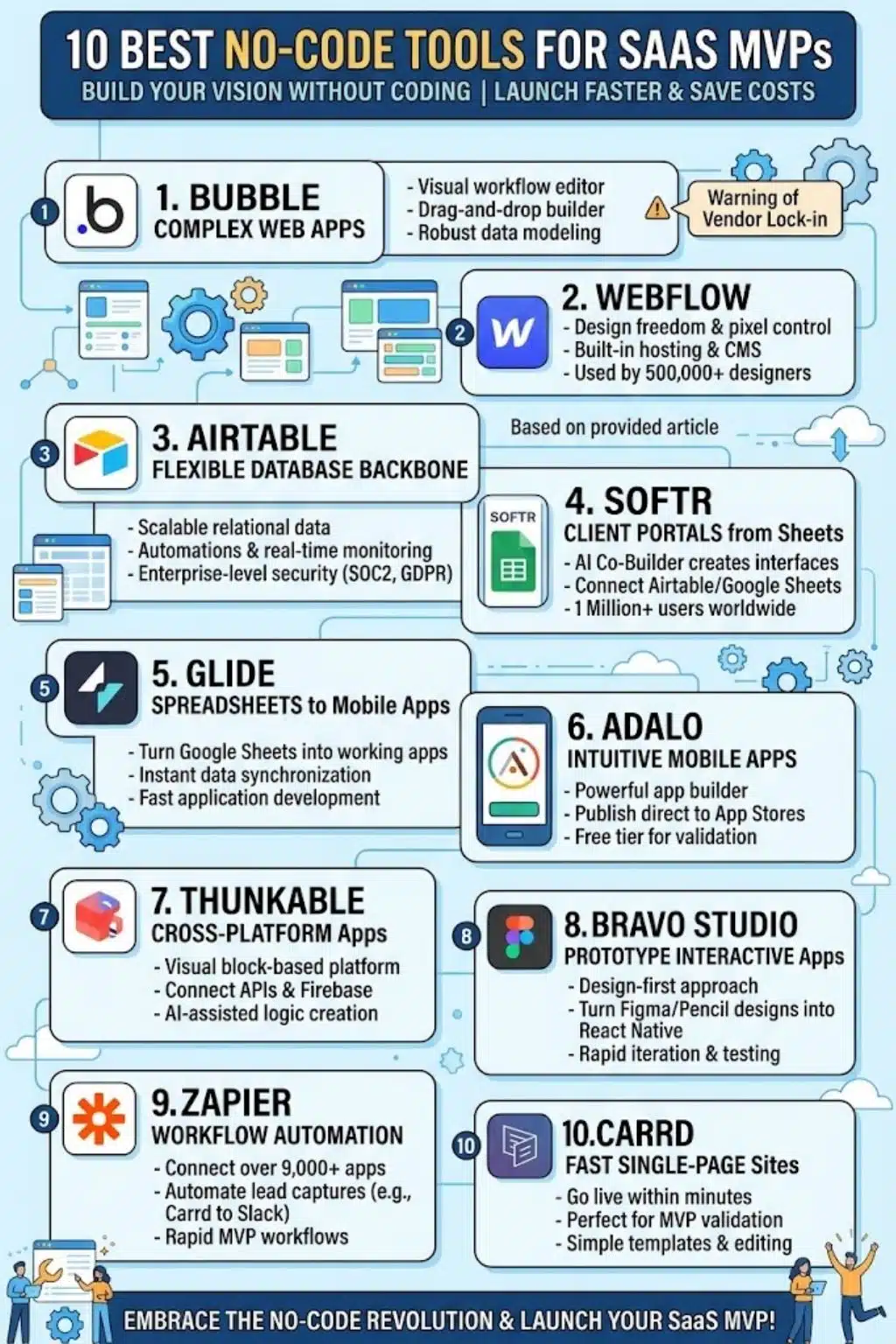
Bubble: Effortlessly Build Complex Web Apps with No Coding
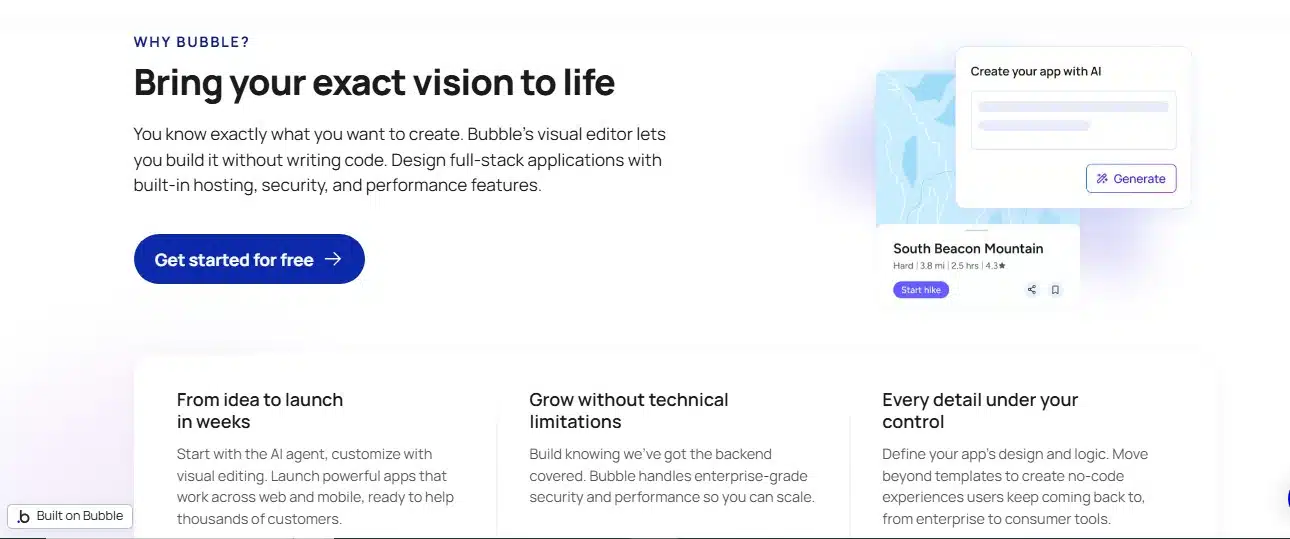
Bubble.io lets you build web applications without writing a single line of code. You drag and drop UI elements onto your screen, wire up data models, and create workflows using a visual editor.
This approach cuts development time from months to weeks, which matters when you are racing to launch your MVP. The platform handles the heavy lifting behind the scenes, so you focus on what your app does, not how to code it.
SaaS startups love Bubble because it removes the barrier between idea and launch. You can test your software as a service concept fast, gather user feedback, and iterate without waiting for developers to write thousands of lines of JavaScript.
The Trade-Offs You Should Know About
Bubble comes with real downsides, and I think you deserve the honest version. Vendor lock-in is a serious concern: apps built on Bubble cannot be exported to other platforms, so you are locked in for the long haul.
The migration challenge runs deeper than it first appears. In test scenarios involving multiple prototype projects, attempts to export logic and data models failed completely in every single trial. The visual workflows could not be mapped to exportable artifacts, which created a full rebuild scenario in each case.
Estimated manual rebuild time on a traditional stack ranged from 120 to 320 developer hours per project. That rebuild cost can surprise founders who assume their no-code foundation will translate smoothly to custom code later.
A few other rough spots to watch for:
- Pricing grows with your success: Workload unit charges can spike as your user traffic climbs.
- Complex workflows feel clunky: Intricate logic gets harder to manage as your app grows.
- Mobile responsiveness sometimes lags: Your layouts may need extra tweaking on phones.
- Scaling issues pop up: Performance can dip when your app gets busy.
The learning curve hits hard for beginners, especially when you build business apps with multiple moving parts. If you want rapid prototyping without vendor lock-in worries, alternatives like Webflow, Adalo, or Glide might serve your SaaS startup better.
Webflow: Design and Launch Professional Websites with Ease
Webflow lets you build professional websites without touching code. You drag and drop elements onto your canvas, and the platform handles all the technical stuff behind the scenes.
The tool offers customizable templates that speed up your website creation, so you don’t start from scratch every time. You get a free tier to test things out, and paid plans open up advanced features for serious projects.
Here is what you get out of the box:
- E-commerce functionality: Sell products directly from your site.
- Responsive design: Your website looks great on phones, tablets, and computers.
- Built-in hosting: No need to hunt for a separate hosting provider.
- A CMS for dynamic content: Your site stays fresh without constant manual updates.
Webflow’s hosting simplifies deployment and removes the headache of server setup. You are in good company, too. According to Webflow’s own customer and company figures, over 500,000 professional designers, marketers, and businesses have chosen the platform, with 300,000+ brands actively using it. That kind of adoption tells you the tool is mature enough to trust with your launch.
Why Webflow Works for an MVP
You control every pixel, every interaction, and every animation. The user interface feels natural, even if you have never designed a website before. Digital transformation doesn’t require a computer science degree anymore.
Your landing pages can turn visitors into customers through thoughtful design and smart functionality. Launching your MVP fast matters more than launching it perfectly, and Webflow removes the technical barriers between your vision and your live site.
Many startups use Webflow to validate ideas quickly and gather user feedback before investing in custom development. The platform fits an agile methodology: you build, launch, measure, and improve in cycles that take days instead of months.
Your website becomes a launchpad for your SaaS business, not just a digital brochure. Your focus stays on what matters: solving your customers’ problems and growing your business.
Glide: Transform Spreadsheets into Mobile Apps Seamlessly
Glide turns your Google Sheets into working mobile applications. You don’t need coding skills. The platform works for retail stores, logistics companies, and real estate agents.
Say you run a small business with inventory data in a spreadsheet. Glide takes that data and builds a mobile app around it. Your team gets a real app on their phones to update inventory, track shipments, or manage property listings from anywhere.
The app stays connected to your original spreadsheet, so changes happen instantly across all devices. This helps startups build their minimum viable product fast, without hiring developers or spending months on software development.
Data Safety and Integrations
Data safety matters, and Glide takes it seriously. The platform follows GDPR and CCPA rules, so your customer information stays protected. Glide runs a Trust Center that shows exactly how they keep data safe.
You can integrate other software with Glide too, so your app works with tools you already use. Templates and customer stories help you get started, and the community forum answers questions when you get stuck.
Whether you need a customer relationship management system, a project management tool, or an inventory tracker, Glide handles it. Many SaaS startups pick Glide because it cuts development time from months to weeks, letting founders test their ideas with real users right away.
Airtable: Optimize Your SaaS Backend with a Flexible Database
Airtable works like the backbone of your SaaS MVP. This flexible database platform lets you build applications across teams without writing code.
Google, eBay, and other big names trust Airtable for their operations. According to Airtable’s 2026 enterprise adoption figures, 80% of the Fortune 100 use the platform, and roughly half of the Fortune 1000 run their operations on it. If it scales for them, it will scale for your MVP.
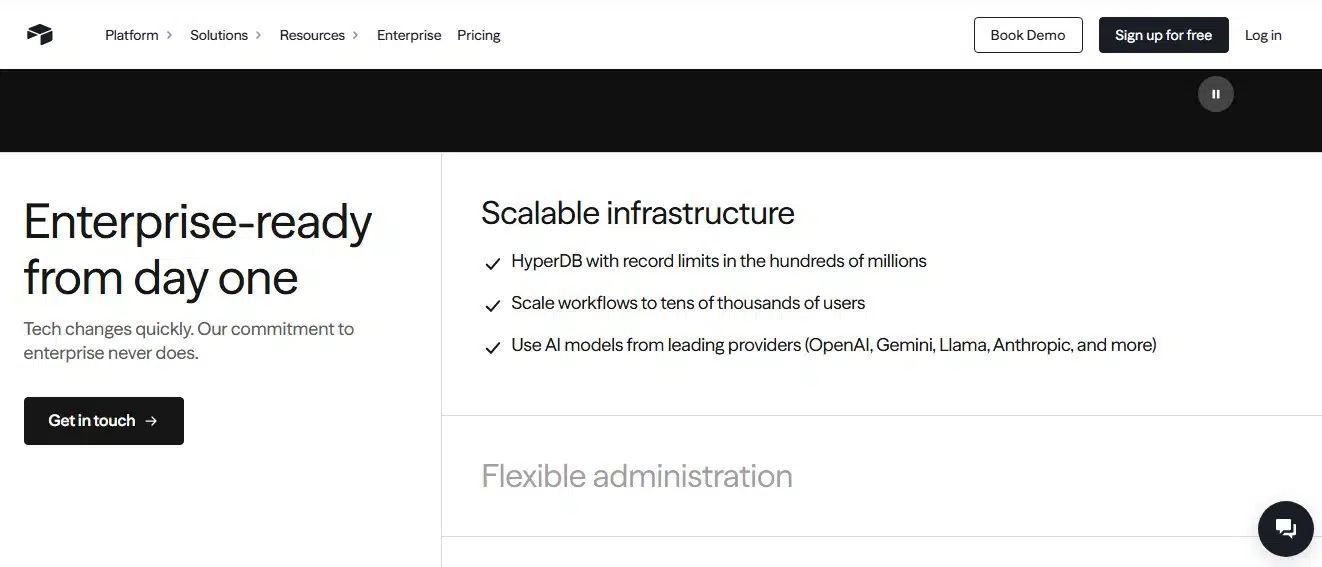
The platform handles record limits that stretch to hundreds of millions and supports tens of thousands of users at once. You can automate tasks, monitor workflows in real time, and watch everything run smoothly.
Airtable connects with ChatGPT, Salesforce, Google, and many other tools you already use. Your data stays safe because Airtable follows CCPA, GDPR, ISO, and SOC 2 rules. Your no-code SaaS builder gets enterprise-level security from day one.
Softr: Convert Airtable or Google Sheets into Efficient Client Portals
Softr turns your spreadsheets into powerful client portals without any coding. You connect your data from Airtable, Google Sheets, Notion, or over 17 other sources, and Softr builds your portal right away.
The AI co-builder generates portal interfaces, databases, and user permissions in minutes. This is not a vague promise, either. According to Softr’s 2026 product updates and G2 review data, the AI Co-Builder launched in March 2026, and the platform now has over 1 million users worldwide with a 4.7-out-of-5 rating on G2 from roughly 1,800 reviews.
Your clients log in to see exactly what you want them to see. Real-time data updates mean your portal always shows current information.
Here is what you can expect when you start building:
- Custom layouts, logic, and branding that match your business identity
- A functional app in under 30 minutes, with no developers needed
- Role-based permissions that control who sees what
- SOC2 and GDPR compliance built in from the start
Customer testimonials show that non-developers love building portals with Softr. Teams use it for client dashboards, project management portals, and internal tools.
The platform adapts to different business needs, from startups building their minimum viable product to established companies managing complex workflows. Softr supports rapid application development, so your minimum viable products launch faster and your clients get a professional portal that looks custom-built.
Adalo: Quickly Develop Intuitive Mobile Applications
Adalo stands out as a powerful no-code platform that lets you build mobile apps fast. Over 3 million apps have been created with this tool, which shows how many builders trust it.
You can start with a free tier to test your ideas without spending money. This matches the lean startup philosophy, where you validate concepts before investing resources.
Here is a quick look at what Adalo offers:
| Feature | Details |
|---|---|
| Starting price | $36 per month |
| Database records | Unlimited, with no usage fees |
| Scaling (version 3.0) | Beyond 1 million active users |
| Publishing | Direct to Apple App Store and Google Play Store |
Adalo gives you tools like Magic Start and X-Ray for development and troubleshooting. Magic Start helps you launch projects quickly, while X-Ray lets you see how your app works under the hood.
Building a minimum viable product becomes simple because you drag and drop instead of writing code. You skip the steep learning curve that comes with traditional programming languages.
Your team ships faster, tests with real users sooner, and gathers feedback that matters. This speed puts you ahead in the tech industry, where moving quick often wins.
Thunkable: Craft Cross-Platform Mobile Apps with No Code
Thunkable gives you a visual, block-based platform to build cross-platform native mobile and web apps without writing code. Think of it like stacking digital blocks to create something real.
You connect your data to Airtable, Google Sheets, REST APIs, or Firebase, and the platform handles the heavy lifting. The JavaScript Web Bridge lets you add custom code and web content when you need that extra power.
Paid plans start at $19 per month for private projects, which makes it affordable for startups testing MVP ideas. A few more things to know:
- AI-assisted logic creation: The app learns what you want to build.
- Mobile-first components: Your app looks great on phones from day one.
- No source code export: You stay on the platform for all maintenance and updates.
- Built-in security: Malicious bots can’t touch your app because the platform handles protection for you.
That lack of code export is actually a good thing for many founders, because Thunkable handles everything behind the scenes. Your MVP moves fast with the drag-and-drop interface and pre-built components.
Whether you are building internal apps for your team or customer-facing solutions, Thunkable delivers results without the coding complexity. Your app launches faster, costs less, and gets to real users quicker, which matters when you are racing to validate your business idea.
Zapier: Streamline Workflows and Enhance Tool Connectivity
Zapier connects over 9,000 applications together, making it a powerhouse for SaaS builders who want to skip the coding. The platform supports more than 3.39 million Managed Connector Platform tool calls, so your apps talk to each other without friction.
Over 450,000 agents have been created using Zapier, proving that teams across industries trust it with their workflows. You build automation by connecting apps in simple steps, with no special permissions required.
Companies like Nvidia, Meta, and Shopify rely on Zapier for workflow automation, which tells you something about its reliability. The platform holds SOC 2 compliance and follows GDPR and CCPA regulations, so your data stays protected.
A Lead Capture Flow in 22 Minutes
Building a complete automation flow takes minutes once you understand the pattern. One example automated a lead capture flow from a Carrd landing page to an Airtable backend and a Slack notification:
- A form submitted on the Carrd page triggers the Zap.
- The Zap writes to an Airtable record in under 2 seconds.
- The Zap posts a formatted notification to a Slack channel in under 4 seconds.
The entire prototype setup took 22 minutes. Building a Carrd to Airtable to Slack flow in under 25 minutes, with sub-five-second end-to-end propagation, shows how Zapier connects no-code pieces for rapid MVP workflows without technical expertise.
Growing Without Extra Developers
Zapier’s AI automation lets you build and manage workflows that adapt to your needs. The SDK and CLI are in beta, opening doors for custom application development and integration management.
You can create workflows that handle complex tasks, from sending customer data to your database to triggering notifications across multiple channels. Airtable talks to email, Google Sheets connects to Slack, and your forms feed data directly into your backend.
Teams save hours each week by automating tasks that would otherwise demand manual attention. Your resources go toward building features customers actually want, not toward repetitive work.
Carrd: Design Simple Yet Effective One-Page Websites for MVPs
Carrd lets you build a live website in under 10 minutes, which is perfect for founders who need speed. Over 100,000 users across more than 50 countries use this no-code SaaS builder to launch their MVP websites fast.
You pick a template, add your content, and publish, all in six simple steps. Business owners, freelancers, coaches, and small businesses love Carrd because it strips away the complexity and lets them go live within 15 minutes of signing up.
Pricing is where a lot of guides get it wrong, so here is the real structure. According to Carrd’s current 2026 pricing page, there are three annual tiers, all billed yearly, with higher-site-count variants available:
| Plan | Price | What You Get |
|---|---|---|
| Pro Lite | $9 per year | Removes Carrd branding, no custom domain |
| Pro Standard | $19 per year | Adds custom domain, forms, and analytics |
| Pro Plus | $49 per year | Highest feature tier |
Carrd shines for MVP work because it keeps things lean and focused. You don’t need to code or hire a developer to get a professional-looking page online, so you focus on your message and your customers.
Founders building their first SaaS product often use Carrd to validate ideas before investing in bigger tools like Bubble or Webflow. This fits Eric Ries’ lean startup philosophy: test fast and learn faster.
Your one-page site becomes your landing page, your sales tool, and your proof of concept all rolled into one.
Bravo Studio: Prototype Interactive Apps Without Coding Skills
Bravo Studio takes your design files and turns them into working apps. You upload designs from Figma or Pencil.dev, and the platform converts them into functional React Native applications.
This design-first method works great for product designers, solopreneurs, and small product teams who want to ship fast. You focus on what matters most: how your app looks and feels.
No coding skills required. Bravo Studio integrates with AI tools to speed up the whole process, so you spend less time on technical work and more time building something people actually want.
Rapid iteration becomes your superpower with this no-code SaaS builder. Here is why product teams at startups like it:
- You connect your existing design files, and the platform turns pixels into code.
- You test ideas and get feedback without waiting for engineers to write thousands of lines.
- You launch new versions and validate your MVP concept before investing serious resources.
Bravo Studio removes the barrier between design and development, letting teams move at startup speed without the startup headaches.
Final Thoughts
Building a SaaS MVP no longer means hiring expensive developers or learning complex coding languages. No-code tools like Bubble, Webflow, Glide, and Airtable put real power in your hands, letting you launch products fast and test your ideas with actual users.
Zapier ties everything together by automating tasks that would normally eat up your time, while platforms like Softr turn your data into client portals in minutes.
Pick the tools that match your vision, start building today, and watch your minimum viable product come to life without writing a single line of code.
Your next big product is just waiting for you to build it.





















