You don’t need a year or a hundred thousand dollars to test a SaaS idea. You need a properly scoped MVP and thirty days. The data is blunt about what happens without one: the most cited analysis of startup failures, CB Insights’ review of hundreds of post-mortems, puts “no market need” at 42 percent of failures, with the updated 2024 study of 431 failed VC-backed companies pegging poor product-market fit at 43 percent.
About 48 percent of startups fail within five years. Almost all of them built something before confirming anyone wanted it. This guide walks through a 30-day MVP build, day by day and week by week, with verified cost and timeline data, so you get real customer feedback instead of a nine-month surprise.
What an MVP actually is
An MVP is the smallest version of a product that lets you collect maximum validated learning about customers with the least effort. That’s the definition Eric Ries popularized in “The Lean Startup” in 2011, and it’s still the right one. The term itself goes back further, to Frank Robinson in 2001, but Ries made it the engine of the build-measure-learn loop.
The point is not to ship a smaller version of a finished product. The point is to expose your riskiest assumption to real customer behavior. Dropbox is the classic example. Before the syncing engine existed, Drew Houston made a three-minute video showing how the product would work. The beta waiting list went from 5,000 to 75,000 people overnight, per Eric Ries’ own account on TechCrunch. The video was the MVP. It tested demand without building the product.
That’s the mindset you need for a 30-day build. Every feature you add beyond what is required to start learning is waste, no matter how important it seems at the time. The MVP isn’t the goal. The validated learning is, and that’s a distinction most founders learn the hard way.
Why 30 days is the right window
Let’s start with the honest part: a focused SaaS MVP can realistically be built in about 30 days, roughly four weeks, per Innew’s development timeline analysis. Industry estimates vary from 2-3 weeks for a standard MVP to 6-8 weeks for a fuller scope, per BuildMVPFast and Raftlabs. No-code tools like Bubble typically land at 4-8 weeks, per Uinno. The 30-day window sits in the sweet spot: long enough to build something real, short enough to force hard scope decisions.
The cost difference is where it gets uncomfortable:
| Approach | Timeline | Investment before customer feedback |
| Traditional development | 6 – 12 months | $80,000 – $150,000 |
| Focused 30-day MVP | 30 days | $7,000 – $25,000 |
| Agency build (2026 typical) | 6 – 8 weeks | $10,000 – $40,000 |
Those ranges come from Nitramix’s 2026 playbook and Raftlabs. The uncomfortable truth is that the traditional path spends $80,000 or more before a single customer says whether the idea is worth building. The 30-day path gets that answer for a fraction of the cost and a fraction of the time.
There’s a second reason the window matters: momentum. A 30-day build forces you to make decisions daily. A six-month build lets you postpone every hard call until next month. Most founders who stall in MVP development aren’t failing at building. They’re failing at deciding.
The five MVP types and when to use them
Before you open a code editor, pick the MVP type that tests your riskiest assumption cheapest. Five proven patterns exist, and all of them have funded-company evidence behind them.
The landing page MVP. A single page with a value proposition and a signup form. Buffer started this way. Joel Gascoigne built a two-page site: one page explained the product, the second showed pricing with a signup button that led nowhere. When people clicked it, they were told the product was coming. The clicks proved willingness to try. Buffer is now a nine-figure company built on that two-page test.
The concierge MVP. You do the job by hand for your first users. Zappos is the canonical example. Before building an inventory system, Nick Swinmurn photographed shoes in local stores, posted them online, and bought and shipped the pairs after orders came in. The MVP proved people would buy shoes online, without a warehouse or a supply chain.
The wizard of oz MVP. The product looks automated, but a human runs it behind the scenes. Groupon started as a WordPress blog where Andrew Mason manually emailed PDF vouchers to a mailing list. Customers thought the system was automated. The learning was about demand, not about the software.
The video MVP. Dropbox’s three-minute demo is the template. If the product is hard to explain or hard to build, show it working and measure signups. The video took a weekend. It produced 75,000 waitlist signups.
The single-feature MVP. You build one complete workflow, nothing else. This is the default for a 30-day SaaS build when the product itself is the test, and it’s what the rest of this guide assumes.
Choose the type by your riskiest assumption. Demand risk? Landing page or video. Willingness to pay? Pricing page with a real checkout. Can you deliver the value manually? Concierge. Every dollar and day spent on the wrong MVP type is the waste Ries warns about.
Team and roles for a 30-day build
Here’s a relief for solo founders: you don’t need a founding team for a 30-day MVP. You need a generalist who ships.
A solo founder with no-code skills can cover product, development, marketing, and support, and the budget stays at the low end of the $7,000 to $25,000 range. Add a second person and the build gets faster but the communication overhead grows. Add a third and you’re managing a team instead of testing an idea. For the MVP, one person who ships beats a team that plans.
The roles that actually matter, in order:
- The builder. Someone who can turn the core workflow into a working product. Could be you, a developer, or a no-code tool.
- The interviewer. Someone who talks to customers and reads the feedback honestly. This is often the founder, and it shouldn’t be delegated away.
- The operator. Someone who keeps the launch running: email, support, payment test, analytics.
If you’re solo, you are all three, and the way to survive is to time-box each role. Mornings for customer conversations. Afternoons for building. Evenings for the operational cleanup. A month of that rhythm is enough to get the answer you need.
Week 1: Validate before you build
Here’s a hard truth about day one: it’s not about code. It’s about naming the riskiest assumption and testing it cheaply.
Start with the problem, not the product. Who has this problem? How urgent is it? What do they use today? If you can’t answer those three questions with specifics, no amount of code fixes it. The CB Insights data is the reason for this discipline: no market need is the top failure cause, with the updated 2024 research on 431 failed companies putting poor product-market fit at 43 percent.
This week’s deliverable is a validation artifact, not a prototype. Options, cheapest first:
- A landing page with a clear value proposition and a signup form. If people join, you have a signal.
- A concierge test. Do the job by hand for a few users and watch what they actually do.
- A demo video in the Dropbox style. Explain the product, measure the signups.
- Five to ten customer interviews with a strict script. Listen for the problem, not the feature requests.
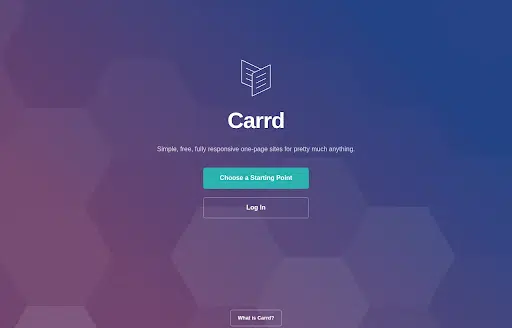
A landing page builder like Carrd turns week 1 into a one-afternoon validation test: value proposition, signup form, done. Screenshot: carrd.co, captured August 2026.
By Friday, you should know three things. Whether the problem is urgent. Whether anyone has tried to solve it before. And whether your landing page converts well enough to keep going. If the answer to all three is weak, the 30 days saved you from a 12-month mistake. That’s not failure. Honestly, it’s the cheapest validation you’ll ever buy.
Week 2: Build the core loop
Validation done, now build the smallest thing that delivers the core value.
Define the one job the product does better than the alternative. Write it as a sentence: “This product helps [customer] do [job] in [time] without [pain].” Everything that doesn’t serve that sentence gets cut. This is where most MVP builds die, not from lack of skill but from scope creep.
A practical MVP feature list usually fits on one page:
- One core workflow that delivers the value
- A minimal signup and login
- A basic dashboard showing the result
- One way to pay or start a trial
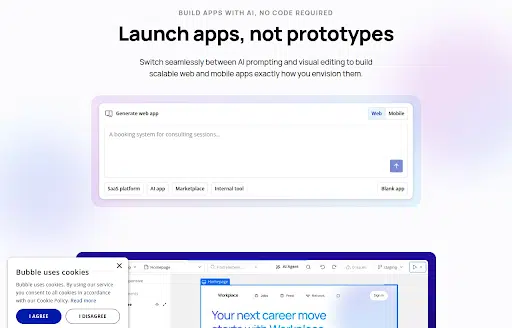
The Bubble editor, the kind of no-code tool that lets one person ship a functional MVP in weeks. Screenshot: bubble.io, captured August 2026.
Use the stack that ships fastest. If you can build with no-code in four weeks, per Uinno, do that. If you need a developer, keep the scope tight enough that one person can build it in two weeks. The tool doesn’t matter. The learning does. A typical fast stack looks like this: a no-code builder or a lightweight framework for the app, a managed database, a ready-made auth provider, and Stripe for payments. Buy the commodity parts. Spend your two weeks on the workflow that differentiates you.
Week 3: Onboarding, activation, and payment
Here’s what nobody warns you about: the build is the easy part. The hard part is getting users to the moment where they experience value.
The data explains why this deserves a week of its own. A 2026 churn benchmark analysis found that 40 to 60 percent of SaaS users churn within the first 30 days because they never experience the product’s value. Average activation rates sit at about 37.5 percent, per DigitalApplied’s 2026 onboarding metrics framework. If your onboarding doesn’t get users to the aha moment fast, half of them vanish before you can measure anything.
This week, optimize one metric: time to first value. Cut every step between signup and the moment the user sees their problem solved. Add a welcome email that points to the core action. Watch session recordings to find where people stall. And put a payment or trial step in place, because willingness to pay is the strongest validation signal there is.
A useful mental model for the week: the user should go from signup to value in under five minutes. If they can’t, the onboarding is the product’s biggest bug, and it will look exactly like the 40 to 60 percent churn data.
Week 4: Launch and measure
Launch day feels like the finish line. It’s actually the start of measurement.
The week’s shape: deploy, announce to the people who joined your waitlist, collect every piece of feedback, and fix the top blocker daily. A production-ready MVP with paying customers is the deliverable, per Nitramix. “Production-ready” here means stable and usable, not perfect.
Measure these numbers from day one:
| Metric | Why it matters | Benchmark context |
| Activation rate | Users who reach the value moment | Average around 37.5% |
| 30-day retention | Whether users come back | 40-60% churn in first 30 days is the warning |
| Monthly churn | Revenue leakage | B2B SaaS averages about 3.8% monthly |
| Net revenue retention | Expansion vs churn | Median 100-104%; best-in-class 120-130% |
Don’t optimize vanity metrics. Page views and signups feel good. Activation and retention tell you whether the product works. If the first users don’t come back, you learned something worth more than the $7,000 to $25,000 you spent.
The 30-day sprint map, day by day
The weeks give you the shape. The days, honestly, are where the discipline lives. Here’s the full sprint map, adjusted for your actual start date:
| Days | Focus | Deliverable |
| Day 1 – 2 | Problem interviews | Five interviews completed, riskiest assumption named |
| Day 3 – 4 | Landing page | Page live with signup form and clear value proposition |
| Day 5 | Concierge test or analysis | First signal on whether the problem is urgent |
| Day 6 – 7 | Scope freeze | One-page feature list locked, no more additions |
| Day 8 – 14 | Core loop build | Auth, main workflow, dashboard working |
| Day 15 – 16 | Payment | Checkout live in test mode, then a real charge |
| Day 17 – 19 | Onboarding | Welcome email, first-value path under five minutes |
| Day 20 | Internal test | Full walkthrough, top bugs fixed |
| Day 21 – 23 | Waitlist launch | Announce to waitlist, invite first ten users |
| Day 24 – 27 | Observe and fix | Daily blocker fixes, session recordings reviewed |
| Day 28 – 29 | Measure | Activation and retention numbers reviewed, Sean Ellis survey sent |
| Day 30 | Decide | Launch decision plus next-30-days plan written down |
Print this map. Tape it next to your screen. Every day that drifts from the map is a day the scope crept back in.
Finding your first ten customers
The MVP is built. Now you need the ten people who will tell you the truth. Don’t start with ads. Start where your customers already gather.
Three channels work best for a fresh MVP, and they’re all cheap.
Communities. Find the subreddit, Slack group, Facebook group, or forum where your target customer already asks for help. Answer questions genuinely. Mention your product only when it directly solves the question being asked. Ten thoughtful answers will outperform one promotional post.
Outreach with a warm angle. Identify people who have publicly complained about the problem. A short message that references their specific situation and shows how your MVP addresses it will get replies. Generic “I noticed your company…” templates get ignored.
Product Hunt and launch directories. A thoughtful launch with a clear problem statement, a demo, and a visible response to every comment can bring your first hundred visitors. The goal is not the upvotes. It’s the feedback threads.
One rule governs all three: talk to users, not at them. The first ten customers are not a sales channel. They are a research panel that happens to pay you.
Pricing your MVP
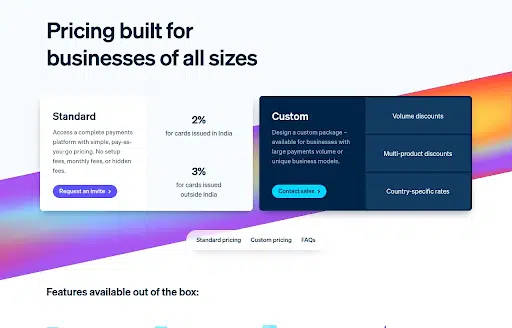
Think of pricing as a test, not a commitment. You can change it later. What you can’t do is skip it, because willingness to pay is the strongest validation signal you can collect in 30 days.
Start with one simple tier. Pick a number you can defend to a customer. If you have no idea, price against the cost of the problem: what does your customer lose per month by not having this solved? Charge a fraction of that. A tool that saves a business $500 a month can justify $50 a month without a fight.
Stripe pricing page showing payment tiers
Stripe is the payment layer most MVPs plug into. A real charge in test mode is your willingness-to-pay signal. Screenshot: stripe.com, captured August 2026.
Offer annual as a discount and monthly as the default. Put the price on the page with no “contact us” gate, because hidden pricing kills conversion and hides demand. Track what happens at checkout. People who reach the payment page and stop are telling you something specific, and it’s usually about trust or value, not about your button color.
What belongs in an MVP and what doesn’t
| Belongs in the MVP | Wait for later |
| One core workflow | Multi-role dashboards |
| Basic auth | SSO and complex permissions |
| Stripe or a simple checkout | Billing portal, invoicing, dunning |
| Basic onboarding email | Full lifecycle email sequences |
| Manual work behind the scenes | Automations that save your time, not the user’s |
| One platform | Mobile apps and browser extensions |
The test for every feature: does removing it stop the user from experiencing the core value? If not, it doesn’t belong in the MVP. Your job in 30 days is to learn, not to impress.
Security basics for the MVP
Security for an MVP is less about building a fortress and more about not doing the dangerous things yourself.
The short list:
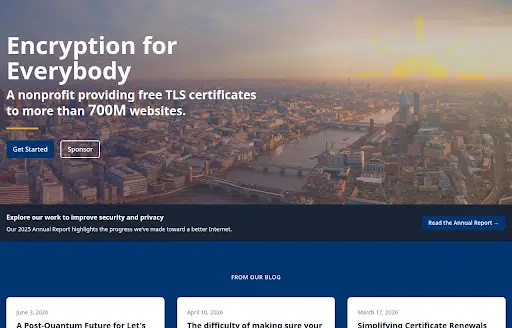
Let’s Encrypt issues free HTTPS certificates, which makes the first security item on this list both non-negotiable and cheap. Screenshot: letsencrypt.org, captured August 2026.
- Use HTTPS everywhere. A free certificate from Let’s Encrypt or your hosting provider is non-negotiable, and it’s a trust signal at the checkout.
- Never store passwords yourself. Use a managed auth provider. Password hashing and reset flows are solved problems; building them by hand is how MVPs leak data.
- Let Stripe handle card data. Payment card details should never touch your server. Stripe’s hosted checkout keeps you out of PCI scope. The rule is simple: if a card number appears in your logs, you’ve done it wrong.
- Automate backups. A daily database backup to a separate location is the difference between an incident and a disaster.
- Protect your secrets. No API keys or database credentials in code, commits, or client-side files. Environment variables only.
- Add basic abuse protection. Rate limiting on signup and login stops the most common bot abuse.
None of these take more than a day. All of them protect the one thing an MVP cannot afford to lose: user trust.
Legal and compliance basics
Legal pages feel like paperwork. They’re actually launch requirements, and payment processors and app stores will ask for them.
The minimum set before you charge a customer:
- Privacy policy. States what data you collect, why, and how users can request deletion. Required under GDPR for EU users and by app stores worldwide.
- Terms of service. Sets the rules of use, your liability limits, and what happens on abuse.
- Refund and cancellation policy. Stripe and most payment providers expect a clear refund policy, and customers look for it before paying.
- Cookie consent. If you use analytics cookies, visitors in the EU and UK need a consent banner. Keep it simple and honest.
- A deletion path. GDPR and CCPA give users the right to request their data be deleted. You need a working process, not just a promise.
This is not legal advice, and your jurisdiction may need more. The point for the 30-day build is that these five basics should be drafted by the end of week 2, so week 4’s launch doesn’t stall on a compliance question.
The pre-launch checklist
Before you hit publish, run this checklist. Each item is quick, and each one prevents a launch-day failure that looks exactly like a product failure.
- Domain connected and HTTPS working
- Email domain configured for SPF and DKIM so your welcome email doesn’t land in spam
- Analytics installed with activation event tracking, not just page views
- Error monitoring set up so you hear about crashes before users do
- Daily automated backups confirmed working
- Payment tested in test mode, then with a real one-dollar charge
- Privacy policy, terms, and refund policy live
- Waitlist export ready with permission to contact
- A support inbox that someone actually checks
- One clear value sentence on the landing page that matches what the product does
Ten items, most of them under an hour. A launch without this checklist is a roll of the dice, and the 30-day MVP is supposed to remove luck from the process.
The 30 days after launch
The MVP is live. What you do in the next month decides whether it becomes a business.
Days 1-10: Obsess over the first users. Talk to every single one. Fix the blockers they hit. You’re looking for one repeatable pattern: a user who signs up, reaches value, and comes back. If you find it, you have the seed of product-market fit.
Days 11-20: Run the Sean Ellis test. Ask your active users: “How disappointed would you be if you could no longer use this product?” The famous threshold from Sean Ellis’ product-market fit research is 40 percent answering “very disappointed.” Below that, keep iterating. At or above it, you have a signal worth scaling.
Days 21-30: Decide. Double down on what works, or pivot on what doesn’t. This is the decision the whole 30-day exercise was built to force. Most founders avoid it. The ones who answer it honestly are the ones whose MVPs turn into companies.
Pivot or persevere: reading the signals
The build-measure-learn loop only works if you can read the output. Here’s the honest reading guide.
Persevere when you see: activation rate climbing week over week, users returning without reminders, paying customers who stay, the Sean Ellis test at or above 40 percent, and at least one user who says the product changed how they work. Any two of those together justify continuing.
Pivot when you see: no activation improvement after three weeks of onboarding changes, zero willingness to pay, users who love a side feature but ignore the core workflow, or churn that looks exactly like the 40 to 60 percent first-30-days baseline.
A pivot is not a failure and it’s not a restart. It’s a change in strategy with the vision intact, in Ries’ framing. The common pivots after an MVP: zoom-in, where one feature becomes the whole product; customer-segment, where the same product serves a different buyer; and value-capture, where you change how you charge, not what you build. All three keep the learning and throw away only the parts that didn’t work.
Funding after validation
Let’s be clear about one thing: you don’t raise money to build the MVP. You raise money after the MVP tells you the idea works.
The path usually looks like this. Bootstrap through validation, keeping the $7,000 to $25,000 build inside what you can fund yourself or with early customer revenue. When you have paying customers and a repeatable story about how they found you, angel investors become relevant, typically at the seed stage. Venture capital enters only when the unit economics prove out and the question becomes scale, not survival.
The worst funding move in SaaS is raising before product-market fit. It converts a cheap learning problem into an expensive scaling problem, and it’s how startups burn through eight-figure rounds building products nobody asked for. If a VC asks why you haven’t raised yet and you can answer “because I’m still testing who wants this,” you’re doing it right.
Common MVP mistakes
- Building the full vision instead of the core loop. The vision is the roadmap, not the MVP.
- Validating with friends. They’ll say nice things. Strangers with money won’t.
- Launching to nobody. Collect the waitlist before you build, then launch to them.
- Polishing instead of shipping. A usable MVP today beats a polished one in three months.
- Ignoring the metrics. If you don’t measure activation and retention, you won’t know what you learned.
- Treating the MVP as the product. The MVP is a learning instrument. The product comes after.
- Skipping the legal basics. A compliance gap at launch is a trust gap with your first paying customers.
Final thoughts
Thirty days is not a constraint. It’s a discipline. The data says most startups fail because they build something nobody wanted, and most of them spent months or years discovering it. A 30-day MVP collapses that risk into one month and a five-figure budget.
The founders who benefit most from this process are not the ones with the best ideas. They’re the ones who treat the 30 days as a research project: state the assumption, test it cheaply, read the data honestly, and decide. Dropbox tested demand with a weekend video. Zappos tested online shoe buying with a handful of trips to local stores. Buffer tested willingness to try with a two-page site and a dead button.
Your version of that test is the one workflow you can ship in a month. Build it, put it in front of ten real users, and let them tell you what the business should be. The answer is cheaper and faster than you think, and a lot less painful than a six-month detour into something nobody wants.
FAQ: Frequently asked questions about building a SaaS MVP in 30 days
1. Can a SaaS MVP really be built in 30 days?
Yes. A focused SaaS MVP can be built in about 30 days, per Innew, with some scopes finishing in 2-3 weeks. The constraint is scope: one core workflow, basic auth, one payment path. The 30-day window forces the discipline most failed startups never had.
2. How much does a 30-day SaaS MVP cost?
Roughly $7,000 to $25,000, per Nitramix’s 2026 playbook, depending on stack and whether you use an agency. Traditional development runs $80,000 to $150,000 before customer feedback. No-code options can be cheaper if you build it yourself.
3. What is the riskiest part of a SaaS MVP?
The riskiest assumption is demand. CB Insights puts no market need at 42 percent of startup failures, and its updated 2024 study puts poor product-market fit at 43 percent. Validate the problem before building anything substantial.
4. Should I use no-code or custom code for the MVP?
Use whatever ships fastest. No-code platforms like Bubble typically take 4-8 weeks for a functional MVP, per Uinno. Custom development takes 8-12 weeks and costs more. For a 30-day build, the fastest stack that lets you test the core assumption wins.
5. What should I measure after launch?
Activation, 30-day retention, monthly churn, and net revenue retention. Average activation sits around 37.5 percent, and 40-60 percent of users churn in the first 30 days if they never experience value. Those two metrics tell you more than any dashboard of page views.
6. Is a landing page a real MVP?
Yes. Buffer built a nine-figure business starting from a two-page site with a pricing page and a button that led nowhere. The landing page tests demand, and demand is the riskiest assumption for most ideas.
7. When should I raise the 40 percent Sean Ellis threshold?
The Sean Ellis test asks active users how disappointed they would be if your product disappeared. At 40 percent answering “very disappointed,” you have the classic product-market fit signal. Below that, keep iterating on the value, not on the features.
8. Do I need legal pages for an MVP?
Yes, before you charge anyone. A privacy policy, terms of service, and refund policy are the minimum, and payment providers and app stores expect them. GDPR and CCPA also require a working data-deletion path.
9. What’s the difference between pivoting and failing?
A pivot keeps the learning and changes the strategy, in Eric Ries’ framing. Common pivots are zoom-in, customer-segment, and value-capture. Failure is ignoring the data and continuing to build what nobody wants.