


You wake up, brush your teeth, grab your coffee, and check your phone. Before you know it, an hour has slipped by, and you barely remember doing any of it. Sound familiar? Most of us run on autopilot for huge chunks of our day. We repeat the same actions without thinking. That’s exactly where habits live. The tricky part is that many of these habits don’t serve us well. You want to exercise more, but your brain keeps pulling you back to the couch. You want to eat healthier, but your hand reaches for the snack bowl before you even notice. You want to focus better, but scrolling takes over instead.
Here’s the good news: your brain isn’t your enemy. Scientists have discovered that your brain rewires itself through repetition, a process called neuroplasticity. That means you can change your habits once you understand how they actually work.
The neuroscience of habit formation and change shows us exactly why we do what we do, and more importantly, how we can shift course. This guide walks you through the brain mechanisms behind your habits, shows you how to break the ones holding you back, and helps you build new behaviors that actually stick.
You’ll get practical strategies grounded in real science, not just willpower. So grab a cup of coffee, and let’s go through it all together.
Understanding Habit Formation
Your brain runs on autopilot more than you think. Every day, your habits shape what you do, how you feel, and who you become.
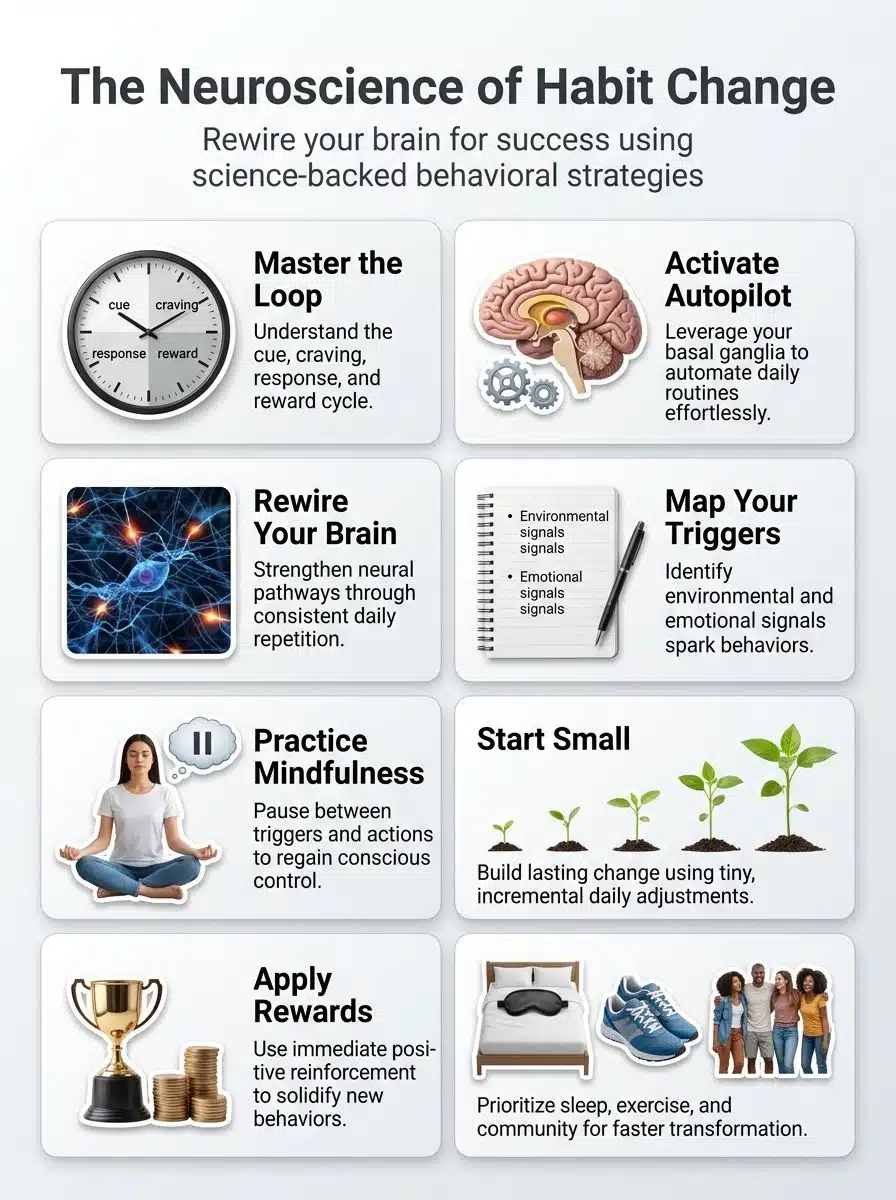
What Is a Habit and Its Role in Daily Life?
Habits are automatic behaviors your brain performs without much thinking. You brush your teeth every morning, drive to work without consciously planning each turn, or grab coffee at the same café each day.
These routines save your brain energy. Your brain stops making active decisions about familiar tasks. Instead, it runs them like a background program. This shift from conscious choice to automatic action is exactly what we call a habit.
Habits shape how you spend your time, what you eat, and how you exercise. They influence your health, your productivity, and your relationships. Some habits help you succeed. Others hold you back.
According to a September 2025 study conducted by the Arnold School of Public Health at the University of South Carolina, a staggering 66.34% of everyday behaviors are driven by habit, not conscious choice. That means roughly two-thirds of your day runs on autopilot. This makes it even more urgent to actively design the habits that truly serve you.
The neurobiology of habit formation explains why some routines stick around for years while others fade quickly. Habits develop through a process called conditioning, where your brain links a cue to a reward. The cue might be stress, boredom, or a specific time of day. The reward could be pleasure, relief, or comfort. This connection grows stronger over time through reinforcement.
Your environment plays a massive role, too. If you keep snacks on your desk, you’ll snack more often. If your gym clothes sit in plain sight, you’ll exercise more frequently. The psychology behind this is simple: proximity breeds behavior.
We are what we repeatedly do. Excellence, then, is not an act, but a habit. – Aristotle
The Habit Loop: Cue, Craving, Response, Reward
Your brain follows a specific pattern every time a habit forms. This pattern is called the habit loop, and it has four parts that work together seamlessly every single time.
- Cue: A trigger that tells your brain to switch to automatic mode. It might be your alarm going off, the smell of coffee, or stress from work.
- Craving: The motivational force that pulls you toward a specific feeling or outcome.
- Response: The actual behavior you perform, like checking your phone, eating a snack, or going for a run.
- Reward: The satisfaction, pleasure, or relief you feel after completing the behavior.
Your craving follows the cue immediately, pulling you toward a specific outcome or feeling. Based on a December 2025 neurological study from the Georgetown University Medical Center, a drop in the brain protein KCC2 actually amplifies dopamine-driven learning signals. This makes routine cues trigger far stronger cravings than you would expect, which is a key reason habits feel so hard to resist.
The reward completes the loop. Your brain’s reward system releases dopamine during this phase, and that chemical strengthens the memory of the entire sequence. This is how neuroplasticity works in real time: your brain wires these connections deeper and stronger with each repetition.
The more you repeat this loop, the more automatic the behavior becomes. You need less and less conscious decision-making to perform the action each time.
Understanding this loop is critical because it shows you exactly where you can step in to change your behavior before the pattern takes over.
The Role of the Brain in Habit Formation
Your brain runs habits like a well-oiled machine. It shifts control from your conscious mind to your automatic systems through specific brain mechanisms that work together, making repeated actions feel effortless over time.
The Basal Ganglia and Automatic Behaviors
Deep inside your brain sits a structure called the basal ganglia. Think of it as your brain’s autopilot for daily tasks. This cluster of nerve cells takes over when you brush your teeth, tie your shoes, or drive the same route to work each morning.
The basal ganglia store automatic behaviors through reinforcement, freeing your conscious mind to focus on new challenges. Over time, this brain mechanism transforms repeated actions into habits that require little to no thought.
The basal ganglia grows stronger each time you repeat a behavior, making the routine feel more effortless with every pass.
This structure works by creating neural pathways that get thicker and faster with repetition. Each time you perform an action and receive a reward, your brain releases dopamine, which strengthens these pathways even more. The reward system locks in habitual behavior so firmly that your brain can run through the entire sequence without conscious decision-making.
The more you repeat a behavior, the less energy your brain uses to perform it. This is why breaking old habits feels so hard: your basal ganglia has already built superhighways for those actions, and your brain always prefers the easy route.
Neuroplasticity and Habit Reinforcement
Your brain rewires itself every single day. This incredible ability is called neuroplasticity. Each time you repeat a behavior, your neural pathways strengthen, making that action easier to perform next time. Think of it like walking a path through the forest: the more you walk it, the clearer and wider it becomes. Your brain’s learning capacity allows these neural connections to grow stronger through repetition and reinforcement.

Your brain is not fixed. It changes and adapts throughout your entire life.
The reward system releases dopamine, a chemical that makes you feel good. This reinforcement locks the behavior into your memory. Over time, repeated actions transform into habits your brain performs on autopilot.
Habit reinforcement works because your brain loves efficiency. The basal ganglia take over routine tasks, so your prefrontal cortex can focus on new challenges. The more you practice a behavior, the less mental energy you need to carry it out. Motivation plays a huge role, too: when you feel excited about a goal, your brain releases more dopamine and cements the behavior faster.
This neurobiological process explains why breaking old habits feels hard and why building new ones takes genuine patience. Understanding how neuroplasticity fuels habit reinforcement sets the stage for learning how to identify what triggers your current behaviors.
The Science of Breaking Bad Habits
Breaking bad habits starts with understanding what triggers them. Your brain has wired these behaviors deep into your neural pathways, so you need real strategies to interrupt the pattern.
Identifying Triggers and Cues
Your habits start with triggers, the environmental or emotional signals that spark automatic behavior. Spotting these cues is your first step toward real, lasting change.
Start by tracking your external patterns. These are the signals that come from your surroundings, your schedule, and the people around you.
- Track your behavior for one week, writing down what you did and what happened right before. This creates a clear map of your patterns and reveals hidden triggers.
- Identify location-based cues in your environment, like your couch triggering snacking or your desk sparking phone scrolling. Physical spaces powerfully influence automatic behaviors.
- Examine time-related triggers that activate habits, such as morning coffee rituals or evening scrolling sessions. Your brain links specific hours to specific actions through reinforcement.
- Observe social cues that prompt habits, including peer behavior or group settings. Other people’s actions often activate your own behavioral patterns.
Once you’ve mapped your external triggers, shift your attention inward to your emotional and physical states.
- Notice emotional states that come before your habits, such as stress, boredom, or loneliness. Your brain often uses habits to manage these feelings through the reward system.
- List internal cues like hunger, fatigue, or restlessness that spark unwanted habits. Physical sensations frequently drive decision-making and routine behaviors.
- Distinguish between the actual trigger and your interpretation of it through mindfulness. Your perception shapes whether a cue launches a habit or passes unnoticed.
Finally, test your findings to confirm what’s truly in control of your behavior.
- Create a trigger log that sorts habits into categories: stress-related, social, or environmental. This organization helps your cognitive psychology work with you, not against you.
- Temporarily remove suspected triggers from your surroundings. This experimentation reveals which cues truly drive your behavior versus which ones simply don’t matter.
The Role of Mindfulness in Disrupting Habits
Once you spot your triggers, mindfulness becomes your best tool for breaking the cycle. Mindfulness means paying attention to the present moment without judgment.
This practice interrupts the automatic pathway your brain travels when a habit kicks in. Your basal ganglia normally run habits on autopilot. Mindfulness forces you to wake up and notice what’s actually happening right now.
You pause between the cue and your response. That pause gives your prefrontal cortex time to take charge instead of letting old programming run the show. It’s a small gap, but it’s where real change begins.
Research shows that mindfulness strengthens self-regulation and decision-making. The practice literally rewires your brain through neuroplasticity, building new neural pathways that support better choices. Here are three simple ways to start:
- Try five minutes of focused breathing each morning before you check your phone.
- When a craving hits, pause and name the feeling out loud or in writing before responding to it.
- Use a simple body scan during stressful moments to notice tension before a habit kicks in.
Over time, this repeated practice weakens the reinforcement loop that kept your old habit alive. Behavioral change starts to feel less like fighting uphill, and more like following a natural new direction.
Building Positive Habits
You can build positive habits by starting small and stacking new behaviors onto routines you already follow. Your brain responds powerfully to rewards, so celebrate each win right after you complete your desired behavior.
The Importance of Small, Incremental Changes
Small, incremental changes form the foundation of lasting behavioral change. Your brain responds better to gradual shifts than dramatic overhauls. According to 2025 research highlighted by the American Psychological Association, people who adopt consistent, incremental habit-forming techniques are 50% more likely to meet their long-term objectives compared to those who attempt massive behavioral overhauls. Starting small isn’t just a suggestion. It is mathematically the stronger choice.
Here’s how to make incremental change work for you:
- Start with one tiny behavior instead of overhauling your entire routine at once. This reduces overwhelm and increases your odds of sticking with it.
- Add just five minutes to your exercise routine this week rather than committing to an hour. Incremental progress feels manageable and keeps motivation high.
- Stack new habits onto existing ones you already perform daily. This leverages your current routine and makes reinforcement easier.
- Reduce friction by making your desired behavior slightly easier each day. Small environmental tweaks compound into major behavioral shifts over time.
- Track each small win you achieve, no matter how minor it seems. Celebrating progress activates your reward system and strengthens decision-making pathways.
- Adjust your approach based on what actually works rather than forcing a rigid plan. Flexibility during habit formation leads to better long-term conditioning.
Your neuroplasticity allows your brain to rewire itself through repeated small actions. This biological reality means patience and consistency beat intensity every single time.
Leveraging Rewards to Solidify New Behaviors
Your brain craves rewards. This craving is the secret ingredient for building lasting habits.
The reward system in your brain releases dopamine, a chemical messenger that makes you feel good. Your brain remembers this feeling. Each time you complete a desired behavior, it strengthens the neural pathways connected to that action. You can use this natural process by pairing your new behavior with an immediate reward.
The key is choosing rewards that land quickly after the behavior. Here are a few practical pairings that work well:
- After a workout, enjoy your favorite smoothie or a short episode of a show you love.
- After a reading session, reward yourself with a cup of tea or a short walk outside.
- After completing a focused work block, take a five-minute break doing something you enjoy.
These immediate rewards trigger reinforcement in your brain. The conditioning process works best when rewards arrive quickly after the behavior, not weeks later. Your brain connects the action directly to the pleasure, strengthening the memory and decision-making pathways involved in habit formation.
Start with tangible rewards that excite you, then gradually shift toward intrinsic rewards as the behavior becomes automatic. You might initially reward yourself with a treat, then transition to the deep satisfaction the routine itself provides. This approach makes behavioral change feel natural rather than forced.
The Influence of Environment and Lifestyle
Your surroundings shape your habits more than you might think. Your brain picks up cues from your environment constantly, and these cues trigger automatic responses that either support or sabotage your goals.
How Your Surroundings Impact Habit Formation
The objects around you, the people nearby, and the layout of your space all influence behavioral change. A messy desk makes procrastination easier. A clean one invites focus. If you keep junk food visible on your kitchen counter, you’ll reach for it without thinking.
Scientists call this environmental design, and it works powerfully on your brain. Your basal ganglia respond directly to cues in your physical space. A coffee mug on your nightstand triggers a morning routine. A gym bag by the door reminds you to exercise. You can redesign your surroundings to support better habits. Small changes add up fast.
- Place your running shoes where you see them first thing in the morning.
- Stock your fridge with vegetables at eye level, not hidden in a drawer.
- Keep a book on your pillow if reading is a routine you want to build.
- Sit in the same chair for meditation or focused work to anchor the behavior.
Social surroundings matter just as much as physical ones. The people in your life shape your decision-making and motivation in ways you often don’t notice. Friends who exercise regularly inspire you to move. Coworkers who skip meals or scroll constantly can normalize those patterns in you.
Your culture and social norms shape what feels natural to do. If everyone in your circle reads daily, reading becomes part of your identity. Loneliness makes bad habits easier to form. Community support strengthens good ones.
You absorb behaviors from those around you through a process called social conditioning. This is why joining a class, club, or team accelerates habit formation. Shared goals create accountability and reinforce neuroplasticity in powerful ways.
The Role of Sleep, Exercise, and Mindfulness
Beyond your physical surroundings, three biological forces shape how your brain locks in habits: sleep, exercise, and mindfulness. These factors work like invisible architects, reshaping your neural pathways while you rest, move, and breathe.
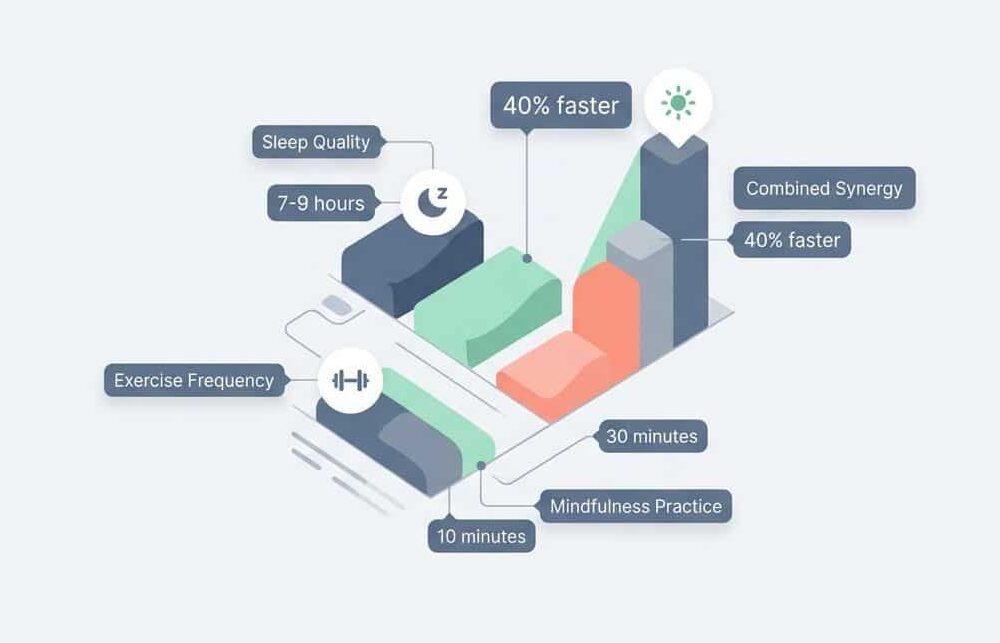
| Factor | Impact on Habit Formation | Key Action |
|---|---|---|
| Sleep Quality | Sleep consolidates memories into long-term storage. Your basal ganglia strengthen habit pathways during deep sleep cycles. Without adequate rest, habit formation stalls. Seven to nine hours nightly supports optimal neural consolidation. The brain replays your daily actions during REM sleep, cementing behavioral patterns. | Prioritize consistent bedtimes. Aim for seven to nine hours each night. Create dark, cool sleeping environments. Eliminate screens one hour before bed. |
| Exercise Frequency | Physical activity triggers dopamine release, the same neurotransmitter that rewards habits. Exercise increases brain-derived neurotrophic factor (BDNF), which enhances neuroplasticity. Movement strengthens connections between neurons. Thirty minutes of moderate exercise five times weekly boosts habit-building capacity. Aerobic activity particularly strengthens the prefrontal cortex, your habit-control center. | Move your body daily. Start with walking, swimming, or dancing. Build toward thirty-minute sessions. Mix cardio with strength training. Schedule exercise at consistent times. |
| Mindfulness Practice | Mindfulness creates space between cue and response, interrupting automatic patterns. Regular meditation strengthens your anterior cingulate cortex, enhancing self-awareness. Ten minutes of daily meditation reduces habit triggers’ power. Mindfulness helps you notice cravings without acting on them. This awareness lets you choose new responses instead of defaulting to old behaviors. | Start meditation with just five minutes daily. Notice your thoughts without judgment. Practice during morning routines. Use guided apps initially. Expand sessions gradually over weeks. |
| Combined Synergy | These three elements amplify each other’s effects. Sleep restores mental clarity for mindfulness practice. Exercise energizes you for better meditation focus. Mindfulness helps you maintain exercise routines and sleep schedules. Together, they create a feedback loop that accelerates habit change. Research shows people combining all three succeed at habit transformation forty percent faster than those using single strategies. | Integrate all three into weekly routines. Stack habits together and meditate after morning walks. Track progress weekly. Adjust based on what feels sustainable. |
Sleep deprivation weakens your prefrontal cortex, the brain region responsible for decision-making and habit resistance. Exercise floods your system with endorphins, making positive habit rewards feel more satisfying. Mindfulness rewires your brain’s automatic response patterns, giving you genuine control over your choices.
These three pillars work together, creating the neurochemical environment where habit change sticks, not just temporarily, but for good.
The Role of Culture and Social Norms
Your culture shapes how you form habits. Your social circles either push you forward or pull you back. The people around you act as mirrors, reflecting habits back at you until those behaviors feel like your own natural norm.
Cultural Context in Shaping Habits
Culture shapes habits in powerful ways that most people overlook. Your family background, neighborhood, and social circles all influence which behaviors stick around. A person raised in a culture that values early mornings develops very different routines from someone from a culture that embraces late nights.
Social norms act like invisible scripts, telling you which habits matter and which ones don’t. Consider how these habits differ by culture:
- In Japan, removing shoes indoors is automatic and universal. In America, many people keep them on without a second thought.
- In many Mediterranean cultures, long shared meals are a daily ritual. In the US, eating at a desk while working feels completely normal.
- In communities with strong fitness cultures, working out regularly feels expected. In others, it requires constant personal motivation.
These aren’t random choices. Their habits are rooted in cultural values, passed down through generations, and reinforced by the people around us every day.
Community support transforms habit change from a solo struggle into a group effort. Cultures with strong collective values make behavioral change easier because friends and family hold each other accountable. If everyone in your social circle exercises regularly, you’re far more likely to exercise too.
The reward system in your brain responds to social approval just as strongly as it responds to physical rewards. Habits don’t live in isolation. They live inside communities, shaped by psychology, reinforcement, and the decision-making patterns of those around them. This is why joining a group, finding a workout buddy, or sharing your goals with others works so well for habit formation and behavioral change.
The Power of Community Support
Your friends and family shape your habits more than you might realize. Social connections act as powerful forces that push you toward behavioral change. Studies show that people who share their goals with others succeed far more often than those who go it alone.
Your community holds you accountable, celebrates your wins, and picks you up when you slip. This social reinforcement triggers reward system activation in your brain, making positive behaviors stick faster. Group settings create motivation that solo efforts simply cannot match.
Surrounding yourself with people who support your goals reshapes your environment in deep ways. Friends who exercise together, eat well, and practice mindfulness influence each other’s decision-making through constant exposure. Your brain learns through observation and imitation, a process called social conditioning.
When your community normalizes healthy routines, your own habits shift without requiring constant willpower. The basal ganglia respond powerfully to social cues and group norms. Joining clubs, classes, or support groups transforms habit formation from a lonely struggle into a shared adventure, making lasting behavioral change feel achievable rather than impossible.
Key Insights: Utilizing the Science of Habit Formation
You shape your habits through deliberate choices. Science shows that patience paired with consistency creates real, lasting change in your brain. Your personalized strategy works best when you build it on what actually motivates you, not what works for someone else.

The Importance of Patience and Consistency
Building new habits takes time, and your brain needs that time to rewire itself. Neuroplasticity doesn’t happen overnight. Your basal ganglia require repeated reinforcement to shift old patterns into fresh ones.
You may have heard that it takes 21 days to form a new habit. That’s a myth. According to widely cited behavioral science reviews and 2025 clinical updates, it actually takes an average of 66 days to form a new habit, and complex routines can take up to 254 days. Knowing this sets realistic expectations and keeps you from quitting too early.
The 21-day habit myth has caused countless people to give up right when their brain was just beginning to rewire. Real change takes an average of 66 days. Give yourself that time.
Most people quit after two weeks because they expect instant results. Stick with your routine even when progress feels invisible, because your brain is working behind the scenes, strengthening those new connections with each repetition.
Consistency acts as the glue that holds your decision-making and habit formation together. Missing one day won’t destroy your progress. But missing ten days will erase weeks of work.
The reward system in your brain responds best to predictable, repeated actions that follow the same cue and response pattern. Show up for your habit every single day, even when motivation runs dry. That’s when true behavioral change takes root. Small, incremental changes compound into major transformations, but only when you maintain steady effort without expecting perfection.
Designing Personalized Strategies for Success
Patience and consistency create the foundation for change. Your brain also needs a personalized roadmap to follow. Crafting strategies that match your specific neurobiology, lifestyle, and goals accelerates your progress toward lasting behavioral change. Start by understanding what drives you and how your environment affects you.
- Map your personal triggers by tracking when cravings hit hardest, what situations spark old habits, and which environmental cues pull you backward most often.
- Identify your dominant reward system. Some people chase dopamine through social connection; others through physical sensation or achievement. Tailor your reinforcement accordingly.
- Start with one small habit change rather than overhauling everything at once, since your basal ganglia learns better through incremental progress than drastic shifts.
- Design your environment to support new routines by removing temptations, placing helpful reminders in plain sight, and restructuring spaces where old habits thrived.
- Schedule your new behaviors at consistent times each day, allowing your brain’s neuroplasticity to strengthen these neural pathways through repetition and memory consolidation.
Once your foundation is set, focus on reinforcement and ongoing adjustment.
- Pair your new habit with an existing routine you already perform automatically, creating a chain that leverages your brain’s natural decision-making shortcuts.
- Choose rewards that genuinely satisfy your motivation system, not generic incentives that fail to activate your brain’s reinforcement centers or sustain long-term engagement.
- Track your progress visually through apps, charts, or journals. As noted in a 2025/2026 Gartner digital wellness report, integrating automated tools and digital reminders into daily routines increases habit adherence by 35%. Monitoring your behavioral change keeps your prefrontal cortex engaged in self-regulation and accountability.
- Adjust your strategy every two to three weeks based on what actually works for your neurobiology, since cognitive psychology shows people respond differently to identical interventions.
Final Thoughts
You now know how your brain forms habits through the loop of cue, craving, response, and reward. That knowledge gives you real power to reshape your life.
Your basal ganglia automates behaviors, but neuroplasticity means you can rewire these patterns. You do this by identifying triggers, using mindfulness to interrupt old routines, and building new behaviors through small, incremental changes.
Your environment matters deeply. Sleep, exercise, and your surroundings all influence behavioral change. Community support and cultural context make your success far more achievable than going it alone.
Pick one habit you want to change, and start today. Apply these strategies with consistency and self-regulation. Your brain is not fixed, and every single day offers a fresh chance to build the life you actually want.
Frequently Asked Questions (FAQs) on Neuroscience of Habit Formation
1. How does the brain form habits?
Your brain forms habits through a loop involving the basal ganglia, a region that stores automatic behaviors. MIT researchers found that when you repeat an action enough times, your brain literally rewires itself to make the behavior automatic. This saves mental energy for other tasks.
2. Can you really change a bad habit?
Yes, your brain stays flexible throughout life thanks to neuroplasticity. The key is to replace the bad routine with a new one while keeping the same cue and reward.
3. How long does it take to build a new habit?
A 2009 University College London study found it takes an average of 66 days for a behavior to become automatic. It can range from 18 to 254 days, depending on the person and the habit.
4. What role do rewards play in habit formation?
Rewards trigger your brain to release dopamine, which creates a feeling of pleasure. This dopamine rush teaches your brain to repeat the behavior that led to the reward.





















